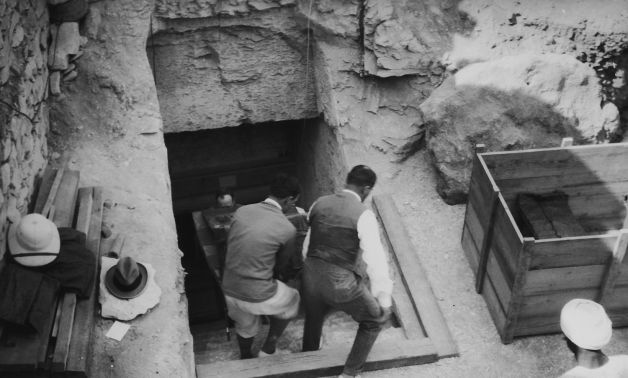
On 26 November 1922 Howard Carter stood before a sealed door blocking a dark corridor. Behind him stood his patron Lord Carnarvon. Both men knew that they were standing in the tomb of the 18th-Dynasty boy king Tutankhamun – the sealing on the now dismantled outer door had made that clear. But the outer door had also shown the unmistakable signs of more than one forced entry. Was Tutankhamun still lying undisturbed in his tomb? Or had the ancient robbers once again thwarted the modern archaeologists? Nervously, his hands trembling, Carter forced a small hole in the left hand corner of the doorway, lit a candle, and peered inside.
“Presently, as my eyes grew accustomed to the light, details of the room within emerged slowly from the mist, strange animals, statues and gold – everywhere the glint of gold. For the moment – an eternity it must have seemed to the others standing by – I was struck dumb with amazement, and when Lord Carnarvon, unable to stand the suspense any longer, inquired anxiously, ‘Can you see anything?’ it was all I could do to get out the words ‘Yes, wonderful things’.”
The next day the doorway was unblocked and an electric light installed. Carter and Carnarvon found themselves standing in the antechamber, an untidy room packed with everything that an Egyptian king could possibly need for an enjoyable afterlife. But Carter’s attention was fixed on the northern wall. Here, blocked, plastered, sealed and guarded by two large statues of Tutankhamun, was the doorway to the burial chamber. Once again, the sealed doorway had been breached by a robber’s hole.
Carter and Carnarvon knew that the anteroom must be emptied before the wall could be dismantled, but that would take many weeks of hard work. Desperate to know if the tomb was intact they returned that night and crawled through the robber’s hole. To their delight they found that the burial chamber was almost completely filled by a golden shrine, its seals still intact. Swearing each other to secrecy they crawled back and sealed the hole.
The burial chamber would be officially opened on 17 February 1923 in the presence of an invited audience of Egyptologists and government officials.
The public was fascinated by the activities in the Valley of the Kings. Those who could travel to Egypt did, though there was little for them to see. Those who could not visit in person relied upon the newspapers that carried almost daily reports from the Valley. Soon the small, sleepy town of Luxor was swamped with visitors and the expedition found itself living in near siege conditions. As a means of recovering some of the money that he had spent looking for Tutankhamun, Carnarvon decided to sign an exclusive deal with
The Times. This incensed the reporters from the other newspapers, and did nothing to stop their demands for information. Denied official access to the tomb, they now printed sensational gossip in place of facts.
 Carter, watched by assistant Arthur Callender and an Egyptian foreman, opens the golden shrines surrounding the sarcophagus. (Hulton Archive/Getty Images)
In late February 1923 the excavation was closed to allow the exhausted excavators a brief holiday. While Carter stayed in Luxor, Carnarvon and his daughter, Lady Evelyn Herbert, sailed south to spend a few days at Aswan. During this trip Carnarvon was bitten on the cheek by a mosquito. Then, soon after his return to Luxor, he accidentally sliced the scab off the bite while shaving. He soon started to feel unwell. With his condition worsening he travelled to Cairo for expert medical attention. But it was too late. Blood poisoning set in and pneumonia followed. A younger, fitter man may have been able to throw off the infection, but the 57-year-old Carnarvon was still suffering the effects of a severe motor accident in 1901 that had left him weak and vulnerable to chest infections. He died on 5 April 1923.
Here was a dramatic Tutankhamun story that everyone could report. News of the death travelled fast, stimulating intense debate. For the first time the general public, made sensitive to the plight of the defenceless dead by the First World War and the major flu epidemic that followed it, started to question the archaeologists’ easy assumption that the dead were a legitimate target. Would Carter be happy if someone attempted to dig up the recently deceased Queen Victoria, asked one indignant
Times correspondent?
For some observers this was far more than a question of ethics. They believed that the excavation had put the lives of the archaeologists at risk. Anyone with a taste for popular fiction understood just how dangerous the ancient Egyptians could be. Victorian literature was filled with accounts of vengeful mummies who strangled, poisoned and possessed their victims, with one of the most sensational works,
Lost in a Pyramid, or,
The Mummy’s Curse, being penned by Louisa May Alcott, more famous today as the author of Little Women. Already, before Carnarvon’s death, novelist Marie Corelli had warned against tampering with the unknown: “I cannot but think that some risks are run by breaking into the last rest of a king of Egypt whose tomb is specifically and solemnly guarded, and robbing him of his possessions”.
Britain, in 1923, was a land looking for comfort. The old religious certainties, already weakened by the scientific advances of the Victorian age, had been further eroded by the horrors of the First World War. Now the country was experiencing a wave of interest in all aspects of the occult as seances and ouija boards offered a glimmer of hope that the bereaved could contact those who had “passed over”. Theosophy, an occult attempt to reach spiritual enlightenment partially inspired by the spiritual forces or “elementals” of the ancient Egyptians, was all the rage.
False reports started to emerge from the tomb. Many people believed that an engraved plaque – “Death comes on swift wings to he who disturbs the tomb of the pharaoh” – had been discovered and suppressed by Carter. It hadn’t; the plaque quite simply did not exist. Carter himself had little patience with the curse theorists. He made his feelings plain in an interview with the
New York Times: “It is rather too much to ask me to believe that some spook is keeping watch and ward over the dead Pharaoh, ready to wreak vengeance on anyone who goes too near”. Inevitably, his vehement denial sparked rumours that Carter was collaborating with “the authorities” to hide the evidence of a dangerous curse.
 Reporting the discovery, 13 January 1923. (Illustrated London News)
Testing the curse theory
How could the long-dead Tutankhamun have killed anyone? The idea that his burial might have been booby trapped with poison was a popular one. It is theoretically possible that the sealed chamber could have housed a cocktail of microscopic spores and, indeed, a black fungus was found growing inside the tomb. However the Egyptian scientists simply did not have the knowledge necessary to set such a sophisticated trap. Could Carnarvon have been killed accidentally? Maybe he had been infected by poisonous bat-droppings? Or had been poisoned by a mosquito which had drunk embalming fluids?
It was left to the more practically minded to point out that the sealed tomb could not have housed a bat colony, while the lack of water in the Valley of the Kings meant that there were no mosquitoes. This injection of common sense did little to halt speculation. Many “experts”, most notably Sir Arthur Conan Doyle, author of two popular tales of ancient Egypt, preferred the idea of an intangible curse implemented by “elementals”.
In 1934 Egyptologist Herbert Winlock attempted to disprove the curse theory by studying the statistics. He found that only six of the 26 people present at the opening of the tomb had died within a decade. Time was to prove that, of those who had first visited the burial chamber, only Carnarvon had died suddenly at the relatively young age of 57. Howard Carter died aged 64, some 16 years after Carnarvon, while Lady Evelyn, who had been present on the first, clandestine, visit to the burial chamber, did not die until 1980.
Professor Douglas Derry who, it might be argued, committed the gravest desecration by autopsying and dismembering the king’s body, reached the grand age of 87. In 2002 Mark Nelson of Monash University, Melbourne, confirmed Winlock’s results, finding that the 25 people most likely to have been exposed to the curse died at an average age of 70. To set these figures into context, life expectancy at birth for men born in 1900 was 47 years, while those who lived to the age of 65 might be expected to reach the age of 76.
------------------------------------------
Howard Carter: the accidental egyptologist
Howard Carter was a gifted artist who became an Egyptologist by accident. Born on 9 May 1874, the youngest of the seven surviving children of the animal painter Samuel Carter and his wife Martha, he was raised in the Norfolk village of Swaffham, where he came under the patronage of the Amhersts of Didlington Hall. William Amherst Tyssen-Amherst was a keen amateur Egyptologist with a private museum. It was on his recommendation that the Egypt Exploration Fund employed the 17 year-old Carter as a draughtsman.
Carter gained valuable experience working on the rock tombs of Beni Hassan, at the desert city of Amarna, and at Hatshepsut’s Deir el-Bahari mortuary temple. Then, in 1899, he was offered a permanent position with the Egyptian Antiquities Service. He spent five productive years in Luxor as antiquities inspector for Southern Egypt before moving to Cairo to become inspector for Northern Egypt. Here his career received an unexpected check. An argument with a group of drunken Frenchmen led to his resignation from the antiquities service, and in October 1905 he started a new life as an artist and antiquities dealer.
 Howard Carter, Egypt, 1923. (Photo by Hulton Archive/Getty Images)
Carter lived a hand to mouth existence until he was introduced to Lord Carnarvon, a wealthy amateur Egyptologist in need of a professional partner. Together in 1917 they determined to discover the tomb of Tutankhamun. Carter was prepared to strip the Valley of the Kings down to the bedrock if necessary. Carnarvon, who was funding the mission, was at first equally enthusiastic, but by 1922 was having second thoughts. The partners agreed that the 1922–3 season of excavation would be the last. Digging started on 1 November 1922. Just three days later the entrance to Tutankhamun’s tomb was revealed.
His great discovery saw the end of Carter’s career as an excavator. He was to spend the next decade recording and preserving the tomb and its contents. When the tomb was finally empty, the publication of the results became his top priority. But his health was starting to fail and the publication was never completed. Howard Carter died in London on 2 March 1939.
The curse: suspicious deaths or just coincidence?
On 6 April 1923 the
Daily Express printed a story telling how, at the exact moment
of Carnarvon’s death the previous day, Cairo was plunged into darkness. No explanation could be found for this unexpected power failure although anyone who has visited the Egyptian capital will confirm that power cuts are by no means rare events. Far more intriguing is the story of Carnarvon’s three-legged fox terrier, Susie. Susie had been left behind in England. At exactly the moment of her master’s death, the dog sat up and howled. In later versions of the anecdote Susie actually died. However, it has proved impossible to trace this story to its source.
One violent death attributed to Tutankhamun was that of Professor HG Evelyn-White, classicist and archaeologist at Leeds University, who committed suicide in a taxi in 1924. The newspapers were thrilled to report that the Professor had left a suicide note stating: “I know there is a curse on me”. Another “curse victim” was Richard Bethell, an assistant to Howard Carter, who died of apparently natural causes at the Bath Club in 1929.
After hearing the sad news his father, Lord Westbury, an amateur Egyptologist, threw himself out of a seventh-story window. On the way to the cemetery Lord Westbury’s hearse knocked down and killed an eight-year-old boy. Many people believe that the British Museum owns a cursed coffin lid that has been blamed for a variety of disasters including the sinking of the
Titanic. The lid, known to believers as the coffin of the magical priestess of Amen-Re, is an ordinary 21st-Dynasty coffin lid belonging to an unnamed lady.
The significance of the discovery: why tutankhamun’s tomb was so special
Tutankhamun is the only New Kingdom (c 1550–1070 BC) monarch to have been discovered undisturbed in his own sarcophagus. Dying at just 20 years of age, before his tomb was complete, he was interred in a small-scale courtier’s tomb with a restricted number of grave goods. His tomb was robbed at least twice in antiquity and Carter estimated that thieves stole more than half of his jewellery.
Nevertheless, his burial has provided Egyptologists with the most substantial and diverse collection of royal artefacts ever recovered. They offer a rare opportunity to understand aspects of New Kingdom life, including crafts and technologies, art styles, clothing and foods, religion and funerary beliefs. Meanwhile the king’s body is the subject of a research project conducted by the Egyptian Antiquities Service under the supervision of Dr Zahi Hawass. If there is one disappointment, it is the almost complete lack of non-ritual written material in the tomb.
His personal history remains a mystery and we cannot name his parents with any degree of certainty.
Writer and broadcaster Dr Joyce Tyldesley is honorary research fellow at the School of Archaeology, Classics and Egyptology at Liverpool University, and teaches Egyptology at Manchester University.