Showing posts with label gods. Show all posts

Wednesday, March 7, 2018

Freyr and Gerd: Lovesick Norse God Seeking Giantess


Ancient Origins


There is a well-known Norse myth which tells of how the Vanir Freyr fell in love with the giantess Gerd, wooed her, and eventually convinced her to marry him. She was not any easy catch - many attempts and various tactics were needed to gain the proud giantess’ hand…

 In the Norse religion, Freyr was the son of the Vanir Njord and the twin brother of Freya. According to Norse mythology, Freyr and his father were sent to live with the Æsir as hostages in the peace agreement at the end of the Æsir-Vanir War. Freyr was worshipped as a god of fertility, prosperity, and good harvest. As for Gerd (whose name may be translated from Old Norse as ‘fenced-in’), she is said to be the daughter of Gymir, a little-known jötunn, and Aurboda. Gerd is best-known, however, for being Freyr’s wife.


Artwork by Jacques Reich showing the Norse god Freyr and his boar Gullinbursti. ( Public Domain )

A Vanir Falls in Love
The myth of how Freyr fell in love with Gerd can be found in several different literary works. It begins with Freyr sitting on Hlithskjolf (Odin’s throne), where he looked over all the worlds. As he set his eyes on Jötunheimr, the homeland of the jötnar, the god saw a maiden walking towards a house on an estate. According to the Gylfaginning, one of the books in the Prose Edda , as the maiden opened the door of the house, “brightness gleamed from her hands, both over sky and sea, and all the worlds were illumined of her.” Freyr was immediately love-struck and removed himself from Odin’s throne with much sorrow.


Seated on Odin's throne Hliðskjálf, the god Freyr sits in contemplation. In his hand he holds a sickle and next to the throne sits a sheaf. ( Public Domain )

A Melancholy Norse God
When Freyr returned home, his melancholy was perceived by his father, who bade Skirnir, one of Freyr’s servants, to ask his master what was bothering him. Skirnir did so and found out about Freyr’s dilemma. In the Gylfaginning, the god then sends Skirnir to woo the maiden, promising him a reward for his effort. In the Skirnismol of the Poetic Edda , on the other hand, Skirnir volunteers to woo the maiden for his master.

 In both sources, Skirnir requests a horse and a sword from Freyr. Both the horse and the sword that Freyr gives Skirnir are magical objects, as the former could pass through magical flames, whilst the latter would fight on its own, if wielded by a worthy hero.


“The Lovesickness of Freyr”, by W.G. Collingwood, 1908. ( Public Domain )

Skirnir eventually arrives at Gymir’s house, where he attempts to woo Gerd. Whilst the version in the Gylfaginning states merely that Skirnir succeeded in his quest, that of the Skirnismol elaborates on how Skirnir managed to accomplish the task. In this version of the myth, Skirnir attempts to purchase Gerd’s love for Freyr with precious gifts, firstly with 11 golden apples, and then with a magic gold ring that belonged to Odin (presumably Draupnir). Gerd refuses the gifts, telling Skirnir that there is enough gold in her father’s house.


A depiction of the meeting between Skírnir and Gerðr. ( Public Domain )

Seeing that gifts would not persuade Gerd to love Freyr, Skirnir changes his strategy, and resorts to using threats instead. A long list of threats follows, including the promise of using Freyr’s magic sword to slay Gerd and placing various curses on her.

Do Freyr and Gerd Live Happily Ever After?
 In the end, Gerd agrees to meet Freyr nine days later in a forest called Barri. Skirnir returns to Freyr with the good news, though the god is impatient, and is not able to wait for nine days. Freyr expresses his anguish with the following, “Long is one night, longer are two; How then shall I bear three? Often to me has a month seemed less than now half a night of desire.” In both the Skirnismol, and the Gylfaginning, the story comes to an abrupt end. It is generally accepted that after the nine tortuous days for Freyr, he meets Gerd meet in Barri and the two become husband and wife.


A guldgubbe , an amulet of gold from the iron age, found by Kongsvik, Nordland, Norway in 1747. It is thought to depict the Norse deities Frey and Gerðr. ( Public Domain )

 Top image: Skyrnir and Gerda - Illustration by Harry George Theaker (1920). Source: Public Domain

By: Wu Mingren

Thursday, August 24, 2017

Pagan Gods and the naming of the days

Ancient Origins


We speak the names of the gods on a daily basis and most people do not even realise it. Every day of the week, religious and non-religious people alike follow the old pagan tradition of giving thanks to the gods of old.

 In ancient Mesopotamia, astrologers assigned each day of the week the name of a god. In a culture where days were consumed by religion, it is unsurprising that the days of the week were made in homage to the gods believed to rule the lives of mortals.

 Many centuries later, the Romans, upon beginning to use the seven day week, adopted the names of the week to fit their own gods. These were then adopted by Germanic people who also adjusted the names according to their gods. It is predominantly these Germanic and Norse gods that have lived on today in the days of the week, which are outlined below.

Sunday, as you may be able to guess, is the “Sun’s Day” – the name of a pagan Roman holiday. In many folklore traditions, Sunday was believed to be a lucky day for babies born. Many societies have worshiped the sun and sun-gods. Perhaps the most famous is the Egyptian Sun-god Ra, who was the lord of time.

Monday comes from the Anglo-Saxon ‘monandaeg’ which is the “Moon’s Day”. On this day people gave homage to the goddess of the moon. It was believed by ancients that there were three Mondays during the year that were considered to be unlucky: first Monday in April, second in August and last in December.

Tuesday is the first to be named after a Germanic god – Tiu (or Twia) – a god of war and the sky and associated with the Norse god Tyr, who was a defender god in Viking mythology. Tiu is associated with Mars. He is usually shown with only one hand. In the most famous myth about Týr he placed his hand between the jaws of the wolf Fenrir as a mark of good faith while the other gods, pretending to play, bound the wolf. When Fenrir realised he had been tricked he bit off Tyr's hand.

Wednesday means “Woden’s Day” (in Norse, ‘Odin’), the Old Norse’s equivalent to Mercury, who was the messenger to the gods and the Roman god of commerce, travel and science. He was considered the chief god and leader of the wild hunt in Anglo-Saxon mythology, but the name directly translated means “violently insane headship” – not exactly the name of a loving and kind god! Woden was the ruler of Asgard, the hoe of the gods, and is able to shift and change into different forms.

Thursday was “Thor’s Day”, named after the Norse god of thunder and lightning and is the Old Norse equivalent to Jupiter. Thor is often depicted holding a giant hammer and during the 10 th and 11 th centuries when Christians tried to convert the Scandinavians, many wore emblems of Thor’s hammer as a symbol of defiance against the new religion.

Friday is associated with Freya, the wife of Woden and the Norse goddess of love, marriage and fertility, who is equivalent to Venus, the Roman goddess of love.

Lastly, Saturday derives from “Saturn’s Day”, a Roman god associated with wealth, plenty and time. It is the only English week-day still associated with a Roman god, Saturn. The Hebrews called Saturday the "Sabbath", meaning, day of rest. The Bible identifies Saturday as the last day of the week.

The seven-day week originates with in ancient Babylon prior to 600 BC, when time was marked with the lunar cycle, which experienced different seven-day cycles. A millennium later, Emperor Constantine converted Rome to Christianity and standardised the seven-day week across the Empire. Rome may initially have acquired the seven-day week from the mystical beliefs of Babylonian astrologers. But it was the biblical story of creation, God making the Heavens and Earth and resting on the seventh day that will have led the first Christian emperor of Rome to make sure it endured to this day.

By April Holloway

Saturday, July 15, 2017

The Story of Sif, Powerful Wife of Norse God Thor

Ancient Origins


The warrior god Thor is well known from Old Norse literature. He has become a popular cultural icon, but his wife seems to be largely forgotten these days. However, Sif was once recognized as an important Norse goddess and a powerful ''neck, which ruled the head''.

 A Goddess of Wheat, Fertility, and Family
Sif is known as a Norse deity whose powerful position was dictated by her marriage. She appears in the Poetic Edda and Prose Edda, which are the best known 13th century traditional sources on Norse mthyology.

In these texts, Sif appears as a beautiful woman with long golden hair. She was described as the mother of the goddess Thrúd (meaning ''Might'', a goddess of the storm), and god Ullr (meaning ''The Magnificent'', a god of winter). Researchers suggest that she represented the fields of wheat, which had a golden color similar to her hair.

Since the beginning, Sif was associated with fertility and family caregiving, and she was connected to the rowan tree. Her name means ''relation to marriage''. She may also be represented in the Old English poem Beowulf. The number of references of the goddess suggests that she was very important to the Norse people until at least the early medieval period.


Sif (1909) by John Charles Dollman. (Public Domain)

The Legend of Sif
The story in both Edda's about Sif is similar. She appears in the poem Hárbarðsljóð, of the Poetic Edda, where she meets Thor. They two engage, but Harbaror refuses to ferry Thor to the bay. The action of the poem contains many insults from Thor. Harbaror punishes him by telling him that Sif has a lover. Thor gets angry, but tells his enemy that it's a lie.


Image from The Elder or Poetic Edda. (Public Domain)

In another part, Sif appears in a scene with Loki, another Norse god. It's a scene related to the crystal cup of mead, but also provides an example of Loki’s personality, as the god lies by swearing that Sif had a romance with him.

Sif sleeps while Loki lurks behind in an illustration (1894) by A. Chase. (Public Domain)

In the Prose Edda, Sif appears in the Prologue section and in chapter 31 of Gylfaginning, but also in a few more places. Analysis of these texts reminds one of reading an old alphabet in the dark, but some researchers have made interesting conclusions about her based on these accounts. According to Ellis Davidson, there are some explanations about her position in the pantheon of Norse deities:

''The cult of Thor was linked up with men's habitation and possessions, and with well-being of the family and community. This included the fruitfulness of the fields, and Thor, although pictured primarily as a storm god in the myths, was also concerned with the fertility and preservation of the seasonal round. In our own times, little stone axes from the distant past have been used as fertility symbols and placed by the farmer in the holes made by the drill to receive the first seed of spring. Thor's marriage with Sif of the golden hair, about which we hear little in the myths, seems to be a memory of the ancient symbol of divine marriage between sky god and earth goddess, when he comes to earth in the thunderstorm and the storm brings the rain which makes the fields fertile. In this way Thor, as well as Odin, may be seen to continue the cult of the sky god which was known in the Bronze Age.''


Sif from a Swedish translation of the Edda. (Public Domain)

Thor was her second husband; the first one was the Giant Orvandil. Sif seems to be a similar goddess to Freya, Fjorgyn, Jord and Gefjun. It is likely that the legends about these deities were inspired by each other. She was also sort of a Norse Demeter, who was associated with vegetation on the surface of the earth, as well as fertility.

Moreover, Sif is depicted as a prophetess who knew and could see more than those around her. She was believed to be a goddess who helped others to find solutions and peace in difficult times. It was once tradition for people to bake breads with many grains to honor this goddess and ask for her help.

A Goddess for All Times
Other themes associated with Sif are: kinship, the arts, summer, passion, and the sun. In iconography, her symbols are gold, a beautiful female with golden cascading hair, and the sun. She was an Earth goddess, whose long golden hair was described as shining brighter than the sun.

Sif was also able to dominate the sky with her light. Moreover, during the summer she supposedly liked to make love to Thor beneath the open sky in the fields. Sometimes people would say that if they heard a couple making love in such a place it could have been Sif with Thor, so they didn't disturb them.

The Norse people of Iceland always greet the first day of the summer with much joy and gratitude. It seems that Sif (as an Earth Goddess) played an important role in this celebration.

 In the 19th century, a researcher named Jacob Green wrote about Sif in his works, bringing her back to Scandinavian folklore. Her popularity rose with the resurgence of past folklore and the rise in the importance of old traditions and beliefs. Since Thor's temple has started to become a new reality in Iceland, his wife is also becoming one of the most popular deities of the Norse religion.

Sif became a main character of the Marvel Comics and in the movie Thor by Marvel Studios as well. Her name was also used to name a volcano on the planet Venus – the Sif Mons.


Artwork for the cover of Thor: Son of Asgard 3 (Jun, 2004). Art by Adi Granov. (Fair Use)

Top image: A depiction of the Norse goddess Sif. Source: Journeying to the Goddess

By Natalia Klimczak

Monday, January 30, 2017

8 ancient Egyptian gods and goddesses that you (probably) didn’t know about

History Extra


Ancient Egyptian papyrus, 11th-10th century BC, depicting the scarab-headed god Khepri, a divine version of the humble scarab beetle. (Photo by Art Media/Print Collector/Getty Images)

 1. Taweret
At first sight the goddess Taweret, ‘the great female one’, appears to be composed of randomly selected animal parts. She has the body and head of a pregnant hippopotamus standing on its hind legs, the tail of a crocodile, and the limbs of a lioness – topped, occasionally, by a woman’s face. Her mouth lolls open to reveal rows of dangerous-looking teeth, and she often wears a long wig. We might find this combination of fierce animals and false hair frightening, but the women of ancient Egypt regarded Taweret as a great comfort, as she was able to protect them during childbirth by scaring away the evil spirits who might harm either the mother or the baby. This made her extremely popular so that, although she did not have a grand temple, her image was displayed on walls, beds, headrests and cosmetic jars in many private homes, and she even appears on palace walls.

 The same assortment of animal parts – this time the head of a crocodile, the foreparts and body of a lion or leopard and the hind parts of a hippopotamus – can be found in Ammit, the ‘eater of the damned’. Unlike Taweret, Ammit was greatly feared. She lived in the kingdom of the dead where she squatted beside the scales used during the ‘weighing of the heart’, a ceremony that saw the heart of the deceased being weighed against the feather of truth. Those whose hearts proved light were allowed to pass into the afterlife. Hearts that weighed heavy against the feather were eaten by Ammit.

 2. Bes
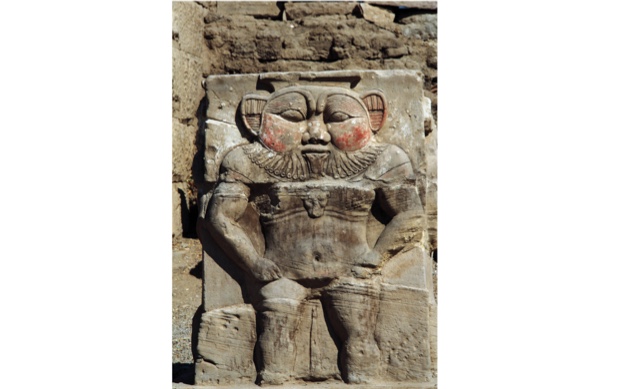
Bes was another god who brought comfort and protection to mothers and children. A part-comical, part-sinister dwarf with a plump body, prominent breasts, bearded face, flat nose and protruding tongue, Bes might be either fully human, or half-human, half-animal (usually lion). He might have a mane, a lion’s tail, or wings. He often wears a plumed headdress and carries either a drum or tambourine, or a knife.

 Bes offered a welcome protection against snakes. But his primary role was as a dancer and musician who used his art to frighten away bad spirits during the dangerous times of childbirth, childhood, sex and sleep. His image decorated bedrooms of all classes, and we can also see him, either tattooed or painted, on the upper thigh of dancing girls.

A relief depicting the god Bes on a facade of the Small Temple of Hathor, Abu Simbel. His primary role was as a dancer and musician who used his art to frighten away bad spirits during the dangerous time of childbirth. (Photo by DeAgostini/Getty Images)

 3. Neith
Neith is a warrior or a hunter. Human-form and bald, she wears a crown and carries a bow and arrows. Her linen sheath dress is so tight that, in an age before lycra, she would have had difficulty moving around the battlefield. Her title ‘mother of the gods’ identifies her with the creative force present at the beginning of the world, and it is possible that she is credited with inventing childbirth. On the wall of the temple of Khnum at Esna, in southern Egypt, we see Neith emerging from the primeval waters as a cow-goddess who creates land by simply saying the words: “Let this place be land for me.”

 Neith was worshipped throughout Egypt, but was particularly associated with the western Delta town of Sais (modern Sa el Hagar) where her temple became known as the ‘house of the bee’. During the 26th dynasty (664-525 BCE), a time when Sais was Egypt’s capital city, she became the dominant state god, and the kings were buried in the grounds of her temple. Her temple and the royal tombs that it contained are now lost.

 4. The Aten
If Taweret and Ammit seem to have too many body parts, the god known simply as the Aten, or ‘the sun disk’, does not seem to have enough. The Aten is a bodiless, faceless sun that emits long rays tipped with tiny hands. He hangs in the sky above the royal family, offering them the ankh, symbol of life. As he has no known mythology, we can say very little more about him.

 This apparently dull deity inspired such devotion in Pharaoh Akhanaten (ruled c1352–1336 BC) that he abandoned the traditional gods, closed their temples and built a new capital city which he named ‘Horizon of the Aten’ (modern Amarna), dedicated to the Aten. Had a private citizen decided to worship just one god, there would have been no problem. But Akhenaten, as pharaoh, was expected to make offerings to all of Egypt’s gods. His decision to abandon the traditional rituals was seen as very dangerous –surely the old gods would get angry? Not long after his death, the pantheon was restored by Tutankhamen (ruled c1336–1327 BC). As the old temples re-opened, the Aten sank back into obscurity.

 5. Sekhmet
Many of us are familiar with Hathor, the gentle cow-headed sky goddess associated with motherhood, nurturing and drunkenness. Few of us realise that Hathor has an alter ego. When angry, she transforms into the Sekhmet, ‘the powerful one’, an uncompromising, fire-breathing lioness armed with an arsenal of pestilences and plagues and the ability to burn Egypt’s enemies with the fierce heat of the sun. Sekhmet was a ruthless defender of her father the pharaoh and this, together with her skill with a bow and arrow, caused her to become closely associated with the army. When the sun god, Re, learned that the people of Egypt were plotting against him, he sent Sekhmet to kill them all. When he changed his mind, and determined to save the people, he had a lot of trouble stopping the killing. Sekhmet was not entirely vicious, however. As ‘mistress of life’, she could cure all the ills that she inflicted, and her priests were recognised as healers with a powerful magic.

From The Book of the Dead of Userhetmos, the dead woman prays to the hippopotamus goddess Taweret. (Photo by Werner Forman/Universal Images Group/Getty Images)

 6. Khepri
Khepri, ‘the one who comes into being’, is the morning sun. He is usually shown in the form of a beetle, although he might also be a beetle-headed man, or a beetle-headed falcon. He is a divine version of the humble scarab beetle whose habit of pushing around a large ball of dung made the ancients imagine a huge celestial beetle rolling the ball of the sun across the sky.

 Hidden within the scarab beetle’s dung ball were eggs that eventually hatched, crawled out of the ball and flew away. Observing this, the Egyptians jumped to the conclusion that beetles were male beings capable of self-creation. This enviable ability to regenerate made the scarab one of Egypt’s most popular amulets, used by both the dead and the living. Although Khepri did not have a temple, he was often depicted alongside Egypt’s other gods in the royal tombs in the Valley of the Kings.

 7. Renenutet
Renenutet was a cobra goddess. The Egyptian cobra can grow to be nine feet long and can, when angry or threatened, raise a third of its body from the ground, and expand its ‘hood’ (cervical ribs). This made the female cobra a useful royal bodyguard. A rearing cobra (the uraeus) was worn on the royal brow; cobra amulets were included in mummy wrapping to protect the dead; and a painted pottery cobra, placed in the corner of a room, was known to be an effective means of warding off evil ghosts and spirits.

 Every year the river Nile flooded in late summer. The rising waters caused an increase in the number of snakes attracted to the settlements by the vermin flushed from the low-lying ground. This caused the cobra to be associated with the fertility of the Nile. Renenutet, ‘she who nourishes’, lived in the fertile fields where, as goddess of the harvest and granaries, she ensured that Egypt would not go hungry. Cobras were considered exceptionally good mothers, and Renenutet was no exception. As a divine nurse she suckled the king; as a fire-breathing cobra she protected him in death.

 8. Geb
In most mythologies, the fertile earth is classed as female. In ancient Egypt, however, the earth was male. Geb was an ancient and important earth god who represented both the fertile land and the graves dug into that land. For this combination of attributes, and for his prowess as a healer, he was both respected and feared. He usually appears as a reclining man beneath the female sky. His naked green body often shows signs of his impressive fertility, and he may have grain growing from his back. Alternatively, he might appear as a king wearing a crown. In animal form, Geb might be a goose (or a man wearing a goose on his head) or a hare, or he might form part of the crew of the sun boat that sails across the sky each day.

 Geb ruled Egypt during the time when people and gods lived together. Later, Greek tradition would equate Geb with the Titan Chronos, who overthrew his father Uranus at the urging of his mother, Gaia.

 Joyce Tyldesley teaches a suite of online courses in Egyptology at the University of Manchester. She is the author of Myths and Legends of Ancient Egypt (Viking Penguin 2010).

Thursday, February 4, 2016

Spectacular Statuettes of Apollo and Artemis Discovered in Rare State of Preservation in Crete

Ancient Origins
While the size of the find may be small, the quality is great. Archaeologists working in Aptera in Iraklio, Crete, have recently unearthed well-preserved statuettes of the mythical Greek goddess Artemis and her twin brother Apollo.
The Artemis sculpture is cast in bronze and depicts the goddess in the process of firing an arrow. The head of the excavation at the site in Aptera, Vanna Niniou-Kindeli, said that the goddess statuette was found in an excellent state or preservation, with all of her limbs intact.
Detail of the front of the Artemis bronze sculpture.
Detail of the front of the Artemis bronze sculpture. ( Greek Ministry of Culture )
The Artemis statuette is wearing a short chiton (tunic) and even the white material used for her eyes has been preserved. She was found with the bronze base that the sculpture would have stood upon. The Greek News Agent Ethnos reports that the statuette would have measured 54cm (21.3 inches) tall with the base and is 35cm (13.8 inches) tall without it.
Back view of the Artemis sculpture from Aptera, Crete.
Back view of the Artemis sculpture from Aptera, Crete. ( Greek Ministry of Culture )
In Greek mythology, Artemis was the goddess of nature, chastity, virginity, the hunt, and the moon. According to legends, Artemis and Apollo were the children of Zeus and Leto, and soon after her birth, Artemis helped her mother to give birth to her twin brother. Afterwards, she asked her father to allow her to remain chaste for her life – which she chose to devote to hunting and protecting the natural environment.
The statuette of the Greek god Apollo is arguably less-impressive than that of his sister, but still shows artistic talent. The Apollo sculpture is carved out of marble and measures approximately 54cm (21.3 inches) with the base as well. The International Business Times reports that the Apollo statue has a “rare preservation” of red coloring in some of the creases of the base, suggesting it was painted.
The marble statue of Apollo.
The marble statue of Apollo. ( Greek Ministry of Culture )
In contrast to his twin sister, Apollo was the Greek god of music, healing, light, and truth. Like his sister he was also an archer. Two important tasks given to Apollo were giving the science of medicine to man and moving the sun across the sky each day.
First estimates suggest that the sculptures are from the late 1st – early 2nd century AD. The archaeologists believe that the two figures were probably imported to Crete and originally used to decorate the altar of a Roman luxury residence or were used for decorative purposes at the Roman-era Villa in which they were found.
The base the statues of Artemis and Apollo once stood upon.
The base the statues of Artemis and Apollo once stood upon. ( Greek Ministry of Culture )
Vanna Niniou-Kindeli told Ethnos that the statues will be added to the collection of the Archaeological Museum of Chania on Crete. She also emphasized the support of the Region of Crete and the district commissioner Stavros Arnaoutakis in the excavations to the same source.
Artemis was perhaps the more popular twin for devotion, however temples and sites that worshipped both she and her brother Apollo have been found. Last year, Ancient Origins reported that the twins were also discovered to have been worshipped together at a site for divination via hydromancy in Athens, Greece. The combined honoring of the siblings was described as:
“[…] a yin and yang type of dichotomy: Apollo, famous for his pursuit of nymphs, was worshiped as the protector of domestic flocks and herds and the patron of the founding of colonies and cities. While Artemis, who protected girls, seems to recall an earlier time as the goddess of hunting and nature.“
Featured Image: The bronze statuette of Artemis and the marble one of Apollo. Source: Greek Ministry of Culture
By Alicia McDermott