Showing posts with label Alfred the Great. Show all posts

Wednesday, December 14, 2022

Celebrating Christmas in the Ninth Century during the time of Alfred the Great by Mary Ann Bernal


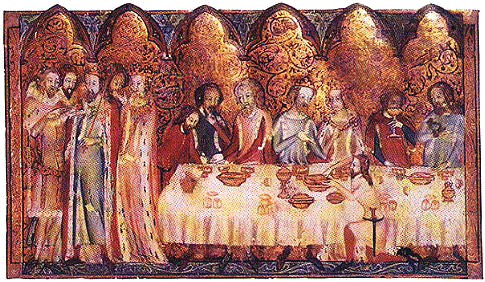
The court of Alfred the Great was Christian, deferring to the Pope in Rome for religious guidance. King Alfred rigorously enforced the Church’s mandates from fasting during Lent to Almsgiving throughout the year, and not just at Christmastime.


There was merrymaking and feasting, but it was also a solemn occasion; prayer and attending Mass was foremost since the holiday celebrates the birth of Christ.


During the twelve days of Christmas, the Christian community prayed at daily Mass, attended vigils, and participated in almsgiving, donating to the poor and the religious communities.


One must not forget the food. Meats included beef, pork, turkey, and boar. Available vegetables were carrots, onions, parsnips, and cabbage. Bread warmed on the hearth, and everything was washed down with wine, mead, and ale. Yes, there was always room for dessert with a variety of tasty pies or fruit, such as apples, plums, and cherries. And, like today, a great chef was worth their weight in gold.


Minstrels would play festive tunes, and guests would dance; gift-giving was also practiced.


Over the centuries, customs have come and gone, but the main reason for the celebration remains, celebrating the birth of Christ.

The Briton and the Dane series transports the reader to ninth-century Anglo-Saxon England, a tumultuous period in history when the feared Vikings ravaged all of Christendom. Click HERE to learn more. 


About the Author


Mary Ann Bernal

Mary Ann Bernal attended Mercy College, Dobbs Ferry, NY, where she received a degree in Business Administration. Her literary aspirations were ultimately realized when the first book of The Briton and the Dane novels was published in 2009. In addition to writing historical fiction, Mary Ann has also authored a collection of contemporary short stories in the Scribbler Tales series and a science fiction/fantasy novel entitled Planetary Wars Rise of an Empire. Her recent work includes Crusader’s Path, a redemption story set against the backdrop of the First Crusade, and Forgiving Nero, a novel of Ancient Rome.

Since Operation Desert Storm, Mary Ann has been a passionate supporter of the United States military, having been involved with letter-writing campaigns and other support programs. She appeared on The Morning Blend television show hosted by KMTV, the CBS television affiliate in Omaha, and was interviewed by the Omaha World-Herald for her volunteer work. She has been a featured author on various reader blogs and promotional sites.

Mary Ann currently resides in Elkhorn, Nebraska.

 Connect with Mary Ann

Website   Publisher   Amazon Author Page   BookBub   Instagram   Linked-in   Blog   Pinterest


Friday, August 20, 2021

The Briton and the Dane: Legacy by Mary Ann Bernal - hardcover edition now available


…Filled with intrigue, betrayal, hate, and love, The Briton and the Dane: Legacy by Mary Ann Bernal is as breathtakingly poetic, as it is sweepingly elegant in its brilliance. This story left me so breathless with anticipation that I could not turn the pages fast enough. I was utterly enthralled from start to finish.

I simply adored this book. So much happens that at times it left my head spinning! There is a cast of very colourful and memorable characters. Some of these characters I have come to adore over the course of the series, others not so much! One thing that can never be said is that Bernal’s characters are dull. They are so unpredictable, and many times during the course of this novel, I found myself shaking my head and whispering, “What are you doing? No. Don’t do that! Please… No, you did it!” The impulsiveness of the characters and the fact that their hearts and not their heads rule many, made their stories not only believable but wonderfully human in the telling.

Like before, with the first two books in this fabulous series, Bernal has captured the very essence of the era in which she writes about. Her compelling narrative and her decision to show every possible side to the story made this book not only exceedingly engaging, but it is also one that was next to impossible to put down.

What I liked about this series the most was the way Bernal has portrayed women. The majority of authors who write their fictional stories about Alfred the Great and this era in history concentrate their efforts on the men of this time, and the women take a more sedate secondary role. Not so with Bernal’s books. The women are centre stage, which I found exceedingly refreshing.

As with the first two books in the series, I was drawn to Elizabeth. She is such a warm and wonderful woman who will do anything for her family, even if it is sometimes a little misguided. Another character who I particularly enjoyed reading about was Dalla. It has been two years since Dalla’s husband, Rigr, was killed, but her love for him has not diminished. I had high hopes that she would find happiness with Loki, but Bernal was not about to make things easy for her!

 As I have already touched upon, the historical detailing of this book has to be commended. Bernal has chosen to paint a vast canvas in which to set her story. Within this canvas, Bernal allows us to walk with Kings and members of the clergy— including the Pope, Norseman, and Saxons. Rich or poor, you can discover them all between these pages. This rich tapestry of life gave this story an incredible sense of depth. The depiction of the sea battle was particularly well-drawn. This was undoubtedly a violent time, and Bernal has not shied away from the brutalities of the era, but at the same time, she has an author’s intuitive understanding of when to stop and change the scene, therefore, giving her readers a moment to catch their breath.

 As with the other books in this series, Bernal has presented her readers with a vast and wondrous cast of characters and, for this reason alone, The Briton and the Dane: Legacy is not, in my opinion, a standalone read. This series thrives on political intrigue and complicated sub-plots, so it is imperative that you start this fantastic reading adventure with Book 1.

Having read all of the books in The Briton and the Dane series, I now feel slightly bereft that this wonderful story has come to an end. I have thoroughly enjoyed not only Bernal’s interpretation of Alfred the Great but also of the women who are so often overshadowed by the men in this era. I look forward to reading more books by this author in the future. Kudos, Ms Bernal.  

I Highly Recommend.
 
Review by Mary Anne Yarde.
The Coffee Pot Book Club.


Thursday, April 16, 2020

The Briton and the Dane: The Complete Trilogy by Mary Ann Bernal


The Briton and the Dane novels bring to life the tumultuous ninth century when the formidable Vikings terrorized the civilized world. The epic adventure runs the gamut of deception, treachery, intrigue, and betrayal during a time of war and conquest in Anglo-Saxon Britain.


Purchase

Wednesday, February 26, 2020

The Briton and the Dane: Legacy by Mary Ann Bernal


Whispered by the wise and the learned. Talked of in hushed tones round luminous firesides. Engraved by awestruck scribes in the scriptoria of the Chronicles.  Against all the odds, great King Alfred defeated a vastly superior Danish army outside Chippenham.

This victory, the sages prophesied, would guarantee peace throughout the land. Or so they thought.

Two years later, Rigr the Bastard, vengeful and seeking to claim his birthright, was defeated in the wilds of East Anglia. His blood smeared berserker warriors vanquished; no quarter asked for - no quarter given.

Now, a further two years later, the Vikings return. Noble Prince Sven instigates a seaborne invasion, fuelled partly by blind rage when he discovers that his brother, Prince Erik, has sworn fealty to the Anglo-Saxon king.  

His own brother: A traitor and a fool.

Erik’s love, Lady Gwyneth, attempts to stop the invasion before it starts by uniting the two estranged brothers, but her scheming only succeeds in making matters worse. Indeed, her interference guarantees the death of thousands of warriors in the freezing, tumultuous North Sea.

So, when the horns of Sven’s monumental fleet of warships are heard off the fogbound coast of Britannia, King Alfred – outnumbered, outshipped and weary of the fray - must rouse his jaded Saxon warriors and lead them to sea, to repel his most formidable enemy yet.

For a host motivated by the spilled blood of the fallen, the spirit of black vengeance, and the delights of a warrior’s reward in Valhalla, is the most fearsome opponent of all.  


Alfred. Sven. Erik. Gwyneth.  Amidst the ferrous reverberation of a battle royale - one or all must die, and the fate of a nation hangs in the balance, one final time.


Purchase


Thursday, February 20, 2020

The Briton and the Dane: Birthright by Mary Ann Bernal


Two years have passed since Alfred the Great successfully defeated Guthrum, King of the Vikings.

The fair land of England is at peace. That is, until the harmony is threatened by Guthrum’s angry, vengeful, illegitimate son, Rigr, who is hell-bent on usurping his father’s throne.

Rigr demands his Birthright – an acknowledgement that he is the sole heir to the Danelaw, but his father refuses his claim. Rigr assembles his army; a motley, but formidable, cohort of disenchanted warriors.

Fearsome Guthrum, ruler of everything from Kent to Northumbria, is made aware of the threat and conjures his forces, meeting the rebellious host on the field at Thetford. 


Thousands upon thousands of bloodthirsty warriors confront each other on the sunlit, windless plains of East Anglia. The victors will rewrite the course of history, and the fate of England is in the hands of the gods of war.

Purchase


Tuesday, February 11, 2020

The Briton and the Dane by Mary Ann Bernal


King Alfred the Great has thwarted the Viking threat against his kingdom of Wessex. Signing a treaty with the formidable Danish King Guthrum, he succeeds in pushing the heathen army back to the rolling fens of East Anglia.

An uneasy peace holds sway: The King establishes a standing army under Lord Richard, who takes command of the citadel at Wareham.

Richard and his army are accompanied by his daughter, Gwyneth, an impetuous and reckless young woman – at once striking, intellectually gifted, but dangerously vain and imprudent.

While Richard broods on the Viking threat, Gwyneth falls in love with an enemy prince - only to discover that she has been betrothed to a Saxon warrior twice her age.  

Refusing to countenance her grim fate, she flees the fortress, but is soon kidnapped by a Viking warrior and taken to the camp of King Guthrum while Saxon search parties scour the land.  

In captivity, a hostage to fortune, and the focus of political intrigue, Gwyneth is submerged in a world of expediency, betrayal, and black treachery. Slowly, she realizes the truth is suspect, nothing is what it appears and her reality cannot be trusted. 

And all the time, against this background, she desires nothing more than to be reunited with her dashing Danish prince.

Purchase


Friday, November 15, 2019

The Briton and the Dane: Concordia - Coffee Pot Book Club Book of the Year Finalist - Early Medieval


Finalist 
The Coffee Pot Book Club Book of the Year
The Historical Fiction Book of the Year 
Early Medieval

Travel back in time to late Ninth Century Anglo-Saxon Britain where Alfred the Great rules with a benevolent hand while the Danish King rules peacefully within the boundaries of the Danelaw. Trade flourishes, and scholars from throughout the civilized world flock to Britannia’s shores to study at the King’s Court School at Winchester.

Enter Concordia, a beautiful noble woman whose family is favored by the king. Vain, willful, and admired, but ambitious and cunning, Concordia is not willing to accept her fate. She is betrothed to the valiant warrior, Brantson, but sees herself as far too young to lay in the bedchamber of an older suitor. She wants to see the wonders of the world, embracing everything in it; preferably, but dangerously, at the side of Thayer, the exotic Saracen who charms King Alfred’s court and ignites her yearning passions.

Concordia manipulates her besotted husband into taking her to Rome, but her ship is captured by bloodthirsty pirates, and the seafarers protecting her are ruthlessly slain to a man. As she awaits her fate in the Moorish captain’s bed, by sheer chance, she discovers that salvation is at hand in the gilded court of a Saracen nobleman.


While awaiting rescue, Concordia finds herself at the center of intrigue, plots, blackmail, betrayal and the vain desires of two egotistical brothers, each willing to die for her favor. Using only feminine cunning, Concordia must defend her honor while plotting her escape as she awaits deliverance, somewhere inside steamy, unconquered Muslim Hispania.


Purchase at:


Sunday, November 12, 2017

If King Alfred was great, was Æthelstan even greater?


History Extra


Æthelstan is shown dressed as a pilgrim with Guy of Warwick in a scene from the 14th-century 'Chronicle of England'. (Bridgeman)

Was King Alfred (reigned 871–99) really the greatest Anglo-Saxon king? Certainly he remains the best-remembered – even if it’s only for burning the cakes. But should it really be his grandson Æthelstan (reigned 924–39) – now largely forgotten – whom we celebrate as the most significant pre-Conquest monarch?

Alfred was a highly successful military leader who, in a battle at Edington in 878, resoundingly defeated the Danish army that had almost conquered Wessex. In the ensuing period of peace he launched a programme of educational reform that transformed the use of English as both a literary and a governmental language. Yet Alfred only ruled the West Saxon people, and those in the western part of the Midland kingdom of Mercia not under subjection to the Danes. When he died (the sole remaining native king in England), the east Midlands, East Anglia and Northumbria all lay in Danish hands.

Æthelstan, on the other hand, was the first king to rule all England and laid claim to an imperial overlordship over the whole of Britain. His military prowess brought him direct authority over not just Wessex and Mercia, but the Danelaw (the name given to the area of northern England where Vikings settled) and the kingdom north of the Humber. Celtic rulers from elsewhere in the British Isles subsequently submitted to his authority. He crushed a rebellion of the Scots king in 934, attacking his realm with a land and sea force and ravaging as far north as Caithness. When Æthelstan defeated a combined Norse-Scots-Northumbrian force at the battle of Brunanburh in 937, a contemporary poem entered into the Anglo-Saxon Chronicle recalled: “Never yet in this island before this was a greater slaughter of a host made by the edge of the sword since the Angles and Saxons came hither from the east, overcame the Britons and won a country.”


The tomb of King Æthelstan in Malmesbury Abbey. (Alamy)

 Foreigners also recognised Æthelstan’s status. He played a significant role on a European stage, forging alliances with royal and ducal houses across the territories of the former Carolingian empire through marriage and fostering arrangements. Scholars from Britain and abroad flocked to his court, bringing books, precious gifts and the relics of the saints (to which Æthelstan showed particular devotion). Alfred founded a dynasty. Æthelstan (who died childless) paved the way for that royal line (through his brothers and nephews) to govern all the English peoples via an effective administrative machine. When he died, an Irish chronicler lamented the demise of the “pillar of the dignity of the western world”. How can so great a king, once celebrated for his achievements, have fallen into such oblivion today?

Alfred’s posthumous reputation received a substantial boost from the profusion of literature that emanated from his court in the latter years of his reign – including the first version of the collection of year-by-year accounts of early English history we know as the Anglo-Saxon Chronicle.


The statue of King Alfred the Great in Wantage, Oxfordshire. Alfred may widely be regarded as the father of the English nation, yet Æthelstan was the first to unite the English people under a single authority and proclaim himself "king of all Britain". (Alamy)

One of his circle, the Welsh priest Asser, also wrote a life of the king in the 890s, giving an unparalleled insight into his personality, his devotion to the saints, his practical and creative abilities and his attitudes to kingship. Texts translated from Latin into English at his court also included passages attributed to the king himself.

By contrast, the reign of Æthelstan is ill-served with narrative sources; the Chronicle offers the sketchiest narrative of events in his reign, there is no surviving biography, nor any writing attributed to his own authorship. Creating a picture of him as a man as well as a royal figurehead involves piecing together information from a disparate range of sources (and a good deal of imaginative licence).

Even so, after his death, Æthelstan enjoyed considerable fame. The West Saxon Latin chronicler Æthelweard saw Æthelstan as a mighty king and drew attention to his victory at Brunanburh (still remembered in the late tenth century as the ‘Great Battle’). Æthelstan’s submission of the Scots and the Picts brought significant and lasting consequences: “The fields of Britain were consolidated into one, there was peace everywhere and abundance of all things, and [since then] no fleet has remained here having advanced against these shores, except under treaty with the English.”

Æthelred the Unready (reigned 978–1016) called his eldest son Æthelstan – and worked through various Old English royal names before he thought to name his eighth son Alfred.

A king to remember
After the Conquest, Æthelstan’s reputation remained strong. To Anglo-Norman writers, he stood out as the founder of a united English realm, and – perhaps more significantly in that era – as having successfully asserted his authority over his Celtic neighbours. William, a monk of Malmesbury Abbey where Æthelstan was buried, paid him particular attention, providing insights not found in any other source, possibly drawing on a now-lost tenth-century life of the king. In William’s hands, Æthelstan became not just a king to remember but one about whom there were many stories, even popular songs worth recalling and repeating.

Various factors combined to diminish Æthelstan’s standing in the literary imagination during the late Middle Ages. Legends about a heroic British king, Arthur, received a substantial boost from the writing of Geoffrey of Monmouth. While Æthelstan’s martial success still gained approval, rumours first reported by William of Malmesbury that Æthelstan’s mother had been a concubine and he was therefore illegitimate gained increasing currency. The mysterious circumstances in which his younger brother, Edwin, was drowned at sea in 933 (supposedly in an open boat without an oar), and Æthelstan’s foundation of the church at Milton Abbas in reparation did him little good either. Æthelstan’s literary reputation reached its nadir in the 14th‑century poem, Æthelston, in which the eponymous hero comes across as a troubled and insecure king, struggling to achieve the moral authority to control his realm.

At the same time, other pre-Conquest kings achieved equal or greater prominence. Attempts to make a saint of Edward the Confessor began soon after his death; he was canonised in 1161. Most problematically for Æthelstan’s cause, Alfred was frequently hailed as the first king to have held sway over all England. Orderic Vitalis, writing in the 12th century, first made that claim, which was energetically promoted by monks at St Albans including Matthew Paris, who went so far as to say that “in view of his merits Alfred was called Great”. King Henry VI even tried in 1441 to get Alfred “the first monarch of the famous kingdom of England” canonised, but without success. No one tried to make a saint of Æthelstan, even though he never married and had such a great reputation for piety in his lifetime.


Æthelstan was overshadowed by the legend of King Arthur, shown in a c1250-80 vellum. (Bridgeman)

 Neither great nor saint, Æthelstan’s place in the popular memory started to slide as the reputation of Alfred increasingly eclipsed that of all Anglo-Saxon kings. Elizabeth’s reign saw an increasing interest in the history of pre-Conquest England; antiquarians collected early English manuscripts and began to publish Anglo-Saxon texts, including Asser’s Life of Alfred. This helped to increase popular understanding of Alfred’s qualities as a ruler and build his reputation as a scholar and statesman at the expense not just of Æthelstan but of all other Anglo-Saxon kings for whom no equivalent biographies survive. William Tyndale had claimed that Æthelstan commissioned an early translation of the Bible. But it was Alfred’s promotion of English over Latin as the language through which to get closer to God that would resonate in the reformed English church, eager to find the historic roots of the Ecclesia Anglicana in the distant past.

Alfred’s reputation flourished further after the publication (in Latin in 1678, and in English in 1709) of John Spelman’s Life of King Alfred, which promoted the king as first founder of the English monarchy. Prince Frederick (son of George II) and his circle of patriots enthusiastically evoked Alfred for his protection of English freedoms and his defeat of foreign enemies, on land and sea. Thomas Arne’s masque Alfred, first performed for Prince Frederick in 1740, concludes famously with the anthem Rule Britannia.


A tenth-century script of the Venerable Bede's 'History of the English People', which was translated during Alfred's reign. (Photoshot)

Thus, gradually during the 18th and 19th centuries, Æthelstan’s memory waned. Only the Freemasons remembered Æthelstan and celebrated him as their mythical founder in England, his ‘son’ (brother) Edwin the first English Grand Master. History books (especially those written for children) found much to celebrate in the deeds for which Alfred was famed, not just his victories over the Danes but his inventions – a candle-clock sheltering inside a horn lantern – and his supposed role in founding the English navy by having ships of a new, longer, design built to try and defeat the enemy at sea.

A national myth
Æthelstan’s right to be considered the first king of all England seemed long forgotten, that epithet given either to Alfred’s grandfather (Ecgberht, d839) or more often to Alfred. Anglo-Saxon topics were popular among Victorian painters but neither Æthelstan nor his great battle at Brunanburh found visual commemoration in any picture exhibited at the Royal Academy between 1769 and 1904; Alfred was however frequently depicted. It was Alfred who took the central role in the creation of a national myth of English and British origins; he became the archetypal symbol of the nation’s own sense of itself. The beginnings of political stability in Britain (which stood in marked contrast to the upheavals elsewhere in 19th‑century Europe) went back to Alfred’s day. As Edward Augustus Freeman argued, Alfred was the most perfect character in history; no other name could compare with his.

Nothing brings out the contrast between the two kings’ reputations better than the marking of the millennial anniversaries of their deaths. Thanks to uncertainty about the precise date of Alfred’s demise, his millennium was celebrated not in 1899 but in 1901. First planned in the aftermath of Queen Victoria’s diamond jubilee in 1897, the celebration was to be a “National commemoration of the king to whom this empire owes so much.”

Crowds travelled to Winchester on Friday 20 September to watch Lord Rosebery unveil Hamo Thornycroft’s massive statue of the king set in the Broadway, Winchester, before proceeding to Winchester Cathedral for a service with the massed choirs of southern English cathedrals, at which the archbishop of Canterbury preached.


Both sides of a silver coin of Æthelstan, which proclaims him as "Rex To Brit" ("King of All Britain"). (British Museum)

 In stark contrast, a single notice in The Times of London for 25 October 1940 (buried under “Ecclesiastical News”), noted the supposed millennium of “Æthelstan the Great” (dating his death to 940, in error for 939). Lamenting that there might in happier times have been some celebration of this event, the correspondent remembered the king as the greatest and most munificent benefactor to St Paul’s Cathedral in London, his donations making that cathedral the richest in England.

Only with the revival of Anglo-Saxonism in the latter years of the 20th century, increased scholarly interest in the Latin and vernacular literature of England before the Conquest, and the critical editing of royal administrative documents, has Æthelstan begun to regain something of his former prominence. His reign lay at the source of many developments. First to unite the English peoples under a single authority, Æthelstan also accepted the submission of all the other rulers of Britain. Welsh kings attended regularly at his court, travelling round the kingdom with him.

 Ã†thelstan expressed his claim to hegemony over all Britain in a new language of imperial rulership and in visual symbols, most obviously his decision to wear a crown (shown on his coins and in the surviving portrait of the king giving a book to St Cuthbert). His sway over the whole island brought together under one rule peoples that had previously suffered significant political disruption and consequent social breakdown because of the Danish wars and Scandinavian settlements.

Æthelstan created an efficient administrative machine to govern a dispersed realm, and directed much of his legal activity towards the repair and renewal of this fractured and damaged society.

“Very mighty”, “worthy of honour”, “his years filled with glory”, “pillar of the dignity of the western world”, “pious King Æthelstan”: each of these near-contemporary comments reflects aspects of Æthelstan’s achievement and personality. He deserves to be brought out of the shadows that have obscured his memory and celebrated as a key figure in the making of England – and, indeed, the forging of Britain.

Where Æthelstan is remembered
Æthelstan supposedly visited Beverley in the East Riding of Yorkshire on his way to fight a major battle in the north and paused to pray for victory at the shrine of St John of Beverley (a prominent figure in Bede’s History, and an early bishop of Hexham). On his return south, victorious, he refounded Beverley church as a collegiate community of canons and granted it land and a number of privileges including the right of sanctuary. Three monuments in the minster recall the king, including a life-size statue cast in lead in 1781 added to the screen at the entrance to the choir. Æthelstan stands holding a sword in one hand, and in the other the charter of privileges he had given to the town of Beverley. On the opposite side of the archway leading into the choir is a similar statue of Bishop John of Beverley.

Outside the guildhall at Kingston upon Thames in Surrey stands a piece of grey-wether sandstone, believed to be the Anglo-Saxon coronation stone on which Æthelstan was crowned in September 925. The stone once lay in St Mary’s chapel in the town; when that was destroyed, it was moved to the market place, where it served as a mounting block. The Masonic order of Surrey led a campaign in the 1850s to re-situate the relic in a more formal setting, arranging for it to be moved in 1854 to its current location, mounted on a heptagonal base and surrounded by railings. Re-laying the stone involved appropriate Masonic ceremonies, including the sprinkling of the monument with corn, oil and wine.


The coronation stone in Kingston upon Thames on which Æthelstan was crowned in September 925. (Alamy)

In the restored Norman abbey church at Malmesbury in Wiltshire, Æthelstan is commemorated by a late medieval tomb chest in perpendicular style, now in the north aisle.

The king’s recumbent, full-length effigy lies beneath a heavy traced canopy. The original head has been removed and replaced with another of unknown date. Æthelstan was a generous patron of Malmesbury in life and chose to be buried there, near the tomb of St Aldhelm. In the 12th century, William of Malmesbury saw the king’s remains and remarked on his fair hair. During the Reformation his bones were lost and the tomb is now empty.

St Cuthbert and the kings of Wessex
 Both Alfred and Æthelstan are associated with legends relating to St Cuthbert (bishop of Lindisfarne, d687). At his time of greatest need, before the battle of Edington, King Alfred supposedly received a night-time visitation from the saint, who promised him victory and a glorious future for his sons. If Alfred would be faithful to Cuthbert and his people, Albion would be given to him and his sons, and he would be chosen king of all Britain. Æthelstan – who claimed that very title: king of all Britain – showed great devotion to the saint’s shrine on a visit to Chester-le-Street in 934. He gave many precious gifts including a book containing Bede’s life of Cuthbert. The frontispiece to that volume depicts a double portrait of the crowned King Æthelstan presenting the manuscript to Cuthbert.

Sarah Foot is Regius Professor of ecclesiastical history at Christ Church, Oxford and author of Æthelstan: The First King of England.

Wednesday, September 20, 2017

The real Alfred the Great

History Extra


In 878 King Alfred had to flee for his life when Twelfth Night celebrations at his residence in Chippenham, Wiltshire, were rudely interrupted by a surprise Viking attack, well outside the normal campaigning season. Alfred took refuge in the marshes at Athelney in Somerset, where he allegedly burnt the cakes, a story first recorded in the 11th century. The point of this anecdote was to emphasise how low the King’s fortunes had sunk in order to make his comeback at the battle of Edington (also Wiltshire) later in the same year all the more dramatic. By defeating the Viking leader Guthrum, Alfred ensured that his kingdom of Wessex in southern England remained free of the Viking occupation that had overrun the eastern half of the country, and set the stage for his successors to make themselves kings of all England.

 Alfred’s victory at Edington did much to earn him the epithet “the Great”, though this was not widely applied to him before the 16th century. However, his successes against the pagan Vikings are arguably not the most remarkable thing about him; medieval kings, after all, were expected to win battles. No, what really makes Alfred stand out in the canon of Anglo-Saxon leaders are skills and interests that few of his contemporaries shared.

 A chance find near Athelney in 1693 brings us closer to what made Alfred such an unusual king. This is the famous Alfred Jewel, which incorporates the Old English inscription “Aelfred mec heht gewyrcan”: “Alfred had me made”, and it is believed that the Alfred in question must be the ninth-century king. But what sort of artefact is the Jewel, and why may Alfred have commissioned it? The answer probably lies in the socket at the end of the artefact’s animal-head terminal. This presumably once held a thin rod, giving us reason to suspect that the Jewel is an æstel, a pointer to help those who were not experienced at reading to spell out the words. A unique reference to the gift of an æstel occurs in a letter sent by Alfred to his bishops, some of whom, it appears, were in need of improving their reading skills which they were expected to hone on the volume that accompanied the gift. The book was a translation into Old English of a key Latin work of the early Middle Ages, the Pastoral Care by Pope Gregory the Great, and the leader of the translation team was the King himself.


The Alfred Jewel, which was discovered in 1693 near Athelney, where Alfred took refuge from the Vikings in 878. It bears the inscription ‘Alfred had me made’. (Ashmolean Museum/Salisbury & South Wiltshire Museum)

 Kings who read books in the early Middle Ages were pretty unusual, but a king who was an author as well as a successful military commander was as rare as the proverbial hen’s teeth. Alfred was an adult learner. His Welsh biographer and adviser Asser describes how in 887, when the King was 38, he began to study Latin works. From his reading, Alfred seems to have gained a much clearer idea of his own responsibilities as a Christian ruler, and to have felt that others in his kingdom who were also in positions of responsibility would benefit similarly if they got down to study. Not only were his bishops expected to find time to do so, but so were his secular leaders and administrators. In addition to the translation of Pastoral Care, Alfred was involved in the translation of Boethius’s Consolation of Philosophy, Augustine’s Soliloquies and the first 50 Psalms. Such books were usually only available in Latin, but Alfred was not afraid to break with convention, and so did much to launch English as a language of learning.

 The works selected for translation were not so far removed from Alfred’s other concerns as king as they might at first appear. King David of the Psalms, and many of the classical characters referred to by Boethius, were military and political leaders with similar concerns and problems to those faced by Alfred himself. To a certain extent we can see the King treating these works as self-help guides. In the letter he sent to his bishops with the æstel and their copy of Pastoral Care, Alfred looked back on earlier periods and concluded that those in which rulers had been successful in warfare and wealth were also those in which wisdom had flourished. By wisdom, the King meant the knowledge to act and think correctly as defined by the Bible and those who commented upon its meaning. The bishops were further encouraged to make the same connection through the gift of a valuable æstel. They had literally acquired wealth (ie the æstel) with wisdom, (their copy of the translation of Pastoral Care) whose import they were to pass on to the wider population via the priests whom it was their duty to train. The people would learn that it was their duty to fall into line behind the King and to accept the demands that he needed to make upon them in order to be successful in warfare against the Vikings. 

An enquiring mind and willingness to adopt original solutions for practical problems appear to have been characteristics of King Alfred. The æstels may be an example of the “wonderful and precious new treasures made to his own design” described by Asser. Another may be the splendid silver Fuller brooch, with its depiction of the five senses in which “Sight” bears a close resemblance to the enigmatic central figure on the Alfred Jewel. When the King wanted a more accurate way of allocating his time equally to his different responsibilities, he designed a candle-clock, and when the winds whistling around his wooden palaces caused his candles to gutter, he ordered lanterns of wood and horn to be made to contain them. When he saw how the Vikings were making use of fortified sites, he ordered new fortresses to be built in Wessex, existing ones to be strengthened and garrisons to be placed within them. These burhs, as they were known, played a major role in Alfred’s ability to see off further Viking attacks after his defeat of Guthrum at Edington in 878.

 But in Asser’s biography, and through comments in the translations associated with him, Alfred also appears as an introspective man who was troubled by the problems of reconciling the expectations of him as a military and Christian leader. He also suffered serious illness from adolescence onwards. Illness had first come upon him when he was worrying about how to avoid teenage lust, and entered a new phase when he fell ill at his wedding in 867 when he was about 20. From this time we are told he had recurring agonising attacks and was always on edge because he never knew when he might be struck down again. (One modern diagnosis of Alfred’s symptoms is that he suffered from Crohn’s disease, a chronic abdominal disorder.)

 Some modern historians have found this picture of Alfred as an apparent neurotic invalid with sexual hang-ups difficult to reconcile with Alfred the man of action who excelled in hunting and warfare (as Asser also tells us). Yet, whatever their doubts, it would appear that Alfred found a way of turning illness to his advantage. When he was able to achieve so much in spite of bad health and his many other preoccupations as king, it was rather difficult for his nobles to claim they did not have time to learn their letters.


Harry Mileham’s 1909 oil painting showing King Alfred translating Pope Gregory the Great’s key Latin work, Pastoral Care. (Bridgeman)

 An early medieval micro-manager
Alfred’s demands on his subjects seem to have caused some resentment. Asser speaks of resistance to the building of fortresses as well as to the need to improve literacy skills. A document about a land dispute from the reign of Alfred’s son, Edward the Elder, asks “if one wishes to change every judgement which King Alfred gave, when shall we finish disputing?”, so reinforcing the picture that Asser paints of a King who was given to enquiring closely into legal cases. Alfred was much more of a micro-manager than many early-medieval kings and was aware of how his administrators might abuse their positions. But any resentment towards his demands is likely to have been countered by another of his characteristics – generosity. Generosity and conspicuous bravery, which Alfred also seems to have possessed, were the two most valued traditional attributes of early medieval kings. The converse of that was that Alfred could be harsh to those who defied him. Without going into details, Asser reveals that Alfred dealt severely with those who shirked fortress work or plotted the death of one of his foreign ecclesiastical advisers. In fact, it was fear of the consequences, as well as the lure of treasures like the Alfred Jewel, that persuaded members of the nobility to at least make a show of following their ruler’s interest in books, and encouraged defeated Vikings to embrace Christianity.

 It is almost impossible to get a full understanding of the character of any early medieval person, even one as relatively well recorded as King Alfred. Asser’s biography and the translations may provide some genuine insights, but they are also deliberately concerned with presenting a persona that promoted contemporary ideals of Christian kingship, what today we might refer to as spin. Asser makes no bones about revealing that King Solomon of the Old Testament, another ruler closely associated with the pursuit of wisdom, was a model for some of what he says about Alfred. Perhaps such a persona was actively adopted by the King to impress his subjects and mark his difference from them. The end result was, as the 19th-century historian Edward Freeman put it, that Alfred appears as “the most perfect man in history”.

 In the reign of Victoria in particular, he was adopted as an exemplar of all that was best in the English character and as the founder of English institutions and empire. The desire for Anglo-Saxon origins for 19th-century innovations led to some startling claims. For instance, Alfred’s modest provision of better schooling at the royal court led Arthur Conan Doyle to assert that “his standard was that every boy and girl in the whole of the nation should be able to read and write”. It was in this spirit that international celebrations were held in Winchester for Alfred’s millennium in 1901 which culminated in the unveiling of the statue of the King by Hamo Thornycroft. In 2008 a more 21st-century evaluation of Alfred is to be made in Winchester in the exhibition, Alfred the Great: Warfare, Wealth and Wisdom, which will explore the interaction between these concerns – something on which Alfred himself seems to have reflected to exceedingly good effect.


A statue of Alfred in Winchester. (Alamy)

 What did Alfred actually do?

1) Alfred travelled twice to Rome as a young boy, at the ages of four and six, and was received by the Pope. On his second visit he was accompanied by his father, King Æthelwulf. On the return journey they stayed with the great Frankish king, Charles the Bald, whose daughter married Æthelwulf.

 2) Alfred succeeded his brother Æthelred I as king of Wessex in 871, when he was 22 years old, in the midst of a major assault on the kingdom by a Viking army. Nine major battles were fought between Vikings and West Saxons in that year. They ended in stalemate and a temporary truce.

 3) After narrowly escaping capture by Vikings in 878, Alfred rallied to decisively defeat the Danish leader Guthrum at the battle of Edington in Wiltshire. Guthrum agreed to convert to Christianity, take the Anglo-Saxon name of Athelstan and retire to East Anglia, where the Anglo-Saxon royal family had been ousted in earlier Viking attacks.

 4) In 886 Alfred restored the city of London and moved the settlement from the Strand to inside its refurbished Roman walls. Control of London was given to Ealdorman Æthelred, the ruler of the western part of Mercia, who also became Alfred’s son-in-law. Their alliance was a major factor in countering Viking attacks.

 5) Alarmed by poor standards of learning in Wessex, Alfred recruited scholars from other parts of Britain and Europe in the late 880s. These included Asser from Wales and Grimbald and John from the Frankish empire. These men assisted Alfred in the translation of key Latin works into Old English.

 6) Alfred issued a new law code for his subjects that drew upon previous Anglo-Saxon laws and contemporary Frankish practice. Parallels were drawn between Anglo-Saxon and Old Testament law-making. The royal officials who administered the local law courts were encouraged to learn to read and also to act impartially.

 7) Between 892 and 896 Alfred had to face a second phase of major Viking attacks. Thanks to the reforms he had instigated in military service, and his foresight in having additional fortresses built and garrisons placed within them, the Vikings were unable to establish themselves and eventually dispersed.

 8) Alfred founded a monastery at Athelney and also a nunnery at Shaftesbury where one of his daughters became abbess. A new religious community was established in Winchester which was greatly enlarged after Alfred’s death in 899 by his son and successor Edward the Elder to become New Minster and the place of Alfred’s burial.

 Alfred’s World: Kingdoms under Viking attack
When Alfred was born in 849, there were four Anglo-Saxon kingdoms still in existence – Northumbria, East Anglia, Mercia and his own kingdom of Wessex, which consisted of England south of the Thames, plus Essex. Wales was also divided among a number of kingdoms and Alfred’s biographer Asser came from one of these, Dyfed in the south west. A further Welsh-speaking province was the kingdom of Strathclyde, but the two most significant players in the north of Britain were the Picts and the Irish of Dalriada (Argyll and adjacent islands) who were in the process of amalgamating to form Scotland.

 The greatest kingdom in mainland Europe was that of the Franks. Their famous king, Charlemagne, (768–814) had ruled a huge swathe of land consisting of the modern countries of France, Germany, Belgium, the Netherlands, Austria, Switzerland and most of Italy. However, during the ninth century these were divided into smaller kingdoms ruled by his heirs. Charlemagne had sponsored a major revival in Christian learning and culture, and in the ninth century it was to Francia that kings of less sophisticated areas, such as Wessex, looked for inspiration. Alfred had two Frankish clerical advisers, Grimbald from St Bertins and John from Saxony.

 The stability of all areas of western Europe was seriously threatened in the ninth century by attacks from Viking raiders from Denmark and Norway. Although similar in most respects to other peoples of western Europe, the Scandinavians were not Christians, and their raids became increasingly aggressive and difficult to counter as the century progressed. In fact, during the period 866–78, Viking leaders took over East Anglia, and much of Mercia and Northumbria. Wessex alone survived the onslaught and at the time of Alfred’s death in 899 he was the only Anglo-Saxon king still ruling in Britain.

 Barbara Yorke is professor of early medieval history at the University of Winchester.

Sunday, August 13, 2017

Millennium Old Structure Unearthed at Medieval Pictish Fort in Scotland

Ancient Origins


Archaeologists have recently uncovered the traces of a millennium old building at the location of the Pictish fort of Burghead in Moray, Scotland. The fort dates back to the time of Alfred the Great and was thought to have been largely destroyed by 19th century development.

 Notable Pictish Fort Unearthed
Experts have concluded that the fort was possibly a major source of power for the Pictish kingdom between 500 and 1000. Many notable Pictish artifacts including the Burghead Bull carvings and a mysterious underground well were discovered in the area during the 1800s, but since then it had long been speculated most of the Pictish remains were destroyed when a new town was built on top of the fort at this time. The University of Aberdeen archaeologists overseeing the dig at Burghead Fort near Lossiemouth in Moray, however, have a different opinion and the dig they started in 2015 at Burghead is now uncovering many important clues about the Picts as Live Science reports.


Archaeologists have recently unearthed the traces of an ancient Pictish fort in Scotland underneath an 1800s-era town. (Credit: University of Aberdeen)

The team recently unearthed a Pictish 1,100-year-old longhouse within the fort. Not much is known about Pictish architecture so the new finding could provide very significant information as to the character of Pictish domestic architecture and the nature of activity at major forts such as Burghead. Professor Gordon Noble, Senior Lecturer at the University of Aberdeen, stated as Live Science reports, “Beneath the 19th century debris, we have started to find significant Pictish remains. We appear to have found a Pictish longhouse. This is important because Burghead is likely to have been one of the key royal centers of Northern Pictland and understanding the nature of settlement within the fort is key to understanding how power was materialized within these important fortified sites.”


Excavation site at Burghead (Credit: University of Aberdeen)

Coin of Alfred the Great Found Within the Building
Within the floor layers of the building, an Anglo-Saxon coin of Alfred the Great was found, a fact that indicates the age of the house and fort as the coin dates to the late ninth century when Viking raiders and settlers were leading to drastic changes within Pictish society. Dr. Gordon Noble told Heritage Daily, “There is a lovely stone-built hearth in one end of the building and the Anglo-Saxon coin shows the building dates towards the end of the use of the fort based on previous dating. The coin is also interesting as it shows that the fort occupants were able to tap into long-distance trade networks. The coin is also pierced, perhaps for wearing; it shows that the occupants of the fort in this non-monetary economy literally wore their wealth. Overall these findings suggest that there is still valuable information that can be recovered from Burghead which would tell us more about this society at a significant time for northern Scotland – just as Norse settlers were consolidating their power in Shetland and Orkney and launching attacks on mainland Scotland.”


A coin dated to the era of Alfred the Great was found in the remains of a Pictish fort in Scotland. (Credit: University of Aberdeen)

What do we Really Know about the Picts?
Truth is that we don’t know many things about the Picts, as not much has remained from their peculiar and enigmatic civilization. For that matter, we don’t really know what they called themselves since it was the Romans who “baptized” them Picts (meaning painted people), due to the many characteristic tattoos they had painted all over their bodies.

As a previous Ancient Origins article reports, the Picts have often suffered from the biases of the times, which led to the overgeneralization of their society. Roman historians usually portrayed the Picts as warriors and savages, but contemporary historians are not entirely sure if their Roman counterparts were being as objective as they should with their descriptions. As much as they are known for their body art, the Picts are also known for the variety and quantity of sculpture and artwork that they left, a proficiency that defies their early reputation as uncivilized warriors.


A Pictish Man Holding a Human Head by Theodore de Bry (Public Domain)

Bruce Mann, an archaeologist for Aberdeenshire Council Archaeology Service, said about the new finding as Live Science reported, “Burghead Fort has long been recognized as being an important seat of power during the Early Medieval period, and is known as the largest fort of its type in Scotland. Its significance has just increased again with this discovery. The fact that we have surviving buildings and floor levels from this date is just incredible, and the universities’ work is shedding light on what is too often mistakenly called the ‘Dark Ages’,” implying that the Picts were not as uncivilized as the Romans depicted them to be and have most likely left enough culture behind them, that we just haven’t discovered yet. The dig has been carried out in conjunction with the Burghead Headland Trust and with support from Aberdeenshire Council Archaeology Service.

Top image: Burghead, recognized as an important seat of power during the Early Medieval Period (Credit: University of Aberdeen)

By Theodoros Karasavvas

Sunday, July 9, 2017

Æthelflæd: The Anglo-Saxon Iron Lady Who Showed the Vikings No Fear

Ancient Origins


The UK now has a female prime minister and Elizabeth II has been queen for more than six decades, but few would associate Anglo-Saxon England with powerful women. Nearly 1,100 years ago, however, Æthelflæd, “Lady of the Mercians”, died in Tamworth – as one of the most powerful political figures in tenth-century Britain.

Although she has faded from English history, and is often seen as a bit-part player in the story of the making of England, Æthelflæd was in fact a hugely important figure before her death in 918, aged around 50. Indeed, the uncontested succession of her daughter, Ælfwynn, as Mercia’s leader was a move of successful female powerplay not matched until the coronation of Elizabeth I after the death of her half-sister Mary in 1558. So, while Bernard Cornwell’s novels and the BBC series The Last Kingdom are cavalier with the historical facts, perhaps they are right to give Æthelflæd a major role.


Æthelflæd as depicted in the cartulary of Abingdon Abbey (Public Domain)

Æthelflæd was born in the early 870s. Her father, Alfred “the Great” had become King of the West Saxons in 871, while her mother, Eahlswith, may have been from Mercian royal kindred. At the time, Anglo-Saxon “England” was made up of a series of smaller kingdoms, including Wessex in the south, Mercia in the Midlands and Northumbria in the far north. All faced encroachment by Viking forces that were growing in strength and ambition, as outlined in Charles Insley’s article The Strange End of the Mercian Kingdom and Mercia and the Making of England by Ian Walker.


Famous statue of King Alfred the Great on Broadway in Winchester. (CC BY-SA 2.0)

Æthelflæd spent most of her life in the Kingdom of Mercia married to its de facto ruler, Æthelred. Mercia had seen some dark days by the time of her marriage. In the eighth and early ninth centuries, the Mercian kings had had good cause to consider themselves the most powerful rulers in southern Britain. But by the 870s, the kingdom had suffered dramatically from the Viking assaults which had swept across England.

 One king, Burgred, had fled to Rome, and his successor, Ceolwulf II, was seen as a mere puppet by the West-Saxon compiler of the Anglo-Saxon Chronicle and disappeared between 878 and 883. Soon, the East Midlands were ruled by Scandinavians – what became known as the “Danelaw” – and so the kingdom ruled by Æthelflæd and Æthelred was by then just the western rump of the old Mercia. 

Nevertheless, Æthelflæd and Æthelred together engaged in massive rebuilding projects at Gloucester, Worcester, Stafford and Chester, overseeing the refounding of churches, new relic collections and saints’ cults. Famously, in 909, the relics of the seventh-century saint, Oswald were moved from Bardney, deep in Scandinavian-controlled Lincolnshire, to a new church at Gloucester. Perhaps appropriately, for a couple facing the Vikings, Æthelflæd and her husband had a great attachment to the saint, a warrior king and Christian martyr. Æthelred was buried alongside Oswald in 911, and Æthelflæd joined him seven years later.


Remains of St Oswalds Priory, Gloucester, burial place of Æthelflæd and Æthelred (Public Domain)

Powerplay and Politics
At the time, Athelred and Æthelflæd did not call themselves king or queen, nor do the official documents or coins refer to them as such. Instead, they used the title “Lord/Lady of the Mercians”, because Alfred had extended his authority over Mercia and styled himself “King of the Anglo-Saxons”.

But they acted like rulers. Æthelflæd, with her husband and her brother Edward the Elder, King of the Anglo-Saxons, launched a series of military campaigns in the early tenth century. These brought all of England south of the Humber and Mersey river under Anglo-Saxon control and rolled up the Scandinavian lordships which had been established in the East Midlands and East Anglia.

These advances were backed up by an energetic programme of fortification, with burhs (fortified towns) built in places such as Bridgnorth, Runcorn, Chester and Manchester.


Statue in Tamworth of Æthelflæd with her nephew Æthelstan, erected in 1913 to commemorate the millennium of her fortification of the town. (Humphrey Bolton/CC BY SA 2.0)

But while she called herself a “lady”, outsiders, especially the Welsh and Irish, saw Æthelflæd as a “queen” and she surely wasn’t just her husband’s subservient wife. As Alfred the Great’s daughter, the role Mercia and the Mercians would play in the kingdom of the Anglo-Saxons was at stake.

A Potent Widow
But Æthelflæd really came into her own following her husband’s death in 911, although it seems that he had been in poor health for the best part of the previous decade. The Mercian Register in the Anglo-Saxon Chronicle, certainly celebrates her deeds from 910 onwards.

In 915, she successfully campaigned against the Welsh and the major Welsh kings, and in England she began further to expand her kingdom. In 917-8, her army took control of Viking-occupied Derby and Leicester, and just before her death, the “people of York” – that is, the Scandinavian lords of southern Northumbria – also agreed to submit to her.

Æthelflæd. (Public Domain)

For a brief moment, she had authority not just over her own territory in Mercia, but over the Welsh, the Scandinavian East Midlands and possibly part of Northumbria, making her perhaps one of the three most important rulers in mainland Britain – the others being her brother Edward king of the Anglo-Saxons and Constantin II macAeda, King of the Scots.

This made her a major political actor in her own right, but also a respected and feared figure. Even more remarkably, she passed her authority on to her daughter, Ælfwynn, who was around 30 when her mother died. The rule of Ælfwynn in Mercia, which attracts virtually no comment at all from historians, lasted about six months before her uncle Edward launched a coup d’état, deprived her of all authority and took her into Wessex.

Æthelflæd’s legacy is enigmatic, wrapped up in the “making of England”. But she was a ruler of consequence in an era defined by male authority. Indeed, her project to rebuild the kingdom of Mercia and the Mercians might have placed midland England at the heart of later history.

Top Image: Medieval miniature of Æthelflæd in Genealogical roll of the kings of England. 14th century (Public Domain) What Aethelflad may have looked like. (History's HEROES?)
The article, originally titled ‘Æthelflæd: The Anglo-Saxon Iron Lady’ by Philip Morgan, Andrew Sargent, Charles Insley and Morn Capper was originally published on The Conversation and has been republished under a Creative Commons license.