Showing posts with label Christmas. Show all posts

Wednesday, December 14, 2022

Celebrating Christmas in the Ninth Century during the time of Alfred the Great by Mary Ann Bernal


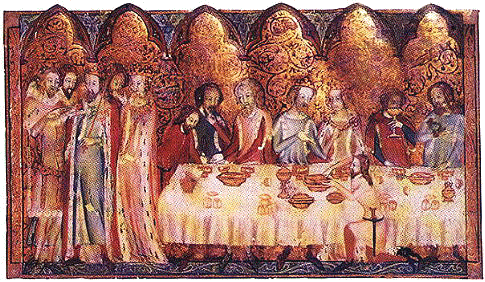
The court of Alfred the Great was Christian, deferring to the Pope in Rome for religious guidance. King Alfred rigorously enforced the Church’s mandates from fasting during Lent to Almsgiving throughout the year, and not just at Christmastime.


There was merrymaking and feasting, but it was also a solemn occasion; prayer and attending Mass was foremost since the holiday celebrates the birth of Christ.


During the twelve days of Christmas, the Christian community prayed at daily Mass, attended vigils, and participated in almsgiving, donating to the poor and the religious communities.


One must not forget the food. Meats included beef, pork, turkey, and boar. Available vegetables were carrots, onions, parsnips, and cabbage. Bread warmed on the hearth, and everything was washed down with wine, mead, and ale. Yes, there was always room for dessert with a variety of tasty pies or fruit, such as apples, plums, and cherries. And, like today, a great chef was worth their weight in gold.


Minstrels would play festive tunes, and guests would dance; gift-giving was also practiced.


Over the centuries, customs have come and gone, but the main reason for the celebration remains, celebrating the birth of Christ.

The Briton and the Dane series transports the reader to ninth-century Anglo-Saxon England, a tumultuous period in history when the feared Vikings ravaged all of Christendom. Click HERE to learn more. 


About the Author


Mary Ann Bernal

Mary Ann Bernal attended Mercy College, Dobbs Ferry, NY, where she received a degree in Business Administration. Her literary aspirations were ultimately realized when the first book of The Briton and the Dane novels was published in 2009. In addition to writing historical fiction, Mary Ann has also authored a collection of contemporary short stories in the Scribbler Tales series and a science fiction/fantasy novel entitled Planetary Wars Rise of an Empire. Her recent work includes Crusader’s Path, a redemption story set against the backdrop of the First Crusade, and Forgiving Nero, a novel of Ancient Rome.

Since Operation Desert Storm, Mary Ann has been a passionate supporter of the United States military, having been involved with letter-writing campaigns and other support programs. She appeared on The Morning Blend television show hosted by KMTV, the CBS television affiliate in Omaha, and was interviewed by the Omaha World-Herald for her volunteer work. She has been a featured author on various reader blogs and promotional sites.

Mary Ann currently resides in Elkhorn, Nebraska.

 Connect with Mary Ann

Website   Publisher   Amazon Author Page   BookBub   Instagram   Linked-in   Blog   Pinterest


Tuesday, November 30, 2021

Book Spotlight and Excerpt: Glass Ornament Christmas by Cheryl A. Hunter


This year, Christmastide will be extra special for glassblower Shayla Toselli who lives in Canterbury Corner, England. The town square will have its first electrically lit tree, and she has been commissioned to create delicate glass ornaments for the new Duke’s Christmas Eve ball. One morning, the Duke’s youngest brother, Adam Preston, finds himself in the Toselli glass factory. He is fascinated with glass blowing and with Shayla. The temperature in the workshop heats up in more ways than one as the unlikely pair works together in the days leading up to the ball. This will certainly be a Christmastide to remember.


Buy Links:

 Available on KindleUnlimited.

 Universal Link

 ¸.•*´¨) ¸.•*¨) ( ¸.•´

EXCERPT

A half-hour later, Sarah had several packages, and Shayla only had a small bag of candy. “You have not seen anything you like as of yet?” Sarah asked in an exasperated tone.

Shayla shook her head. “Not yet.” They entered the shop that still displayed the lavender gown in the window. She liked the merchandise in that shop, and Shayla tried on a dark navy skirt and a floral silk blouse with long sleeves and a scoop neckline. She stood in front of the cheval glass and looked at her reflection.

“That is a good color for you,” Sarah commented as she turned to look at herself in the glass. She glanced over at Shayla. “The skirt is not very full though.”

“I prefer the newer more streamlined style, but I am not sure I need this outfit.”

Sarah laughed. “Shopping is not about necessity. It is about getting something pretty.”

Shayla could not help but laugh at that. “This is pretty, and Papa said I should get something.”

“I like it, but it is not dance-worthy,” Sarah replied.

Shayla moved back and forth as she looked at her reflection. “I have a birthday next week. I could wear it then, and it is fine for the tree lighting festival.”

Sarah shook her head. “It is not sexy enough for a dance. You need something that shows off your figure and bosom.”

 Sarah!” Shayla laughed.

 “Well, why not? You are thin and have a good figure. You eat everything, and I wish I could eat as much as you and still be thin.”

They made their purchases and were laughing and talking when they exited the shop, turned the corner, and saw Adam and another man. The two men crossed the street and walked toward Shayla and Sarah. Shayla felt her heart beating faster as she watched Adam walking toward her.

Miss Toselli, Miss Williams,” Adam said with a low bow. Shayla sighed. Of course, he would be very formal.

She almost retorted and called him Adam, but she decided to play along. “Captain Preston. So nice to see you.” She and Sarah curtsied.

Adam smiled. He recognized Shayla’s sarcasm. “Miss Toselli, and Miss Williams, may I present Captain Shawn Atkinson.”

Captain Atkinson bowed low. “Ladies, it is indeed a pleasure to meet you both.” They responded by curtsying to him. Sarah giggled softly, and Adam chuckled to himself when he heard Shayla’s sigh of annoyance. He knew she preferred informality, but a little formality was fun and besides necessary and expected on a public street.

“Shopping this fine afternoon?” Adam inquired with a nod to the packages they carried.

“Oh yes,” Sarah replied eagerly in a high pitched excited voice. “Christmastide is approaching. Will you be attending the town’s Christmas tree lighting festival this year, Captains?”

“Regrettably, I must return to London before then,” Captain Atkinson replied.

“And you Captain Preston? The whole town is very excited. Duke Wellshore said the tree will be lit with electric lights this year instead of candles,” Sarah sounded excited.

Adam smiled at Shayla. “Will you be attending the festival, Miss Toselli?”

“I have not yet decided,” she replied quickly.

Adam fixed Shayla with a stare. He wanted to ask her to save him a dance, but they had just pretended to be interested in one another at his sister-in-law’s charity party. She might think this was a continuation of the pact they made. He knew he should tell Shayla how he felt about her. He hoped she felt the same way about him. They got along superbly. They talked while they worked and at lunch. They sometimes took walks, and when they danced, he felt that Shayla enjoyed his company and being held in his arms. But he also saw the turmoil in her eyes. Either she did not know how she felt about him, or she was conflicted in her feelings. He laughed to himself. He was sure it was part attraction and part annoyance.

Shayla was the first to break eye contact. “Well, we should continue our shopping, gentlemen.”

Captain Atkinson bowed again. “Lovely to make your acquaintance, Miss Toselli, Miss Williams.”

Adam bowed. “Ladies, enjoy this glorious afternoon.” He looked at Shayla then picked up her hand and kissed it. “Miss Toselli, a great pleasure to see you as always.” Shayla stood staring at him. She was at a loss for words. He smiled at her lack of response and released her hand.

“Good day ladies,” he tipped his hat as he and Shawn walked toward the pub. Shayla stood glued to the spot and watched them walk away. Her hand remained held up in front of her. She still felt the touch of Adam’s lips on her fingers. It sent tingles up her spine. Her eyes were slightly dazed, but then they hardened over. What was his game? she thought to herself.


Cheryl A. Hunter is an author and artist. Her books span multiple genres including historical fiction, contemporary fiction, paranormal fantasy, and nonfiction. Cheryl is also an artist who works in glass, ink and watercolor, and photography. When she is not writing, taking pictures, or creating glass art, she loves to travel. Her interest in Ancient Greek and Roman cultures has taken her to many Archeological sites and museums in several countries.

 Social Media Links:

 Website   Twitter   Facebook   Instagram   Pinterest    Amazon Author Page    Goodreads


Monday, December 24, 2018

Christmas celebrations: the old versus the new


History Extra


Professor Arthur Purdue takes a look at our fascination with 'Christmas past' and how the celebration has evolved since Victorian times.


Christmas is, notoriously, a time for nostalgia, and for many ‘Christmas present’ is considered never to be quite the same as ‘Christmas past’. This is partly due to our getting older, but is also because there are layers of tradition in our celebrations, some of them pre-Christian, which draw us inevitably to the ‘Old Christmas’. As Charles Dickens wrote: “How many old recollections and sympathies does Christmas time awaken?”
Christmas is still essentially that which was remodelled in the 19th century to suit the tastes and ideals of the time. Victorian festivities were centred on the home, the family and the indulgence of children and if, in many homes, the hearth or fireside has disappeared and computer games have replaced the railway set as presents, this is still the Christmas we attempt to recapture and regard as traditional.
The trappings of this festival reflect Victorian innovations: the cards, the tree, the crackers, the family meal with a turkey and, of course, Father Christmas or Santa Claus. Yet an older Christmas hovers behind it and its image is fixed on numerous cards and illustrations depicting a world of stagecoaches, ruddy-faced landlords, thatched cottages, manor houses and hospitable squires. The Victorians built into their new Christmas nostalgia for an ideal Christmas located forever in the 18th-century countryside.
Those very architects of the Victorian Christmas, Charles Dickens and Washington Irving looked back to an idealised Christmas of their recent past. To Dickens, Christmas epitomised not only conviviality and humanity, but an affection for the past. In Pickwick Papers he describes a merry old Christmas, a “good humoured Christmas” in which, after blind-man’s buff, “there was a great game at snap-dragon, and when fingers enough were burned with that, and all the raisons were gone, they sat down by the huge fire of blazing logs to substantial supper, and a mighty bowl of wassail”.
Dickens may well have helped create a new Christmas but at the heart of his vision was an idealised old Christmas; one he hoped to revive. This Christmas was a merry, lengthy and mainly adult affair with some relaxation of the normal rules of propriety.
Whether the occasion was generally observed has been doubted by some, as there is evidence that Christmas was in decline during the late 18th century. The puritans of the Commonwealth, who considered it a Popish survival, attempted to abolish the festival, but the Restoration saw it reinstated amidst popular acclaim. However, forms of celebration based on the open-handed hospitality of the aristocrat or squire in the big house and the often drunken and bawdy customs of the country people, were coming to seem quaint and old-fashioned to many.
Such celebrations had little appeal for the well-to-do in towns and, in the countryside, the gentry no longer automatically kept open house for their dependents, while up-and-coming farmers, distanced themselves from their workers and the mumming and licence of the ‘world-turned-upside-down’ that was the ‘Old Christmas’. Only in more backward areas was Christmas celebrated in the old style and The Times reflected in 1790 on the time of festivity having “lost much of its original mirth and hospitality”.
It was the very decay of Christmas traditions and a consciousness of their passing that appealed to romantics and antiquarians. The American writer, Washington Irving, visiting England in the early 19th century, saw the ‘Old Christmas’ as resembling “those picturesque morsels of Gothic architecture which we see crumbling in various parts of the country, partly dilapidated by the waste of ages, and partly lost in the additions and alterations of later days”. His account of the ‘Old Christmas’ presided over by the antiquarian Squire Bracebridge at Bracebridge Hall was an imaginative reconstruction of old customs and traditions, rather than a description of a contemporary Christmas.
It wasn’t, however, solely the antique and antic customs of the decaying ‘Old Christmas’ that appealed to Dickens and Irving, but the underlying social harmony that they perceived in it. The ‘New Christmas’ that Dickens helped to create was essentially a private and family affair, even if Victorian families were large, and one that centred on children. The ‘Old Christmas’, whose passing he regretted, had been more of a community festival; an expression in the idle period of the agricultural year of charity in its older sense of fellowship.
Much has been made of the contrast between Christmas at Dingley Dell in Pickwick Papers, a gregarious and merry festival lasting twelve days, and A Christmas Carol where the emphasis is upon Christmas Eve and Christmas Day, as well as the notion of the family, represented by the Cratchits. This difference can be exaggerated for, if Dickens was Victorian enough to put home and hearth at the centre of things, his main aim was to stress fellowship, empathy between different sections of society, the responsibility of employers and good cheer. Mr Fessiwig’s Ball, held by the employer for all who worked for him, looks back to the festivities in the manor or farm house in which villagers or retainers, as well as family, participated and forward to the office party. Social harmony was the vision he saw Christmas representing and, if the half-imaginary 18th-century Christmas he drew on was a rosy image of pre-industrial society, it was ever-present in his works.
The third ghost to visit Scrooge is the Ghost of Christmas Present who in fact bears a strong resemblance to some of the more jovial depictions of the spirit of the ‘Old Christmas’ – “a jolly Giant, glorious to see” who, “in a green robe, or mantle bordered with white fur”, is surrounded by a display of plenty in the shape of turkeys, geese and ‘seething bowls of punch’. This spirit, a prototype Father Christmas and a kindly if rather pagan figure, continued to hover over the Christmas that Dickens helped refashion.
The Dickensian Christmas is, therefore, a bridge between the old and the new Christmas, the Anglo-American Christmas, which we inherit. The latter is, no doubt, better suited to an urban and mobile society; it is centred upon the family and children and is essentially private and home-based amidst eerily empty streets. It is also rather tamed for, if we eat and drink enough, it lacks the boisterousness and wider conviviality of the older, more adult, Christmas.
Yet, that ‘Old Christmas’ is annually invoked today, as it was in the 19th century, by Christmas cards and festive illustrations in which jovial squires forever entertain friends by roaring fires while stout coachmen swathed in greatcoats, urge horses down snow covered lanes as they bring anticipatory guests and homesick relations to their welcoming destinations in a dream of merry England.
Professor Arthur Purdue is visiting senior lecturer in history at the Open University and co-author with JM Golby of The Making of the Modern Christmas, Batsford (1986).

Monday, December 25, 2017

Christmas celebrations: the old versus the new

History Extra


Christmas is, notoriously, a time for nostalgia and for many ‘Christmas present’ is considered never to be quite the same as ‘Christmas past’. This is partly due to our getting older, but is also because there are layers of tradition in our celebrations, some of them pre-Christian, which draw us inevitably to the ‘Old Christmas’. As Charles Dickens wrote, ‘How many old recollections and sympathies does Christmas time awaken’?

 Christmas is still essentially that which was remodelled in the 19th century to suit the tastes and ideals of the time. Victorian festivities were centred on the home, the family and the indulgence of children and if, in many homes, the hearth or fireside has disappeared and computer games have replaced the railway set as presents, this is still the Christmas we attempt to recapture and regard as traditional.


The trappings of this festival reflect Victorian innovations: the cards, the tree, the crackers, the family meal with a turkey and, of course, Father Christmas or Santa Claus. Yet an older Christmas hovers behind it and its image is fixed on numerous cards and illustrations depicting a world of stagecoaches, ruddy-faced landlords, thatched cottages, manor houses and hospitable squires. The Victorians built into their new Christmas nostalgia for an ideal Christmas located forever in the 18th-century countryside.

Those very architects of the Victorian Christmas, Charles Dickens and Washington Irving looked back to an idealised Christmas of their recent past. To Dickens, Christmas epitomised not only conviviality and humanity, but an affection for the past. In Pickwick Papers he describes a merry old Christmas, a “good humoured Christmas” in which, after blind-man’s buff, “there was a great game at snap-dragon, and when fingers enough were burned with that, and all the raisons were gone, they sat down by the huge fire of blazing logs to substantial supper, and a mighty bowl of wassail”.

Dickens may well have helped create a new Christmas but at the heart of his vision was an idealised old Christmas; one he hoped to revive. This Christmas was a merry, lengthy and mainly adult affair with some relaxation of the normal rules of propriety.

Whether the occasion was generally observed has been doubted by some, as there is evidence that Christmas was in decline during the late 18th century. The puritans of the Commonwealth, who considered it a Popish survival, attempted to abolish the festival, but the Restoration saw it reinstated amidst popular acclaim. However, forms of celebration based on the open-handed hospitality of the aristocrat or squire in the big house and the often drunken and bawdy customs of the country people, were coming to seem quaint and old-fashioned to many.

Such celebrations had little appeal for the well-to-do in towns and, in the countryside, the gentry no longer automatically kept open house for their dependents, while up-and-coming farmers, distanced themselves from their workers and the mumming and licence of the ‘world-turned-upside-down’ that was the ‘Old Christmas’. Only in more backward areas was Christmas celebrated in the old style and The Times reflected in 1790 on the time of festivity having “lost much of its original mirth and hospitality”.

It was the very decay of Christmas traditions and a consciousness of their passing that appealed to romantics and antiquarians. The American writer, Washington Irving, visiting England in the early 19th century, saw the ‘Old Christmas’ as resembling “those picturesque morsels of Gothic architecture which we see crumbling in various parts of the country, partly dilapidated by the waste of ages, and partly lost in the additions and alterations of later days”. His account of the ‘Old Christmas’ presided over by the antiquarian Squire Bracebridge at Bracebridge Hall was an imaginative reconstruction of old customs and traditions, rather than a description of a contemporary Christmas.

 It wasn’t, however, solely the antique and antic customs of the decaying ‘Old Christmas’ that appealed to Dickens and Irving, but the underlying social harmony that they perceived in it. The ‘New Christmas’ that Dickens helped to create was essentially a private and family affair, even if Victorian families were large, and one that centred on children. The ‘Old Christmas’, whose passing he regretted, had been more of a community festival; an expression in the idle period of the agricultural year of charity in its older sense of fellowship.

Much has been made of the contrast between Christmas at Dingley Dell in Pickwick Papers, a gregarious and merry festival lasting twelve days, and A Christmas Carol where the emphasis is upon Christmas Eve and Christmas Day, as well as the notion of the family, represented by the Cratchits. This difference can be exaggerated for, if Dickens was Victorian enough to put home and hearth at the centre of things, his main aim was to stress fellowship, empathy between different sections of society, the responsibility of employers and good cheer. Mr Fessiwig’s Ball, held by the employer for all who worked for him, looks back to the festivities in the manor or farm house in which villagers or retainers, as well as family, participated and forward to the office party. Social harmony was the vision he saw Christmas representing and, if the half-imaginary 18th-century Christmas he drew on was a rosy image of pre-industrial society, it was ever-present in his works.

The third ghost to visit Scrooge is the Ghost of Christmas Present who in fact bears a strong resemblance to some of the more jovial depictions of the spirit of the ‘Old Christmas’ – “a jolly Giant, glorious to see” who, “in a green robe, or mantle bordered with white fur”, is surrounded by a display of plenty in the shape of turkeys, geese and ‘seething bowls of punch’. This spirit, a prototype Father Christmas and a kindly if rather pagan figure, continued to hover over the Christmas that Dickens helped refashion.

The Dickensian Christmas is, therefore, a bridge between the old and the new Christmas, the Anglo-American Christmas, which we inherit. The latter is, no doubt, better suited to an urban and mobile society; it is centred upon the family and children and is essentially private and home-based amidst eerily empty streets. It is also rather tamed for, if we eat and drink enough, it lacks the boisterousness and wider conviviality of the older, more adult, Christmas.

Yet, that ‘Old Christmas’ is annually invoked today, as it was in the 19th century, by Christmas cards and festive illustrations in which jovial squires forever entertain friends by roaring fires while stout coachmen swathed in greatcoats, urge horses down snow covered lanes as they bring anticipatory guests and homesick relations to their welcoming destinations in a dream of merry England.

Professor Arthur Purdue is visiting senior lecturer in history at the Open University and co-author with JM Golby of The Making of the Modern Christmas, Batsford (1986).

Sunday, December 24, 2017

The History of... Christmas crackers


History Extra


Who do we have to thank for the Christmas cracker?
Traditionally the credit goes to london confectioner Tom Smith. In 1847 he is said to have introduced England to the delights of the French bonbon, a sugar-almond wrapped in paper with a twist at both ends. To boost sales and keep ahead of his competitors, Smith added a ‘love motto’ before enlarging the packaging, replacing the bonbon with a gift and, in 1860, adding the exploding ‘crack’ that was to give the cracker its name. His son, Walter, later introduced the now-obligatory paper hat.

Yet it’s possible that the first person to sell crackers in Britain was in fact the Italian-born gaudente Sparagnapane, another London confectioner (and the father of noted suffragette maud Sennett). His company, which was established in 1846, a year before Smith’s, described itself as “the oldest makers of Christmas crackers in the United Kingdom”.

Were crackers always called crackers?
No. Both companies initially called their creations ‘Cosaques’, supposedly because the crack they made when pulled were reminiscent of the cracking whips of Russian Cossack horsemen.

What’s the story behind the introduction of the ‘crack’?
 Tradition has it that Smith was inspired by the cracking of a log on his fire. Some accounts even claim he spent two years trying to perfect a way of making the sound. However silver fulminate ‘snaps’ had been around for decades and it’s more likely that Smith merely found a new use for an existing novelty.

And they’re not just for Christmas?
Not at all. Late 19th and early 20th-century manufacturers in particular kept a close eye on current affairs and produced crackers with a variety of themes. Votes for women, Charlie Chaplin, coronations, the wireless, even the battle of Tel el Kebir (in the Anglo-Egyptian War of 1882) were just some of the subjects to get the cracker treatment.

Were the mottoes and jokes always so awful?
Smith’s certainly didn’t think so. They were proud of the quality of the verse in their early mottoes. But by 1906 the efforts of some manufacturers were certainly bad enough for the Westminster Gazette to describe a particularly poorly written play as being “not up to the standard of cracker poetry”.

By Julian Humphrys

Saturday, December 23, 2017

5 festive facts from BBC Two’s QI


History Extra


The festive season is well and truly upon us, but how much do you know about the history of Christmas? Here, we bring you a festive extract from the newly released QI book – The Third QI Book of General Ignorance

 1) Prince Albert didn’t bring the first Christmas tree to Britain
 The first Christmas tree in England went up in December 1800, when Queen Charlotte, wife of George III, gave a children’s party. One of the grown-up guests remarked, ‘After the company had walked round and admired the tree, each child obtained a portion of the sweets it bore, together with a toy, and then all returned home quite delighted.’

 Christmas trees soon became wildly fashionable in high society, but it took 40 years (helped by the popular press) for them to catch on across the country. By then Queen Victoria’s husband, Prince Albert, was busy importing them, which is why they are so often associated with him.


December 1848 illustration. (Photo by Hulton Archive/Getty Images)

Prince Albert and Queen Charlotte were both born in Germany, where families had been bringing evergreen trees indoors and putting candles on them since the sixteenth century. According to legend, the first person to do this was Martin Luther (1483–1546), better known for his role in the Protestant Reformation. One evening, it’s said, he looked up at the night sky, saw the stars twinkling between a tree’s branches, and decided to recreate the effect in his home. Luther was a controversial figure. He was also said to eat a spoonful of his own faeces every day. The Christmas tree story may be romantic fiction, but the German tradition of decorating trees indoors did begin in Luther’s lifetime.

Artificial Christmas trees became popular in Britain after the death of Queen Victoria, when large ostentatious trees suddenly seemed inappropriate. The first ones were made from goose feathers that were dyed green. These were also imported from Germany, where they had become fashionable as a way of conserving the country’s fir tree population. But artificial Christmas trees only took off in the 1930s with mass production by the Addis Brush Company. Founded by William Addis, inventor of the toothbrush, they used the same machinery to make bristly branches that they used to make toilet brushes.

Today artificial Christmas trees are seen as an environmentally conscious alternative to the real thing. Unfortunately, an independent study released in 2009 showed that, to be greener than buying a fresh-cut tree each year, you would have to reuse your plastic tree for more than 20 years.

2) ‘Jingle Bells’ wasn’t originally written as a Christmas song
‘Jingle Bells’ is the only Christmas song that doesn’t mention Christmas, Jesus or the Nativity. That’s because it was written to celebrate Thanksgiving.

Originally entitled ‘The One-Horse Open Sleigh’, ‘Jingle Bells’ was the work of American composer James Lord Pierpont (1822–93), uncle of the financier J. P. Morgan. Pierpont’s father commissioned it for a Thanksgiving service.

Pierpont led a wild life – at 14 he ran away to sea and joined a whaling ship. At 27 he left his wife and children in Boston to join the California gold rush. After re-inventing himself as a photographer, he lost all his possessions in a fire and moved to Savannah, Georgia, where he joined the Confederate army during the Civil War. Throughout this period he continued to write songs, ballads and dance tunes, including Confederate battle hymns and ‘minstrel’ songs for performance by white people with blacked-up faces. Some of his less festive tunes include ‘We Conquer or Die’ and ‘Strike for the South’.

The states of Massachusetts and Georgia both claim Pierpont was there when he wrote ‘Jingle Bells’ in 1857. Wherever he was, he made very little money out of it and never lived to see his song’s enormous popularity.

‘Jingle Bells’ was the first tune played live in space. On 16 December 1965, as US astronauts Wally Schirra and Tom Stafford were preparing to re-enter the Earth’s atmosphere in Gemini VI, Stafford contacted Mission Control to report a UFO. ‘We have an object, looks like a satellite going from north to south, probably in polar orbit . . . Looks like he might be going to re-enter soon . . . I see a command module and eight smaller modules in front. The pilot of the command module is wearing a red suit.’ Before Houston could respond, Schirra began playing ‘Jingle Bells’ on a harmonica he’d smuggled aboard in his spacesuit. He was accompanied by Stafford on sleigh bells.

‘Rudolph the Red-nosed Reindeer’ started life as a colouring book devised by US advertising copywriter Robert May in 1939. His reindeer was originally called ‘Reginald’ but he changed his mind at the last minute and the book sold 2 million copies in its first Christmas alone. The song was written a decade later by May’s brother-in-law Johnny Marks, who also wrote ‘Rockin’ Around the Christmas Tree’. Marks was Jewish, joining a tradition of Jewish songwriters behind classic Christmas songs, including ‘White Christmas’ (Irving Berlin), ‘Let It Snow’ (Sammy Cahn) and ‘Santa Baby’ (Joan Javits).


Santa returns to the North Pole after delivering presents from the now empty sack on the back of the sleigh, 1880s. (Photo by Transcendental Graphics/Getty Images)

The story of ‘Winter Wonderland’ (1934) is a sad one. The lyrics were inspired by watching children playing in the snow outside the sanatorium where songwriter Dick Smith was dying of tuberculosis.

3) Jesus’ mum didn’t call him Jesus
For a start, when Jesus lived in Galilee, the letter ‘J’ didn’t exist. In Hebrew, his name was Yeshua or Yehoshua – from which we get the name Joshua. In Aramaic (the language he probably spoke at home) it was Isho or Yeshu.

When the Gospels were translated from Hebrew into Greek, Yeshua became Iesous. When the Greek was rendered into Latin, it became Iesus. Joshua and Jesus were once the same name.

Classical Latin had no letter J – Caesar was Iulius, not Julius. Except for a handful of borrowed foreign words, modern Italian still has no J. The letter J wasn’t really in common use until the seventeenth century, at first to distinguish between words with ‘i’ as a consonant, pronounced as ‘y’ in ‘iest’ (jest) and the short vowel sound ‘i’, as in ‘it’ or ‘inch’. J wasn’t used in English until around 1630, so Shakespeare never used it either – he wrote Romeo and Iuliet, King Iohn and, like Caesar himself, Iulius Caesar. In time, J came to be spoken in English like the Old English ‘dj’ sound, as in ‘hedge’, while in Spanish J still has a ‘Y’ sound’ and in French it’s halfway between the two.

In Hebrew Jesus’ father’s name was Yusuf, not Joseph, and Jesus would have been Yeshua ben Yusuf (‘Joshua, son of Joseph’). It’s possible neither of them were carpenters. The Hebrew word used to describe what they did is naggara (tekton in Greek). It only comes up twice in the New Testament and other possible meanings are ‘architect’, ‘stone mason’ and ‘builder’ – so Jesus may have been a brickie rather than a chippie.

 In 2012 more than 4,000 American children were given the first name Jesus. There were also 800 Messiahs, and 29 Christs.

 4) The holiday celebrated on 26 December every year is not Boxing Day
Boxing Day in Britain is defined as ‘the first working day after Christmas’, so it’s not always on 26 December.

For example, if Christmas Day falls on a Friday, Boxing Day is on Monday the 28th, because the Saturday and Sunday aren’t working days. When Christmas falls on a Saturday, Boxing Day is on Monday the 27th (the next working day) and, to make up for Christmas Day being on a weekend, the Christmas Bank Holiday moves to Tuesday the 28th – so that, in one sense, Boxing Day sometimes comes before Christmas.

But there is a holiday that always takes place on 26 December: the Feast of St Stephen. Appropriately for someone whose feast day comes the day after Christmas, St Stephen is the patron saint of headaches. He also looks after deacons, horses and coffin makers, and is the patron saint of stone workers – which is grimly ironic as he was the first Christian martyr to be stoned to death.

St Stephen’s Day is celebrated as an official public holiday throughout most of Europe; only Commonwealth countries celebrate Boxing Day instead. The name comes from the British tradition of giving small ‘Christmas boxes’, containing money or treats, to workers for their service throughout the year.


 (Photo by George Pickow/Three Lions/Hulton Archive/Getty Images)

In Scotland Boxing Day was once known as ‘Sweetie Scone Day’, when the lords and ladies of great estates would make cakes with dried fruit and spices to distribute among the poor.

In Ireland Boxing Day is sometimes called ‘Wren Day’, after a tradition that continued till the early twentieth century. Children hunted and killed a wren and took it from door to door, offering its feathers in exchange for money. Boxing Day in Wales was even grislier: female servants who were caught oversleeping were traditionally whipped with holly branches.

 5) You don’t need to take down your Christmas decorations by Twelfth Night
Taking down decorations on Twelfth Night (5 or 6 January) is a modern superstition. For many centuries they were kept up until Candlemas Eve, 1 February. Candlemas celebrates Mary and Joseph taking the baby Jesus to the Temple at Jerusalem and presenting him to the Lord. According to St Luke’s gospel they had to sacrifice two pigeons to do so.

Early Christmas decorations consisted mainly of greenery, which kept the house looking cheerful even when the weather outside was miserable. Some people clung to older, pre-Christian beliefs about these – namely that they contained woodland spirits who, if you left the decorations up, would cause mischief in your house. Careful householders took them down and burned them just to make sure.


 This photograph was sold for use in the Christmas 1948 issue of Mother magazine. (Photo by SSPL/Getty Images)

In North America Candlemas is celebrated as Groundhog Day. Groundhogs are large rodents related to squirrels and, according to folklore, if it’s cloudy when a groundhog emerges from its burrow on this day, spring will come early. If it’s sunny, the winter weather will persist for six more weeks.

 Of course, the groundhog has no interest in weather forecasting: he’s looking for a mate. Recent statistics, released by the USA’s National Climatic Data Center, "show no predictive skill for the groundhog". Groundhog Day comes from an older medieval European tradition of the Candlemas Bear, where people watched for a hibernating bear as it awoke to get a similar weather prediction. The rarity of bears in France meant that this duty eventually had to be taken over by a man in a bear costume. A similar tradition in Germany is called Dachstag (‘Badger Day’), and in Ireland they use a hedgehog.

 Until the 17th century ‘Christmas’ lasted almost three months, from the Feast of St Martin on 11 November to Candlemas on 2 February. Although today it doesn’t officially begin until Advent (the fourth Sunday before Christmas), the shops make it seem as if it’s starting earlier and earlier – a process known as ‘Christmas Creep’. This is getting faster, and it’s not just retailers. Analysis of Internet searches in 2007 found people started looking for ‘Santa Claus’, ‘elf ’ and ‘presents’ on 11 November. By 2013 they started on 25 August.

The Third QI Book of General Ignorance, published by Faber & Faber, is on sale now.

Wednesday, December 20, 2017

The Dickensian Christmas


History Extra


Thanks to his seminal 1843 novel A Christmas Carol, Charles Dickens is often credited with inventing winter festivities as we know them. His book of literary favourites including Ebenezer Scrooge, Tiny Tim and the host of Christmas ghosts are thought to define the Dickensian Christmas but is Dickens’ pioneering reputation really deserved?

Charles Dickens’ association with Christmas is infamous. A Christmas Carol was an immediate smash with the public, and quickly spawned a range of ‘pirated’ copies forcing Dickens into a number of legal actions to protect his creation.

 “Dickens, it may truly be said, is Christmas,” said the literature scholar, VH Allemandy, in 1921. However, important though he undoubtedly was, Dickens did not create Christmas. Rather, he reflected a general early 19th‑century interest in the season and was part of a widespread, particularly middle-class, desire to reinvigorate its ancient customs.

At the time Dickens was writing his now world famous story he could have consulted an ever-burgeoning number of popular histories of Christmas such as TK Hervey’s Book of Christmas (1836), and his A History of the Christmas Festival, the New Year and their Peculiar Customs (1843) and Thomas Wright’s Specimens of Old Carols (1841). Dickens, being perfectly in-tune with Britain, therefore published his story at precisely the right moment. He was a massive player in a revival that was already under way, but he was not the sole instigator of it.

Mark Connelly is professor of modern British history at the University of Kent, His books include 'Steady the buffs! A regiment, a region and the Great War'.

Monday, December 18, 2017

A Tradition Revived? Inverted Christmas Trees May Have Pagan Roots

Ancient Origins


Hanging a Christmas tree from the ceiling makes some sense – it can keep your floor space clear and may protect your pets or young children from harm – but it is not common. The costly trend of hanging a tree upside-down is a whole other matter. As with many things that go against the norm, there is a lot of controversy and confusion about the practice of hanging an inverted tree from the ceiling. But it seems the idea is not a new one; in fact, the unconventional decorating idea may trace its roots, at least loosely, to pagan traditions.

 CBC News reports that inverted hanging Christmas trees can be found “dangling from the ceilings of exclusive hotel lobbies and public atriums from London to Vancouver.” It is certainly an eye-catching way to decorate for the holidays, but are the people who practice this method of tree-trimming really following a tradition from the Medieval period, or is the idea purely commercial?


An upside-down Christmas tree. Galeries Lafayette. (Laika ac/CC BY SA 2.0)

Followers of the upside-down Christmas tree practice say that it was a popular way of doing things in in the 12th century in Eastern Europe. Yet it is important to note here, the hanging element was generally just the top of a fir tree – not a huge, heavily decorated tree like you may find in a shopping center or luxury hotel today. In Poland, the top of the tree, or a branch from a fir tree, was hung pointing down from the rafters, usually facing the dinner table, in preparation for the holiday of Wigilia or Wilia. These decorative features were adorned with fruit, nuts, shiny sweets, straw, ribbons, golden pine cones, and other ornaments. An article by The Spruce says that the treats and sweets on the tree could not be eaten until the day after the festivities.

There is a legend that may explain the peculiar practice. The traditional story says Saint Boniface was the first to hang a “Christmas tree” upside-down, in the 8th century. Apparently, Boniface saw pagans preparing to celebrate the winter solstice by sacrificing a young man under an oak tree – a sacred tree in their beliefs. He was angered by their actions and cut the tree down. A fir tree grew in its place and Boniface supposedly decided to hang the inverted tree and use the triangular shape as a tool to explain the Holy Trinity to the pagans while trying to convert them to his religion.


Boniface chops down a cult tree in Hessen, engraving by Bernhard Rode, 1781. (Public Domain)

Some historians say that the tradition of hanging a Christmas tree was still popular in certain European countries as recently as 100 years ago. But the reason had changed by then. Bernd Brunner wrote in his book, Inventing the Christmas Tree, that people living in the 19th century needed the floor space. However, it’s worth mentioning that the tree was right-side up.

It seems the modern tree-hanging practice is meant to essentially serve the same purpose in stores. Dan Loughman, vice president of product development at Roman Incorporated, told NPR in 2005, “By having a tree upside down, you're taking a very small footprint on the floor, and you're placing all the ornaments at eye level. And then the retailers can move their store products around the bottom of the tree or on shelves, you know, just behind it.”


An upside-down Christmas tree is suspended from the ceiling at the Fairmont Vancouver Airport hotel in Richmond, B.C. (Darryl Dyck/Canadian Press)

The tradition of putting up Christmas trees may be tied to the German reformer Martin Luther, who popularized the use of the Christmas tree in 1605 after being inspired by the beauty of the stars on Christmas Eve night. Pine trees also used to have a place in ‘miracle plays’ that were performed in front of cathedrals at Christmas time –the Church eventually banned the practice, but the tradition of having a decorated Christmas tree has continued.

Top Image: An upside-down Christmas tree. Source: This is Why I’m Broke

By Alicia McDermott

Tuesday, December 12, 2017

Wartime Christmas: 5 First World War recipes

History Extra


Christmas was a challenge for the wartime chef on the home front, with food shortages and high prices, even for basic ingredients. So how did Britain feast during the First World War? Hannah Scally, senior historian at illustratedfirstworldwar.com, presents five recipes from the wartime Christmas kitchen

Christmas is today the biggest food event of the year, and things were little different in the 1910s, when abundant courses and elaborate French cuisine were de rigeur. But wartime from 1914 made things tricky, and put a new moral emphasis on economy.

Imports were restricted by naval warfare, and food producers were fighting at the front. Shortages soon appeared, and the Ministry of Food Control was set up in 1916. Initially advocating voluntary rationing, it was forced to introduce compulsory rationing in the last year of the war.

From popular magazine The Bystander, here are some of the Christmas recipes Britain enjoyed during the First World War.

Oyster soufflé
Oysters were eaten in astounding quantities during the 19th century: supplies were bountiful, and they were known as a cheap meat alternative for the poor. They were so popular in fact, that by the end of the 19th century oyster stocks had collapsed, and native oyster beds became exhausted.

 By the 20th century oysters had become an expensive delicacy, as this wartime recipe from December 1914 shows. This festive starter, a delicate ‘oyster soufflé’ calls for six oysters:

Put 4 oz. of whiting or sole through a sieve. Make a panada of 1 oz. of butter, 1 oz. of flour, and a quarter of a pint of milk. Stir into this two yolks of eggs and the fish. Beat the whites very lightly, and stir well. Add half a pint of fish stock (made from the bones), one tablespoonful of cream, and six oysters cut up, steam slowly for one and a half hours. Turn over very carefully, pour a rich white sauce round, and decorate the top with a sprinkling of red pepper.

'Panada' was a paste made of flour, breadcrumbs or another starchy ingredient, mixed with liquid.

'White sauce' was defined as a plain sauce based on melted butter, whisked with flour. Milk is slowly added over a low heat until the sauce becomes thick and creamy.

Celery a la Parmesan
This would be a side dish on modern tables, but during the First World War it formed its own course, emulating the French style of table service. Creamy baked celery with a cheesy crust was a rich platter, worthy of the Christmas occasion, and the ingredients were still relatively affordable. This recipe from December 1914 reads:

Stew some celery in milk till tender, then make a white sauce, into which grated Parmesan should be stirred, and then place the celery in the dish it is to be served in. Pour the white sauce over then a layer of grated Parmesan, then a thin layer of breadcrumbs, and over all put pieces of butter, brown in the oven, and serve very hot.

A boned Turkey
This December 1914 recipe is from a special feature in The Bystander, ‘Four methods of cooking a turkey’. Turkey was emerging as a popular Christmas dish, but it did not dominate the Christmas table as it does today. Other fowl – particularly goose – were also popular.

The following recipe is for what was a particularly elaborate dish, recommended for a special public occasion like ‘a ball supper’. While many of The Bystander’s recipes were intended to be practical guides, it seems unlikely that the magazine’s readers would have followed this recipe in large numbers. We can think of this as early food entertainment; the equivalent of watching modern cookery shows. In this case, variety and interesting ideas were just as important as practicality.

Bone a turkey and lay it with the inside uppermost, cut the meat from the thick parts, and distribute it equally all over the inside, season with salt and pepper. Make some forcemeat with veal, ham, and truffles, put a layer of this over the meat of the bird, then a layer of sliced tongue, then another layer of turkey, then forcemeat, then tongue and truffles.

 Roll it up, and tie it with tape, and put it in a well-buttered cloth into a stew pan, with two carrots, two onions, a stick of celery, some parsley and peppercorns, and sufficient white stock to cover it. Let it simmer gently for three hours, strain, and let it get cold; remove the cloth, and glaze it all over; if any glaze is left, cut it into various strips and lozenge shapes and garnish the dish with it. This dish is excellent for a ball supper.

 'Forcemeat' was a mixture of uncooked ground or pureéd meat, similar to paté, while 'white stock' was a clear meat stock (as opposed to brown stock). The glaze in this instance would be a sweet jelly, brushed over the meat while warm and liquid. When cooled, the jelly would be firm enough to ‘cut into various strips’.

Novel dessert dish
Chestnuts were a traditional Christmas ingredient by December 1915, being grown in abundance on home soil – particularly handy for the wartime cook. But this recipe's dependence on sugar makes it an extravagant dish all the same.

 Roast three dozen large chestnuts, peel them, and put them into a stewpan; add 4 oz. of castor sugar and half a gill of water; cook slowly till the nuts absorb the sugar; then pile them up on a glass dish, squeeze over with the juice of a lemon, and dust rather thickly with castor sugar.

A 'gill' was an old unit of measure, equivalent to about 120ml.

Another inexpensive pudding
This recipe, which dates from November 1915, is a classic response to wartime shortages and economy. Unlike some of the exciting recipes above, this is a cheap, practical method for cooking Christmas pudding.

Sugar and eggs were both in increasingly short supply, and this recipe uses only one large spoon of sugar, and no eggs. Instead, the inclusion of a mashed carrot brings some essential sweetness and moisture to the recipe – just like in modern carrot cake.

Although fruit, like everything else during the war, has gone up in price, every English household must have a Christmas Pudding, but today, when eggs are so very expensive, it is necessary to be as careful as possible to try and obtain good results with fewer in the pudding. The secret of success is in the boiling, and the longer a Christmas pudding is allowed to boil the richer it will be.

Six spoonfuls of flour, ½ lb. of beef suet, ½ lb. of currants, one large spoonful of sugar, one large carrot to be boiled and mashed finely and mixed with the above ingredients, and the pudding to be boiled five hours. No milk or eggs are to be used in mixing the pudding. Serve with sweet sauce [almond or brandy sauce – popular accompaniments to Christmas pudding].

A 1915 Yuletide menu
The addition of olives with anchovies, and two extra dessert courses, promised to satisfy the most eager Christmas diner. Here is a typical 1915 festive menu:

 Hors-d’oeuvres
Clear Ox-tail Soup
Oyster Souffle
Roast Turkey, Chestnut Stuffing
Boiled Ham
Plum Pudding, Mince Pies
Orange Jelly
Olives with Anchovies
Dessert
Coffee, Liqueurs

Saturday, December 31, 2016

The changing faces of Santa Claus

History Extra


© Alamy

On 23 December 1951, the Catholic clergy at Dijon organised an execution of Santa Claus. An image of him was hanged from the railings of the cathedral and then burned in front of several hundred Sunday School children. Santa Claus arouses strong feelings.

 The Anglo-American Santa Claus or Father Christmas has come to dominate the modern Christmas. You can find him in the department stores of Tokyo and Singapore as well as New York and London. But who is he? His characteristics were set out by Clement Moore in his poem, A Visit from Santa Claus, published in 1823 in the Troy Sentinental: he was “chubby and plump, a right jolly old elf”; he arrived on a sleigh drawn by flying reindeer; and came down the chimney with a sack of toys for children.

 Essentially he’s a composite figure: a bit of St Nicholas, an element of the old English personification of Christmas and quite a lot of pagan mythology. It has even been suggested that this figure at the heart of our mid-winter feast draws on shadowy memories of shamans of central Asia, who were believed to be able to fly after eating the red and white fly agaric mushroom and entered yurts via the roof. At any rate, he’s very different to Saint Nicholas, an ascetic figure on a white horse.

 Santa through the ages

 1) Christmas is cancelled
Attempts were made to ban Christmas under the mid-17th century Commonwealth, which held that there was no Biblical mention of the date of Christ’s birth and that the festival gave rise to feasting, drinking and bawdy behaviour. “Old Christmas” is told to keep out by a Cromwellian soldier. The personification of Christmas was known as Old, Sir or Captain Christmas.

 2) A heroic drinker
Victorian images of Old Christmas, the pre-modern spirit of Christmas, vary from a jovial, almost Dionysian, figure, a Lord of Misrule dispensing alcoholic good cheer, to a lean and gaunt aged man, rather akin to Old Father Time athough he, nevertheless, still brings warmth and refreshment.

 3) Wheezy bringer of gifts
If Clement Moore described Santa Claus in words, it was his fellow American, the illustrator, Thomas Nast, who fixed the appearance of this spirit of Christmas until well into the 20th century. His drawings for Harper’s Weekly which he began in 1863, show Santa as much like Moore’s “jolly old elf” though in his later work he settled on a portrayal closer to that which has now become traditional: a large jovial white-bearded figure, dressed in a red suit with a matching cap.

 4) Father Christmas goes to war
By the late 19th century, Father Christmas, as he was called in Britain, had become a central figure in Christmas festivities, even depicted delivering presents to British troops serving in Afghanistan.

 5) He’s the real thing
What has become the definitive image of Santa Claus was created from the 1930s to the 1960s by Haddon H Sundblom in his many adverts for Coca Cola. He exudes warmth and kindliness, has a luxuriant white beard and wears a long red jacket trimmed with white fur and fastened with an enormous belt and long leather boots. He is, however, secular and somewhat sanitised like the modern Christmas itself; there’s still an echo of the Lord of Misrule in his “Ho ho ho” but the pipe has gone and instead of holding a flowing bowl he drinks Coca Cola.

 6) These boots are killing me
Although the modern Christmas is an Anglo-American creation, the British Father Christmas dresses differently to the American Santa. He wears a long red habit trimmed with white fur and a hood rather than the red suit and cap favoured in America. Increasingly the British Father Christmas was replaced by the American Santa Claus.

 7) US Santa’s not welcome
The Anglo-American Santa is not always welcomed in European countries by those who cherish their own customs and versions of seasonal visitors. The Dutch Saint Nicholas is not popular with traditionalists in the Netherlands. The municipal authorities of Assen were not tolerant of one Santa who went there in 1994. As reported in the Sunday Times on 4 December, the police ran him out of town.

Friday, December 30, 2016

Christmas carols: the history behind 5 festive favourites

History Extra


Three medieval carol singers depicted in a card from 1911. (Chronicle/Alamy Stock Photo) 1)

The Twelve Days of Christmas

 Of all the Christmas carols we sing today, none presents more of a challenge than The Twelve Days of Christmas, with its baffling list of lyrics. What exactly are we to make of this aviary of birds – the swans, geese, doves, hens and calling birds – and what on earth is a partridge (strictly a ground bird) doing up a pear tree? The origins of the carol make things a little clearer. Historians generally agree that the verse first evolved as a festive memory game. The list of objects or animals grows with each verse and forfeits are imposed for forgetting one.

 But that still leaves us with the problem of the partridge. While the English partridge is a creature of fields and moors, its French cousin is apparently more likely to find itself up a tree. And if the partridge really is French then it would be called une perdrix. Correctly pronounced ‘pere-dree’, suddenly this word sounds an awful lot like that pear tree. Could it, perhaps, just be an elaborate international game of Chinese whispers that has left us with a partridge stuck forever in a misheard pear tree?

 One interpretation of the carol places its origin in the 16th century. The list of bizarre gifts given by the carol author’s ‘true love’ becomes a secret code for Catholics – whose religion had to be practised in secret after the Reformation – to share their beliefs. So the ‘true love’ becomes God himself and the partridge Jesus Christ. The ‘two turtle doves’ are the old and new testaments, ‘three French hens’ the Trinity, ‘four calling birds’ are the four Gospels, all the way through to ‘twelve drummers drumming’ – the twelve points of the apostles’ creed. If you were a Tudor child, wouldn’t you much rather recite this than your catechism? 

2) We Wish You a Merry Christmas

 What’s interesting about this catchy little carol are the customs it reveals. Both wassailing and mumming were still going strong under the Tudor monarchs, with carollers and players going from door to door performing. It was terribly bad luck not to reward their efforts with food and drink, including the ‘figgy pudding’ – an early version of what we now know as Christmas pudding.


Three young carol singers. (Keystone/Getty Images)

3) Deck the Halls

 One popular 16th-century song was the carol we know today as Deck the Halls. Back then it was a favourite Welsh song, originally titled Nos Galan. It wasn’t until the 19th century that it acquired Christmassy words and became part of our own festivities. In its earliest form, Deck the Halls was just a folk song, but one with some rather naughty words. Translated directly, the Welsh text reads something like this:

 Oh! how soft my fair one’s bosom, fal lal lal lal lal lal lal lal la Oh! how sweet the grove in blossom, fal lal lal lal lal lal lal lal la

Oh! how blessed are the blisses, Words of love, and mutual kisses, fal lal lal lal lal lal lal lal la These words would not have suited the prim Victorians, so when Thomas Oliphant came to write an English text for the melody in the 1860s he started from scratch, co-opting the dancing melody and lively ‘fa la la’ chorus for an altogether more innocent celebration of Christmas preparations.


A Christmas carols greeting card received 1893. (Amoret Tanner/Alamy Stock Photo)

 4) The Holly and the Ivy

 Although this charming carol, based on an English folk tune, probably dates from the 17th century, its symbolism is far older. Both the festivals of Saturnalia and Yule placed great emphasis on evergreens. The Romans would exchange boughs of holly and ivy with their friends during the festival, while both the Scandinavians and the Anglo-Saxon pagans would decorate their homes with the evergreens they saw as symbols of eternal life.

 So try as Christian carol writers might to impose their own symbols on the plants – the red holly berry as Jesus’s blood, the white holly flower his shroud – they have to work hard to displace earlier layers of meaning. Some think there’s a further secret layer of meaning to the carol. Is the holly, with its phallic prickles, a symbol of the masculine, and the clinging ivy of the feminine? English courtiers were fond of such hidden language and holly-and-ivy carols could have formed the basis of courting games.

 5) Silent night

 A firm favourite throughout the 19th century was the lovely Silent Night. Schoolmaster Franz Xaver Gruber and priest Joseph Mohr first performed the carol in the church of St Nikola in Oberndorf, Austria, in its original German (Stille Nacht) on Christmas Eve 1818.

 Legends attached to this timeless carol persist, to a point where it’s hard to dig out the truth from among them. One charming tale tells of mice chewing through vital sections of St Nikola’s organ, leaving the church without music at Christmas. The resourceful young teacher and priest, so the story goes, stepped in to save the service by composing a simple carol that could be sung with just guitar accompaniment.

 These extracts are taken from Carols from King’s (BBC Books, £9.99) by Alexandra Coghlan, a music journalist and former Cambridge choral scholar.