Showing posts with label British Museum. Show all posts

Sunday, December 13, 2015

Massive Viking Hoard Unearthed by Treasure Hunter Publicly Revealed for First Time

Ancient Origins

An impressive Viking and Saxon hoard of silver and gold riches that was discovered by an amateur treasure hunter in October is being publicly revealed for the first time at the British Museum.  The treasure trove is believed to have been buried during ninth-century AD war and upheaval in southern England.
The Watlington Hoard, as it is known, consists of more than 200 pieces including chopped up gold, silver arm rings, silver ingots and coins minted by King Alfred the Great of Wessex and King Ceolwulf II of Mercia. The coins alone, 180 of them, are worth up to £2,500 (US$$3,788) apiece, for an approximate total of £450,000 (US $947,000).
James Mather, a retired advertising manager, found the hoard while equipped with a metal detector on a farm near Watlington, and will get to share the value of it with the landowner.
Whoever the original owner of the hoard was, he probably buried it in the late 870s, when the Anglo-Saxons began to push the Vikings north of the Thames into East Anglia. Prior to 878, the Vikings had been increasing raids from Denmark. The Anglo Saxons began to re-establish their rule over southern England and won a decisive battle at Edington in 878. Experts have speculated that a Viking fleeing the Anglo Saxons after this battle buried it on his way north, on the ancient road from East Anglia to Wiltshire and Dorset.
A silver coin depicting Alfred the Great
A silver coin depicting Alfred the Great (public domain)
On one side of the coins is shown an emperor’s head, and on the other are Kings Alfred and Ceowulf II seated side by side. They became allies to defeat the Vikings, though their realms had been traditional enemies.
Later, Alfred annexed Mercia and called Ceowulf a fool and a Viking puppet.
The BBC reports that the British Museum’s curator of early medieval coins, Gareth Williams, said: “This is not just another big shiny hoard. They give a more complex political picture of a period which has been deliberately misrepresented by the victor.”
This time in English history is poorly understood, he said, and the coins give insight into the coalition of Alfred’s West Saxons and Ceowulf’s East Anglians. The alliance broke up acrimoniously, and Ceowulf disappeared from history except in a list of kings that says he ruled for five years and a document recording Alfred’s insults.
A statue of Alfred the Great at Winchester; he is considered one of the great English kings.

A statue of Alfred the Great at Winchester; he is considered one of the great English kings. (Photo by Odejea/Wikimedia Commons)
For more than 20 years, Mr. Mather’s hobby has been metal detecting. Last October he had spent a long day finding nothing important when he finally came across what he thought was a silver Viking ingot like one he had seen at the British Museum. He dug a hole and saw the big clump of coins. He filled in the hole and then called the local representative of the portable antiquities scheme to record the discovery. He told the BBC he went back to the field several times over the weekend to check on the find and make sure it was unmolested.
The next week David Williams, the finds official, excavated the earth and lifted a block of clay that held the hoard, placed it on an oven tray and took it to London in a suitcase.
A museum conservator, Pippa Pearce, said that some of the coins are so thin they can’t be handled by the edges.
The treasure has been reported, per British law. The British Museum and the Ashmolean Museum in Oxford are in negotiations to purchase the hoard, and it is on display along with a 2010 find of more than 52,000 Roman coins found in jars at Frome, Somerset.
So far in 2015 113,784 portable antiquities have been reported, including 1,008 treasure discoveries.
Coins from the Frome hoard of more than 52,000 Roman coins are on display along with the Watlington hoard at the British Museum.
Coins from the Frome hoard of more than 52,000 Roman coins are on display along with the Watlington hoard at the British Museum. (British Museum photo)
Featured image:  Credit: The British Museum 
By: Mark Miller

Tuesday, August 11, 2015

Medieval Sword Carries Mysterious Inscription

This 13th-century sword with a gold inscription was likely made in Germany, but was found at the bottom of the River Witham in 1825.Credit: The British Museum

A medieval sword inscribed with a mysterious message is stumping researchers and causing a stir among armchair historians.
The 13th-century weapon was found in the River Witham in Lincolnshire, in the United Kingdom, in 1825. It now belongs to the British Museum, but is currently on loan to the British Library, where it's being displayed as part of an exhibit on the 1215 Magna Carta.
The sword looks fairly ordinary at first glance. Weighing in at 2 lbs., 10 ounces (1.2 kilograms) and measuring 38 inches (964 millimeters) long, the weapon is steel, with a double edge and a hilt shaped like a cross. But on one side of the sword is a mysterious inscription, made by gold wire that has been inlaid into the steel, which reads, "+NDXOXCHWDRGHDXORVI+." [The 7 Most Mysterious Archaeological Finds on Earth]

What does this strange group of letters mean? No one knows for sure, according to the British Library, which recently posted information about the weapon on its website, along with a request for readers to help crack the seemingly incomprehensible code.
Is the message some kind of magical incantation, meant to empower the weapon's owner with mystical abilities during battle? Perhaps the inscription is a religious blessing, or maybe it's just the complicated signature of whoever forged the weapon. Those who read the British Library's blog post put these and many other theories forward regarding the sword's enigmatic message.
A close up of the inscription.
A close up of the sword's mysterious inscription.
Credit: The British Museum
Dozens of commenters chimed in to help solve the mystery. And luckily, one of those commenters had a lot of insight into the history of inscribed swords in Europe. Marc van Hasselt, a graduate student of medieval studies at Utrecht University in the Netherlands, has studied similarly inscribed swords and said that these weapons were "all the rage" in 13th-century Europe. The British Library recently updated its blog post with more information from van Hasselt.
Wordy weaponry
Many inscribed swords have been found in countries including Poland, France, Sweden, the Netherlands and the United Kingdom, making the River Witham sword "part of a large international family," according to van Hasselt.
In 2006, researchers from Uppsala University in Sweden (as well as several other institutions) started the Fyris Swords Project, a research project dedicated to figuring out the historical context in which these inscribed medieval swords were used.
The River Witham sword was forged in Germany, which was then the blade-making center of Europe, according to the British Museum. And pre-Christian Germanic tribesman inscribed runes onto their swords, axes and armor to "endow the items with magical powers," the Fyris Swords Project researchers wrote in a paper published in the journal Waffen- und Kostümkunde (Weaponry and Costumes) in 2009.
It's possible that this ancient tradition was carried over to Christian times and that the inscriptions on the blades were therefore meant to "invoke God’s holy name and his grace to gain support and protection in battle," according to the researchers.
Such swords were likely owned by wealthy warriors, according to the British Museum, which speculates that the River Witham sword belonged to a knight or some other rich individual who rode into battle during the crusades of the late medieval period. The British Museum also suggests that such swords may have been a part of the ceremony in which a man became a knight and vowed to defend the church.
Cracking the code
Even though historians are fairly certain why inscribed swords were popular in the medieval period and who owned them, they still aren't sure just what these swords actually say. Interpreting the inscriptions on the blades is like "trying to crack a mysterious code," according to the Fyris Swords Project researchers.
While historians aren't entirely sure what language the letters on the sword represent, they are fairly certain that the letters are a short-form version of Latin, according to van Hasselt, who said that Latin was the "international language of choice" in 13th-century Europe. The first two letters on the River Witham sword are ND, which van Hasselt said might be a kind of invocation that stands for "Nostrum Dominus (our Lord) or Nomine Domini (name of the Lord)."
The XOXcombination that follows could refer to the Holy Trinity of the Christian faith. And the two plus sign-shaped symbols before and after the inscription are likely Christian crosses, according to the Fyris Swords Project researchers.
This sort of speculation about what the sword's inscriptions might represent has been going on for more than a century (researchers have been publishing their interpretations of the inscriptions in the journal Waffen- und Kostümkunde since 1904). The variety of the letter sequences on the swords makes it clear that the inscriptions are not general statements (i.e., a standard blessing written out in short form). Quite the opposite is true, according to the researchers.
"[The] inscriptions (even though sometimes showing a constancy of letters) are extremely variable and appear to be very personal. One might say the individual secret of every sword bearer. It must have been a special dictum [saying] so obvious and so self-evident to him that it was not necessary to spell out its significant meaning," the researchers said.
Commenters on the British Library website have suggested a number of possible interpretations of the River Witham sword's inscription (which you can read under the library's blog post). But just as with the other inscribed swords found throughout Europe, it's unlikely that anyone will be able to say with complete certainty just what message this medieval sword conveys.


Live Science

Thursday, January 15, 2015

History Trivia - Emperor Galba murdered

January 15

69 Emperor Galba was murdered in the streets of Rome. Otho (Marcus Salvius Otho Caesar Augustus) seized power and proclaimed himself Emperor of Rome, but ruled for only three months before he committed suicide.

1535 Henry VIII declared himself head of English Church.

1559 Elizabeth I was crowned Queen of England in Westminster Abbey, London by Owen Oglethorpe, Bishop of Carlisle.

1759 British Museum opened in Montague House, London


Follow on Bloglovin

Friday, August 22, 2014

Volunteers help British Museum in crowdsourcing archeology project

Thousands log on to transcribe handwritten catalogue dating back to 18th century and put 30,000 ancient objects online


The bronze age exhibition at the British Museum.
The bronze age exhibition at the British Museum. Photograph: Sarah Lee for the Guardian
A 3D plastic model of a 3,000-year-old bronze axe – stored in the British Museum since it was found more than 30 years ago at Jevington, East Sussex – has been printed out in a public library in Washington DC through a unique experiment in crowdsourcing archaeology.
Volunteers worldwide are logging on to help transcribe more than 30,000 handwritten catalogue cards dating back to the late 18th century, and making digital photographs of thousands of ancient bronze objects so they can be stitched together to form 3D images.
The catalogue records and the images – which are freely available in return for the volunteers' help and are starting to appear on T-shirts and as miniature axe-head jewellery – will form one of the largest databases of prehistoric metalwork in the world.
There will be no copyright on the objects or the information, and the project is entirely built on open-source software, so could be copied anywhere. Producing the axe at an archaeology open day in Washington DC was the idea of volunteer Joseph Koivisto, a research assistant at the Catholic University of America.
Daniel Pett, of the British Museum, who jointly leads the MicroPast project with Andrew Bevan, of University College London, said: "There's something quite magical about the idea of an object that is still safely in our stores being given to a child to hold and experience so far away."
Neil Wilkin, curator of the bronze age collections at the British Museum, finds the enthusiasm of the volunteers, who include students, amateur archaeologists, office workers, doctors and teachers, heartwarming. "Opening the treasures of the bronze age to the widest public is why I get up," he recently tweeted.
Some of the volunteers have completed only a few tasks while others are becoming hooked. The busiest is Joellen McGann – thought to be from the US – who joined on day one, and to date has completed 2,905 tasks.
The index cards, many with hand-drawn illustrations, make up a catalogue which was once state of the art and maintained by Wilkin's predecessors.
It was founded in 1913 – but incorporated much older records – and moved to Bloomsbury in the 1920s. In the digital era it was increasingly falling out of use. The cards had been recorded as digital photographs, but could not be searched online until the wealth of information they held about the objects, including where and when they were found, was transcribed.
Wilkin said museum staff would have taken years to do the job, and the funding would probably never have been found. The crowdsourcing was launched in April, with a grant from the Arts and Humanities Research Council, and is on target to complete the project within a year.
The information will be added to the huge Portable Antiquities database – recording archaeological finds made by members of the public, mainly with metal detectors – which will soon record the millionth object since it was launched as a pilot scheme in 1997.
http://www.theguardian.com/science/2014/aug/18/volunteers-british-museum-crowdsourcing-archeology
Follow on Bloglovin

Sunday, June 1, 2014

Vikings - Life and Legend at the British Museum - 2.20pm Entry - March - June 2014

Vikings - Life and Legend at the British Museum - 2.20pm Entry - March - June 2014

The British Museum
KIDS UNDER 16 YEARS GO FREE!!

Step back in time and discover an ancient Viking land in The British Museum s first major exhibition in 30 years. Enter a world of warriors, seafarers and conquerors to discover the many fascinating aspects of a history that is both strangely alien yet remarkably familiar.

Vikings: The Life and Legend at the British Museum will present personal objects, including jewellery, amulets and religious images, which help to reveal more about how the Vikings saw themselves and their world. Exquisite objects, including the magnificent Vale of York Hoard, demonstrate the global reach of the Viking network of trade, plunder and power.

At the heart of the exhibition will be the surviving timbers of a fascinating 37-metre-long warship. Found in 1997, and dating to around 1025, it is the longest Viking ship ever discovered. Many other new discoveries, including part of a mass grave of Viking warriors, will be on display showing how our understanding of the Vikings is still being changed by new excavations and recent research.

Don t miss out on your chance to take an extraordinary journey back in time to see Vikings: The Life and Legend at the British Museum.

Supported by BP.
Organised with the National Museum of Denmark and the Museum für Vor- und Frühgeschichte Staatliche Museen zu Berlin

Entry time: 2.20pm only

Sword, late 8th–early 9th century. Kalundborg or Holbæk, Zealand, Denmark. Photo: John Lee. © The National Museum of Denmark. Background: Kim Westerskov/Getty Images.
Book a trip to Vikings - Life and Legend at the British Museum - 2.20pm Entry online with us, with tickets to Vikings - Life and Legend at the British Museum - 2.20pm Entry and accommodation included in the price.

British Museum
Great Russell Street
London
WC1B 3DG

 http://www.superbreak.com/go/HB993/events/event-1343.htm
Follow on Bloglovin

Monday, May 19, 2014

Tomb raider: enter the British Museum's underground mummy store

From Edgar Allan Poe to Scooby Doo, culture is cursed with the ancient Egyptian dead. Jonathan Jones visits the British Museum's mummy store to unwrap our fascination


CT scan 3D visualisation of the mummified remains of Tayesmutengebtiu
Living for ever … a CT scan 3D visualisation of the mummified remains of Tayesmutengebtiu, also called Tamut (detail). Photograph: Trustees of the British Museum
It was a couple of days after I visited the mummy store that my nightmares began. Bandaged bodies on shelves. A loose wrapping, perhaps about to uncoil further as the corpse within awoke from its 3,000-year sleep. Most of all, the painted face of a young man gazing untiringly into darkness as the curator turned out the lights behind us and firmly locked the door.
Hidden in the heart of the British Museum, deep within a labyrinth of research departments the public never sees, is a secret world of the dead. This museum, whose collections blossomed in the age of empire when Egypt was under British control, owns more than 100 mummies. Many are on permanent display. Eight were taken to hospital to undergo CT scans for the museum's revelatory new exhibition Ancient Lives. Others lie here, on wooden pallets, layered one over the other, in London's most enigmatic morgue.
The room doesn't need to be especially cold – the mummies were embalmed millennia ago, their brains and organs removed to prevent internal decay – but it does have a carefully regulated temperature that suits the fragile dead. Their casings, too, are organic and need care: linen wrappings, wooden coffins. One of the coffins dates from about 3,000BC – older than the pyramids – and is just a timber crate. Later ones are painted in styles from Old Kingdom to Roman, laden with hieroglyphic spells.
Why are mummies spooky? Why are horror stories told about them and why do Scooby Doo scenarios come to mind when you see them in a museum? I'd love to pretend that I was too interested in proper archaeology to waste time on such stuff, but I really did have nightmares after visiting the mummy store. And they got me thinking about what mummies really are: vehicles of immortality.
It's amazing that any Egyptian mummies have survived to be preserved in the British Museum. Over the centuries, thousands have been destroyed through superstition and morbid curiosity. In the 18th century, "mummy", the powdered flesh and bone of the ancient Egyptian dead, was swallowed as medicine. Even when a growing fascination with Egypt made this seem wasteful, things got little better, for public unwrappings of mummies became all the rage. Invaluable archaeological evidence was destroyed for cheap thrills.
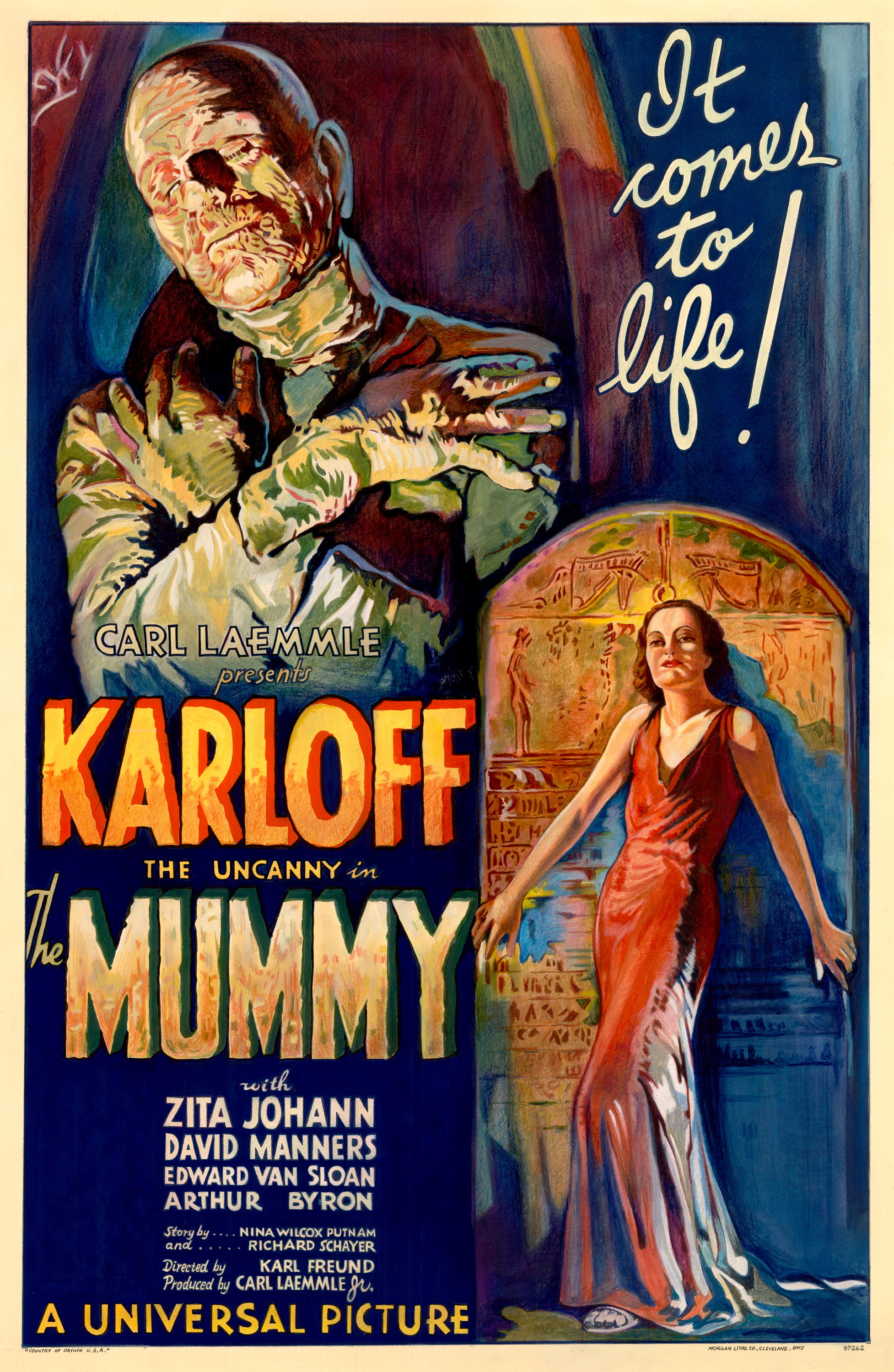
Mummies Cartonnage of a priestess, named Tayesmutengebtiu, found in Thebes, 22nd Dynasty. Photograph: Trustees of the British Museum. Then the horror stories began. The 19th-century writers Theophile Gautier, Edgar Allan Poe and Bram Stoker all wrote eerie tales about mummies, but it was Arthur Conan Doyle, creator of Sherlock Holmes, who hit on the perfect formula of the revived mummy in his story Lot 249. Soon the 1932 Boris Karloff classic The Mummy launched the pharaonic dead on their fantastic film career.
Is all this a depressing insight into our vulgar souls and inability to be interested in the remote past unless it is turned into cheap fiction? No. The gothic imagination feasts on mummies for a good reason. They are genuinely uncanny: the closest that humanity has come to conquering death.
Ancient Egyptians wanted to live for ever. Almost all the Egyptian art and artefacts in museums are part of an effort to achieve this. False doors from tombs – the British Museum has a majestic one painted red that resembles a massive stone Mark Rothko painting – are portals through which the ka, or spirit double, of the deceased person could come to receive food offerings. The models of people brewing beer that were put in tombs were intended to provide actual beer for the living dead.
Everything important in a tomb, from small sculpted servants to the mummy itself, was touched with an adze by a priest in a ritual called "the opening of the mouth". This rite gave magical potency to everything the ka would need in the next life – and its needs included the mummified corpse. The reason for perfectly preserving the corpse was so that its ka could recognise it, and so connect with it to enjoy the food and drink the mummy digested on its behalf.
Spirit and body were mysteriously connected. It's not that Egyptians believed that the mummy could get up and chase people round museums – but they did believe that the dead person's spiritual ka form, which needed the mummy to exist, could leave the tomb and walk around. There are statues of it doing just that.
So what? People believe all kinds of things. But the ancient Egyptians believed in their conquest of death for at least 3,000 years and repeated their spells and rituals over and over again. Their art is incredibly powerful because it is full of the confidence and faith of those rituals. It is truly magical art. Looking at the painted caskets in the mummy store I am moved by the conviction they communicate that death is not the end, but only the beginning of a strange adventure.
The door closes. The eternal night of the tomb returns. The young man's painted face looks calmly into the eyes of his ka.
Ancient Lives: New Discoveries is at the British Museum, London WC1, until 30 November. Tickets: 020-7323 8181.
http://www.theguardian.com/artanddesign/2014/may/19/ancient-lives-new-discoveries-egyptian-mummies-british-museum
 
Follow on Bloglovin

Thursday, March 13, 2014

German archaeologist suggests British Museum's Warren Cup could be forgery

Roman silver drinking vessel which cost the museum £1.8m could be 20th century creation, professor claims during debate


Warren Cup
The British Museum says the Warren Cup dates from the 1st century AD. Photograph: Martin Godwin for the Guardian
A Roman silver drinking vessel that depicts two sets of male lovers is one of the most prized jewels in the British Museum, singled out by director Neil MacGregor for his critically acclaimed History of the World in 100 Objects.
But on Wednesday, 15 years after the British Museum bought the Warren Cup for £1.8m, a highly respected German archaeologist suggested it could be a forgery.
At a public debate staged by King's College London, Prof Luca Giuliani challenged the museum's view that it dates from the 1st century AD.
The professor of classical archaeology at Humboldt University in Berlin dismissed it as a creation of the early 20th century, arguing that such explicit imagery is unprecedented in Roman silverware. He suggested instead that the cup was designed for the pleasure of its former owner – a wealthy American gay man, Edward Perry Warren, who bought it in Rome in 1911, and who also acquired other "counterfeit" pieces, he said.
At the debate, which was sponsored by the King's classics department and institute of classical studies, the British Museum's position was defended by Prof Dyfri Williams, author of The Warren Cup, published by the British Museum Press in 2006.
After Warren's death in 1928, the cup remained in private hands, too explicit to be shown in public for tastes at that time. It features male lovers in various poses. One pair shows the erastes – an older, active lover – who is bearded and wears a wreath, and the eromenos – the younger "beloved" – who is a beardless youth. Another scene features a beardless erastes and an eromenos who is just a boy.
Giuliani's doubts were aired in Germany last year, but Wednesday marked the first time he has addressed a British audience on the subject.
He acknowledges the high skill, but much of his doubt were based the fact the iconography suited Warren's specific taste – and the fact that this is supposedly a unique Roman item: "There is no other Roman silver tableware with a comparable subject matter. Silver vessels have a completely different iconography. Sexual escapades have no place here." Parallels are only found in lesser material – pottery – he argued.
Speaking to the Guardian just before the event, he said such highly explicit imagery is completely unknown from the Roman world: "You never find any such example." But it is comparable to pornographic imagery available in the 1900s, he said.

Williams paid tribute to his adversary, describing him as "a very intelligent, highly respected scholar, very important person in German scholarship". He told the Guardian: "I wouldn't want to attack him on a personal level at all."
But he disagrees with his theories. The fact that Warren bought other fakes is irrelevant, he said. He also dismissed the uniqueness of the iconography as not being proof: "We're really only reacting to each piece when it's found. We may find something spectacular next week."
He added: "The real issue, which he has not addressed, is the object itself … If the cup was made around 1900, as he claims, they would be using virtually pure silver. They have been refining silver since the middle of the 19th century."
Giuliani said at the beginning of the lecture on Wednesday night that his thinking was "an experimental line of thought". He also made reference to the fact that the cup could be deemed genuine if it showed signs of ancient corrosion on the inner side of the cup.
Williams was able to confirm that it did indeed show signs of corrosion and showed an image to prove this, leading Giuliani to say if that was so, then he would need to change his mind.
• This story was updated after the event on Wednesday night to reflect the discussion at the debate and Giuliani's recognition that the cup showed signs of ancient corrosion.

http://www.theguardian.com/science/2014/mar/12/british-museum-warren-cup-forgery
Follow on Bloglovin

Monday, March 10, 2014

Vikings: Life and Legend review – a stirring tale of shock and oar

Three of the Lewis Chessmen, c.1150-1200, discovered on Lewis, Shetland, and thought to originate from Norway. Photograph: British Museum


The Observer,
 
Anyone who has even dipped a toe in the briny sagas of the Viking kings will know that the stag outing the itinerant Norsemen prized above all others always began something like this: "On Saturday the fleet-lord throws off the long tarpaulin, and splendid widows from the town gaze on the planking of the dragon ship. The young ruler steers the brand new warship west out of the Nio, and the oars of the warriors fall into the sea… " Those lines come from the 11th-century court poet Þjóðólfr Arnórsson, and they describe the characteristic actions of the fleet of Harald Hardradra (Harold the Hard Ruler), the last great Viking king, who fought unsuccessfully to extend his Norwegian monarchy to Denmark and then Britain. He died at the Battle of Stamford Bridge in 1066 along with his poet.
  1. Vikings: Life and Legend
  2. British Museum,
  3. London
  4. WC1
  1. Starts 6 March
  2. Until 22 June
  3. Details:
    020-7323 8181
  4. Venue website
For nearly three centuries prior to that, the collective skill of creating "brand new warships" in a society seemingly geared to the singular thrill of that moment of setting forth on the ocean, west or east, powered a culture that came to explore, colonise, terrify (and enslave) large parts of northern Europe and Asia, and which extended its trading reach to Constantinople, Newfoundland and beyond. The word "viking" was originally shorthand for the experience of throwing back that sealskin tarpaulin and setting oars to water, deriving from "vik", which was the name for the mouth of a river or fjord. Later, in particular in the Icelandic sagas, it became something like the catch-all term we now understand: to "fara í viking", "go on a viking" came to mean not only to set out on a voyage but to take part in anything that might follow – trade, commerce, raiding, piracy or worse.
One thing this quite austere British Museum exhibition seeks to establish is that the lines of the saga poets were secondary to the lines of the ships themselves. The legends of the exhibition's title are told very much through its objects rather than its famous verses (though the soundtrack is a looped, guttural telling of some of those legends in a language you seem to half understand from box sets of The Bridge). Empires have been built by many means, but the implication here is clear, the Vikings built their roving power on a single collective facility: they understood curves. This knowledge enabled them to build large, fast sea-going ships with shallow enough drafts to navigate far inland on rivers, and light enough to be dragged up on to beaches (Viking raiders got as far into England as Lichfield in the landlocked Midlands, and they raided and colonised far into Russian lands along the tributaries of the Volga).
viking Silver-inlaid axehead Silver-inlaid axehead in the Mammen style, AD 900s, Bjerringhoj, Mammen, Jutland, Denmark. Photograph: © National Museum of Denmark
For a quarter of a millennium no other culture in their sphere had much of an answer to that curvilinear knowledge. Like the splendid 11th-century widows marvelling at the unsheathed warship, you confront those curves immediately in the new hangar-like exhibition space of the British Museum, which is also launched with this show. The great dragon ship Roskilde 6 is reconstructed in the new hall with a good deal of its original planking laid on a steel skeleton. The ship seems likely to have been part of the fleet of Canute (or Cnut, as he is here, to which the epithet "total" remains silent); it was, like most Viking vessels, essentially a troop carrier, 36 metres long, and is the largest longship ever found. Having probably crisscrossed the North Sea 1,000 years ago before being scuttled to protect the harbour entrance to Roskilde, the ancient capital of Denmark, it was discovered and excavated in 1996, and has made the journey across the greyest of oceans once again. About a quarter of its timbers survive, but even in its hollowed and reimagined state, its aerodynamic heft, the sheer prowess of its ribs and stays, retain a good deal of the original 11th-century shock and awe.
Launch Of Vikings Exhibition At British Museum The Viking longboat Roskilde 6 at the British Museum. Photograph: Dan Kitwood/Getty Images
That ship so dominates this show that you begin, probably justifiably, to see its curves almost everywhere in the exhibits that surround it. The dominant Viking forms are obvious in the representations of the curious longhouses, often windowless and built like upturned boats, and in the shape of the graves that took notable Viking warriors on their last voyages of discovery – accompanied by valkyries in the myth, perhaps to the great hall of Valhalla to drink with the god Odin, and imagine how their stories might echo down the ages to be recast in CGI and given Hollywood endings.
Odin, who takes his place here only as a tiny silver figurine, a tactile charm, was associated with "feminine magic", and appears to be depicted in women's clothes. There is precious little else that might be described as feminine in the Viking aesthetic, beyond some of the delicate skill in carving. The investment in ships afforded chiefs and kings great wealth, traded or looted and defended with double-edged swords, of which there are many lethal looking examples.
There was, it seems, a formidable culture of bling, great rope-like chains of silver and gold; almost comically outsized buckles and brooches that became status symbols from Stockholm to Shetland. In some instances amulets and bracelets doubled as currency; the silver of some examples is scored in regular increments for the purposes of trade; cattle or silk would be purchased by chiselling off a couple of segments.
viking Hunterston Brooch Hunterston Brooch, c.700, Hunterston, Ayrshire, Scotland, made of gold, silver and amber. Photograph: © National Museums Scotland
Almost universally, jewellery and armour, as well as the many whalebone artefacts, are decorated with bold riverine and wave designs, reminders of where the money came from. When Christianity began to supersede Norse mythology – and crucifixes replaced valkyries – it is easy to see how the Vikings might have taken to a god who walked on water.
The trade that underpinned a good deal of that wealth was in slaves, or "thralls". The neck chains and manacles of Irish slaves, literally enthralled and sent off to Iceland, are grimly emblematic of what the sight of longships on the horizon might have represented to native populations. A preserved warrior's skull in which the front teeth have been filed flat for aggressive effect also makes a chilling point (though his helmet was never adorned with horns; those were a Victorian addition to the myth).
Though dues are paid here to the profound depths of Norse mythology, and to the Vikings' civilisation-changing technological expertise and sporadic efforts at diplomacy, you are unlikely to leave this exhibition with the feeling that longships were often welcome visitors on foreign beaches. In part of an excavated mass grave from Weymouth, in which the exclusively male DNA is sourced to 10th-century Scandinavian origins, each skeleton has been brutally beheaded (with in some cases protective hands sliced clean through as well). This is thought to be evidence of the manner in which the crew of a single Viking longship were repelled. For many decades, such a violent reverse was obviously an exception to the rule.
http://www.theguardian.com/artanddesign/2014/mar/09/vikings-life-legend-review-british-museum-tim-adams