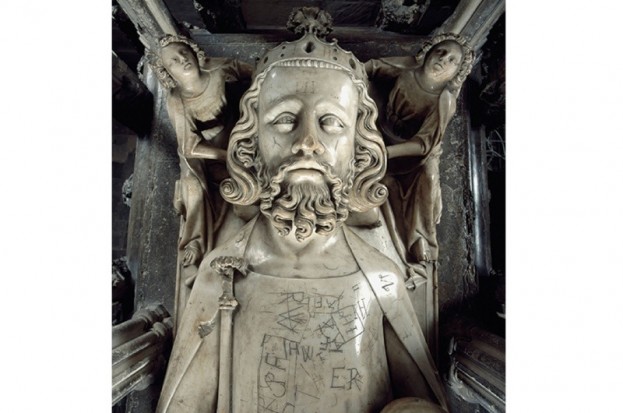
If there’s one thing most historians agree on, it’s that Edward II was one of medieval England’s least capable rulers. He is chiefly remembered for squandering his father, Edward I’s, military gains in Scotland (notably by losing the battle of Bannockburn), and alienating his wife and barons by promoting personal favourites such as Hugh Despenser the Younger.
But how did Edward die? We know that Queen Isabella’s patience with her husband snapped in 1326, and that she invaded England with her lover, Roger Mortimer, who was living in exile in France. Edward was forced to abdicate and was then imprisoned at Berkeley Castle, where he was murdered on 21 September 1327 (with, as legend would have it, the assistance of a red-hot poker).
That, at least, has been the accepted view of events for centuries. Yet, in 2005, Ian Mortimer challenged the consensus by arguing – in the journal The English Historical Review – that Edward had cheated death and was still alive in 1330. Mortimer’s theory has sparked a lively debate in the historical community, as the following exchange proves…
Ian Mortimer:
How can we be sure whether Edward II did or did not die in Berkeley Castle? The answer is not a straightforward: ‘because this document says so’ – after all, any single piece of evidence could be wrong. It is, rather, a matter of showing first that the evidence for the death, which we have hitherto accepted, is fundamentally flawed; and second that there are multiple independent accounts from people who knew him, stating that Edward was alive at a later date.According to the royal accounts, Edward II died in Berkeley Castle on 21 September 1327. Lord Berkeley’s accounts show that the news was taken in his own letters to the royal household, which was then at Lincoln. An extant letter written at Lincoln by Edward III on 24 September states that news of his father’s death had been received during the previous night. It was therefore accepted in the royal household and circulated from 24 September.
Additionally, one chronicle specifies that members attending the parliament at Lincoln (which finished on 23 September) were told the news as they dispersed. As Lincoln is over 150 miles (240km) from Berkeley, no check on the veracity of the news of the death was possible before it was circulated and preparations for a royal funeral began. The body itself was embalmed and completely covered in cerecloth (waxed fabric used for wrapping corpses) before it was shown publicly, and exhibited only superficially.
So the evidence that led everyone to believe Edward II was dead at that time – and which was widely held as fact until 2005 – depends entirely on that initial message from Lord Berkeley. However, Lord Berkeley admitted in parliament three years later (in November 1330) that he had not previously heard about Edward’s death. We can therefore have no confidence in the reliability of his original message. If he did not know about the death of the ex-king in his custody, how could he have faithfully reported it?
Given that the hundreds of documents attesting to the death are based on this one unreliable message, it behoves us to consider the evidence for possible alternative events, including testimonies of his survival. There are multiple items to consider.
First, there is Lord Berkeley’s own testimony, which implies that the king could still have been alive in 1330. Second, an original letter from the highly regarded archbishop of York states that the latter had received “certain news” that Edward was still alive in January 1330, and the archbishop consequently made efforts to rescue him.
Third, Lord Pecche took part in a plot to free Edward from Corfe Castle in Dorset in 1330. This is significant because Lord Pecche had been in charge of that castle from 1325 to 1329, so had the means to ascertain whether or not Edward II was being held there. Fourth, the Earl of Kent, Edward II’s respected half-brother, was sentenced to death in parliament for trying to rescue Edward from Corfe Castle and make him king again in March 1330.
Fifth, there is an extant copy of a letter written by the secretary of Luca Fieschi, a friend of Edward II, who claimed to have met him in the disguise of a pilgrim at the papal court in 1331. This letter gave a detailed version of Edward’s account, telling how he had been taken by his gaoler from Berkeley to Corfe Castle, then sent to Ireland and only released after the fall of Roger Mortimer, the man who dethroned him. There are at least three other information streams that attest to Edward’s survival after 1330.
These points should be seen in the context of a huge number of otherwise inexplicable circumstantial details that historians have traditionally ignored, such as Edward III’s failure to prosecute Sir John Maltravers for failing in his duty to keep Edward II safely when he was in his care. Taken together, they strongly suggest that Edward III’s maintenance of the lie that his father was dead was a political convenience – one welcomed by everyone who trusted the young king and feared the renewal of the unrest brought about by Edward II during his disastrous reign.

The room at Berkeley Castle, Gloucestershire, in which Edward II was imprisoned – and in which he may have died. © Alamy
Nicholas Vincent:
Ian Mortimer makes the case that we should suspend disbelief and allow that evidence points to the survival of Edward II beyond the supposed date of his death, in September 1327. I agree that the evidence here requires careful consideration. I disagree that it is “fundamentally flawed” or that it points inexorably towards the king’s survival.To disprove a negation is never an easy task. Nonetheless, consider the following. All of the main political actors at the time behaved, after September 1327, as if the king were dead. There was a public funeral at Gloucester. When in 1330 Lord Berkeley denied any knowledge of Edward II’s death, he was on trial for his life, desperate to prove that he had been absent from Berkeley. He did not deny that others had carried out the deed.
As late as 1330, the archbishop of York, Sir John Pecche and Edward II’s half-brother, Edmund of Woodstock, may all have hoped (or feared) that Edward might still be alive. Edmund was executed for a deluded attempt to free the late king from captivity at Corfe – but Edmund had many enemies.
In 1322 Edmund had played a leading role in the execution of his cousin, Thomas of Lancaster, and in the following year had seized back Berkeley Castle for the king. After 1326 his alliance with the new regime was never secure, and his trial and execution were very much acts of political vengeance. It is surely significant that even the public executioner, believing that Edmund was too naive to merit death, refused to behead him – he was kept waiting for a whole day until at last a common criminal was found who was prepared to wield the axe. Indeed, Roger Mortimer, when tried later that year on the charge of assuming royal power, was accused of deliberately duping Edmund into the belief that the late king still lived.
As for the Fieschi letter, or Edward III’s later meetings with a ‘hermit’ who claimed to be his father, these fit all too neatly into a wider pattern. Throughout the Middle Ages and beyond, the legend of the hidden or undying king remained a powerful one – in political reality, not just in the legends of Arthur, Charlemagne or Frederick Barbarossa. King Harold, it was rumoured, had not been killed at Hastings but lived on as a hermit outside Chester into the 1180s (by which time he would have been more than 160 years old). The German emperor Henry V, far from dying in 1125, was likewise rumoured to have lived on as a hermit.
As with Edward II after 1327, there were sound political reasons to encourage such rumours, not least to discredit the dynasties that had thereafter ‘usurped’ the succession. Count Baldwin of Flanders, Latin emperor of Constantinople, disappeared into Greek captivity in 1205, assumed dead. The regency government that he left behind had little incentive to confirm his demise; hence, as late as 1225, when a man appeared in Flanders claiming to be the real Baldwin, many were prepared to believe him. He led a revolt against the real Baldwin’s daughter, until the following year when he was unmasked as a Burgundian pretender and executed.
In the Middle Ages, rumour was a powerful weapon. In 1263, Edward II’s grandfather, King Henry III of England, was rumoured to have died. So keen were various people to credit this that the annalist of Tewkesbury Abbey in Gloucestershire inserted it as a certain fact in his chronicle, penning a rhyming obituary notice. In fact, Henry did not die until 1272.
As for the ‘hermit’ claiming to be Edward II, whom Edward III is said to have met many years later in Flanders, consider this: I live for much of the year in Paris, where one of our neighbourhood beggars regularly declares himself king of Poland. Rather than denounce him as a pretender, or insist that he share the fate of Lambert Simnel or Perkin Warbeck (both imposters who challenged Henry VII in his claim to the throne), I greet him with a friendly wave and a murmured “Your Majesty”. Perkin Warbeck, it may be remembered, was executed in 1499 only after strenuous attempts to tolerate his mythomania. Lambert Simnel, having dropped all pretence, was allowed to live out his life as a minor court servant. He died in c1530, four decades after his coronation in 1487 in Dublin (the only English coronation ever held there) as ‘King Edward VI’.
Ian Mortimer:
This argument is not about ‘suspending disbelief’ – it is about hard information. It is not about what happened to Baldwin of Flanders or Perkin Warbeck – or any other postmortem royal claimant.It is about what happened to Edward II in 1327. One cannot use the cases of 13th and 15th-century pretenders as evidence for the events of 1327 – that is reductionism. It is like saying: “These cats look grey, therefore all cats are grey.” Nor should we rely on circumstantial evidence when we have direct evidence for how the story of the death came to be circulated.
The key thing that Professor Vincent should appreciate is why he thinks Edward II died in 1327. He relies on the fact that “all the main political actors in 1327 behaved… as if the king were dead”. But why did those political actors behave in that way? Because they had been told Edward was dead by the royal household at Lincoln on 24 September. Their behaviour is therefore merely circumstantial evidence: they weren’t at Berkeley themselves.
Why did the royal household believe Edward was dead? Because Lord Berkeley had sent them news to that effect. As I have explained, the dates of sending and receipt of information prove that there was no check on this news – and, three years later, the sender himself stated he had not heard about the death. The entire edifice of evidence that Professor Vincent trusts was thus founded on a self-confessed lie.
The important aspect here is the methodology. The traditional methodology is basically the same as that employed by those who maintain that Shakespeare did not write Shakespeare. Proponents select the circumstantial evidence that best tallies with their preferred belief, and they ignore the testimonies of those contemporaries whose information was obtained at first hand. Every historian should resist such methods, even if the results challenge a long-accepted orthodoxy.
It’s a great shame that here we have a senior academic dismissing a scholarly reappraisal of the inconsistent contemporary evidence. He does this even though the said reappraisal has gone through a peer-review process and been published by The English Historical Review.
Nicholas Vincent:
Ian Mortimer demands that I ask myself why I think that Edward II died in 1327. I think that Edward died because people at the time declared this to be so. They also behaved as if it were so. For much the same reasons, I believe that Barack Obama is president of the US and that water flows downhill. I regard the evidence of Edward’s survival to be unreliable, and I believe (foolishly, according to Mortimer; prudently in my reckoning) that this survival story fits in to a wider pattern of such stories that extends across the Middle Ages and into more recent times.In my opinion, it has not been proved that Edward II cheated death in 1327 any more than Elvis Presley can be proved to be alive and well and living in Hemel Hempstead. Many people believe that Elvis still lives.
Ian Mortimer believes that Edward II did not die at Berkeley Castle. In both cases, a passionate belief is founded upon evidence that unbelievers consider implausible. I remain an unbeliever.
Dr Ian Mortimer is the author of numerous history books and a fellow of both the Royal Historical Society and the Society of Antiquaries. Nicholas Vincent is professor of medieval history at the University of East Anglia.


