Showing posts with label WW II. Show all posts

Wednesday, June 29, 2022

Spotlight on Rachel R. Heil, author of Leningrad: The People’s War (Leningrad, Book 1)


Leningrad, 1941. As Europe crumbles under the German war machine, the people of the Soviet Union watch. There are whispers of war but not loud enough for the civilians of Leningrad to notice. Instead, they keep their heads down and try to avoid the ever-watching eyes of their own oppressive government.

University student Tatiana Ivankova tries to look ahead to the future after a family tragedy that characterizes life under the brutal regime. But, when the rumors that have been circulating the country become a terrifying reality, Tatiana realizes that the greatest fear may not be the enemy but what her fellow citizens are prepared to do to each other to survive.

As his men plow through the Russian countryside, Heinrich Nottebohm is told to follow orders and ask no questions, even if such commands go against his own principles. His superiors hold over him a past event that continues to destroy him with every day that passes. But, when given the opportunity to take an act of defiance, Heinrich will jump at the chance, ignoring what the end results could be.

Leningrad: The Peoples War tells the harrowing beginning of a war that forever changed the landscape of a city, told through the eyes of both sides in a tale of courage, love, and sacrifice.


  Buy Links:

 This novel is available on #KindleUnlimited.

 Universal Link

Follow the tour HERE

 ¸.•*´¨) ¸.*¨) ( ¸.•´

FUN FACTS

Rachel R. Heil

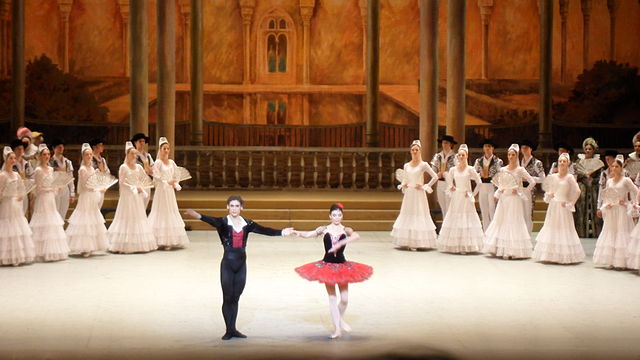
I didn’t always want to be a writer. I actually wanted to be a professional ballet dancer. My bedroom was decorated with a ballet theme, and when I was little I would binge-watch the animated Barbie movies because they always incorporated ballet. I started taking classes at five years old and went until I was thirteen. Ultimately it didn’t work out, but I still have a love for ballet and have attended a few ballets in my home city. A dream of mine would be able to see one of the premier ballet companies perform in their native city.


Paris Ballet
Source: Wikimedia Commons

In 2008 my state’s major museum got to host the Titanic exhibit that traveled the country. The Titanic was the event that sparked my love for history, so when I saw the exhibit was coming to my state it was all I could talk about for six months. My parents took me on the second day it was open (alas, the first day was a Friday and eleven-year-old me had to go to school) and I looked at every item, spewing to my parents and sister a million facts about the ship. Only years later did my mom tell me how I had a group of other visitors following me so they could hear the stories and facts I was sharing! I was just too absorbed in the exhibit to notice.


Titanic Pigeon Forge

My favorite book is The Great Gatsby, and F. Scott Fitzgerald is my favorite author. In my final year of college, I had to do a senior seminar project. I wrote an essay and gave a presentation on how The Great Gatsby was Fitzgerald’s definitive book as opposed to Tender is the Night, the work Fitzgerald was seemingly most proud of. 


Source:  Charles Schribner's Sons, Wikimedia Commons

I’ve done quite a bit of travel. My family has taken many vacations together, and we’ve been to Disney World, Chicago, Niagara Falls, Washington DC, Boston, Seattle, New Orleans, Minneapolis, Fort Meyers, and Michigan. Internationally, I’ve been to Toronto, London, and Paris. Currently, we’re planning a trip to Ireland and a brief stop in London. I have plenty of more places I want to see, and I hope I can get back into it with the end of the pandemic. I don’t like my passport collecting dust.


Buckingham Palace

I am not much of a summer person. The heat and bugs are just not my cup of tea. While I enjoy a lazy day by the pool reading a good book, I’m much more of a fall and winter person, especially if I can stay inside during not-so-great winter. People tend to be pretty surprised by that as I live in Wisconsin, and our winters last a long time! But I love the winter and especially enjoy writing when it’s snowing.


Source: Wikimedia Commons

¸.•*´¨) ¸.•*¨) ( ¸.•´

Rachel R. Heil

Rachel R. Heil is a historical fiction writer who always dreamed of being an author. After years of dreaming, she finally decided to turn this dream into a reality with her first novel, and series, Behind the Darkened Glass. Rachel is an avid history fan, primarily focused on twentieth-century history and particularly World War Two-era events. In addition to her love for history, Rachel loves following the British Royal Family and traveling the world, which only opens the door to learning more about a country's history. Rachel resides in Wisconsin.

 Social Media Links:

 Twitter   Facebook   Linked-in   Instagram   BookBub   Amazon Author Page    Goodreads


Monday, September 21, 2020

Spotlight on novelist Kathleen Harryman


Kathleen Harryman

Fun Facts

Ever since I can remember, I have wanted to write. As a little girl, long before I could write or read, I would sit on my bed with my toys and tell them a story. Sometimes I would lose myself to the fanciful thought that I was a ‘great writer,’ and with pen and paper, I would write my novel. Not being able to write at the time may have put some children off. But if I could make a mark on the paper, I was writing.

I used to be so scared of the dark that my parents bought a radiator that gave out a soft red glow. The house didn’t have central heating, I know, it’s incredible!

I have a twin sister. We are identical, and people still get us mixed up today! Of course, like most kids, we used our likeness to our advantage. Mum was once called into school because we kept swapping our name badges round.


I am the little girl on the right

The perfect part of the day is that time in the morning when there is no one else around but me. I sit hugging my coffee, watching the birds swoop on the bird table. It is peaceful, without stress or thought and indulgent.

I still have the teddy bear my dad gave me when he brought mum, my sister, and me back from hospital. That bear and I have been through a lot. I do feel, however, that I have managed to come out of our relationship looking better (for the moment). His white fur (or what is left of it) is now grey, and his little red paws are wearing away. His head wobbles to one side. But he still smiles at me and sits proudly on his chair.

***

How far would you go to keep a promise?
In the heat of battle, one man's promise to another will be tested.


September 1939

As Britain is gripped by the fear and uncertainty of war, Tom Armitage stands to gain the one thing that he never thought possible - his freedom.

Rosie Elliot sees her future crumbling to dust as Will Aarons leaves Whitby with Jimmy Chappell to fight in the war. As she begins work at The Turnstone Convalescent Home, Rosie finds something she thought she had lost. Friendship. But friendship soon turns to love. Can this new love replace Will?

This is not an ordinary love story.

It's a story of love, loss, courage, and honour.

Of promises that must be kept or risk losing everything you've ever held dear.


Purchase at

***
About the Author

Kathleen Harryman is a storyteller and poet in the historically rich city of York, North Yorkshire, England, with her husband, children and pet dog, and cat.

Kathleen was first published in 2015, a romantic suspense entitled The Other Side of the Looking Glass. Since then, Kathleen has developed a unique writing style that readers have enjoyed, and she became a multi-genre author of suspense, psychological thrillers, poetry, and historical romance.


Connect with Kathleen


Friday, August 28, 2020

Book Spotlight and Excerpt: The Smallest Crack by Roberta Kagan


1933 Berlin, Germany.

The son of a rebbe, Eli Kaetzel, and his beautiful but timid wife, Rebecca, find themselves in danger as Hitler rises to power. Eli knows that their only chance for survival may lie in the hands of Gretchen, a spirited Aryan girl. However, the forbidden and dangerous friendship between Eli and Gretchen has been a secret until now. Because, for Eli, if it is discovered that he has been keeping company with a woman other than his wife, it will bring shame to him and his family. For Gretchen, her friendship with a Jew is forbidden by law and could cost her, her life.


Excerpt


Berlin, Germany
Spring 1932

Eli Kaetzel paced on the stone steps outside the yeshiva and took a deep breath. He loved the freshness in the spring air as it filled his lungs. Everything about spring made him feel as if the world around him was born anew. The tiny blades of new grass, the flower buds, the crystal-blue cloudless sky. He sighed and looked around. He felt a sense of well-being wash over him. And to make things even better, it was Tuesday, his favorite day of the week. On Tuesday afternoons, when the weather permitted, he and his best friend, Yousef Schwartz, went to the park to study. Instead of being cramped up inside the yeshiva until late afternoon, they sat on a park bench where they ate potato knishes that Eli’s mother packed for them and had stimulating discussions about Talmud stories. But that was not the real reason that Eli was so elated and anxious to get to the park today.  The real reason was her, the girl in the park. Since the first time he saw her, three weeks ago, he’d thought of little else. She was playing ball with a group of her friends, and when he saw her for the first time, he thought that she might be the most beautiful girl he’d ever seen. All that week he’d hoped to see her on the following Tuesday, and then he thought his heart would burst with joy when he and Yousef went to the park the following week, and she was there: then, again, the week after. He was mesmerized by her. And even though he knew for certain, by her clothing, that she was not Hasidic, he hoped that at least she was Jewish. Not that his family would have been pleased with him for being attracted to a girl who was not Hasidic. But in his mind, he began creating all kinds of possible scenarios. Perhaps, she is Jewish, assimilated, but Jewish. He thought. And, if by some wonderful miracle I met her and she decided she liked me, she might be willing to join the Hasidic community.
Today, Yousef was late, but that was nothing new. Yousef could easily get caught up in a heated conversation with his teacher about a story in the Talmud and a half-hour might pass before he realized he’d left Eli waiting. Eli smiled and shook his head thinking about how absentminded his good friend could be.

“Eli!” Yousef called out as he was coming out of the building. “Were you waiting long? I’m sorry. I got tied up discussing today’s lesson with the teacher. And you know how intense he can be. Oy! He gets on a subject, and there is just no stopping him. I am so sorry I kept you waiting.”

“Don’t worry. I wasn’t waiting long.  And besides, it’s so beautiful outside today that I didn’t mind at all,” Eli said, but he wasn’t telling the truth.  Inside he was a trembling nervous wreck. He tried to appear calm in order to hide his deepest secret, his attraction to the girl in the park, from Yousef.
Eli had known Yousef since they were young boys, and he knew his friend’s shortcomings. If he had to place a bet, he would have wagered it was probably Yousef who had been the one who kept the conversation going with the teacher, which made him late. Yousef loved having discussions about Torah.

“Come on, let’s go” Eli said.

“Oy, I forgot one of my books. ” Yousef looked down at the pile of books in his hands.

“Leave it, you’ll get it tomorrow. Let’s get going, We want to have time to study don’t we? At this rate, we won’t get there until it’s dark.”

“I’m sorry Eli. But, I want to read you an important story from this book. I was hoping we could take some time to discuss it.  So, I  can’t leave without my book. I’ll be right back. I promise not to get involved in any long conversations with anyone. If anyone tries to stop me to talk I will tell him that Eli Kaetzel the son of the rebbe is waiting and I can’t keep him waiting any longer” Yousef winked.

“Stop joking and go and get the book already,” Eli said
 “Come on, let’s go,” Eli said when he saw Yousef strolling casually out of the building.

“All right, I’m coming.”  Yousef said, straightening his kippah, the little head covering he wore out of respect for God, and although he pinned it, was always sliding around on his fine hair. He put on his customary black hat and twisted his long payot around his finger, forming curls.

The two boys walked together toward the park, each carrying a pile of books, their identical, long black coats flapping in the warm breeze. The park was on the outskirts of their neighborhood. Dressed as they were, anyone could easily see they were very religious and came from the Jewish side of town. As they entered the park, a scrappy, young man with blond hair and a strong jawline, wearing a brown leather jacket, was leaning against a tree. He sneered at Eli and Yousef. Then he said loudly, “Dirty Jews.”

Yousef and Eli shot each other a quick glance but kept walking. They were not permitted to start a fight even if someone insulted them. The Hasidic way was one of nonviolence. Since he was a child, Eli was taught that even if he were attacked, he was not to fight back. Eli’s father would have been furious if Eli came home with evidence that he’d been fighting.

“Eli, perhaps we should leave. It’s been getting more and more dangerous at this park for us. They used to whisper the insults about Jews under their breath. They are not hiding their hatred of our people anymore.  Maybe we should just go home and stop coming here.”

Eli’s heart sank. Leave, now? He couldn’t leave.  He had to see her. He’d waited all week to see her. A wave of guilt came over him. He knew Yousef was right. They should probably go but he couldn’t. 

“Yousef, don’t worry so much. It will be all right. Come,” Eli said smiling. “Sit down; it will be fine. You’ll see. Now, let’s eat.”

Yousef gave Eli a look of concern, but he nodded and followed his friend. The two boys sat on the bench under the tree and took off their coats. Underneath, they wore white shirts and black pants. They lay their piles of books on the bench beside them.  Eli took out the grease-stained paper bag that held the knishes and handed it to Yousef. Yousef took one then gave the bag back to Eli. Eli bit into the knish and closed his eyes. It was delicious—the crispy dough, the soft potato insides. Taking a deep breath, he opened his eyes and glanced across the park and saw a group of girls playing kickball. Eli quickly lost interest in the food as his eyes searched frantically for the girl.  Yousef was speaking to him, but he couldn’t hear what Yousef was saying. Where is she? Is she here? And then he saw her.  She was tall and slender with hair the color of rose gold that was blowing in the wind like the mane of a wild lion.  As she was running after the ball, he felt dizzy with desire as he caught a glimpse of her thigh. It was as white as his mother’s porcelain china, and in that instant, his heart skipped a beat. She laughed, and he heard her laughter twinkle in the spring air. He thought if the stars in the sky could talk that is how they would sound.

Eli’s heart was beating loudly in his throat. He felt had never seen such a free-spirited creature, and her natural beauty left him breathless. Her body was slender and agile, not womanly. She had very small breasts, and her hips were straight rather than curvy. As he watched her playing kickball, he realized that she could run faster and kick harder than any of her teammates.

“What are you looking at?” Yousef asked. “You haven’t heard a word I've said since we sat down.”

“Nothing.”

“Good, and make sure you are not looking over there.” Yousef indicated toward the girls playing ball. “You know better than to be looking at them. That is forbidden.”

Eli nodded as Yousef handed him his book on Talmud. “Come on, open your book, and let’s do some studying,” Yousef insisted.

Eli opened his book halfheartedly, then when he was sure Yousef was busy turning pages, he glanced back up at the girl.

“She’s pretty, don’t you think?” Eli asked. He hadn’t meant to say it. Somehow he just blurted it out.
“It’s getting late. We should be going home,” Yousef said.

Eli nodded in agreement. But he didn’t want to leave. He wanted to stay and watch the girl for as long as possible. But he got up and gathered his books together, thinking about the girl as he did so. He heard her laugh and turned to look. When he did, one of his books fell behind the bench.  Yousef was already halfway across the park heading toward the exit. Eli was in a hurry to catch up with him, so he never noticed the book that had fallen.
Gretchen, the girl in the park with the strawberry-blonde hair, was walking with her friends toward the exit of the park. They weren’t good friends, just girls she knew from school who had asked her to play kickball with them when they were short a team member. She hardly had time for friendships; she was too busy studying and taking care of things around the house. Her mother had passed away, and her father was working, so she had a lot of responsibilities at home. As the girls headed toward the exit they passed the bench where Eli and Yousef had been studying.  Gretchen glanced over and saw the book.  She didn’t want to mention it to the others. So as they left the park she turned to them and said, “I am going to go back and run to the washroom. You girls go on.”

“Are you sure? I can go with you?” One of the others said.

“Of course, I’m sure. I’ll be fine. You head on home.”

“All right, then”

Gretchen went into the bathroom and waited until she was sure the others were long gone. Then she walked toward the bench where she had spotted the book. She’d been watching the two boys for the last three Tuesdays as they sat on the bench. She knew one of them had been staring at her the entire time she was playing kickball, and she was intrigued because this was the third time she’d seen them.  They were Hasidic Jews, she thought, with their long, black coats and tall, black hats. From their clothing, she knew they were a part of the religious Jewish community, which, for Gretchen and her friends, had always been shrouded in mystery.
She picked up the book, knowing that one of the two Jewish boys had left it there. All of her friends had left the park. She was alone and knew she should get home, but she took a moment to sit down and look inside the book. The book was not written in German. In fact, the letters didn’t look like any she’d ever seen before. She scanned through the pages until she got to the back where written in large black letters it said in German, "If found, please return this book to Eli Kaetzel at 1627 Augsburger Strabe. You will receive a reward for your kindness."

A reward? Well, Papa and I could use any extra money we can get our hands on. If we had a little extra, I might be able to buy something nice for Papa. Some cake perhaps. Gretchen tucked the book under her arm and headed for the address written inside.
Gretchen mustered her courage and knocked on the door. It opened. There he stood, the boy from the park. He wore no hat; only a small, round skullcap covered his thick, black, wavy hair. He was beardless, but his sideburns were a single, long curl that looked strange to her. Still, even with the sideburns, there was no denying that he was handsome. More handsome than any man she knew, with his deep- coal-black eyes in which she was sure she saw both wisdom and tenderness.

Purchase Link 


Roberta Kagan

I am an USA Today Best Selling Author of Historical Jewish Fiction mainly set during World War 2. My father was Romany and my mother was Jewish, When I was very young I learned about the Holocaust. I couldn't understand how something like this could happen. So, I began to research and learn more. I met with survivors. I even met with children and grandchildren of SS officers. But I still had no answers. I cannot say that I have all of the answers to all of my questions even now. But what I do know is that soon all of the survivors will be gone. Their message must be remembered, the sacrifices that they made must not be forgotten. And so I humbly and with the utmost humility, I try to tell their stories. It is painful, but I must convey the darkness and horror of the time. However, I also want the world to know and celebrate the unsung heroes. Because there were many ordinary people who acted in heroic ways. I realize that writing these books is a great responsibility. I pray every day that I am able to do this correctly. I am trying to reach out and touch many people, not with the message of the horrors but with the promise of hope. I thank you from the bottom of my heart for considering my work. It is an honor that I never take lightly.

Connect with Roberta


Friday, November 9, 2018

Kicker (The Forgotten Front) by R. Grey Hoover, sheds light on our forgotten veterans of the China-Burma-India theater.

 As a tribute to the veterans of the China-Burma-Inda theater, author R. Grey Hoover is offering his novel, Kicker (The Forgotten Front), for free on Amazon on November 9, 10 and 11, 2018.


World War II is raging. A young father must choose between his family and duty to his country- a decision that could cost him everything.
Based on actual experiences of United States veterans and official military aviation history records from World War II, this is the thrilling story of a family’s journey into war. While his loved ones struggle with shortages and rationing at home, Sam endures relentless Japanese attacks against his unarmed aircraft over the treacherous mountains and torrid jungles of Asia. His job is to drop supplies to Merrill’s Marauders and over 750,000 allied soldiers fighting in the perilous jungles of Burma. If the enemy is not stopped, the American way of life will end.
If you like non-stop action with a touch of humor and romance and the chance to learn about the “forgotten front” of WWII, then this is the book for you. 
Excerpt
 Sam and Bobby Joe were totally exhausted when they crawled into their charpoys. The harrowing events of the day had taken its toll on them physically and mentally. In spite of the heat and noise of the jungle, Sam felt the blessed relief of sleep approaching soon after his head hit the pillow. However, as he drifted off, a feeling of unease came over him. It was a feeling that something was wrong, not here in India, but at home. He didn’t know if he felt uneasy because he still hadn’t received mail from home or because of some unknown reason, but the feeling stayed with him until he finally succumbed to his exhaustion and slipped into a deep sleep. 
Thankfully, his slumber was not disturbed by his recurring nightmare, and he slept soundly until the wee hours of the morning when he suddenly awoke not knowing what had disturbed him. A light rain was falling outside, and except for an occasional flash of distant lightning, the basha was in total darkness. He lay very still, listening to the sounds around him. He strained his hearing, but no sound came except for the steady breathing of the sleeping men around him. After several minutes, he relaxed, thinking his imagination was playing tricks on him. He was almost asleep again when he thought he detected a faint unfamiliar sound coming from somewhere in the basha. Once again, he listened intently, not sure he had heard anything; but then he heard the sound again—only this time it seemed closer, and he was sure it came from within the basha. He couldn’t quite place the sound, but it seemed like something soft brushing against an object. He listened closely, but all was silent. None of the other men in the basha stirred, and after an extended period of silence, he relaxed once again in anticipation of sleep. 
He was in that dreamy state just before slumber when he felt the presence of something or someone nearby. Once again, his senses came to full alert, and he made a conscious effort not to move. He listened carefully, bringing all his senses to bear. He could see or hear nothing, and yet he was sure something was there. He was startled when someone at the other end of the room moved, but then all was silent once again. He was lying on his back, so he slowly moved his head to the right and scanned the darkness. 
At first, he saw nothing, but then attention was drawn to a slight movement at the foot of his bed. He couldn’t make out what it was. It appeared to be an undistinguishable shadow against the darker background of the room. As he watched, the shadow moved, and he held his breath as it silently glided along the side of his bed. There was no sound as it moved, and it slowly drew nearer and stopped near the head of his bed. He could tell that it was something large, but due to the extreme darkness, he was unable to see what it was. His instincts told him this was something dangerous and evil, and the hairs on the nape of his neck stood erect. At that moment, a distant flash of lightning faintly illuminated the scene, and in that instant of light, Sam could see the large form of a tiger standing beside him.
 The animal’s head was enormous. Its eyes, momentarily reflecting light from the faraway lightning, gave the beast an evil, devil-like appearance. This was death incarnate staring directly at him.
Sam was frozen with fear, and his heart seemed to stop. His .45-caliber pistol hung on the wall not three feet away, and he cursed himself for not keeping it inside the mosquito netting with him. He knew the tiger could see that he was awake, and he feared any movement would cause it to attack. The animal stepped closer, and Sam could see its dim outline and smell its damp fur and the fetid odor of its breath. The tiger appeared to know its victim was helpless. The great beast took its time as it sniffed the mosquito netting as if testing its strength. Slowly it raised a huge paw and placed it against the puny impediment. The tiger’s claws caught in the netting, and with a mighty swipe, it ripped the flimsy material away from the bed.

About the Author


R. Grey Hoover is an Air Force veteran with a family tradition of military service that dates back to the American revolution. He wrote his book “Kicker the Forgotten Front” to honor his father and the other veterans of World War II who fought in the China-Burma-India (CBI) theatre.  During the war, the European and Pacific theatres got most of the supplies and media attention leaving the CBI theatre with the leftovers. Even in today’s media coverage of World War II, the CBI theatre is never mentioned. The author’s book is an attempt to correct this gross oversight.

Follow the author on social media:

Wednesday, June 6, 2018

Mein Kampf: what happened to Hitler’s money after his death?


History Extra


It is true that Mein Kampf made Hitler a very rich man. Originally written as a political tract, but also as a way of defraying the costs of Hitler’s treason trial in 1924, the book was translated into 16 languages and had sold around eight million copies by the time of its author’s death in 1945. In the interim, it was estimated to have earned around $1 million per year in royalties, which funded Hitler’s purchase and expansion of his Alpine retreat, the Berghof near Berchtesgaden.

 Yet, for all his apparent wealth, Hitler was a rather ascetic character, who had little ‘feel’ for money, and – once chancellor and führer – had little need of it. Indeed, he even chose to forgo his Reich chancellor’s salary and, as his valet recalled, never carried any money on his person.

Thus, the royalties from Mein Kampf were administered by Hitler’s business manager, Max Amann, a director of his publisher, the Franz Eher Verlag in Munich – one of the richest and most influential publishing houses in Nazi Germany.

Prior to his death in April 1945, Hitler wrote a will in which he left most of his possessions and estate to the Nazi Party. However, with the abolition of the latter after the war, along with the Franz Eher Verlag, Hitler’s remaining assets and estate were transferred to Bavaria, the state of which he was a registered resident.

Bavaria has prevented publication of the book in German-speaking territories, and has sought, with limited success, to restrict it elsewhere. Under German law, however, that copyright expired on the 70th anniversary of the author’s death – 30 April 2015.

Heavy demand for the first edition of Hitler’s Mein Kampf to be printed in Germany since his death took its publisher by surprise in January 2016, with orders received for almost four times the print run, the Guardian reported. The BBC has reported in January 2017 that the Institute of Contemporary History (IfZ) in Munich will launch a sixth print run.

Answered by Roger Moorhouse, author of The Devils’ Alliance (Basic Books, 2014) and Berlin at War (Bodley Head, 2010)

Thursday, September 22, 2016

Days of Destiny: 5 key moments of the Battle of Britain


History Extra


 Heinkel He-111 bomber pictured above London's India Docks on 7 September 1940. (Credit: AKG Images/Imperial War Museum)
 
Following the collapse of France, the Luftwaffe had spent most of the latter half of June and early July 1940 preparing for the coming battle with the British. As Churchill electrified the nation with his soaring oratory, strengthened the resolve of the embattled British people and gave them hope, a small band of fighter pilots – just over 700 in total – would indeed act as that thin blue line of defence.
 
Tentative plans had been made for an invasion of England, codenamed Operation Seelöwe (Sea Lion), but Reichsmarschall Hermann Göring, commander of the Luftwaffe, believed that his air force alone could bring Britain to her knees. Göring, however, failed to recognise that the campaigns in the Low Countries and France had taken their brutal toll, and the Luftwaffe could now only muster 1,380 bombers and 428 dive-bombers, nowhere near the 5,000 he liked to boast of in his propaganda.
 
Supplemented by 1,100 fighters, the Luftwaffe still enjoyed a numerical superiority of almost five to one over the British defenders. But Göring’s bomber pilots should have taken little comfort in this. They were simply ‘potential kills’ for Spitfire and Hurricanes, incapable of attacking the British fighters effectively themselves. If the British pilots were deployed correctly, then the dice would not be as heavily stacked against Fighter Command as is commonly believed. It all came down to how the imminent battle would be fought.
 

10 July 1940 - Official start of the battle of Britain

The battle began with the Kanalkampf, or Channel Battles phase, when the Germans launched sustained attacks against British shipping to prevent much-needed supplies from reaching the beleaguered British Isles. Such attacks had been taking place since late June but early July saw a marked increase in the frequency and ferocity.
The tenth of the month was the date later chosen by the RAF as the official start date for the battle proper and this day certainly saw the largest dogfight fought over the Channel up to that point. By sundown the RAF had lost seven planes against the Luftwaffe’s 13. This was an astonishing rate of success for the outnumbered British fighter pilots. German losses should have sent alarm bells ringing within the Luftwaffe high command but instead they chose to believe their own inaccurate intelligence reports that claimed 35 British ‘kills’. It was a portent of things to come.

Britsh shipping comes under attack from German bombers off the south coast of England on 20 July. (Credit: Popperfoto/ Getty Images)

13 August 1940 - Eagle Day

With the outcome of the Kanalkampf phase of the battle inconclusive, Göring made plans for an all-out assault against Fighter Command on the British mainland. Codenamed Adlerangriff (Eagle Attack), it was due to commence on 13 August. Yet the weather was to throw German plans into disarray. Grey skies and mist forced the Luftwaffe high command to order a postponement, and when several bombers – unaware of the change in plans – arrived over England unprotected by their fighter escort, they were badly mauled. The Luftwaffe regrouped in the afternoon and, flying in better weather conditions, launched a determined assault.
Throughout August the airfields would come under virtually unremitting attack, causing devastating losses to fighters caught on the ground as well as support crew. But the Luftwaffe continued to rely on faulty intelligence, frequently attacking bases that were not operational fighter stations. A total of 87 RAF aircraft were destroyed on the ground on 13 August but only one of these was from Fighter Command. Three British pilots were killed, while the Luftwaffe lost almost 90.
Fighter Command could take heart from its performance. The tactic of deploying in small numbers to prevent all available fighters being caught refuelling on the ground was paying dividends. However this policy required nerves of steel from the heavily outnumbered British pilots.

18 August 1940 - The Hardest Day

Believing their attacks were decimating the much smaller force of Fighter Command, the Luftwaffe planned a series of ambitious assaults on key British airfields including Kenley, Biggin Hill, Hornchurch and North Weald. With the British pilots putting up a desperate defence, the attacks were soon reaping a grim harvest. In fact, 18 August saw both sides suffering their greatest number of losses so far: 69 German aircraft versus Fighter Command’s 29. It had been a terrible day but just one in an ongoing battle of attrition.
It is little wonder then that many pilots on the frontline of Britain’s defence were beginning to show the strain, as Spitfire pilot Alan Deere recalled: “You were either at readiness or you were in the air. It was pretty tiring. I was bloody tired, I can tell you; very tired. My squadron, 54, I think we were down to five of the original pilots so were operating on a bit of a shoestring.”

German pilots are given their objectives before taking to the skies, 18 August 1940. (Credit: Corbis)

7 September 1940 - Target: London

Dismayed by the failure to destroy Fighter Command and incensed by a British bombing raid on Berlin, Göring turned his attention to London. Now the citizens of the British capital would feel the full wrath of the Luftwaffe, and in the process either the RAF would be destroyed or the British government would be forced to the negotiating table.
British radar screens lit up as wave after wave of German bombers streamed towards London. It was an astonishing and terrifying sight, 350 Luftwaffe bombers accompanied by 617 German fighter aircraft.
Within an hour, every squadron in a 70-mile radius of the capital was either airborne or waiting to be scrambled. Fighter Command realised too late that the raid’s intended target was not its own airfields – and soon, bomb after bomb began to rain down on the docks, factories and houses below. The British were caught unprepared and lost 28 aircraft and 448 lives in the attacks. But once again there was no definitive result. Another test was required.
London burns behind Tower Bridge on 7 September 1940, the day of the first mass air raid on the capital. Some 448 Britons were killed in the raid. (Credit: Getty Images)

15 September 1940 - Battle of Britain Day

A spell of bad weather had meant a delay in hostilities on Eagle Day. But 15 September dawned clear and bright. As the first German bombers began to appear one after the other, the British scrambled their fighter squadrons.
Air Vice-Marshal Keith Park, commander of No 11 Group, responsible for the defence of London, famously ordered all his aircraft into the air to defend the capital, abandoning his own policy of deliberate, smaller attacks by individual squadrons.
Drawing on reserves from No 12 Group to the north, the British fighters swarmed around the massed German formations, peeling the fighter escorts off into individual dogfights. It was a tactic that left the bombers unprotected – and they were soon falling in devastating numbers.
An armed guard stands over a portion of a Dornier bomber which has crashed on a London roof, 15 September 1940. (Credit: Hulton/Getty Images)
Park’s decision was absolutely critical. If the Germans had launched a second mass raid immediately after the first, British fighters would have been caught on the ground refuelling. But Park had banked on the Luftwaffe having no reserves, as was the case with Fighter Command. He took a huge gamble, but battles are not won by the timid. For months the Luftwaffe had believed that Fighter Command was on its last legs and all that was required was a final knock-out blow. As the Germans tallied up their devastating losses, it was clear that they had failed.

Kate Moore is the author of The Battle of Britain (2010), which was published by Osprey in association with the Imperial War Museum.

Monday, May 2, 2016

Polish Museum Claims to Have Located the Elusive Amber Room that Was Stolen by Nazis

Ancient Origins


After 60 years of hunting for the missing Amber Room, a magnificent treasure stolen by the Nazis, a museum in Poland suggests that they know where is it located. This is the second time within a year that rumors have run rampant about the treasure being located in Poland.

The Mamerki museum near Węgorzewo, in north east Poland, is one of the most interesting forts related to World War II. The area is still full of secrets (and perhaps a hidden treasure.) According to TVN24, this place has also been connected with the legendary Amber Room, which was created for the Russian tsar Peter the Great in the 1700s.
The original Amber Room, 1931.
The original Amber Room, 1931. (Public Domain)
The museum in Mamerki (in German: Mauerwald) recently reported that they have discovered an unknown room measuring 3 meters (9.84 ft.) long and 2 meters (6.56 ft.) wide. Using geo-radar, they say that they’ve found a secret hidden place located inside an old wartime bunker.
The geo-radar reading the museum says shows the existence of the hidden bunker.
The geo-radar reading the museum says shows the existence of the hidden bunker. (Mamerki Museum)
The Amber Room was stolen by the Nazis and was allegedly on its way to becoming one of Adolf Hitler’s greatest treasures when it was lost. The Amber Room originally contained 450kg (992.08lb) of amber decorated with gold, pieces of art, jewels, and mirrors. It was located in St Petersburg from the times of Peter the Great, until the day when the Nazis dismantled it and decided to transport it to Königsberg Castle (Kaliningrad) (which was controlled by them at the time). It was during this transport that it was said to have accidentally disappeared. Strangely enough, the documentation connected with the transport was lost too.
The suggestion that the Amber Room may be hidden in Mamerki is just one of the hypotheses related to the Amber Room’s location, but the researchers are convinced that it is much more. As Bartlomiej Plebanczyk from the museum told MailOnline:
''We think there is a very good chance that the Amber Room is here for a number of reasons. Of course there were no such devices as ground-penetrating radar in the 1950s, so examining and finding hidden spaces wasn't possible. Inside may be elements of the Amber Chamber, but also other looted art. But there is no doubt that the room was created specifically for the purpose of treasure.''
Evidence for the hypothesis comes from a former Nazi guard who told Polish soldiers in the 1950s, that during the winter of 1944 he saw trucks driving up to the bunker. The trucks were said to have been heavily-guarded and they left their large cargo in Mamerki. At the time, the Polish bomb squads looked for proof, but they didn't find anything. The mysterious room  where the treasure is thought to be, will be opened during the next few weeks.
The bunker in Poland where the Amber Room may be located.
The bunker in Poland where the Amber Room may be located. (TVN24)
In 1982, the Russians started to build a replica of the Amber Room. After 20 years, visitors to Catherine Palace, near St Petersburg, can enjoy the beauty of this incredible place once again. Nonetheless, the obsession of treasure hunters in discovering the real Amber Room is still prevalent. During the last 60 years, many of them have lost their lives or suffered from health problems by searching for it.
In August 2015, Ancient Orgins reported that treasure hunters claimed to have identified a legendary Nazi train packed with gold and other treasure, hidden in a long-forgotten tunnel in the Polish mountains. It was said that the train may also contain the long-lost Amber Room. However, it seems to be unlikely that the train will be explored in the near future. Some of the experts suggested that this location may not even contain a train at all.
Apart from this, there are many other possible hypotheses about the current location of the Amber Room. Some researchers believe that the Amber Room has never left Kaliningrad, and it is buried in the ruins of the city.
Königsberg Castle, 1925.
Königsberg Castle, 1925. (Public Domain)
Another idea says that it was transported on one of two ships - the Steuben or Wilhelm Gustloff. Both of them sank in the Baltic Sea during World War II. Yet another hypothesis claims that the Amber Room is located in a hidden place somewhere in Russia.
In the 1990s, newspapers in Poland and Russia quoted eyewitnesses who swore that they saw the real Amber Room in a house of one of the noble Russians. This rumor has never been confirmed.  Finally, some people also believe that they can find the Amber Room in Germany. For example, an amateur group of treasure hunters hopes to find it in the city of Wuppertal.
Corner section of the reconstructed Amber Room.
Corner section of the reconstructed Amber Room. (Public Domain)
Featured Image: Tsarskoye Selo, Catherine Palace. The Amber Room as it would have appeared in 1917. Source: Public Domain
By Natalia Klimczak

Friday, February 6, 2015

Drought may soon yield mysterious WWII-era bomber beneath Lake Mead

Water levels are at their lowest at Nevada's Lake Mead leading the National Park Sevice to allow permits for recreational diving at the site of a downed B-29 bomber. (National Park Service)

By
Fox News
The drought that has parched much of the southwest may soon yield a mystery that has rested at the bottom of Nevada's Lake Mead for nearly 70 years, a B-29 bomber that went down carrying a top-secret missile defense system that may have actually caused the crash.
The B-29 bomber, also known as the "Superfortress" and the same model as the storied Enola Gay and Bockscar, the planes that dropped atomic bombs on Japan, crashed in 1948 as it flew over the giant lake testing a sun-powered missile guidance system. For decades, it lay at a depth of 300 feet in the man-made lake that was formed by construction of the Hoover Dam. But the drought has lowered water levels to the point where the plane is just 110 feet down, well within the range of recreational divers.

"There's a lot of history there. The site would be right up there with any shipwreck for a diver."
- Curtis Snaper, Sin City Scuba
"It would be amazing," Curtis Snaper, of Sin City Scuba in nearby Las Vegas, told FoxNews.com. "There's a lot of history there. The site would be right up there with any shipwreck for a diver."
The B-29 at the bottom of Lake Mead was one of the last of its kind to be built. The U.S. Army Air Forces, which would later become the U.S. Air Force, received it days after Japan surrendered, on Sept. 2, 1945. Two years later, the plane was stripped of its defensive armament and was turned over to the military’s Upper Atmosphere Research Project. When it went down on June 21, 1948, the plane and its five-man crew were testing a secret ballistic-missile guidance system known as a "sun-tracker," according to the blog War is Boring. According to the blog, the highly-classified device, mounted in a dorsal dome atop the bomber’s fuselage, allowed a missile to get its elevation and orientation from sighting the sun.
Testing it required the B-29’s crew to repeatedly ascend to 35,000 feet, then drop to just 100 feet above the lake. But, according to the blog, the lake's surface reflected the sun, and may have caused Capt. Robert Madison to lose depth perception. The plane skimmed into the lake at 230 miles per hour, and while the crew escaped on life rafts, the plane dropped to the murky depths.
Better-equipped divers, using a special helium-rich gas mixture, for example, have been secretly exploring the crash site since 2001, when it was first discovered in the giant lake's Overton Arm section. But scuba divers have been officially banned by the National Park Service from exploring the site because of the dangers associated with such depths. With Lake Mead at record low levels, the federal agency intends to grant permits for diving the bomber, beginning in April.


But it was not simply the danger to divers that prompted the Park Service to protect it from mistreatment and to prevent recreational divers from going down to the wreckage site. The agency is also concerned that weekend warriors could damage the wreck. In 2002, it sent a remote-controlled submarine down to explore the wreckage, and discovered ropes and lights from previous dives. A year later, technical divers sent down by the Parks Service found signs of damage and looting.
In 2007, the agency allowed two licensed dive operators to lead guided scuba tours of the site, but demand was limited.
“It was costly to dive,” said Steve Schafer of Lake Mead Technical Dives, which led a handful of tours, charging divers $450 each. “We weren’t even allowed to keep a boat on the water to make things go quickly.”

Plunging water levels have made the site much more accessible, and likely much cheaper, for recreational scuba divers, although they would still have to be accompanied by approved guides. The Parks Service plans to offer a two-year, commercial-use permit allowing guides to take up to 100 divers per year down to the wreck.
“We have had people express an interest over the years," Christie Vanover, a spokesperson for Lake Mead National Recreation Area said to the Las Vegas Review-Journal. We think this is the best option, and it provides a business opportunity.”

Sunday, December 7, 2014

Remembering Pearl Harbor - 73rd anniversary of the Japanese attack on December 7, 1941

Pearl Harbor Raid, 7 December 1941
Overview and Special Image Selection


Navy History
The 7 December 1941 Japanese raid on Pearl Harbor was one of the great defining moments in history. A single carefully-planned and well-executed stroke removed the United States Navy's battleship force as a possible threat to the Japanese Empire's southward expansion. America, unprepared and now considerably weakened, was abruptly brought into the Second World War as a full combatant.
Eighteen months earlier, President Franklin D. Roosevelt had transferred the United States Fleet to Pearl Harbor as a presumed deterrent to Japanese agression. The Japanese military, deeply engaged in the seemingly endless war it had started against China in mid-1937, badly needed oil and other raw materials. Commercial access to these was gradually curtailed as the conquests continued. In July 1941 the Western powers effectively halted trade with Japan. From then on, as the desperate Japanese schemed to seize the oil and mineral-rich East Indies and Southeast Asia, a Pacific war was virtually inevitable.
By late November 1941, with peace negotiations clearly approaching an end, informed U.S. officials (and they were well-informed, they believed, through an ability to read Japan's diplomatic codes) fully expected a Japanese attack into the Indies, Malaya and probably the Philippines. Completely unanticipated was the prospect that Japan would attack east, as well.
The U.S. Fleet's Pearl Harbor base was reachable by an aircraft carrier force, and the Japanese Navy secretly sent one across the Pacific with greater aerial striking power than had ever been seen on the World's oceans. Its planes hit just before 8AM on 7 December. Within a short time five of eight battleships at Pearl Harbor were sunk or sinking, with the rest damaged. Several other ships and most Hawaii-based combat planes were also knocked out and over 2400 Americans were dead. Soon after, Japanese planes eliminated much of the American air force in the Philippines, and a Japanese Army was ashore in Malaya.
These great Japanese successes, achieved without prior diplomatic formalities, shocked and enraged the previously divided American people into a level of purposeful unity hardly seen before or since. For the next five months, until the Battle of the Coral Sea in early May, Japan's far-reaching offensives proceeded untroubled by fruitful opposition. American and Allied morale suffered accordingly. Under normal political circumstances, an accomodation might have been considered.
However, the memory of the "sneak attack" on Pearl Harbor fueled a determination to fight on. Once the Battle of Midway in early June 1942 had eliminated much of Japan's striking power, that same memory stoked a relentless war to reverse her conquests and remove her, and her German and Italian allies, as future threats to World peace.
This page features a historical overview and special image selection on the Pearl Harbor raid, chosen from the more comprehensive coverage featured in the following pages, and those linked from them:

For additional information and related resources on the Pearl Harbor attack, see
The Pearl Harbor Attack, 7 December 1941 and WWII Pacific Battles


Click photograph for larger image.
Photo #: NH 50603

Pearl Harbor Attack, 7 December 1941


A Japanese Navy Type 97 Carrier Attack Plane ("Kate") takes off from a carrier as the second wave attack is launched. Ship's crewmen are cheering "Banzai"
This ship is either Zuikaku or Shokaku.
Note light tripod mast at the rear of the carrier's island, with Japanese naval ensign.

NHHC Photograph

Online Image: 57KB; 740 x 540
 
Photo #: NH 50931

Pearl Harbor Attack, 7 December 1941


Torpedo planes attack "Battleship Row" at about 0800 on 7 December, seen from a Japanese aircraft. Ships are, from lower left to right: Nevada (BB-36) with flag raised at stern; Arizona (BB-39) with Vestal (AR-4) outboard; Tennessee (BB-43) with West Virginia (BB-48) outboard; Maryland (BB-46) with Oklahoma (BB-37) outboard; Neosho (AO-23) and California (BB-44).
West Virginia, Oklahoma and California have been torpedoed, as marked by ripples and spreading oil, and the first two are listing to port. Torpedo drop splashes and running tracks are visible at left and center.
White smoke in the distance is from Hickam Field. Grey smoke in the center middle distance is from the torpedoed USS Helena (CL-50), at the Navy Yard's 1010 dock.
Japanese writing in lower right states that the image was reproduced by authorization of the Navy Ministry.

NHHC Photograph

Online Image: 144KB; 740 x 545
 
Photo #: 80-G-266626

USS Utah (AG-16)


Capsizing off Ford Island, during the attack on Pearl Harbor, 7 December 1941, after being torpedoed by Japanese aircraft .
Photographed from USS Tangier (AV-8), which was moored astern of Utah.
Note colors half-raised over fantail, boats nearby, and sheds covering Utah's after guns.

Official U.S. Navy Photograph, National Archives collection

Online Image: 83KB; 740 x 605

Reproductions may also be available at National Archives.
 
Photo #: 80-G-K-13513 (Color)

Pearl Harbor Attack, 7 December 1941

The forward magazines of USS Arizona (BB-39) explode after she was hit by a Japanese bomb, 7 December 1941.
Frame clipped from a color motion picture taken from on board USS Solace (AH-5).

Official U.S. Navy Photograph, National Archives collection

Online Image: 55KB; 740 x 610

Reproductions may also be available at National Archives.

Note: The motion picture from which this image is taken is shown backwards, with the fireball oriented to the left. The image is correctly oriented as shown here.
 
Photo #: 80-G-19942

Pearl Harbor Attack, 7 December 1941


USS Arizona (BB-39) sunk and burning furiously, 7 December 1941. Her forward magazines had exploded when she was hit by a Japanese bomb.
At left, men on the stern of USS Tennessee (BB-43) are playing fire hoses on the water to force burning oil away from their ship

Official U.S. Navy Photograph, National Archives collection

Online Image: 115KB; 740 x 610

Reproductions may also be available at National Archives.
 
Photo #: 80-G-19930

Pearl Harbor Attack, 7 December 1941

Sailors in a motor launch rescue a survivor from the water alongside the sunken USS West Virginia (BB-48) during or shortly after the Japanese air raid on Pearl Harbor.
USS Tennessee (BB-43) is inboard of the sunken battleship.
Note extensive distortion of West Virginia's lower midships superstructure, caused by torpedoes that exploded below that location.
Also note 5"/25 gun, still partially covered with canvas, boat crane swung outboard and empty boat cradles near the smokestacks, and base of radar antenna atop West Virginia's foremast.

Official U.S. Navy Photograph, National Archives collection

Online Image: 119KB; 740 x 620

Reproductions may also be available at National Archives.
 
Photo #: 80-G-19949

Pearl Harbor Attack, 7 December 1941


USS Maryland (BB-46) alongside the capsized USS Oklahoma (BB-37).
USS West Virginia (BB-48) is burning in the background.

Official U.S. Navy Photograph, National Archives collection.

Online Image: 88KB; 740 x 605

Reproductions may also be available at National Archives.
 
Photo #: NH 86118

Pearl Harbor Attack, 7 December 1941


The forward magazine of USS Shaw (DD-373) explodes during the second Japanese attack wave. To the left of the explosion, Shaw's stern is visible, at the end of floating drydock YFD-2.
At right is the bow of USS Nevada (BB-36), with a tug alongside fighting fires.
Photographed from Ford Island, with a dredging line in the foreground.

NHHC Photograph

Online Image: 99KB; 740 x 605
 
Photo #: 80-G-19943

Pearl Harbor Attack, 7 December 1941


The wrecked destroyers USS Downes (DD-375) and USS Cassin (DD-372) in Drydock One at the Pearl Harbor Navy Yard, soon after the end of the Japanese air attack. Cassin has capsized against Downes.
USS Pennsylvania (BB-38) is astern, occupying the rest of the drydock. The torpedo-damaged cruiser USS Helena (CL-50) is in the right distance, beyond the crane. Visible in the center distance is the capsized USS Oklahoma (BB-37), with USS Maryland (BB-46) alongside. Smoke is from the sunken and burning USS Arizona (BB-39), out of view behind Pennsylvania. USS California (BB-44) is partially visible at the extreme left.
This image has been attributed to Navy Photographer's Mate Harold Fawcett.

Official U.S. Navy Photograph, National Archives collection

Online Image: 158KB; 610 x 765

Reproductions may also be available at National Archives.
 
Photo #: 80-G-32836

Pearl Harbor Attack, 7 December 1941


PBY patrol bomber burning at Naval Air Station Kaneohe, Oahu, during the Japanese attack.

Official U.S. Navy Photograph, National Archives collection

Online Image: 91KB; 740 x 605

Reproductions may also be available at National Archives.
 
Photo #: NH 72273-KN (Color)

"Remember Dec. 7th!"

Poster designed by Allen Sandburg, issued by the Office of War Information, Washington, D.C., in 1942, in remembrance of the Japanese Attack on Pearl Harbor on 7 December 1941.
The poster also features a quotation from Abraham Lincoln's Gettysburg Address: "... we here highly resolve that these dead shall not have died in vain ...".

Courtesy of the U.S. Navy Art Center. Donation of Dr. Robert L. Scheina, 1970.

NHHC Photograph

Online Image: 83KB; 525 x 765
 
Follow on Bloglovin