Showing posts with label entertainment. Show all posts

Friday, July 5, 2019

Spotlight on Voiceover Artist Michele Lukovich


Michele Lukovich

It is my pleasure to spotlight the very talented Michele Lukovich, the narrator for The Briton and the Dane: Timeline.  Her artistic interpretation created realistic characters, bringing the story to life with her vibrant, diverse and engaging narration.  

About Michele

Your Vision. My Voice.

Michele has been an entertainer and a storyteller since she was a toddler. With a history of singing and acting, she found her niche in voiceover.  Her musical background has given her a rich, melodic tone and an engaging delivery that keeps the listener entertained and enlightened. She can make the boring and mundane fascinating and memorable. Whether voicing your TV or radio spot, narrating your promo or film, hosting your E-Learning or company training videos, or anything in between, Michele makes each client her priority and makes certain they are not only satisfied but delighted.  And her stage experience gives her the ability to take your direction and run with it.

Need a seasoned pro? Michele has been doing voiceover for more years than she cares to count. In fact, she has been one of the voices of Chicago’s public television station, WTTW for over a decade. And though she can sound like a teenager, she has the experience to convincingly play the compassionate mom, the girl next door, the high-level executive, the physician, the patient, the sophisticate, the quirky best friend or the superhero. Or just narrate with authority or tenderness. She can play it straight or she can be the comic relief. Just tell her whom you want her to be. And she will find an honest way to be just that. Michele believes the best thing about having experience is that you can draw on it to convey almost any sentiment. The more you have gone through in life, the more you can be believable in almost any context. You can’t fake it. You want someone who has real LIFE experience.

Michele’s studio has a very quick turnaround. She uses StudioOne software and Most often, she will get your files in 24 hours or less (depending on the size of your project) and will give you several takes to choose from. If you need real-time recording, you can utilize SourceConnect.


Need a face to go with the voice? Michele’s on-camera experience makes her a versatile talent that can contribute to your project in many ways. Need a singer as well? You are in luck…Michele is also an accomplished singer. She has sung classical music, 40’s ballads, Broadway standards and a little pop, and most things in between. She has sung with symphonies, opera companies, regional theatres and even traveled the world singing on cruise ships.

Read more about Michele at  
Michele Lukovich's webpage

Follow Michele on Facebook     LinkedIn     YouTube

Listen to Michele's narration of The Briton and the Dane: Timeline on Soundcloud

Thursday, September 14, 2017

Ancient Mall Found in Famous Theater City of Aspendos Shows Commerce and Entertainment Went Hand-in-Hand

Ancient Origins


The ancient city of Aspendos was a major commercial center in Roman times. The recent excavations of a large shop complex with offices and storage facilities dating back some 2,000 years provide more insight on the products that were stored and sold near the city’s famous theater. Akin to cinemas found in shopping malls today, the Romans here combined both commerce and entertainment too.


A 2000-year-old two-story shop complex has been excavated at Aspendos, Turkey. (CROSS)

Many coins were discovered in the shops from the Hellenistic and Roman eras. Aspendos coins, minted from the 5th century BC, were often used in the Hellenistic era. The recently unearthed coins had the figure of a slingshot stone on one side and a horse depicted on the other. The appearance of a horse can be connected to Aspendos’ recognition for horse breeding.


Example of a silver stater coin from Aspendos dating to 370-333 BC. Obverse: Olympic games-type scene: two wrestlers grappling, the letters delta and alpha between their legs; Reverse: Olympic games-type scene of a slinger, wearing short chiton, discharging sling to right, triskeles on right with feet clockwise. (Ancientcointraders/CC BY SA 4.0)

Hacettepe University Archaeology Department’s Veli Köse is currently heading the excavations at Antalya and told Hurriyet Daily “We think valuable materials were sold or held in these stores. Some were used as offices. The fact that such a unique structure was unearthed right next to the agora in the city center supports this idea.”

 Some of the products that were apparently stored and sold in the complex include: a small glass amphora, pieces of oil and perfume bottles, candles, a bronze belt buckle, a bone hair pin, and lots of studs and rings.


Some of the artifacts found at the shop complex location of the site of Aspendos, Turkey. (Daily Sabah)

The shops were the focus of the recent excavations, yet the team also found hundreds of mussel shells in a field and some wall painting remnants at other locations around the site.

 “The existence of two-storey shops and a structure complex in an ancient city symbolizes that this place was an important commercial center. We also know it from the inscriptions. Aspendos is famous especially for grain harvest and horse breeding,” Köse concluded.

 The ancient city of Aspendos was established in the 10th century BC. It was likely the most important city in Pamphylia, with its golden age being the Roman period – a great time for trade and commerce. Legends say the famous Greek diviner Mopsos founded the city, however, evidence of a Hittite settlement brings up some debate about the first inhabitants. The city came under Persian rule in the 6th century BC. It was then taken by Alexander the Great in the 4th century BC. By the Roman period, Aspendos was an important harbor city. Yet, it fell from grace in the Byzantine period with the empire’s centralization policies. It has been a UNESCO World Heritage Site since 2015.


Ruins of the Basilica at Aspendos, Turkey. (Saffron Blaze/CC BY SA 3.0)

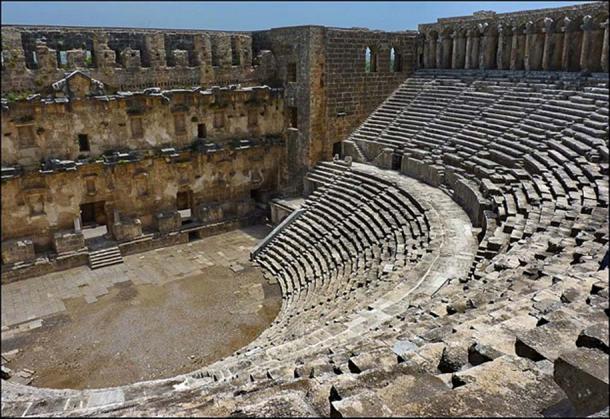
The city is most famous for its Roman theater, the Aspendos Ancient Theater, which seats 7,000 people. The theater is one of the most visited historic sites in Turkey's Antalya province and it is the best preserved ancient theater in the country. Another feature that makes the theater famous is its remarkable acoustics. Even the slightest sound made at the center of the orchestra can be easily heard as far as the uppermost galleries. The theater hosts events by the Aspendos Opera and a ballet festival in the summer.


The theater at Aspendos, Turkey. (CC BY SA 3.0)

Apart from the theater, the Aspendos archaeological site also contains the ruins of a small temple, a nymphaeum (fountain shrine), the foundations of a bouleuterion (council chamber), and a Roman aqueduct.


Roman aqueduct of Aspendos, Turkey. (Bernard Gagnon/CC BY SA 3.0)

Top Image: The famous Roman theater at Aspendos, Turkey. Source: Saffron Blaze/CC BY SA 3.0

By Alicia McDermott

Thursday, June 1, 2017

Say the Magic Word: The Origins of Abracadabra and Other Magical Mutterings


Ancient Origins


Magic words are often used by magicians whilst performing magic tricks on stage. One of the most common of these incantations is ‘Abracadabra’. Although this word is known to many, it is likely that fewer people are aware of its origins. Apart from ‘Abracadabra’ there are several other magic words that are popularly used by stage magicians. Like ‘Abracadabra’, however, the origins of these words are also a mystery to most people.

Religious Roots
Whilst ‘Abracadabra’ is commonly used by stage magicians today for the entertainment of the masses, this word is said to have its origins in the ancient Roman world. Back then, this word was not used for performances, but was believed to contain potent magical power within it. According to one theory, the word ‘Abracadabra’ is derived from the Hebrew words ‘ab, ben, ruach hakodesh’, which translates as ‘Father, Son and Holy Spirit’. Thus, the word ‘Abracadabra’ is in fact an invocation of the Holy Trinity. According to another theory, this magic word is derived from another magic word known as ‘abraxas’. This word is special, as its letters, in Greek numerology, adds up to 365, i.e. the number of days in a year.


Oil sketch for Hone's satirical painting The Pictorial Conjuror, 1775 (Public Domain)

Yet another theory for the origins of the word ‘Abracadabra’ is the Aramaic phrase ‘Avra kadavra’. Fans of the Harry Potter series, would perhaps be familiar with this phrase, as a similar spell, ‘Avada kedavra’ is featured in the books. In the Harry Potter series, ‘Avada kedavra’ functions as a killing curse, and J. K. Rowling, who authored the books, is said to have drawn inspiration for this spell from the original Aramaic version of it. The original meaning of these magical words, according to Rowling, was ‘let the thing be destroyed’, and that it was used for the curing of illnesses.

The Medicinal Charm


‘Abracadabra’ written in its triangular / pyramidal form. (Public Domain)

In any case, ‘Abracadabra’ was used as a talisman over the ages. The 2nd century Roman savant, Serenus Sammonicus, for instance, provides a description in his Liber Medicinalis about the way this magic word may be used. This talisman involved the word being written on a piece of parchment repeatedly, with a letter being removed each time, until only one is left. The use of this ‘Abracadabra’ pyramid is mentioned by writers in later ages, including the 16th century Eva Rimmington Taylor, and the 18th century Daniel Defoe. Eventually, people stopped believing in the efficacy ‘Abracadabra’, and this word became used by stage magicians for performing magic tricks.


Magic words and signs on a rolled strip of paper (18th century). Upper Austrian County Museum (CC BY-SA 3.0)

Other Magic Words
Another common magic word is ‘Alakazam’. This incantation is said to have its origins in the Arabic language, and it has been pointed out that there is a similar-sounding word in that language, ‘Al Qasam’, which means oath. It has also been suggested that ‘Alakazam’ is a proper name, and that this magic spell was supposed to invoke the powers of a certain person by the name of Alakazam. ‘Hocus Pocus’ is yet another magic word that is often used by magicians. Unlike ‘Abracadabra’, the origin of this magic phrase lies in the more recent past, around the early 17th century, to be more precise. Like ‘Abracadabra’ and ‘Alakazam’, there are several theories trying to explain the origin of this phrase. One, for instance, is offered by John Tillotson, the Archbishop of Canterbury in 1694. Tillotson suggests that this is a corruption of ‘hoc est corpus’, and is a parody of the consecration during the Catholic Mass. Another suggestion is that the words sounded exotic, and this pair of words was coined simply because they rhymed.

 In addition to these traditional magic words, there are also many others that have appeared in more recent times. Some of the better-known ones include ‘Bibbidi-Bobbidi-Boo’, used by the Fairy Godmother in Disney’s Cinderella, ‘Shazam’, used by DC Comic’s Billy Batson to transform into the superhero Captain Marvel, and ‘A-la Peanut Butter Sandwiches’, which is uttered by the Amazing Mumford in Sesame Street.

Top image: Ancient Book (CC BY SA 3.0)

By Wu Mingren

References
Conley, C., 2008. Magic Words: A Dictionary. San Francisco, Calif.: Weiser Books.

Martin, G., 2017. Abracadabra. [Online] Available at: http://www.phrases.org.uk/meanings/abracadabra.html

Martin, G., 2017. Hocus-pocus. [Online] Available at: http://www.phrases.org.uk/meanings/hocus-pocus.html

Shnidman, R., 2013. Word of the Day Abracadabra: Be Careful What You Wish For. [Online] Available at: http://www.haaretz.com/jewish/features/word-of-the-day-abracadabra-be-careful-what-you-wish-for-1.519857

Upton, E., 2013. The Fascinating Origin of the Word “Abracadabra”. [Online] Available at: http://www.todayifoundout.com/index.php/2013/11/origin-word-abracadabra/