Showing posts with label Turkey. Show all posts

Thursday, September 14, 2017

Ancient Mall Found in Famous Theater City of Aspendos Shows Commerce and Entertainment Went Hand-in-Hand

Ancient Origins


The ancient city of Aspendos was a major commercial center in Roman times. The recent excavations of a large shop complex with offices and storage facilities dating back some 2,000 years provide more insight on the products that were stored and sold near the city’s famous theater. Akin to cinemas found in shopping malls today, the Romans here combined both commerce and entertainment too.


A 2000-year-old two-story shop complex has been excavated at Aspendos, Turkey. (CROSS)

Many coins were discovered in the shops from the Hellenistic and Roman eras. Aspendos coins, minted from the 5th century BC, were often used in the Hellenistic era. The recently unearthed coins had the figure of a slingshot stone on one side and a horse depicted on the other. The appearance of a horse can be connected to Aspendos’ recognition for horse breeding.


Example of a silver stater coin from Aspendos dating to 370-333 BC. Obverse: Olympic games-type scene: two wrestlers grappling, the letters delta and alpha between their legs; Reverse: Olympic games-type scene of a slinger, wearing short chiton, discharging sling to right, triskeles on right with feet clockwise. (Ancientcointraders/CC BY SA 4.0)

Hacettepe University Archaeology Department’s Veli Köse is currently heading the excavations at Antalya and told Hurriyet Daily “We think valuable materials were sold or held in these stores. Some were used as offices. The fact that such a unique structure was unearthed right next to the agora in the city center supports this idea.”

 Some of the products that were apparently stored and sold in the complex include: a small glass amphora, pieces of oil and perfume bottles, candles, a bronze belt buckle, a bone hair pin, and lots of studs and rings.


Some of the artifacts found at the shop complex location of the site of Aspendos, Turkey. (Daily Sabah)

The shops were the focus of the recent excavations, yet the team also found hundreds of mussel shells in a field and some wall painting remnants at other locations around the site.

 “The existence of two-storey shops and a structure complex in an ancient city symbolizes that this place was an important commercial center. We also know it from the inscriptions. Aspendos is famous especially for grain harvest and horse breeding,” Köse concluded.

 The ancient city of Aspendos was established in the 10th century BC. It was likely the most important city in Pamphylia, with its golden age being the Roman period – a great time for trade and commerce. Legends say the famous Greek diviner Mopsos founded the city, however, evidence of a Hittite settlement brings up some debate about the first inhabitants. The city came under Persian rule in the 6th century BC. It was then taken by Alexander the Great in the 4th century BC. By the Roman period, Aspendos was an important harbor city. Yet, it fell from grace in the Byzantine period with the empire’s centralization policies. It has been a UNESCO World Heritage Site since 2015.


Ruins of the Basilica at Aspendos, Turkey. (Saffron Blaze/CC BY SA 3.0)

The city is most famous for its Roman theater, the Aspendos Ancient Theater, which seats 7,000 people. The theater is one of the most visited historic sites in Turkey's Antalya province and it is the best preserved ancient theater in the country. Another feature that makes the theater famous is its remarkable acoustics. Even the slightest sound made at the center of the orchestra can be easily heard as far as the uppermost galleries. The theater hosts events by the Aspendos Opera and a ballet festival in the summer.
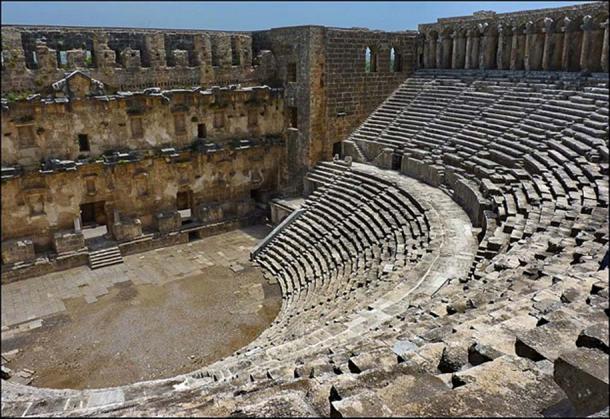

The theater at Aspendos, Turkey. (CC BY SA 3.0)

Apart from the theater, the Aspendos archaeological site also contains the ruins of a small temple, a nymphaeum (fountain shrine), the foundations of a bouleuterion (council chamber), and a Roman aqueduct.


Roman aqueduct of Aspendos, Turkey. (Bernard Gagnon/CC BY SA 3.0)

Top Image: The famous Roman theater at Aspendos, Turkey. Source: Saffron Blaze/CC BY SA 3.0

By Alicia McDermott

Saturday, August 12, 2017

History's 1st emoji? Ancient pitcher shows a smiley face


Fox News


By Laura Geggel


 The iconic smiley face may seem like a modern squiggle, but the discovery of a smiley face-like painting on an ancient piece of pottery suggests that it may be much older.

 During an excavation of Karkemish, an ancient Hittite city whose remains are in modern-day Turkey near the Syrian border, archaeologists came across a 3,700-year-old pitcher that has three visible paint strokes on it: a swoosh of a smile and two dots for eyes above it.

 "The smiling face is undoubtedly there," Nikolo Marchetti, an associate professor in the Department of History and Cultures at the University of Bologna in Italy, told Live Science in an email. "There are no other traces of painting on the flask." [The 25 Most Mysterious Archaeological Finds on Earth]

 The team of Turkish and Italian archaeologists found the pitcher, which dates to about 1700 B.C., in what was a burial site beneath a house in Karkemish, Marchetti said. The pitcher was likely used to drink sherbet, a sweet beverage, he told the Anadolu Agency, a Turkish news outlet.

The archaeologists also found other vases and pots, as well as metal goods in the ancient city, which measures about 135 acres (55 hectares), or slightly more than 100 football fields.

 The name Karkemish translates to "Quay of (the god) Kamis," a deity popular at that time in northern Syria. The city was inhabited from the sixth millennium B.C., until the late Middle Ages when it was abandoned, and populated by a string of different cultures, including the Hittites, Neo Assyrians and Romans, the archaeologists said in a statement. It was used once more in 1920 as a Turkish military outpost, the archaeologists added.

 British archaeologists visited the site in the late 1800s and early 1900s, but there was still much to be uncovered, so the new team, directed by Marchetti, began excavating it in 2003. But it wasn't until this past field season, which began in May, that the archaeologists unearthed the pitcher with the emoji-like painting.

 "It has no parallels in ancient ceramic art of the area," Marchetti told Live Science. "As for the interpretation, you may certainly choose your own."

 Original article on Live Science.

Thursday, April 6, 2017

Quarrying and Blasting May Destroy 2100-Year-Old Castle Site and Statue of Mother Goddess in Turkey

Ancient Origins


Blasting and quarrying of rock at a site near the ancient Kurul Castle in Turkey have endangered the structure and a precious statue of the ancient goddess Cybele.

 The castle, which dates back about 2,100 years, is located in the northern province of Ordu near the Black Sea. King Mithridates VI of Armenia Minor and Pontus had the castle built during his reign, which spanned from 120 to 63 BC.


Kurul Rock archaeological site, Ordu, Turkey. ( Black Sea-silk Road Corridor )

The explosions going on daily near the castle have threatened the sculpture of Cybele, an ancient mother goddess of the region, says an article about the situation in Hurriyet Daily News online. The castle is situated on the peak of the mountain in Bayadi village.

 The digs carried out there since 2010 are being conducted under the supervision of professor Yücel Şenyurt.

When the discovery of the statue of Cybele was made known to the world, about 15,000 people visited the castle to see it.


Examining the Cybele statue in Ordu, Turkey. ( Hurriyet Daily News )

Now, the archaeological excavations are still going on at the same time as the quarrying and blasting with dynamite, on the slopes of the Kurul Rocks above the Melet River. This quarrying could spell the end of, or great damage to, what remains of the Kurul Castle.

 Governmental authorities, the quarrying company, and archaeologists are trying to sort out the situation and see to the protection of the site.

As Ancient Origins reported in January 2017, Cybele was a goddess of ecstatic and chthonic reproductive mysteries, the primary mother goddess of ancient Anatolia, and Phrygia's only known goddess thus far. She was a "Mistress of Animals," "Great Mother" and "Mother of the Mountain" and it appears that Cybele was adopted by the Greeks in Asia Minor (modern day Turkey), and then adapted as she spread from there to mainland Greece, followed by Rome.


Cybele protects from Vesuvius the towns of Stabiae, Herculaneum, Pompeii and Resina (1832) by François-Édouard Picot. ( Public Domain )

A statue of this important goddess is under threat by blasting and quarrying in Turkey.

In Phrygia, no records remain concerning her cult and worship, though there are numerous statues of overweight, seated women that archaeologists believe represent Cybele. Often she is also portrayed giving birth, indicative of her Mother Goddess status.

 Cybele has components of various mother goddesses in ancient Greece: Gaia, Rhea, and Demeter, each notable in their own aspects. Gaia is the ancient Greek mother goddess, responsible for birthing the gods and various aspects of the cosmos with Uranus. Rhea plays a similar role in the universe as the mother of the Olympians, with ancient roots in Minoan and Mycenaean traditions. And Demeter is directly responsible for the changing of the seasons and thus the fertility of the earth.


Figurine of a seated Mother Goddess flanked by two lionesses found at Çatalhöyük, Turkey (about 6000-5500 BC), Museum of Anatolian Civilizations in Ankara. ( CC BY SA 2.5 ) Many say this is one of the earliest representations of Cybele.

Ancient Origins also reported on the king who built Kurul castle, Mithridates (spelled also as Mithradates) VI. His full name is Mithridates VI Eupator Dionysius. He was a famous king of Pontus, a Hellenistic kingdom in Asia Minor of Persian origin. Mithridates is best known for his conflict with the Roman Republic in the three Mithridatic Wars, in which the Pontic king fought against three prominent Roman generals – Lucius Cornelius Sulla, Lucius Licinius Lucullus, and Gnaeus Pompey Magnus.


A bust of the king of Pontus Mithridates VI as Heracles. Marble, Roman imperial period (1st century). ( CC BY 3.0 ) Mithridates VI built Kurul castle, which is now in danger in Turkey.

Top image: The Kurul Rock archaeological site ( @eslidemirel/imgrum) and this statue of Cybele ( T24) are in danger of being destroyed by nearby blasting and quarrying in Turkey.

 By Mark Miller

Friday, January 20, 2017

Remaking the Mausoleum: One of the Seven Wonders of The Ancient World to be Revived

Ancient Origins


Plans are underway to bring the famed Mausoleum at Halicarnassus back to its former glory. This is the second longest surviving ancient wonder, after the Great Pyramid of Giza. However, the ancient tomb of King Mausolus has fallen into ruins and little remains these days of the marvelous structure that once stood. Archaeologists hope that the reconstruction of the tomb and other local sites will help resurrect interest in the history of the region and bring the ancient tomb back to life.

The Mausoleum is located in Halicarnassus, present day Bodrum, in Turkey. It was built between 353 and 350 BC as the final resting place for Mausolus, the second ruler of Caria from the Hecatomnid dynasty. The building was constructed on top of a hill overlooking the city and created with a mixture of styles from three different cultures – Greek, Lycian, and Egyptian. Mausolus’ grieving widow (and sister), Artemisia II, pulled out all the stops in the creation of his tomb.

Ancient Origins writer Dhwty has provided a description of how the grand Mausoleum looked in its glory days:

“A stone platform was first built, and was enclosed with a courtyard. The top of this platform was reached by a flight of stairs flanked by stone lions. Along the outer walls of the courtyard were statues of various gods and goddesses, whilst mounted stone warriors were stationed at each corner. At the center of the platform was the Mausoleum itself. Whilst the building was constructed of bricks, it was covered with white Proconnesian marble, giving it a splendid look. The first 1/3 of the Mausoleum was a square, tapering block covered with relief sculptures. These reliefs included standard images from the Greek repertoire, including the Centauromachy (the battle between the Lapiths and centaurs) and the Amazonomachy (the battle between the Greeks and Amazons). The next 1/3 of the monument consisted of a set of 36 Ionic columns. Between each column was a statue, and a solid block was constructed behind the columns to bear the bear the weight of the structure’s roof. This roof, which covered the final 1/3 of the building, was a step pyramid with 24 levels, topped with a sculpture of Mausolus and Artemisia riding a four-horsed chariot.”


The Mausoleum at Halicarnassus, painting by Ferdinand Knab. (Public Domain)

And now, Hurriyet Daily News reports that Danish archaeologist Professor Poul Pedersen and his assistant Professor John Lund of the University of Southern Denmark have begun working with The Mediterranean Countries Academy Foundation, headed by Özay Kartal, to restore the famous site.

Lonely Planet says that there are only a few ancient elements of the Mausoleum that survived the earthquakes that shook the monument to the ground before the 15th century AD. These are:

 “the pre-Mausolean stairways and tomb chambers, the narrow entry to Mausolus’ tomb chamber and a huge green stone that blocked it, the Mausolean drainage system, precinct wall bits and some large fluted marble column drums.”


Excavations at the ruins of the Mausoleum. (Kristian Jeppesen)

The restoration of the Mausoleum is one of the two main objectives for The Danish Halikarnassos Project, the other being a wider mission covering the rest of the ancient city of Halicarnassus. Specifically, Hurriyet Daily News says that the project also involves excavating some sites along the way from the Bodrum Harbor to the tomb, unearthing ancient city walls that encircle Bodrum, and excavating a 3,500-year-old hippodrome.


A scale model of a reconstruction of the Mausoleum - one of the versions at Miniatürk, Istanbul. (Nevit Dilmen/CC BY SA 3.0)

Discussing the reason behind the ambitious project, Özay Kartal has said:

“There are many locals in Bodrum who don’t know that Heredotus was born in Bodrum and that the Mausoleum at Halicarnassus is listed as one of the Seven Wonders of the World. This is why our priority is to restitute this mausoleum and open a way from the port to this place. Hundreds of thousands of tourists visiting Bodrum return to their countries without seeing it. We, as the foundation, will organize the International Mausolus Workshop in May to provide information about Bodrum’s history with the participation of academics, historians and archaeologists. This workshop will be a very important step leading to the restitution project of the Mausoleum at Halicarnassus.”

Travelers Today says that there are no dates provided yet for the restoration of the Mausoleum. However, when the ancient structure is restored, there will be at least two of the ancient wonders of the world available for modern eyes to gaze upon once again.


The Seven Wonders of the Ancient World were a list of seven monuments that ancient Greek historians considered the ultimate examples of skill and ingenuity.

As April Holloway has written:

“Today, only one of the Seven Wonders remains intact – the Great Pyramid of Giza. Three of the Wonders – the Colossus of Rhodes, Lighthouse of Alexandria and Mausoleum of Halicarnassus – were destroyed by earthquakes. Two of the Wonders – the Temple of Artemis and Statue of Zeus – were intentionally destroyed by enemy forces, while the final Wonder – the Hanging Gardens of Babylon – has remained a matter of contention for millennia, with some historians questioning whether existed at all.”

Although it is limited as it only covers the Mediterranean and Middle Eastern regions, the seven sites included on the list certainly must have been something spectacular to behold.


Top Image: Painting of what the Mausoleum at Halicarnassus may have looked like. Source: CC BY SA

By Alicia McDermott

Monday, November 14, 2016

Tourist Attraction Will Transport You Back in Time to Ancient Hittite Village

Ancient Origins


An exciting new project is on the way for the ancient Hittite capital of Hattusa. The village will be recreated so visitors can experience what daily life was like for people who lived in the Hittite kingdom about 3,500 years ago.

Hurriyet Daily News reports that Turkey’s forthcoming tourist attraction is the result of decades of research on the ancient site of Hattusa. The Hittite center is in what is now the Bogazkale district, in the heart of a national park. It is known for its treasures, monumental gates, statues, and inscriptions. On the world map of ancient cities, it is one of the richest archaeological sites. The texts that were discovered at Hattusa consist of official letters, legal codes, descriptions of cult ceremonies, literature, oracular prophecies, and other interesting documents.
The site is surrounded by 6 kms (3.73 miles) of walls and it is one of the most important sites in Turkey. It has been recognized as a World Heritage site by UNESCO since 2001. Over the last few decades, archaeologists have unearthed 31 temples, granaries, and many other buildings in Hattusa. Now, the project to rebuild the Hittite village is being conducted by the Bogazkale District Governor's Office and led by the District Gov. Osman Aydogan.
Hattusa, the Hittite capital.
Hattusa, the Hittite capital. (Flickr/CC BY 2.0)
The Hittite village project will be constructed in a field measuring 7,000 square meters (75347 sq. ft.) It will cost over 1 million Turkish Liras. Aydogan and the leaders of the Middle Black Sea Development Agency (OKA) believe that the project will help the site bring in more visitors from around the world.
Osman Aydogan said the village will depict the reality of life 3,500 years ago:
“Because the ancient city is 3,500 years old, our artifacts are basic ones. We designed a big Hittite village to be built with Hittite architecture. Their daily life will be revived in the village and tourists will be able to spend the night there. Just like in the Hittite [times], we will build stone and adobe structures with a lion’s gate. It will have a backyard, shops, king’s room, prison, bakeshop and iron work shop.”
Hattusa is one of the most fascinating sites of ancient Anatolia. The city still holds many secrets, but researchers found enough information about its history for the tourist attraction to be created.
The Great Temple in the inner city of Hattusa.
The Great Temple in the inner city of Hattusa. (CC BY-SA 2.0)
A few months ago, archaeologists unearthed one of the site’s most fascinating architectural elements. As Natalia Klimczak reported on August 23, 2016 for Ancient Origins:
Archaeologists announced the discovery of an ancient tunnel which is located in Alacahöyük, one of the most important centers of the Hittite Empire - Hattusa. It is a key excavation site for modern Turkey. According to Hurriyet Daily News, the tunnel is 2,300-years-old and it was a secret passageway known as a potern.
The excavations were led by Professor Aykut Çınaroğlu from Ankara University, along with a team of 24 researchers. They discovered a tunnel during works on a sanctuary unearthed in 2014. The discovery also confirms that there was more than one secret tunnel in Hattusa. As Çınaroğlu said:
''This new potern proves the existence of other poterns in Alacahöyük. We are carrying out excavations right now; we have not finished yet. We started from the gate opening to the sanctuary, trying to open it. This is a potern from nearly 2,300 years ago. We have dug 23 meters so far but think that it is longer. Cleaning work is continuing, too. We will see what we will find in the end. Poterns were placed under the castle, extending into the city. We have previously found a cuneiform tablet here, featuring a king who explains to priests what to do during ceremonies. This secret tunnel might have had a sacred function.''
The researchers said that the discovery was very exciting for the team, and they are going to continue excavations in the new season.
Ancient tunnel found inside Geval Castle.
Ancient tunnel found inside Geval Castle. (Konya Life)
The site of Hattusa was discovered in 1835 by W.C. Hamilton, but the first regular excavations did not take place until 1907 when they were carried out by the Ottoman archaeologist Makridi Bey. Work was continued in 1935, during the rule of Mustafa Kemal Atatürk. In 1997, Professor Çınaroğlu became the director of the campaign.
Hattusa is a site full of treasures and is mentioned in history books due to the rich correspondence between the Hittite kings and other rulers, like the pharaohs of Egypt. The site contains many important places, including pre-Hittite royal tombs dating to 3,000 BC. It has yielded stunning artifacts such as weapons, gold and silver containers, jewelry, bronze and clay animal sculptures, chairs, belt buckles, and gold leaf-covered figures. One of the most famous symbols of the Alacahöyük site is the Sphinx Gate at the south of the city, which consists of two great sphinxes facing outward. This feature is dated back to 1,400 BC.
The Sphinx gate at Alacahöyük.
The Sphinx gate at Alacahöyük. (Public Domain)
Top Image: Lion Gate, Hattusa, Turkey. Source: Bernard Gagnon/CC BY SA 3.0

Wednesday, May 18, 2016

5,000-Year-Old Unlooted Tomb of Thracian Warrior is Biggest Find of the Year in Turkey

Ancient Origins


The intact tomb of a Thracian warrior dating back some 5,000 years has been excavated in Turkey, the Istanbul Archaeology Museum announced. Experts are calling it the biggest archaeological find so far this year in Turkey—a country with many important archaeological sites.

The kurgan tumulus is the first intact burial chamber of its kind ever found, says an article about the news in DailySabah.com. The dig on the kurgan started in December 2015 in Silivri in the Çanta region.
Hurriyet Daily News says the tumulus was looted. However, looters had tried but failed to dig into the main burial chamber.
The tumulus was likely that of a prominent Bronze Age warrior from northern areas. Researchers assume he was a warrior because they found a spear point in his grave, according to the First Istanbul Board for the Protection of Cultural Artifacts.
Hurriyet Daily News says a kurgan is a burial mound constructed in a circle over a grave in a pit. Kurgan burials often have grave vessels, weapons and one body. “The type of tomb was originally used on the Russian steppes but later spread to eastern, central and northern Europe in the 3rd millennium B.C. The type of grave was holy in Turkic and Altay culture,” the article states.
Professor Mehmet Özdoğan of Istanbul University Department of Archeology told Daily Sabah he has studied such tumuli before, but this discovery is important because it is the oldest one found in Thrace. It’s hoped the tomb will help shed light on historical mysteries about Thrace and help with studies about ancient Istanbul.
Years ago, Özdoğan excavated another Thracian kurgan, from around 1200 BC in the village of Asılbeyli in Kırklareli in eastern Thrace, Daily Sabah says.
“Thrace received migrations from the north. This is a kurgan-style tomb and such tombs exist in my studies, too,” Özdoğan told Hurriyet Daily News. “I know that lots of kurgan tombs have been destroyed in Thrace. We have rescued one of them from the digger. But this tomb is older and is from the Bronze Age. It is a very important discovery. I believe scientific examinations will lead to interesting results.”
Sarmatian Kurgan 4th c. BC, Fillipovka, S.Urals.
Sarmatian Kurgan 4th c. BC, Fillipovka, S.Urals. Source: Wikipedia
The Istanbul Archaeology Museum wants to register the grave as a historical site and place the remains of the warrior on exhibit in the museum.
Kurgans are considered sacred burials in Turkic and Altaic cultures. People were buried in kurgans widely across central Asia and Eastern Europe. The word kurgan is from an unknown Turkic language and in Turkish means “fortress,” says Daily Sabah.
Interior of the Tsarsky Kurgan, Crimean Peninsula, 4th century B.C.
Interior of the Tsarsky Kurgan, Crimean Peninsula, 4th century B.C. (Wikimedia Commons)
The practice of building kurgans for important people’s burials was done from the Copper Age, through the Bronze, Iron ages and into the Middle Ages, though it was not as popular during later times.
One of the most prominent historical figures buried in a kurgan was Philip II of Macedon—father of Alexander of Macedon. Philip was buried in Greece.
The circular tomb chamber is 6 meters (19.7 feet) across and is inlaid with stones. The actual tomb itself is rectangular. The skeleton was on a stony floor in the fetal position, and his arms were placed to embrace his legs. Researchers say this may be either so he could enter the next world like a newborn or as a way to prevent him from rising from the dead.
In addition to the spear point, which was on the body, archaeologists found two Bronze Age earthenware pots. Hurriyet called the point an arrowhead and added that it helped identify him as an important soldier or even a commander.
There is a detailed study here about the Kurgan culture, which was widespread from Europe to Kazakhstan and up into Russia. The site says the Kurgan culture differs had common elements, including the distinctive burials, that differentiate it from other Bronze Age cultures in the regions where they overlapped.
Top image: Newly discovered kurgan burial in Turkey (Daily Sabah)
By Mark Miller

Friday, February 12, 2016

Archaeologists uncover underground church with scenes of the damned in Turkey

Ancient Origins

An underground Orthodox church carved into rock in Turkey with scenes of Jesus rising into the sky and the killing of bad souls has been discovered—the first of its kind with such paintings, says the mayor of the town where the church was unearthed.
“We know that such frescoes have so far never been seen in any other church,” Nevşehir Mayor Hasan Ünver told Hurriyet Daily News. “This place is even bigger than the other historical churches in Cappadocia. It was built underground and has original frescoes that have survived to this day.”
The region of Cappadocia in central Turkey is home to one of the most spectacular landscapes in the world – deep valleys and soaring rock formations dotted with homes, chapels, tombs, temples and entire subterranean cities harmoniously carved into the natural landforms. Cities, empires and religions have risen and fallen around these unique underground havens. Archaeologists in December 2014announced they uncovered a massive underground city in Cappadocia, consisting of at least 7 kilometers (3.5 miles) of tunnels, hidden churches, and escape galleries dating back around 5,000 years.
Calling it the biggest archeological finding of 2014, Hurriyet Daily News said the ancient city was found beneath Nevşehir fortress and the surrounding area during an urban transformation project carried out by Turkey’s Housing Development Administration (TOKİ).  About 1,500 buildings were found in and around the Nevşehir fortress, and the underground city was discovered during earthmoving to construct new buildings.
The rock houses of Cappadocia.
The rock houses of Cappadocia. (Public domain)
The church found in 2016 is among the many structures in the underground city. Unver said the church may have been built in the 5th century AD.
“We didn’t even think of finding such a structure when we first started works. But excavations and cleaning work are continuing and we hope to find new data relating to the history of Cappadocia,” Mr. Ünver told Hurriyet. “It is reported that some of the frescoes here are unique. There are exciting depictions like fish falling from the hand of Jesus Christ, him rising up into the sky, and the bad souls being killed. When the church is completely revealed, Cappadocia could become an even bigger pilgrimage center of Orthodoxy.”
Semih İstanbulluoğlu, the archaeologist who is leading the dig in the underground city and church, said snow and rain made the thin walls of the church collapse, but workers would fix them during restorations. 
An underground house in Cappadocia

An underground house in Cappadocia (Photo by Ed Yourdon/Wikimedia Commons)
At the time it was found, the church was filled with dirt, and the archaeological team had to collect pieces of the frescoes. Though some frescoes appear to be intact, restoration work will restore as many as possible.
Ali Aydın, another archaeologist on the job, said they would have to dry the humidity in the church slowly to prevent the frescoes from disintegrating. After the weather warms in the spring, work will resume to protect the frescoes and restore the church, and the team will remove the humidity.
Cappadocia covers the region between the cities of Nevşehir, Ürgüp and Avanos, the sites of Karain, Karlık, Yeşilöz, Soğanlı and the subterranean cities of Kaymaklı and Derinkuyu. One hundred square miles with more than 200 underground villages and tunnel towns complete with hidden passages, secret rooms and ancient temples and a remarkably storied history of each new civilization building on the work of the last, make Cappadocia one of the world's most striking and largest cave-dwelling regions of the world.
Watch UNESCO’s video about Göreme National Park and the Rock Sites of Cappadocia
Featured image: Two of the frescoes from the church, which is in a region of 200 underground villages and tunnel towns. (AA photo)


Wednesday, November 18, 2015

Researchers locate Submerged Lost Ancient City where Athens and Sparta Fought a Battle

Ancient Origins

Researchers have found the location of the lost island city of Kane, known since ancient times as the site of a naval battle between Athens and Sparta in which the Athenians were victorious but later executed six out of eight of their own commanders for failing to aid the wounded and bury the dead.
Some historians say the loss of leadership may have contributed to Athens’ loss of the Peloponnesian War. But a scholar who wrote a book on the battle says the Spartans would have won whether or not Athens executed the generals.
The ancient city of Kane was on one of three Arginus Islands in the Aegean Sea off the west coast of Turkey. The exact location of the city was lost in antiquity because earth and silt displaced the water and connected the island to the mainland.
Geo-archaeologists working with other experts from Turkish and German institutions discovered Kane, where the Athens and Sparta did battle in 406 BC. Athens won the Battle of Arginusae, but its citizens tried and executed six of eight of the city-state’s victorious commanders.
Depiction of a battle between Athens and Sparta in the Great Peloponnese War, 413 BC.
Depiction of a battle between Athens and Sparta in the Great Peloponnese War, 413 BC. (Image source)
 “The Athenian people soon regretted their decision, but it was too late,” writes J. Rickard at History of War. “The execution of six victorious generals had a double effective—it removed most of the most able and experienced commanders, and it discouraged the survivors from taking command in the following year. This lack of experience may have played a part in the crushing Athenian defeat at Aegospotami that effectively ended the war.”
Debra Hamel, a classicist and historian who wrote the book The Battle of Arginusae, however, says she thinks Athens would have lost anyway.
“Sparta at that point was being funded by Persia, so they could replace ships and hire rowers indefinitely,” Dr. Hamel wrote to Ancient Origins in electronic messages. “Athens did not have those resources. Allies had revolted. They weren’t taking in the money they had in earlier days.”
Google Earth image shows the general vicinity of the islands, near Bademli Village in Turkey on the Aegean Sea.
Dr. Hamel, via e-mail, describes how the Battle of Arginusae was likely fought:
The Battle of Arginusae was only fought at sea. …  The state-of-the-art vessel of the period was the trireme, a narrow ship about 120 feet [36.6 meters] long that was powered by 170 oarsmen, who sat in three rows on either side of the ship. There was a bronze-clad ram that extended about six and a half feet [2 meters] at waterline from the prow of the vessel. The purpose of the ram was to sink enemy ships. The goal of a ship's crew—the 170 oarsmen and various officers onboard—was to maneuver a trireme so that it was in position to punch a hole in the side of an enemy ship while avoiding getting rammed oneself. In order to do this you needed to have a fast ship--one that wasn't waterlogged or weighed down by marine growths--and you needed a well-trained crew.
Athens sent 150 ships, the Spartans 120. The Athenian line was about 2 miles (3.2 kilometers) long or longer because it was interrupted by one of the Arginusae islands. The Spartan line was a bit less than 1.5 miles [2.4 km] long, Dr. Hamel estimates.
Greek trireme, drawing by F. Mitchell; note the battering ram on the prow to the right at the waterline.
Greek trireme, drawing by F. Mitchell; note the battering ram on the prow to the right at the waterline. (Wikimedia Commons)
Dr. Hamel’s book on the battle explores not just the battle but its aftermath too. Winning the battle “was a great triumph, saving Athens—at least temporarily—from almost certain defeat in the war,” she wrote in e-mail. “The victory was cause for celebration, but paradoxically, because of what happened afterwards, it was also one of the worst disasters to befall Athens in the war: A series of legal proceedings led ultimately to the Athenians' execution of (most of) their victorious generals. This was the stuff of tragedy.
Because the Battle of Arginusae is tied intimately with the legal proceedings that it led to, I was able to discuss in my book not only the battle itself and the intricacies of naval warfare (which are really very interesting), but also the proceedings back in Athens and Athens' democracy and democratic institutions. All of this was necessary to round out the story for readers who are approaching the book without any prior knowledge of the period.
Later, from 191 to 190 BC, Roman forces used the city of Kane’s harbor in the war against Antiochas III’s Seleucid Empire. That war lasted from 192 to 188 BC and ended when Antiochus capitulated to Rome’s condition that he evacuate Asia Minor. Most of Antiochus’ cities in Asia Minor had been conquered by the Romans anyway. He also agreed to pay 15,000 Euboeic talents. The Romans did not leave a garrison in Asia Minor but wanted a buffer zone on their eastern frontier.
The island on which Kane was situated, which is known from ancient historians’ texts, is in the sea off İzmir Province’s Dikili district Researchers, led by the German Archaeology Institute, included those from the cities of İzmir, Munich, Kiel, Cologne, Karlsruhe, Southampton and Rostock. Prehistorians, geographers, geophysics experts and topographers all worked on the project.
“During surface surveys carried out near Dikili’s Bademli village, geo-archaeologists examined samples from the underground layers and learned one of the peninsulas there was in fact an island in the ancient era, and its distance from the mainland was filled with alluviums over time,” reports Hurriyet Daily News. “Following the works, the quality of the harbors in the ancient city of Kane was revealed. Also, the location of the third island, which was lost, has been identified.”
Featured image: Main: Google Earth image shows the general vicinity of the islands, near Bademli Village in Turkey on the Aegean Sea. Inset: A representation of an ancient Greek ship on pottery (Photo by Poecus/Wikimedia Commons)
By Mark Miller

Friday, October 23, 2015

Archaeologists Unearth Marble Head of Medusa at Roman Ruins in Turkey

Ancient Origins

Archaeologists in Turkey have unearthed a marble head of Medusa, the legendary gorgon from Greek mythology with snakes in place of hair who could turn any person to stone with just her gaze.  The ancient relic was discovered in the 2,000-year-old archaeological ruins of Antiochia ad Cragum on Mount Cragus in Anatolia, Turkey.
Live Science reports that the head of Medusa was not part of a statue, but was likely incorporated into the pediment of a building, which is believed to have been a small temple.
The marble head of Medusa discovered at Antiochia ad Cragum in Turkey.
The marble head of Medusa discovered at Antiochia ad Cragum in Turkey. Credit: Michael Hoff, Hixson-Lied professor of art history, University of Nebraska-Lincoln.

The Legend of Medusa

The earliest known record about the myth of Medusa and the Gorgons can be found in Hesiod’s Theogony. According to this ancient author, the three sisters, Sthenno, Euryale and Medusa were the children of Phorcys and Ceto, and lived “beyond famed Oceanus at the world’s edge hard by Night”. Of the three, only Medusa was said to be mortal, whilst Sthenno and Euryale were immortal. In addition, Medusa is the most famous of the three, and the story of her demise is also mentioned in passing by Hesiod.
Although Hesiod gives an account of Medusa’s origins and the death of Medusa at the hands of Perseus, he does not say more about her. By contrast, a more comprehensive account of Perseus and Medusa can be found in Ovid’s Metamorphoses. In this work, Ovid describes Medusa as originally being a beautiful maiden. Her beauty caught the eye of Poseidon, who desired her and proceeded to ravage her in Athena’s shrine. The goddess then sought vengeance by transforming Medusa’s hair into snakes, so that anyone who gazed at her directly would be turned into stone.
Perseus with the Head of Medusa after he had slain her, by Sebastiano Ricci
Perseus with the Head of Medusa after he had slain her, by Sebastiano Ricci (Wikimedia Commons)

Medusa as a Force of Protection

Although Medusa is commonly regarded as a monster, her head is often seen as a protective amulet that would keep evil away. Thus, the image of Medusa’s head can be seen in numerous Greek and subsequent Roman artifacts such as shields, breastplates, mosaics, and statues. There are also numerous coins that bear not only the imagery of Perseus holding the head of Medusa, but also the head in its own right.
Caravaggio’s Medusa.
Caravaggio’s Medusa. Photo source: Wikimedia.

The Ancient City of Antiochia ad Cragum

The marble Medusa head was discovered in the ruins of the ancient city known as Antiochia ad Cragum, which was founded in around 170 BC by Antiochus IV Epiphanes, a Greek king of the Seleucid Empire.
“There still stand substantial remains of baths, a market, a colonnaded street with gateway, a large early Christian basilica, monumental tombs, and a temple, along with several unidentified structures,” reports the Antiochia ad Cragum Archaeological Research Project. “Antiochia is mentioned by several ancient sources as an important Roman commercial center and during the Byzantine era the city was a seat of a Christian bishopric.”
Some ruins at Antiochia ad Cragum
Some ruins at Antiochia ad Cragum (Public domain)
Michael Hoff, a University of Nebraska–Lincoln art historian and director of the excavations, told Live Science, that the finding is surprising since the image of Medusa would have been considered idolatrous by the Christians, who later came to settle at the site. Anything considered pagan was typically smashed into pieces, but somehow the Medusa head survived the destruction.
Featured image: Head of Medusa by Peter Paul Rubens (Wikimedia Commons)
By April Holloway

Tuesday, October 6, 2015

Dig uncovers gladiatorial ring in an ancient Cilician city of Turkey

Ancient Origins

Dig uncovers gladiatorial ring in an ancient Cilician city of Turkey

The long reach of the Roman Empire was felt in southern Turkey, where in the town of Anazarbus the Romans erected a triumphal arch after defeating a Parthian force in the first century BC and where gladiators fought wild beasts in a well-preserved stadium.
Excavations at the ancient city have been under way since mid-2014. The most recent discovery is the arena or gladiators’ ring. The archaeologists, with a $335,000 grant from Turkey’s Ministry of Culture and Tourism, also intend to excavate a nearby amphitheater in the 4-million-square-meter (988-acre) city.
Underneath the amphitheater are arches and chambers where wild animals, including lions and tigers, waited to be brought into the stadium to fight the gladiators, according to Çukurova University archaeologist Fatih Gülşen, who is in charge of the project.  The stadium had tall granite watchtowers where referees oversaw the combats.
A mosaic of fish in the ancient city
A mosaic of fish in the ancient city (Photo by Klaus-Peter Simon/Wikimedia Commons)
“We’ll be able to see how such structures operated beyond Rome, in distant states like Anatolia. We’ll see how they were planned, which wild animals were used, which tools and equipment were required,” Gülşen said, according to an article in BGN News.
The area was inhabited long before the Romans took over, but the ruins being excavated now were built on the order of Emperor Augustus beginning in 19 BC. Gülşen said the name Anazarbus means “unvanquished” in Persian.
Anazarbus or Anavarza was one of the most important Roman military outposts in the East. There is evidence that the city was at various times home to Sassanian, Greek, Ottoman, Byzantine and Armenian peoples. The foundation of a fortress at the site may date back to the seventh century BC and the Assyrians. The Romans took it over from the Cilicians. It declined during the later Byzantine period but became the capital of the Armenian kingdom in the 12th century AD. The Armenians abandoned the city in 1375 after the Marmalukes defeated them. The city was never reoccupied.
Anazarbus is on the outskirts of present-day Dilekkaya in the Kozan district of Adana Province. The ruins are becoming a tourist attraction.
The ancient fortress at Anazarbus or Anavarza, which may date back to Assyrians building in the seventh century BC.
The ancient fortress at Anazarbus or Anavarza, which may date back to Assyrians building in the seventh century BC. (Photo by Sarah Murray/Wikimedia Commons)
Earlier this year, the triumphal arch of Anazarbus, which is 22.5 meters (74 feet) wide, 10.5 meters (34.5 feet) high and 5.6 meters (18.4 feet) thick, was under renovations to restore it as a tourist attraction.
Gülşen said in May 2015 that the gate had three arches, but only two are still standing, according to Archaeology News Network. However, restoration experts used laser scanners to determine which blocks go where in order to replace them. The arch was made with granite, marble and smooth lime. Gülşen called it an artistic wonder.
“It is a huge and unique structure decorated with Corinthian heads, columns, pilasters [rectangular columns] and niches,” he said. “Because of these features, it is the only one in the region that we call Çukurova today, and one of the few monumental city gates within the borders of Turkey.”
Daily Sabah reports the city had the only known two-lane road in the ancient world. The road was 2,700 meters (8,858 feet) long and was lined with monumental columns, which archaeologists are restoring.
The city was home to some famous ancients, including the poet Opanius and Pedanius Dioscorides, who has been called the founder of pharmacology – he concocted medicines from 50 local plants.
Featured image: The triumphal arch and city gates of the ancient Cilician city of Anazarbus in southern Turkey; archaeologists are excavating and restoring the city. (Photo by Mustafa Tor/Wikimedia Commons)
By Mark Miller

Friday, September 18, 2015

Would you enjoy this 4,000-year-old Hittite feast?

Ancient Origins

An archaeological team excavating an ancient center of the Hittite civilization in Turkey have recreated a 4,000-year-old Hittite feast including sweet breads, casseroles, grilled lamb hearts, and apricot butter, using the same techniques and methods used four millennia ago. The knowledge used to create the meal was based on information acquired from studying ancient tablets found at Alacahöyük.
Alacahöyük was one of the most important centers of the ancient Hittite civilization and remains an important archaeological site. It was first occupied in the Chalcolithic Age, around 7,000 years ago, and has been continuously occupied ever since.  A Sphinx Gate, along with the discovery of sun disks, bull statues, and 13 tombs of Hittite kings, reflect the significance of the site.
Aykut Çınaroğlu, the head of the excavations at Alacahöyük and professor of archaeology at Ankara University reported that his team had conducted research on the diet and preparation methods of the Anatolian-Hittites, dating back 4,000 years.
The archaeological site of Alacahöyük
The archaeological site of Alacahöyük (Wikipedia)

Preparing the Feast

The Daily Sabah reports that the ancient Hittite feast was cooked at Alacahöyük and was prepared using the same methods and conditions of 4,000 years ago – the only piece of kitchenware that was used was a knife, and buckwheat was ground down with a stone to make flour.
Because the Hittites used to record everything, including food recipes, a lot of information was learned about their cuisine by studying their ancient tablets.  Among the records, researchers found reference to more than 100 types of pastry.
"Ancient settlers wrote that they ate cold meat, cooked onion and bread on a festival day. They did not use yeast while making bread or cook them in moist ovens. The team tried to make it with pounded wheat, not sifted flour," Chef Ömür Akkor, an excavation team member, told the Daily Sabah.
By studying the tablets, the research team also discovered that there were incredibly strict hygiene measures in Hittite kitchens. “If a chef with a large, unmanaged beard or long, unmanaged hair cooks in the kitchen or an animal wandered into the kitchen, he or she used to receive a death penalty along with their family,” reports The Daily Sabah.
A Hittite tablet, 14th century BC
A Hittite tablet, 14th century BC (Wikipedia). The excavation team were able to learn about Hittite cuisine by studying ancient tablets.
The feast prepared at Alacahöyük included a sweet bread called Ninda.ku, as well as other breads made from barley, or flavoured with cheese and fig. Also on the menu was apricot butter, a selection of cold meats, a casserole of meat, olive oil, and honey, grilled lamb liver and heart, sandwiches made with cooked meat and onion, and beruwa (a name given to mashed food), with chickpea and cucumber.
The 4,000-year-old Hittite feast prepared at Alacahöyü
The 4,000-year-old Hittite feast prepared at Alacahöyü. (Daily Sabah)
The Hittites were an ancient Anatolian people who established an empire in north-central Anatolia around 1600 BC. This empire reached its height during the mid-14th century BC when it encompassed an area that included most of Asia Minor as well as parts of the northern Levant and Upper Mesopotamia. After 1180 BC, the empire came to an end during the Bronze Age collapse, splintering into several independent "Neo-Hittite" city-states, some of which survived until the 8th century BC.
Featured image: Neo-Hittite Stone relief (Carcemish 8th century BC), photo by Dick Osseman.
By April Holloway


Saturday, June 27, 2015

Secret tunnel near 'Dracula's dungeon' uncovered

Fox News

File photo - An old wall drawing depicting a portrait of Vlad the Impaler is seen in a house in Sighisoara, Romania, where his father lived. (Reuters)
 
Archaeologists still aren't entirely sure where a secret passageway beneath a castle in Turkey leads, but visitors can now explore it for themselves. Not far from where Vlad the Impaler—the inspiration for Dracula—was reportedly held in one of two dungeons inside Tokat Castle, the tunnel stretches for about 100 feet before the path is blocked, reports Hurriyet Daily News.
"We have made progress. Since it has an angle of 45 degrees, it is hard to remove stones and earth," culture and tourism director Abdurrahman Akyuz says of the tunnel, found during restoration efforts in 2009.
"We think that this tunnel was closed in the past to prevent possible danger." Earlier this year, Akyuz told the Daily Sabah that "the history books record that this passage comes down to Pervane Public Bath with a stairway of 360 steps." But for now, "it is a total mystery to where this passage leads." Experts previously said the king's daughters may have used the passage to access the bath, but all that's known for certain is that the tunnel, known as Ceylanyolu or Gazelle Passage, stretches into Tokat's city center, Akyuz says.
It wasn't the only finding that popped up during the restoration, which is ongoing. Food preparation areas, a military shelter, and the two aforementioned dungeons have also been found over the years.
An archaeologist argues Vlad III was held in the dungeons by the Ottomans beginning in 1442, and though that hasn’t been confirmed, officials say a beeswax sculpture of Vlad III will be added to the dungeons, in the hope that it will attract tourists, Hurriyet reports.
"Dracula is a known brand and I think we can begin taking advantage of it," Tokat’s city council president said in announcing the new addition earlier this year.
(Vlad's own castle hit the market last year.)
This article originally appeared on Newser: Secret Tunnel by 'Dracula's Dungeon' Uncovered