Showing posts with label lamps. Show all posts
Thursday, November 16, 2017
Valuable Jewels, Ornate Lamps and Coins Unearthed from 2,000-Year-Old Tombs in Corinth
Ancient Origins
A team of Greek researchers has unearthed unique jewels, coins and other precious artifacts while excavating tombs near the ruins of the ancient city of Corinth. Experts estimate that the newly found objects date between the fourth and first centuries AD.
Unique Jewels and Coins Excavated Near Ancient Corinth
Τhe team of scientists led by Elena Korka of the Greek Ministry, discovered the rare artifacts in eastern Corinthia, at the site of the ancient village of Tenea, during excavation works at a burial ground with two characteristic chambers built when Greece was part of the Roman Empire, as Newsweek reports. The Greek Ministry of Culture announced in a statement that the Greco-Roman burial structures were most likely constructed during a Hellenistic period between the death of Alexander the Great in 323 BC, up until the Battle of Corinth in 146 BC. Archaeologists suggest that five of the better equipped tombs probably belonged to rich ancient Corinthian residents. The bodies were found alongside intricate gilded bronze leaves, a golden ring, valuable stones, as well as gold and bronze coins from the surrounding region as Newsweek reports. Other characteristic items of rituals buried with the dead included perfumes, artifacts made of gold, gold foil and beautifully crafted glassware, as well as items of pottery.
Gilded bronze leaves, a gold ring, valuable stone and coins were found. (Image: Greek Ministry of Antiquities)
Several Graves Organized in Circles
Furthermore, the researchers also excavated from the dig site many different burial plots. Interestingly, fourteen of the graves had been organized in circles – a common Roman tradition. These burials yielded gold and silver coins, vases, and lamps depicting the goddess Venus and two cupids. “Roman-period builders also repurposed the limestone foundations of earlier Greek structures to build the tombs for wealthy, Roman-era occupants,” Elena Korka said as Newsweek reports. Evidence of graves from the earlier Greek period was also traced in other areas of the dig site, including a figurine in the shape of a dove.
The Tenea dig site of 2017. (Image: Greek Ministry of Antiquities)
Greek Culture Conquered Its Roman Conquerors
By using the term “Roman Greece”, historians describe the period of Greek history following the Roman victory over the Corinthians, at the Battle of Corinth (146 BC), until the adoption of the city of Byzantium by the Emperor Constantine the Great as the capital of the Byzantine Empire. Regardless, some Greek cities (such as Pergamon) managed to maintain partial independence and avoid taxation. Most importantly, however, the Greeks were able to maintain a cultural autonomy from their Roman conquerors during the early period of empire, thanks to their rich civilization. Many temples and public buildings were built in Greece by emperors and wealthy Roman nobility, while this would become the longest period of peace in Greek history.
Items found included, gold items, glassware and pottery. (Image: Greek Ministry of Antiquities)
Even though a few Roman nobles regarded the Greeks as petty and inferior, the majority of Romans embraced Greek literature and philosophy. The Greek language became a favorite of the educated and elite Roman citizens, such as Scipio Africanus, who tended to study philosophy and regard Greek culture and science as an example to be followed.
Similarly, most Roman emperors maintained an admiration for things Greek in nature. Hadrian, for example, was known to be fond of the Greeks and before he would become emperor he served as an eponymous archon of Athens, where he constructed the famous Arch of Hadrian.
Arch of Hadrian, Athens. (CC BY-SA 3.0)
Corinth in particular – which was partially destroyed by the Romans in 146 BC – was rebuilt in 44 BC as a Roman city under Julius Caesar. Roman Corinth prospered more than any other Greek city at the time and according to various historical accounts, it had as many as 800,000 inhabitants by the time of Paul. It was the capital of Roman Greece, equally devoted to merchants and entertainment.
Generally speaking, one could say that life in Greece continued under the Roman Empire much the same as it had previously (minus the civil wars). And even though the exhausted Greek city-states after hundreds of years of wars (against each other in most cases) were conquered by the Roman military on the battlefield, it was Roman culture that was conquered by the Greeks, a fact that is best highlighted on Horace’s quotation, “Graecia capta ferum victorem cepit” (translated: Captive Greece captured her rude conqueror).
Top image: The findings included vases and a series of lamps, notably some included depictions of the Roman goddess Venus and two cupids. (Image: Greek Ministry of Antiquities)
By Theodoros Karasavvas
Saturday, December 3, 2016
Puzzling Roman-Era Remains Found in Switzerland
Ancient Origins
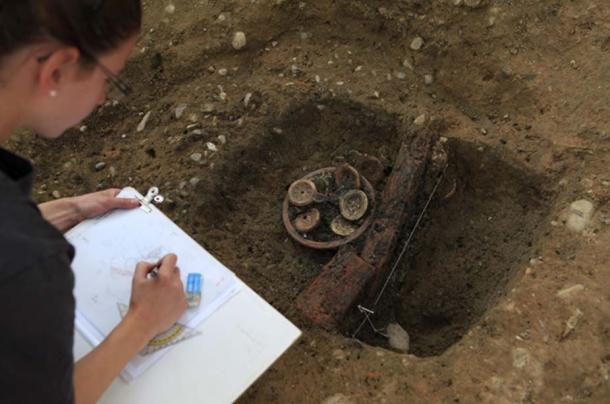
A team of archaeologists have discovered a peculiar Roman-era earthenware pot filled with 22 oil lamps, each containing a bronze coin, in Windisch, a municipality in the district of Brugg in the canton of Aargau in Switzerland. According to the Aargau canton archeology department , the pot was discovered under a street in the area as part of an archaeological investigation in order for the local authorities to proceed with the construction of an ambitious architectural project comprising apartment blocks and commercial property.
The Romans Made It to Switzerland Almost 2000 Years Ago
Experts believe that the pot has probably been buried there for nearly 2,000 years, dating it from the time of the Roman legion camp Vindonissa, which was located near where Windisch is now. According to most contemporary historians Vindonissa was probably established in 15 AD. The Legio XIII Gemina, also known as Legio tertia decima Gemina, was stationed at Vindonissa until 44 or 45 AD. It was a legion of the Imperial Roman army and according to most historical accounts it was one of Julius Caesar's most powerful and important units in Gaul and in the civil war. It was also the legion with which Julius Caesar crossed the Rubicon on January 10, 49 BC and what’s even more impressive is that the legion appears to have still been in existence in the 5th century AD. With the arrival of the 21st legion (XXI Rapax), the camp was reconstructed with stone fortifications. After the 21st legion had looted the countryside in 69 AD, it was replaced by the 11th legion (XI Claudia) which remained stationed until 101 AD. After this date, Vindonissa was a civilian settlement, with a castle built in the 4th century.
The Roman amphitheatre of Vindonissa, now Windisch, Switzerland ( public domain ) A Very Exciting but Also Mysterious Discovery Previous archaeological excavations in the area have exhumed clear confirmation of organized habitation and civilization dating from the Roman era, including the foundations of relatively big structures. This discovery, however, is considered by most archaeologists and experts a very special and puzzling one. Despite the pot being pretty common and representative of the cooking pots used by soldiers stationed at Vindonissa, the purpose of its contents – 22 oil lamps, each containing a carefully situated coin – is surrounded by mystery. Aargau cantonal archaeologist Georg Matter, describes the mixed feelings of his team after the fascinating discovery in the best possible way, “What astonished us was the quantity and the combination of coins and lamps” [via The Local.ch ]. Every single lamp is decorated with an image, including the moon goddess Luna, a gladiator, a lion, a peacock and an erotic scene. The bronze coins are not of value but demonstrate a symbolic gesture and date from 66-67 AD.
An extraordinary find: A Roman cooking pot filled with lamps and coins. Credit: Aargau canton archeology department Future Discoveries Might Reveal More about the Pot’s Content The pot also contained charred fragments of animal bones, ruling it out as an urn for human remains. Despite Matter not being sure about the nature of the pot and its content, he speculates that it could be a ritual burial. However, the fact that there have never been any other comparable or similar discoveries, makes things for Matter and his team even harder. “The intentions behind this burial are puzzling at the moment,” adds Matter, who hopes that additional discoveries will help him understand the use of the pot and its content a little better. From a historical point of view, it’s interesting to notice that the Romans made it right over the Swiss Alps with no modern conveniences, a fact that clearly shows that nothing was poised to stop the ferocious Roman Legions back then.
A researcher documents the Roman find. Credit: Aargau canton archeology department
Top image: The recently discovered pot containing 22 oil lamps. Credit: Aargau canton archeology department
By Theodoros II
The Roman amphitheatre of Vindonissa, now Windisch, Switzerland ( public domain ) A Very Exciting but Also Mysterious Discovery Previous archaeological excavations in the area have exhumed clear confirmation of organized habitation and civilization dating from the Roman era, including the foundations of relatively big structures. This discovery, however, is considered by most archaeologists and experts a very special and puzzling one. Despite the pot being pretty common and representative of the cooking pots used by soldiers stationed at Vindonissa, the purpose of its contents – 22 oil lamps, each containing a carefully situated coin – is surrounded by mystery. Aargau cantonal archaeologist Georg Matter, describes the mixed feelings of his team after the fascinating discovery in the best possible way, “What astonished us was the quantity and the combination of coins and lamps” [via The Local.ch ]. Every single lamp is decorated with an image, including the moon goddess Luna, a gladiator, a lion, a peacock and an erotic scene. The bronze coins are not of value but demonstrate a symbolic gesture and date from 66-67 AD.
An extraordinary find: A Roman cooking pot filled with lamps and coins. Credit: Aargau canton archeology department Future Discoveries Might Reveal More about the Pot’s Content The pot also contained charred fragments of animal bones, ruling it out as an urn for human remains. Despite Matter not being sure about the nature of the pot and its content, he speculates that it could be a ritual burial. However, the fact that there have never been any other comparable or similar discoveries, makes things for Matter and his team even harder. “The intentions behind this burial are puzzling at the moment,” adds Matter, who hopes that additional discoveries will help him understand the use of the pot and its content a little better. From a historical point of view, it’s interesting to notice that the Romans made it right over the Swiss Alps with no modern conveniences, a fact that clearly shows that nothing was poised to stop the ferocious Roman Legions back then.
A researcher documents the Roman find. Credit: Aargau canton archeology department
Top image: The recently discovered pot containing 22 oil lamps. Credit: Aargau canton archeology department
By Theodoros II
Subscribe to:
Comments (Atom)