Showing posts with label coins. Show all posts
Thursday, November 16, 2017
Valuable Jewels, Ornate Lamps and Coins Unearthed from 2,000-Year-Old Tombs in Corinth
Ancient Origins
A team of Greek researchers has unearthed unique jewels, coins and other precious artifacts while excavating tombs near the ruins of the ancient city of Corinth. Experts estimate that the newly found objects date between the fourth and first centuries AD.
Unique Jewels and Coins Excavated Near Ancient Corinth
Τhe team of scientists led by Elena Korka of the Greek Ministry, discovered the rare artifacts in eastern Corinthia, at the site of the ancient village of Tenea, during excavation works at a burial ground with two characteristic chambers built when Greece was part of the Roman Empire, as Newsweek reports. The Greek Ministry of Culture announced in a statement that the Greco-Roman burial structures were most likely constructed during a Hellenistic period between the death of Alexander the Great in 323 BC, up until the Battle of Corinth in 146 BC. Archaeologists suggest that five of the better equipped tombs probably belonged to rich ancient Corinthian residents. The bodies were found alongside intricate gilded bronze leaves, a golden ring, valuable stones, as well as gold and bronze coins from the surrounding region as Newsweek reports. Other characteristic items of rituals buried with the dead included perfumes, artifacts made of gold, gold foil and beautifully crafted glassware, as well as items of pottery.
Gilded bronze leaves, a gold ring, valuable stone and coins were found. (Image: Greek Ministry of Antiquities)
Several Graves Organized in Circles
Furthermore, the researchers also excavated from the dig site many different burial plots. Interestingly, fourteen of the graves had been organized in circles – a common Roman tradition. These burials yielded gold and silver coins, vases, and lamps depicting the goddess Venus and two cupids. “Roman-period builders also repurposed the limestone foundations of earlier Greek structures to build the tombs for wealthy, Roman-era occupants,” Elena Korka said as Newsweek reports. Evidence of graves from the earlier Greek period was also traced in other areas of the dig site, including a figurine in the shape of a dove.
The Tenea dig site of 2017. (Image: Greek Ministry of Antiquities)
Greek Culture Conquered Its Roman Conquerors
By using the term “Roman Greece”, historians describe the period of Greek history following the Roman victory over the Corinthians, at the Battle of Corinth (146 BC), until the adoption of the city of Byzantium by the Emperor Constantine the Great as the capital of the Byzantine Empire. Regardless, some Greek cities (such as Pergamon) managed to maintain partial independence and avoid taxation. Most importantly, however, the Greeks were able to maintain a cultural autonomy from their Roman conquerors during the early period of empire, thanks to their rich civilization. Many temples and public buildings were built in Greece by emperors and wealthy Roman nobility, while this would become the longest period of peace in Greek history.
Items found included, gold items, glassware and pottery. (Image: Greek Ministry of Antiquities)
Even though a few Roman nobles regarded the Greeks as petty and inferior, the majority of Romans embraced Greek literature and philosophy. The Greek language became a favorite of the educated and elite Roman citizens, such as Scipio Africanus, who tended to study philosophy and regard Greek culture and science as an example to be followed.
Similarly, most Roman emperors maintained an admiration for things Greek in nature. Hadrian, for example, was known to be fond of the Greeks and before he would become emperor he served as an eponymous archon of Athens, where he constructed the famous Arch of Hadrian.
Arch of Hadrian, Athens. (CC BY-SA 3.0)
Corinth in particular – which was partially destroyed by the Romans in 146 BC – was rebuilt in 44 BC as a Roman city under Julius Caesar. Roman Corinth prospered more than any other Greek city at the time and according to various historical accounts, it had as many as 800,000 inhabitants by the time of Paul. It was the capital of Roman Greece, equally devoted to merchants and entertainment.
Generally speaking, one could say that life in Greece continued under the Roman Empire much the same as it had previously (minus the civil wars). And even though the exhausted Greek city-states after hundreds of years of wars (against each other in most cases) were conquered by the Roman military on the battlefield, it was Roman culture that was conquered by the Greeks, a fact that is best highlighted on Horace’s quotation, “Graecia capta ferum victorem cepit” (translated: Captive Greece captured her rude conqueror).
Top image: The findings included vases and a series of lamps, notably some included depictions of the Roman goddess Venus and two cupids. (Image: Greek Ministry of Antiquities)
By Theodoros Karasavvas
Friday, September 1, 2017
Analysis of Roman Coins Proves Roman Empire Got Rich on Iberian Silver
Ancient Origins
An analysis of Roman coins has revealed information about the defeat of the Carthaginian General Hannibal and the rise of the Roman Empire. The scientists who examined them suggest that the defeat of the Carthaginian general led to a flood of wealth across the Roman Empire coming from mines on the Iberian Peninsula in Spain.
Roman Coins Track Down the Fall of Hannibal of Carthage and the Rise of Roman Empire A recent examination of Roman coins has revealed how the defeat of Hannibal and the Carthaginian Empire led to coinage spreading across the Roman Empire from silver mines in Spain, as Phys Org reports.
Hannibal was a Carthaginian general who fought against Rome during the second Punic war. His name became synonymous with inciting fear, and to this day he is considered one of the greatest military leaders of all time. As reported in a previous Ancient Origins article, Hannibal was born in Carthage (known as Tunisia today) in 247 BC to Carthaginian leader Hamilcar Barca. One of his most notable achievements was his crossing of the Alps into Italy, where he sought to join up with anti-Roman allies in the region.
According to many historical accounts he led the Carthaginian army and a team of elephants across southern Europe and the Alps Mountains to battle against Rome in the Second Punic War. There has been much scholarly debate as to Hannibal’s exact path through the Alps, but it is the consensus that the journey was treacherous.
Detail, Hannibal's Famous Crossing of the Alps with War Elephants (Public Domain )
During the Second Punic War, Hannibal defeated the Roman army in several battles, but never managed to capture the city completely. Eventually, Rome counterattacked and he was forced to return to Carthage where he was defeated. He worked for a time as a statesman before he was forced into exile by Rome. To avoid capture by the Romans, he eventually took his own life.
Geochemical Analysis Techniques Reveal New Information
Many centuries after the end of the Second Punic War and Hannibal’s downfall, the use of geochemical analysis techniques has helped modern scientists to prove the vast significance of the Spanish silver – owned by Hannibal before losing to the Romans – to the Roman Empire’s rise. As Phys Org reports, a team of scientists based in Germany and Denmark examined seventy Roman coins dating from around 310 to 101 BC. The coins were drilled at the rim to obtain fresh, untouched heart metal for the measurements. Using Mass Spectrometry, the scientists were able to show that lead in the coins made after 209 BC has characteristic isotopic signatures which identified most of the later coins as undoubtedly originating from Spanish sources. After 209 BC, the lead isotope signatures mainly correlate to those of deposits in southeast and southwest Spain or to mixtures of metal unearthed from these districts.
"Before the war, we find that the Roman coins are made of silver from the same sources as the coinage issued by Greek cities in Italy and Sicily. In other words the lead isotope signatures of the coins correspond to those of silver ores and metallurgical products from the Aegean region," researcher Katrin Westner told Phys Org. And added, "But the defeat of Carthage led to huge reparation payments to Rome, as well as Rome gaining large amounts of booty and ownership of the rich Spanish silver mines. From 209 BC, we see that the majority of Roman coins show geochemical signatures typical for Iberian silver."
A Carthaginian silver shekel depicting a man wearing a laurel wreath on the obverse, and a man riding a war elephant on the reverse, c. 239-209 BC (CC BY-SA 3.0)
Iberian Silver Changes Rome's Economic Status
The scientists have no doubt that the incredible flood of wealth across the Roman territories coming from mines on Iberian Peninsula played a significant role to the Empire’s economic rise, “This massive influx of Iberian silver significantly changed Rome's economy, allowing it to become the superpower of its day. We know this from the histories of Livy and Polybius and others, but our work gives contemporary scientific proof of the rise of Rome. What our work shows is that the defeat of Hannibal and the rise of Rome is written in the coins of the Roman Empire,” they stated as Phys Org reports. Furthermore, Dr. Kevin Butcher of the University of Warwick, said the project has verified what had previously only been speculation, "This research demonstrates how scientific analysis of ancient coins can make a significant contribution to historical research. It allows what was previously speculation about the importance of Spanish silver for the coinage of Rome to be placed on a firm foundation."
The scientists presented their work for the first time in Paris yesterday, at the Goldschmidt geochemistry conference.
Top image: The Battle of Cannae was a major battle of the Second Punic War that took place on 2 August 216 BC in Apulia, in southeast Italy. The army of Carthage, under Hannibal, surrounded and decisively defeated a larger army of the Roman Republic (public domain)
By Theodoros Karasavvas
Sunday, April 16, 2017
1,400-Year-Old Coins are the Forgotten Remnants of a Terrifying Siege on Jerusalem
Ancient Origins
Israeli archaeologists have announced the discovery of a hoard of rare Byzantine bronze coins from a site dating back to 614 AD. The coins were discovered during excavations for the widening of the Tel Aviv- Jerusalem highway.
Persian Invasion and Siege of Jerusalem
The newly found coins are clear evidence of the Persian invasion of Jerusalem at the end of the Byzantine period. As the Persian army (supported by many Jewish rebels) marched on Jerusalem in 614 AD, Christians living in the town rushed to hide their possessions, including a hoard of the valuable coins, hoping that things would soon go back to normal.
Nine bronze coins dating to the Byzantine period were hidden in the remains of a settlement near a highway to Jerusalem. (Yoli Shwartz, courtesy of the Israel Antiquities Authority)
Annette Landes-Naggar, Israel Antiquities Authority archaeologist and the one who announced the discovery to the press said, as The Jerusalem Post reports, “The cache was buried adjacent to an area of collapsed large stones. It appears that the owner hid them when there was danger, hoping to return to pick them up. But now we know he was unable to.” She continued, “Apparently, this was during the time of the Persian Sassanid invasion, around 614 AD,” noting that the invasion was among the factors that ended the reign of the Byzantine emperors in Israel. “Fearing the invasion, residents of the area who felt their lives were in danger buried their money against the wall of a winepress. [However], the site was abandoned and destroyed,” Landes-Naggar concluded.
The excavation area and the collapsed wall where the Byzantine coin hoard was found. (Maxim Dinstein, courtesy of the Israel Antiquities Authority)
The Sasanian Empire – the last imperial dynasty in Iran before the rise of Islam – conquered Jerusalem after a brief siege in 614, during the Byzantine–Sasanian War of 602–628, after the Persian Shah Khosrau II appointed his general Shahrbaraz to conquer the Byzantine controlled areas of the Near East.
More than 20,000 Jewish rebels joined the war against the Byzantine Christians and the Persian army, reinforced by Jewish forces and led by Nehemiah ben Hushiel and Benjamin of Tiberias, captured Jerusalem without resistance. According to Sebeos, a 7th-century Armenian bishop and historian, the siege resulted in a total Christian death toll of 17000 and nearly 5000 prisoners, who were massacred near Mamilla reservoir per Antiochus.
Battle between Heraclius' army and Persians under Khosrau II. Fresco by Piero della Francesca, c. 1452. (Public Domain) Experts believe the coins were hidden while there was a siege on Jerusalem in 614, during the Byzantine–Sasanian War of 602–628.
The Coins Tell the Story of the Site
Fast-forward 1,400 years to the summer of 2016, Israeli archaeologists excavating some Byzantine ruins in the area unearthed a cache consisting of nine bronze coins dating from the Byzantine Period around 324-638 AD. The announcement was scheduled to precede the upcoming Easter holiday, which falls this year on April 16, as part of a push coordinated with the Tourism Ministry to boost Christian pilgrimage to Israel. “The coins were found adjacent to the external wall of one of the monumental buildings found at the site, and it was found among the building stones that collapsed from the wall,” Landes-Naggar told The Times of Israel.
Byzantine coins found by Israel Antiquities Authority archaeologists in 2016 and shown to the press in March 2017. (Ilan Ben Zion/Time of Israel staff)
The coins depict the faces of notable Byzantine Emperors such as Justinian I, Maurice, and Phocas, and were minted in Constantinople, Antioch, and Nicomedia. Despite not being particularly rare or of great value they “betray” the story of the site as Landes-Naggar noted,
“It’s the context of the coins that gives us the puzzle of what happened. This site is situated alongside the main road from the entrance to Jerusalem and was used by Christian pilgrims to enter the city. Settlements were developed along the road.”
Local authorities along with the Israel Pipeline Company are committed to working together to preserve the site for the public.
Top Image: The Byzantine coins found near Jerusalem have been dated to around the time of a 614 siege. Source: YOLI SCHWARTZ/IAA
By Theodoros Karasavvas
Israeli archaeologists have announced the discovery of a hoard of rare Byzantine bronze coins from a site dating back to 614 AD. The coins were discovered during excavations for the widening of the Tel Aviv- Jerusalem highway.
Persian Invasion and Siege of Jerusalem
The newly found coins are clear evidence of the Persian invasion of Jerusalem at the end of the Byzantine period. As the Persian army (supported by many Jewish rebels) marched on Jerusalem in 614 AD, Christians living in the town rushed to hide their possessions, including a hoard of the valuable coins, hoping that things would soon go back to normal.
Nine bronze coins dating to the Byzantine period were hidden in the remains of a settlement near a highway to Jerusalem. (Yoli Shwartz, courtesy of the Israel Antiquities Authority)
Annette Landes-Naggar, Israel Antiquities Authority archaeologist and the one who announced the discovery to the press said, as The Jerusalem Post reports, “The cache was buried adjacent to an area of collapsed large stones. It appears that the owner hid them when there was danger, hoping to return to pick them up. But now we know he was unable to.” She continued, “Apparently, this was during the time of the Persian Sassanid invasion, around 614 AD,” noting that the invasion was among the factors that ended the reign of the Byzantine emperors in Israel. “Fearing the invasion, residents of the area who felt their lives were in danger buried their money against the wall of a winepress. [However], the site was abandoned and destroyed,” Landes-Naggar concluded.
The excavation area and the collapsed wall where the Byzantine coin hoard was found. (Maxim Dinstein, courtesy of the Israel Antiquities Authority)
The Sasanian Empire – the last imperial dynasty in Iran before the rise of Islam – conquered Jerusalem after a brief siege in 614, during the Byzantine–Sasanian War of 602–628, after the Persian Shah Khosrau II appointed his general Shahrbaraz to conquer the Byzantine controlled areas of the Near East.
More than 20,000 Jewish rebels joined the war against the Byzantine Christians and the Persian army, reinforced by Jewish forces and led by Nehemiah ben Hushiel and Benjamin of Tiberias, captured Jerusalem without resistance. According to Sebeos, a 7th-century Armenian bishop and historian, the siege resulted in a total Christian death toll of 17000 and nearly 5000 prisoners, who were massacred near Mamilla reservoir per Antiochus.
Battle between Heraclius' army and Persians under Khosrau II. Fresco by Piero della Francesca, c. 1452. (Public Domain) Experts believe the coins were hidden while there was a siege on Jerusalem in 614, during the Byzantine–Sasanian War of 602–628.
The Coins Tell the Story of the Site
Fast-forward 1,400 years to the summer of 2016, Israeli archaeologists excavating some Byzantine ruins in the area unearthed a cache consisting of nine bronze coins dating from the Byzantine Period around 324-638 AD. The announcement was scheduled to precede the upcoming Easter holiday, which falls this year on April 16, as part of a push coordinated with the Tourism Ministry to boost Christian pilgrimage to Israel. “The coins were found adjacent to the external wall of one of the monumental buildings found at the site, and it was found among the building stones that collapsed from the wall,” Landes-Naggar told The Times of Israel.
Byzantine coins found by Israel Antiquities Authority archaeologists in 2016 and shown to the press in March 2017. (Ilan Ben Zion/Time of Israel staff)
The coins depict the faces of notable Byzantine Emperors such as Justinian I, Maurice, and Phocas, and were minted in Constantinople, Antioch, and Nicomedia. Despite not being particularly rare or of great value they “betray” the story of the site as Landes-Naggar noted,
“It’s the context of the coins that gives us the puzzle of what happened. This site is situated alongside the main road from the entrance to Jerusalem and was used by Christian pilgrims to enter the city. Settlements were developed along the road.”
Local authorities along with the Israel Pipeline Company are committed to working together to preserve the site for the public.
Top Image: The Byzantine coins found near Jerusalem have been dated to around the time of a 614 siege. Source: YOLI SCHWARTZ/IAA
By Theodoros Karasavvas
Sunday, April 9, 2017
Crusader Shipwreck Yields Coins and Other Artifacts from the Final Years of a Holy Land Fortress
Ancient Origins
Marine archaeologists have discovered some intriguing artifacts in the wreck of a ship belonging to the Crusaders in Acre, Israel. It dates to the time of the valiant last stand by the few remaining knights and mercenaries who died heroically defending the walls of the last powerful Christian fortress in the Holy Land.
The Geopolitical Significance of Acre in the Past
The Crusader kingdom in the Holy Land began to collapse in the later part of the 13th century. The fall of Jaffa and Antioch in 1268 to the Muslims forced Louis IX to undertake the Eighth Crusade (1270), which was cut short by his death in Tunisia. The Ninth Crusade (1271–72), was led by Prince Edward, who landed at Acre but retired after concluding a truce. In 1289, Tripoli fell to the Muslims, leaving Acre as the only remaining Christian fortress in the Holy Land. Capturing Acre was extremely crucial from a geopolitical and strategical point of view for the Mamluks, as Western European forces had used the site for a very long time as a landing point for European soldiers, knights, and horses, as well as an international commercial spot for the export of sugar, spices, glass, and textiles back to Europe.
The fall of Tripoli to the Mamluks, April 1289. This was a battle towards the end of the Crusades and preceded the siege of Acre. (Public Domain)
During the spring of 1291, the Egyptian sultan Al-Ashraf Khalil with his immense forces (over 100,000 cavalry and foot soldiers) attacked the fortress in Acre and for six weeks the siege dragged on - until the Mamluks took the outer wall. The Military Orders drove back the Mamluks temporarily, but three days later the inner wall was breached. King Henry escaped, but the bulk of the defenders and most of the citizens perished in the fighting or were sold into slavery. The surviving knights fell back to their fortress, resisting for ten days, until the Mamluks broke through, killing them. Western Christianity would never again establish a firm foothold in the Middle East.
The Siege of Acre. The Hospitalier Master Mathieu de Clermont defending the walls in 1291. (Public Domain)
The Discovery of the Wreck at Acre
Marine archaeologists from Haifa University, Prof. Michal Artzy and Dr. Ehud Galili, led the exploration of the Crusader shipwreck. The ship was severely damaged during the construction of the modern harbor of Acre, while the surviving wreckage includes some ballast-covered wooden planks, the ship’s keel, and a few sections of its hull. Carbon dating showed that the wood used to construct the hull dates to between 1062 AD and 1250 AD. Among the keel and planks that remain, thirty impressive golden coins were also found according to an article appearing in Haaretz.
Florins found in the Crusader shipwreck of Acre harbor. (Israel Antiquities Authority)
Robert Kool of Israel Antiquities Authority identified the coins as "florins," which were used in Florence during the 1200’s. Historical firsthand sources from the Siege of Acre recorded that nobles and merchants used such coins to bribe the owners of the boats in order to buy their fleet. In addition to the golden coins found near the wreckage, marine archaeologists also found imported ceramic bowls and jugs from southern Italy, Syria, and Cyprus; corroded pieces of iron, mostly nails, and anchors. Excavation work in the area began last year and the impressive new finds are now coming to light.
Glazed Crusader bowl with human face, found in Acre. (Michal Artzy)
Top Image: A grapnel anchor found in Acre harbor by marine archaeologists. (Ehud Galili) Gold coin issued by John III, Holy Emperor of Nicaea III (1222-1254 AD), found in Acre. (Zinman Institute of the University of Haifa and the Deutsche Orden) And Glazed Crusader bowl and horseshoe, imported from Europe. (Michal Artzy)
By Theodoros Karasavvas
Marine archaeologists have discovered some intriguing artifacts in the wreck of a ship belonging to the Crusaders in Acre, Israel. It dates to the time of the valiant last stand by the few remaining knights and mercenaries who died heroically defending the walls of the last powerful Christian fortress in the Holy Land.
The Geopolitical Significance of Acre in the Past
The Crusader kingdom in the Holy Land began to collapse in the later part of the 13th century. The fall of Jaffa and Antioch in 1268 to the Muslims forced Louis IX to undertake the Eighth Crusade (1270), which was cut short by his death in Tunisia. The Ninth Crusade (1271–72), was led by Prince Edward, who landed at Acre but retired after concluding a truce. In 1289, Tripoli fell to the Muslims, leaving Acre as the only remaining Christian fortress in the Holy Land. Capturing Acre was extremely crucial from a geopolitical and strategical point of view for the Mamluks, as Western European forces had used the site for a very long time as a landing point for European soldiers, knights, and horses, as well as an international commercial spot for the export of sugar, spices, glass, and textiles back to Europe.
The fall of Tripoli to the Mamluks, April 1289. This was a battle towards the end of the Crusades and preceded the siege of Acre. (Public Domain)
During the spring of 1291, the Egyptian sultan Al-Ashraf Khalil with his immense forces (over 100,000 cavalry and foot soldiers) attacked the fortress in Acre and for six weeks the siege dragged on - until the Mamluks took the outer wall. The Military Orders drove back the Mamluks temporarily, but three days later the inner wall was breached. King Henry escaped, but the bulk of the defenders and most of the citizens perished in the fighting or were sold into slavery. The surviving knights fell back to their fortress, resisting for ten days, until the Mamluks broke through, killing them. Western Christianity would never again establish a firm foothold in the Middle East.
The Siege of Acre. The Hospitalier Master Mathieu de Clermont defending the walls in 1291. (Public Domain)
The Discovery of the Wreck at Acre
Marine archaeologists from Haifa University, Prof. Michal Artzy and Dr. Ehud Galili, led the exploration of the Crusader shipwreck. The ship was severely damaged during the construction of the modern harbor of Acre, while the surviving wreckage includes some ballast-covered wooden planks, the ship’s keel, and a few sections of its hull. Carbon dating showed that the wood used to construct the hull dates to between 1062 AD and 1250 AD. Among the keel and planks that remain, thirty impressive golden coins were also found according to an article appearing in Haaretz.
Florins found in the Crusader shipwreck of Acre harbor. (Israel Antiquities Authority)
Robert Kool of Israel Antiquities Authority identified the coins as "florins," which were used in Florence during the 1200’s. Historical firsthand sources from the Siege of Acre recorded that nobles and merchants used such coins to bribe the owners of the boats in order to buy their fleet. In addition to the golden coins found near the wreckage, marine archaeologists also found imported ceramic bowls and jugs from southern Italy, Syria, and Cyprus; corroded pieces of iron, mostly nails, and anchors. Excavation work in the area began last year and the impressive new finds are now coming to light.
Glazed Crusader bowl with human face, found in Acre. (Michal Artzy)
Top Image: A grapnel anchor found in Acre harbor by marine archaeologists. (Ehud Galili) Gold coin issued by John III, Holy Emperor of Nicaea III (1222-1254 AD), found in Acre. (Zinman Institute of the University of Haifa and the Deutsche Orden) And Glazed Crusader bowl and horseshoe, imported from Europe. (Michal Artzy)
By Theodoros Karasavvas
Saturday, December 3, 2016
Puzzling Roman-Era Remains Found in Switzerland
Ancient Origins
A team of archaeologists have discovered a peculiar Roman-era earthenware pot filled with 22 oil lamps, each containing a bronze coin, in Windisch, a municipality in the district of Brugg in the canton of Aargau in Switzerland. According to the Aargau canton archeology department , the pot was discovered under a street in the area as part of an archaeological investigation in order for the local authorities to proceed with the construction of an ambitious architectural project comprising apartment blocks and commercial property.
The Romans Made It to Switzerland Almost 2000 Years Ago
Experts believe that the pot has probably been buried there for nearly 2,000 years, dating it from the time of the Roman legion camp Vindonissa, which was located near where Windisch is now. According to most contemporary historians Vindonissa was probably established in 15 AD. The Legio XIII Gemina, also known as Legio tertia decima Gemina, was stationed at Vindonissa until 44 or 45 AD. It was a legion of the Imperial Roman army and according to most historical accounts it was one of Julius Caesar's most powerful and important units in Gaul and in the civil war. It was also the legion with which Julius Caesar crossed the Rubicon on January 10, 49 BC and what’s even more impressive is that the legion appears to have still been in existence in the 5th century AD. With the arrival of the 21st legion (XXI Rapax), the camp was reconstructed with stone fortifications. After the 21st legion had looted the countryside in 69 AD, it was replaced by the 11th legion (XI Claudia) which remained stationed until 101 AD. After this date, Vindonissa was a civilian settlement, with a castle built in the 4th century.
The Roman amphitheatre of Vindonissa, now Windisch, Switzerland ( public domain ) A Very Exciting but Also Mysterious Discovery Previous archaeological excavations in the area have exhumed clear confirmation of organized habitation and civilization dating from the Roman era, including the foundations of relatively big structures. This discovery, however, is considered by most archaeologists and experts a very special and puzzling one. Despite the pot being pretty common and representative of the cooking pots used by soldiers stationed at Vindonissa, the purpose of its contents – 22 oil lamps, each containing a carefully situated coin – is surrounded by mystery. Aargau cantonal archaeologist Georg Matter, describes the mixed feelings of his team after the fascinating discovery in the best possible way, “What astonished us was the quantity and the combination of coins and lamps” [via The Local.ch ]. Every single lamp is decorated with an image, including the moon goddess Luna, a gladiator, a lion, a peacock and an erotic scene. The bronze coins are not of value but demonstrate a symbolic gesture and date from 66-67 AD.
An extraordinary find: A Roman cooking pot filled with lamps and coins. Credit: Aargau canton archeology department Future Discoveries Might Reveal More about the Pot’s Content The pot also contained charred fragments of animal bones, ruling it out as an urn for human remains. Despite Matter not being sure about the nature of the pot and its content, he speculates that it could be a ritual burial. However, the fact that there have never been any other comparable or similar discoveries, makes things for Matter and his team even harder. “The intentions behind this burial are puzzling at the moment,” adds Matter, who hopes that additional discoveries will help him understand the use of the pot and its content a little better. From a historical point of view, it’s interesting to notice that the Romans made it right over the Swiss Alps with no modern conveniences, a fact that clearly shows that nothing was poised to stop the ferocious Roman Legions back then.
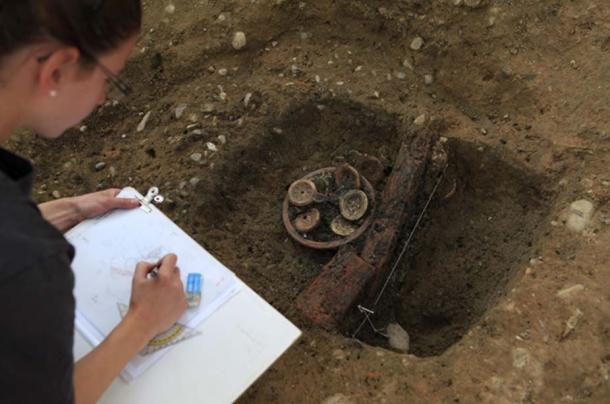
A researcher documents the Roman find. Credit: Aargau canton archeology department
Top image: The recently discovered pot containing 22 oil lamps. Credit: Aargau canton archeology department
By Theodoros II
The Roman amphitheatre of Vindonissa, now Windisch, Switzerland ( public domain ) A Very Exciting but Also Mysterious Discovery Previous archaeological excavations in the area have exhumed clear confirmation of organized habitation and civilization dating from the Roman era, including the foundations of relatively big structures. This discovery, however, is considered by most archaeologists and experts a very special and puzzling one. Despite the pot being pretty common and representative of the cooking pots used by soldiers stationed at Vindonissa, the purpose of its contents – 22 oil lamps, each containing a carefully situated coin – is surrounded by mystery. Aargau cantonal archaeologist Georg Matter, describes the mixed feelings of his team after the fascinating discovery in the best possible way, “What astonished us was the quantity and the combination of coins and lamps” [via The Local.ch ]. Every single lamp is decorated with an image, including the moon goddess Luna, a gladiator, a lion, a peacock and an erotic scene. The bronze coins are not of value but demonstrate a symbolic gesture and date from 66-67 AD.
An extraordinary find: A Roman cooking pot filled with lamps and coins. Credit: Aargau canton archeology department Future Discoveries Might Reveal More about the Pot’s Content The pot also contained charred fragments of animal bones, ruling it out as an urn for human remains. Despite Matter not being sure about the nature of the pot and its content, he speculates that it could be a ritual burial. However, the fact that there have never been any other comparable or similar discoveries, makes things for Matter and his team even harder. “The intentions behind this burial are puzzling at the moment,” adds Matter, who hopes that additional discoveries will help him understand the use of the pot and its content a little better. From a historical point of view, it’s interesting to notice that the Romans made it right over the Swiss Alps with no modern conveniences, a fact that clearly shows that nothing was poised to stop the ferocious Roman Legions back then.
A researcher documents the Roman find. Credit: Aargau canton archeology department
Top image: The recently discovered pot containing 22 oil lamps. Credit: Aargau canton archeology department
By Theodoros II
Monday, October 10, 2016
Roman Coins Discovered at Japanese Castle Raise Questions of Ancient Connections
Ancient Origins
Four Roman copper coins have been unearthed at Katsuren Castle on Okinawa Island, Japan. They are the first of their kind to be discovered in the country and have been dated to 300-400 AD. How the coins came to be at the castle is still a mystery.
According to Seeker, it was first believed that the coins were simply pennies dropped by U.S. soldiers, but washing them showed images of the Roman Emperor Constantine I. Archaeologist Hiroki Miyagi said that the discovery came as a shock and the Independent claims that the coins “were originally thought to be a hoax.”
Japan Times reports that the coins measure 1.6-2 cm (0.6-0.8 inches) in diameter. The designs on the coins are hard to see due to abrasion, however by using x-ray analysis, the researchers found depictions of a soldier holding a spear and the emperor Constantine I. The coins will be on display at Uruma City Yonagusuku Historical Museum in central Okinawa until Nov. 25.
Apart from the Roman coins, the researchers also found a coin from the 17th century Ottoman Empire. Five other possible coins have also been discovered at the castle since excavations began there in 2013.
Jcastle provides more of Amawari’s tale and says that:
Could this suggest Romans had connections or even direct influence on ancient Japan? MessageToEagle.com believes so, and writes “Ancient Romans obviously visited the Katsuren Castle in Japan.” They point to previous evidence of three Roman glass beads found in a 5th century Kyoto burial, as more proof of possible connections. Speaking on the beads, researcher Tomomi Tamura said “They are one of the oldest multilayered glass products found in Japan, and very rare accessories that were believed to be made in the Roman Empire and sent to Japan.”
Top Image: Katsuren Castle, Uruma, Okinawa Prefecture, Japan. (kanegen/CC BY 2.0) Insert: A 4th-century copper coin from ancient Rome found at the castle. (Uruma Board of Education)
By Alicia McDermott
According to Seeker, it was first believed that the coins were simply pennies dropped by U.S. soldiers, but washing them showed images of the Roman Emperor Constantine I. Archaeologist Hiroki Miyagi said that the discovery came as a shock and the Independent claims that the coins “were originally thought to be a hoax.”
Two artifacts found at Katsuren Castle: A Roman coin (Uruma Board of Education) and an Ottoman coin. (Uruma Board of Education)
Apart from the Roman coins, the researchers also found a coin from the 17th century Ottoman Empire. Five other possible coins have also been discovered at the castle since excavations began there in 2013.
- The Seven-Branched Sword: The Mystical Ceremonial Sword of Japan
- Beware of the Cat: Tales of the Wicked Japanese Bakeneko and Nekomata – Part 1
Excavations at the site. (Urama Board of Education)
Katsuren Castle was built sometime in the late 13th - early 14th century, and it was abandoned about 200 years later. The castle ruins received UNESCO recognition in 2000. Japan-guide.com tells one of the most famous legends of the castle. It is associated with Lord Amawari, who was the 10th lord of the castle. They write “Amawari was a sickly child that got abandoned in the mountains to die. However, the child survived and grew into a powerful leader who defeated an oppressive lord and took over Katsuren Castle.”Jcastle provides more of Amawari’s tale and says that:
“He is famous for fostering prosperous international trade and many shards of Chinese pottery and tiles were found on the site of Katsuren Castle. He was also a cunning and deceiving lord. It is said that he pushed the 9th lord Mochizuki Aji off the top of the walls when he tricked Mochizuki to come up there one night and thus assumed lordship of the castle. Mochizuki was considered to be a tyrant so Amawari was a savior to the people of Katsuren. As his strength grew, Lord Gosamaru was moved to Nakagusuku Castle to keep Awamari in check. Awamari deceived the king in Shuri that Gosamaru was the bigger threat and got his support to defeat Gosamaru. Later, he also planned to seize control of the whole kingdom and overtake the king at Shuri, but this time the king was warned in time and Amawari was defeated. Some stories say it was Amawari's wife (the king's daughter) who found out about the plot and warned her father in time. After Amawari, no powerful lords rose from Katsuren Castle.”
- A Surprising Japanese Interpretation of the Lost Years of Jesus Christ
- Glass shard found at Japanese shrine matches artifacts from Persian Royal Palace
The dress of Oji and Aji in Ryukyu Kingdom. (Public Domain)
Although the feudal lord was linked with international trade, no evidence of connections with Europe have been found before the present discovery of the coins. Miyagi offers one possible explanation for where the coins may have been before they arrived at the castle: "East Asian merchants in the 14 and 15th centuries mainly used Chinese currency, a round coin with a square hole in the middle, so it is unlikely that the Western coins were used as a means of currency. I believe they probably got the coins in Southeast Asia or China."Could this suggest Romans had connections or even direct influence on ancient Japan? MessageToEagle.com believes so, and writes “Ancient Romans obviously visited the Katsuren Castle in Japan.” They point to previous evidence of three Roman glass beads found in a 5th century Kyoto burial, as more proof of possible connections. Speaking on the beads, researcher Tomomi Tamura said “They are one of the oldest multilayered glass products found in Japan, and very rare accessories that were believed to be made in the Roman Empire and sent to Japan.”
A glass bead that was made by Roman craftsmen - found in an ancient tomb at Nagaokakyo near Kyoto. (Nara National Research Institute)
The board of education in the city of Uruma echoes Tomomi Tamura by saying that the recent discovery of the Roman coins is “precious historical material suggesting a link between Okinawa and the Western world.” How close that link may have been is still debated.Top Image: Katsuren Castle, Uruma, Okinawa Prefecture, Japan. (kanegen/CC BY 2.0) Insert: A 4th-century copper coin from ancient Rome found at the castle. (Uruma Board of Education)
By Alicia McDermott
Thursday, June 23, 2016
The Impressive Gaulcross Hoard: 100 Roman-Era Silver Pieces Unearthed in Scotland
Ancient Origins
Archaeologists discovered a hoard of 100 silver items, including coins and jewelry, which come from the 4th and 5th centuries AD. The treasure belongs to the period of the Roman Empire’s domination in Scotland, or perhaps later.
Almost 200 years ago, a team of Scottish laborers cleared a rocky field with dynamite. They discovered three magnificent silver artifacts : a chain, a spiral bangle, and a hand pin. However, they didn't search any deeper to check if there were any more treasures. They turned the field into a farmland and excavations were forgotten.
Now, archaeologists have returned to the site and discovered a hoard (a group of valuable objects that is sometimes purposely buried underground) of 100 silver items. According to Live Science , the treasure is called the Gaulcross hoard. The artifacts belonged to the Pict people who lived in Scotland before, during, and after the Roman era.
The three previously discovered pieces were given to Banff Museum in Aberdeenshire, and are now on loan and display at the National Museum of Scotland in Edinburgh.
They also found a part of a silver bracelet, silver strap-end, and several pieces of folded hacksilver (pieces of cut or bent silver). They examined the field over the next 18 months, and as a result, they unearthed 100 pieces of silver all together.
The recent discoveries help shed light on the date of the Gaulcross hoard. It seems that some of the objects were connected with the elites. The silver hand pins and bracelets are very rare finds, so the researchers concluded that the objects would have belonged to some of the most powerful members of the post-Roman society.


The Vikings attacks led to the downfall of the Picts. As Holloway reported:
By Natalia Klimzcak
Almost 200 years ago, a team of Scottish laborers cleared a rocky field with dynamite. They discovered three magnificent silver artifacts : a chain, a spiral bangle, and a hand pin. However, they didn't search any deeper to check if there were any more treasures. They turned the field into a farmland and excavations were forgotten.
Now, archaeologists have returned to the site and discovered a hoard (a group of valuable objects that is sometimes purposely buried underground) of 100 silver items. According to Live Science , the treasure is called the Gaulcross hoard. The artifacts belonged to the Pict people who lived in Scotland before, during, and after the Roman era.
Silver plaque from the Norrie's Law hoard (7th-century Pictish silver hoard), Fife, with double disc and Z-rod symbol. ( CC BY SA 3.0 )
The artifacts were found by a team led by Gordon Noble, head of archaeology at the University of Aberdeen in Scotland. When they started work in the field, they didn't think to search for more artifacts, but were trying to learn more about the context of the discovery made nearly two centuries ago. The researchers claim that the field also contained two man-made stone circles - one dating to the Neolithic period and the other the Bronze Age (1670 – 1500 BC). The three previously discovered pieces were given to Banff Museum in Aberdeenshire, and are now on loan and display at the National Museum of Scotland in Edinburgh.
The surviving objects from the nineteenth-century Gaulcross hoard find. ( National Museums Scotland )
In 2013, two groups of researchers studied the field in northeastern Scotland with the help of metal detectors. It was the first time when researchers explored the field after such a long time. During the second day of work, they uncovered three Late-Roman-era silver "siliquae," or coins, that dated to the 4th or 5th century AD. They also found a part of a silver bracelet, silver strap-end, and several pieces of folded hacksilver (pieces of cut or bent silver). They examined the field over the next 18 months, and as a result, they unearthed 100 pieces of silver all together.
- 3,000-year-old broken weapons found in Scotland loch reveal ancient ritual offerings to gods
- The Missing Pieces: Unraveling the history of the Lewis Chessmen
The recent discoveries help shed light on the date of the Gaulcross hoard. It seems that some of the objects were connected with the elites. The silver hand pins and bracelets are very rare finds, so the researchers concluded that the objects would have belonged to some of the most powerful members of the post-Roman society.
Some of the finds from Gaulcross: A) the lunate/crescent-shaped pendant with two double-loops; B) silver hemispheres; C) a small, zoomorphic penannular brooch; D) one of the bracelet fragments with a Late Roman siliquae pinched inside ( National Museums Scotland )
Another important hoard has previously been uncovered in Scotland. Actually, on October 13, 2014, April Holloway of Ancient Origins reported on the discovery of one of the most significant Viking hoards found there to date. She wrote: ''An amateur treasure hunter equipped with a metal detector has unearthed a massive hoard of Viking artifacts in Dumfries and Galloway, in what has been described as one of the most significant archaeological finds in Scottish history. According to the Herald Scotland , more than 100 Viking relics were found, including silver ingots, armbands, brooches, and gold objects.”
- Treasure hunter uncovers one of the most significant Viking hoards ever found in Scotland
- Treasures Found Within Very Valuable Viking Hoard Finally Revealed
Detail of the Carolingian vessel of the famous Viking hoard. ( Historic Environment Scotland )
Holloway wrote that the Vikings “conducted numerous raids on Carolingian lands between 8th and 10th century AD” and explained that in a “few records, the Vikings are thought to have led their first raids in Scotland on the island of Iona in 794.” The Vikings attacks led to the downfall of the Picts. As Holloway reported:
“In 839, a large Norse fleet invaded via the River Tay and River Earn, both of which were highly navigable, and reached into the heart of the Pictish kingdom of Fortriu. They defeated the king of the Picts, and the king of the Scots of Dál Riata, along with many members of the Pictish aristocracy in battle. The sophisticated kingdom that had been built fell apart, as did the Pictish leadership.''
The Aberlemno Serpent Stone, Class I Pictish stone with Pictish symbols, showing (top to bottom) the serpent, the double disc and Z-rod and the mirror and comb. (Catfish Jim and the soapdish/ CC BY SA 3.0 )
Top Image: The Gaulcross silver hoard, including a silver ingot, Hacksilber and folded bracelets. Source: National Museums Scotland By Natalia Klimzcak
Monday, March 21, 2016
Hiker Finds Extremely Rare Gold Coin in Israel
Ancient Origins
A woman in the Galilee region of Israel stumbled across a rare gold coin while hiking with friends. The coin dates back to the year 107 AD and depicts the Roman Emperor Augustus. Only one other coin bears the likeness to it, and that one is a part of the collection of the British Museum. The Israel State Treasures have just two other gold coins that were also minted by the emperor Trajan.
Arutz Sheva reports that the coin was found by Laurie Rimon, a resident of Kibbutz Kfar Blum in northern Israel while she was resting during a hike near an archaeological site. Rimon showed the artifact to the group’s guide who quickly contacted the Israel Antiquities Authority (IAA). Soon after an IAA representative joined the group of hikers and Rimon turned the rare find over to him admitting, “It was not easy parting with the coin. After all, it is not every day one discovers such an amazing object, but I hope I will see it displayed in a museum in the near future."
Rimon will be awarded with a certificate of appreciation for good citizenship for her honesty. Nir Distelfeld, an inspector with the IAA Unit for the Prevention of Antiquities Robbery, also thanked Rimon for her act. “This is an extraordinarily remarkable and surprising discovery. I believe that soon, thanks to Laurie, the public will be able to enjoy this rare find.”
Returning to the gold coin, the Jerusalem Post says that it “was minted by Emperor Trajan as part of a series of nostalgic coins that Trajan minted and dedicated to the Roman emperors that ruled before him.”
Furthermore, Dr. Danny Syon, a senior numismatist of the IAA told the Jerusalem Post, “This coin, minted in Rome in 107 CE, is rare on a global level. On the reverse, we have the symbols of the Roman legions next to the name of the ruler Trajan, and on the obverse – instead of an image of the emperor Trajan, as was usually the case, there is the portrait of the emperor ‘Augustus Deified.’”
The Bar Kochba (Bar Kokhba) revolt was a Jewish rebellion against the Romans in Israel during 132-136 AD because of harsh treatment. At least some members of the legions were apparently well-compensated at the time. Ariel told the Times of Israel:
Featured Image: The extremely rare gold coin. Source: Samuel Magal, Israel Antiquities Authority
By Alicia McDermott
A woman in the Galilee region of Israel stumbled across a rare gold coin while hiking with friends. The coin dates back to the year 107 AD and depicts the Roman Emperor Augustus. Only one other coin bears the likeness to it, and that one is a part of the collection of the British Museum. The Israel State Treasures have just two other gold coins that were also minted by the emperor Trajan.
Arutz Sheva reports that the coin was found by Laurie Rimon, a resident of Kibbutz Kfar Blum in northern Israel while she was resting during a hike near an archaeological site. Rimon showed the artifact to the group’s guide who quickly contacted the Israel Antiquities Authority (IAA). Soon after an IAA representative joined the group of hikers and Rimon turned the rare find over to him admitting, “It was not easy parting with the coin. After all, it is not every day one discovers such an amazing object, but I hope I will see it displayed in a museum in the near future."
Rimon will be awarded with a certificate of appreciation for good citizenship for her honesty. Nir Distelfeld, an inspector with the IAA Unit for the Prevention of Antiquities Robbery, also thanked Rimon for her act. “This is an extraordinarily remarkable and surprising discovery. I believe that soon, thanks to Laurie, the public will be able to enjoy this rare find.”
Laurie Rimon with the coin. (Samuel Magal, Israel Antiquities Authority)
Just a couple of weeks ago, a young boy also made lucky discovery while hiking in northern Israel, at the Beit She’an Valley site. Like Rimon, he too was praised for his honesty and awarded with a certificate by the IAA. The fortunate boy had unearthed a 3,400-year-old Canaanite Figurine.Returning to the gold coin, the Jerusalem Post says that it “was minted by Emperor Trajan as part of a series of nostalgic coins that Trajan minted and dedicated to the Roman emperors that ruled before him.”
- Explorers find Hidden Treasure in Cave – Coins and Jewelry Dating to Alexander the Great
- Divers find largest golden coin hoard ever discovered in Israel
- The Controversial Origins of the Maine Penny, A Norse Coin found in a Native American Settlement
- Archaeologists Discover Rare Bronze ‘Lovers’ Coin’ Depicting Mark Antony and Cleopatra
Bust of Trajan with the Civic Crown, a sword belt and the aegis (attribute of Jupiter and symbol of divine power). (Public Domain)
Speaking on the rarity of the coin, Donald T. Ariel, head curator of the coin department at the IAA said that,“While the bronze and silver coins of Emperor Trajan are common in the country, his gold coins are extremely rare. So far, only two other gold coins of this emperor have been registered in the State Treasures, one from Givat Shaul near Jerusalem, and the other from the Kiryat Gat region and the details on both of them are different to those that appear on the rare coin that Laurie found.”
Symbols of the Roman legions next to the name of the ruler Trajan on a 2,000-year-old gold coin found in northern Israel. (Samuel Magal, Israel Antiquities Authority)
Ariel has proposed that the importance of the coin goes further as it “may reflect the presence of the Roman army in the region some 2,000 years ago – possibly in the context of activity against Bar Kochba supporters in the Galilee – but it is very difficult to determine that on the basis of a single coin.”The Bar Kochba (Bar Kokhba) revolt was a Jewish rebellion against the Romans in Israel during 132-136 AD because of harsh treatment. At least some members of the legions were apparently well-compensated at the time. Ariel told the Times of Israel:
Although the coin is probably not be related, the Roman Tenth Legion was one of the groups of soldiers that were in Israel during the revolt. They were also one of the four legions that took part in the siege and destruction of Jerusalem in 70 AD. Recent discoveries in Jerusalem showed that the legion were moderately cared for, if the remains of a winery and Roman bathhouse from about 1,600 years ago are any indication.“Historical sources describing the period note that some Roman soldiers were paid a high salary of three gold coins, the equivalent of 75 silver coins, each payday. Because of their high monetary value soldiers were unable to purchase goods in the market with gold coins, as the merchants could not provide change for them.”
Featured Image: The extremely rare gold coin. Source: Samuel Magal, Israel Antiquities Authority
By Alicia McDermott
Saturday, August 29, 2015
Lucky treasure seeker unearths 1,000-year-old Viking coin hoard in Wales
Ancient Origins
About 1,000 years ago an unlucky soul apparently buried his treasure—a cache of Viking coins—in a field in Wales and never dug it up again. Perhaps the medieval person died before retrieving it or forgot exactly where it was buried. The treasure may also have been part of a burial. Whatever the case, the apparent bad luck of the medieval hoarder turned out to be good luck for a Welshman with a metal detector.
The hoard includes coins and coin fragment and ingots going back to the time of King Cnut the Great. Treasure hunter Walter Hanks of Llanllyfni was using a metal detector in Llandwrog in March when he got a hit, reports Wales Online.
Llandrwrog is in Gwynedd, which was a Welsh kingdom around the time the coins were buried. The find will help scholars build a better picture of the 11th century economy of Gwynedd, said Dr. Mark Redknap of the Department of History and Archaeology at the National Museum Wales.
Redknap told Wales Online:
The cache has been declared treasure by northwest Wales Coroner Dewi Pritchard-Jones. The National Museum Wales did not give a value for the coins, but the museum wants to buy them with financing from the Heritage Lottery Fund. The coins and ingots will be taken to the British Museum for safekeeping in the meantime.
“The independent Treasure Valuation Committee, will commission an expert valuer to offer their view on current market/collector value and the committee will consider this, before making their recommendation,” said a museum spokesman. “Finders and landowners are consulted and are able to offer comment or commission their own valuations, if they wish. Usually what happens is that the value is split equally between the finder and the landowner with each getting 50% of the current market value.”
Featured image: The treasure found by a Welshman with a metal detector includes silver pennies and coin fragments from the time of King Cnut of England and Scandinavia. Credit: Robin Maggs
By Mark Miller
About 1,000 years ago an unlucky soul apparently buried his treasure—a cache of Viking coins—in a field in Wales and never dug it up again. Perhaps the medieval person died before retrieving it or forgot exactly where it was buried. The treasure may also have been part of a burial. Whatever the case, the apparent bad luck of the medieval hoarder turned out to be good luck for a Welshman with a metal detector.
The hoard includes coins and coin fragment and ingots going back to the time of King Cnut the Great. Treasure hunter Walter Hanks of Llanllyfni was using a metal detector in Llandwrog in March when he got a hit, reports Wales Online.
Llandrwrog is in Gwynedd, which was a Welsh kingdom around the time the coins were buried. The find will help scholars build a better picture of the 11th century economy of Gwynedd, said Dr. Mark Redknap of the Department of History and Archaeology at the National Museum Wales.
“Canute Reproving His Courtiers,” an etching by R.E. Pine, depicts a legend told about Canute that says he thought he could stop the tide from rising, but when he could not he hung his crown on a crucifix and never wore it again. (Wikimedia Commons)
Found among the collection of coins were fragments of three or four pennies with the visage of Cnut, all likely from the Chester mint. Cnut or Canute was king of England from 1016 to 1035. He also ruled over Denmark, Norway and part of Sweden from 985 to 1035.Redknap told Wales Online:
‘There are three complete finger-shaped ingots and one fragmentary finger-shaped metal ingot. Nicking on the sides of the ingots is an intervention sometimes undertaken in ancient times to test purity, and evidence that they had been used in commercial transactions before burial. At least four hoards on the Isle of Man indicate that bullion retained an active role in the Manx economy from the 1030s to 1060s, and the mixed nature of the Llandwrog hoard falls into the same category. As such it amplifies the picture we are building up of the wealth and economy operating in the kingdom of Gwynedd in the 11th century.’The hoard includes 14 silver pennies minted in Dublin under the Irish-Scandinavian king Sihtric Anlafsson, who ruled from 989 to 1036. Archaeologists say such Irish coins are rarely unearthed on the British mainland. Eight of these coins were dated 995 AD and six were thought to be from 1018.
The treasure found by a Welshman with a metal detector includes silver pennies and coin fragments from the time of King Cnut of England and Scandinavia. (Wales Online photo)
Researchers told Wales Online they think the coins were deliberately buried. The Wales Online story does not mention any human bones or remains found near the coin hoard.The cache has been declared treasure by northwest Wales Coroner Dewi Pritchard-Jones. The National Museum Wales did not give a value for the coins, but the museum wants to buy them with financing from the Heritage Lottery Fund. The coins and ingots will be taken to the British Museum for safekeeping in the meantime.
“The independent Treasure Valuation Committee, will commission an expert valuer to offer their view on current market/collector value and the committee will consider this, before making their recommendation,” said a museum spokesman. “Finders and landowners are consulted and are able to offer comment or commission their own valuations, if they wish. Usually what happens is that the value is split equally between the finder and the landowner with each getting 50% of the current market value.”
Featured image: The treasure found by a Welshman with a metal detector includes silver pennies and coin fragments from the time of King Cnut of England and Scandinavia. Credit: Robin Maggs
By Mark Miller
Labels:
archeology,
Cnut,
coins,
England,
Scandinavia,
treasure,
Vikings,
Wales
Friday, June 26, 2015
Athenian Wealth: Millions of Silver Coins Stored in Parthenon Attic
Live Science
New research indicates millions of silver coins, the reserves of ancient Athens, were once kept in the attic of the Parthenon (shown here as it appears today).
Millions of silver coins may have been stored in the attic of the Parthenon,one of the most famous structures from the ancient world, a research team says.
The attic of the Parthenon is now destroyed and the coins would have been spent in ancient times. The researchers made the discovery by reconstructing the size of the attic, analyzing
ancient records to extrapolate how large the reserves may have been and re-examining archaeological work carried out decades ago.
Their evidence suggests that millions of coins made up the cash reserves of the city-state of Athens and much of this hoard was stored in the attic of the Parthenon. During the fifth century B.C., when the Parthenon was built, Athens was a wealthy city-state whose people erected fantastic buildings and fought a series of devastating wars against their rival Sparta. This vast reserve of coins would have helped fund
those endeavors. [In Photos: Amazing Ruins of the Ancient World]
While the Parthenon's attic is now destroyed, researchers estimate its floor would have spanned an area more than three times that of a tennis court, with dimensions of 62 feet wide by 164 feet long (19 by 50 meters) and about 10 feet (3 m) high at the center. The coin reserves were likely placed there around 434 B.C., when the Parthenon was dedicated to Athena, the patron goddess of Athens.
Incredible riches
In the fifth century B.C., Athens was one of the richest and most powerful city-states in Greece. Boasting a large navy, it exacted tribute from other Greek cities in exchange for military protection. Ancient writers say the Athenians kept vast coin reserves on the Acropolis, but don't say exactly where.
For instance, one decree dated to around 433 B.C. refers to "3,000 talents" being transferred to the Acropolis for safekeeping, a colossal sum of money, researchers say. The highest-denomination coin minted in Athens at the time was a silver tetradrachm, and it took 1,500 tetradrachms to make one talent, the researchers noted. This means the "3,000 talents" mentioned in the decree would be worth 4.5 million tetradrachms. Such a huge number of coins would have weighed about 78 metric tons, or nearly 172,000 lbs., researchers say. To put that in perspective, that's heavier than the M1 Abrams battle tank used today by American soldiers.
Remarkably, ancient writers said the Athenian reserves could, at times, reach up to 10,000 talents (potentially 260 metric tons).
Researchers caution that Athens may have minted some of its coins in gold (which was worth about 14 times more than silver). If that were the case, the number of coins (and the overall weight of the reserves) would be somewhat less, since it takes fewer gold coins to form one talent.
"Gold coinage was always minimal in Athens, in part because Athens mined silver locally," study researcher Spencer Pope, a professor at McMaster University in Hamilton, Canada, told Live Science in an email
. As such, the ancient writer Aeschylus called Athens and its nearby area a "fountain of silver," Pope added.
The ultimate money stash
Ancient records mention nothing about where on the Acropolis the coins were stored, nor do they reveal the purpose of the Parthenon's attic. "The sources are silent on the use of this space," said Pope at a presentation recently in Toronto during the annual meeting of the Classical Association of Canada.
However, there are several reasons why researchers believe the attic was used to store most of Athens' immense coin wealth
. [Photos: Mysterious Tomb from Ancient Greece]
While the attic is now virtually destroyed, the remains of a staircase that would've led up to the attic still survive. This staircase appears to have had a utilitarian rather than a ceremonial use, suggesting it could have been used to bring coins to and from the attic.
Additionally, the sheer floor size of the attic not only would have provided room to store
the coins, but also would have meant the coins' weight could be spread over a wide area. Assuming the attic was floored with thick cypress wood beams, it would have been able to support the weight of the coins, the researchers say.
Because the Parthenon was located centrally, people would've had an easier time securing and accessing the money there. And criminals would be less likely to steal the coins, as the Parthenon was a temple for Athena — meaning any theft from it would be considered a crime against the goddess.
"The attic of the Parthenon is the only suitable space large enough to hold all of the coins in the Treasury," Pope said in an email. "While we cannot rule out the possibility that coins were distributed across numerous buildings, we should recall that the attic is the most secure space."
Researchers say that the coins may have been stored in boxes whose dimensions could be standardized to make counting easier.
Pope co-wrote the scientific paper with Peter Schultz, a professor at Concordia College at Minnesota, and David Scahill, a researcher at the American School of Classical Studies at Athens.
New research indicates millions of silver coins, the reserves of ancient Athens, were once kept in the attic of the Parthenon (shown here as it appears today).
Millions of silver coins may have been stored in the attic of the Parthenon,one of the most famous structures from the ancient world, a research team says.
The attic of the Parthenon is now destroyed and the coins would have been spent in ancient times. The researchers made the discovery by reconstructing the size of the attic, analyzing
Their evidence suggests that millions of coins made up the cash reserves of the city-state of Athens and much of this hoard was stored in the attic of the Parthenon. During the fifth century B.C., when the Parthenon was built, Athens was a wealthy city-state whose people erected fantastic buildings and fought a series of devastating wars against their rival Sparta. This vast reserve of coins would have helped fund
While the Parthenon's attic is now destroyed, researchers estimate its floor would have spanned an area more than three times that of a tennis court, with dimensions of 62 feet wide by 164 feet long (19 by 50 meters) and about 10 feet (3 m) high at the center. The coin reserves were likely placed there around 434 B.C., when the Parthenon was dedicated to Athena, the patron goddess of Athens.
Incredible riches
For instance, one decree dated to around 433 B.C. refers to "3,000 talents" being transferred to the Acropolis for safekeeping, a colossal sum of money, researchers say. The highest-denomination coin minted in Athens at the time was a silver tetradrachm, and it took 1,500 tetradrachms to make one talent, the researchers noted. This means the "3,000 talents" mentioned in the decree would be worth 4.5 million tetradrachms. Such a huge number of coins would have weighed about 78 metric tons, or nearly 172,000 lbs., researchers say. To put that in perspective, that's heavier than the M1 Abrams battle tank used today by American soldiers.
Remarkably, ancient writers said the Athenian reserves could, at times, reach up to 10,000 talents (potentially 260 metric tons).
Researchers caution that Athens may have minted some of its coins in gold (which was worth about 14 times more than silver). If that were the case, the number of coins (and the overall weight of the reserves) would be somewhat less, since it takes fewer gold coins to form one talent.
"Gold coinage was always minimal in Athens, in part because Athens mined silver locally," study researcher Spencer Pope, a professor at McMaster University in Hamilton, Canada, told Live Science in an email
The ultimate money stash
Ancient records mention nothing about where on the Acropolis the coins were stored, nor do they reveal the purpose of the Parthenon's attic. "The sources are silent on the use of this space," said Pope at a presentation recently in Toronto during the annual meeting of the Classical Association of Canada.
However, there are several reasons why researchers believe the attic was used to store most of Athens' immense coin wealth
While the attic is now virtually destroyed, the remains of a staircase that would've led up to the attic still survive. This staircase appears to have had a utilitarian rather than a ceremonial use, suggesting it could have been used to bring coins to and from the attic.
Additionally, the sheer floor size of the attic not only would have provided room to store
Because the Parthenon was located centrally, people would've had an easier time securing and accessing the money there. And criminals would be less likely to steal the coins, as the Parthenon was a temple for Athena — meaning any theft from it would be considered a crime against the goddess.
"The attic of the Parthenon is the only suitable space large enough to hold all of the coins in the Treasury," Pope said in an email. "While we cannot rule out the possibility that coins were distributed across numerous buildings, we should recall that the attic is the most secure space."
Researchers say that the coins may have been stored in boxes whose dimensions could be standardized to make counting easier.
Pope co-wrote the scientific paper with Peter Schultz, a professor at Concordia College at Minnesota, and David Scahill, a researcher at the American School of Classical Studies at Athens.
Subscribe to:
Comments (Atom)


