Hated as a
foreigner, despised as a woman, she became First Lady of Athens.
Aspasia falls
passionately in love with Pericles, the leading statesman of Fifth Century
Athens. Artists, writers and thinkers flock to her salon. She hides her past as
a sex-worker, trafficked to the city, and becomes Pericles’ lover.
Her writings
attract the attention of Socrates, and she becomes the only woman to join his
circle. She is known throughout the city for her beauty and wit and strives to
become recognised as an intellectual alongside men.
Pericles’
enemies attack him through Aspasia and charge her with blasphemy. As a
foreigner she faces execution, but her impassioned address to the jury shames
the city and saves her. Pericles is spellbound, they marry, and she becomes
First Lady of Athens.
Sparta besieges
the city; plague breaks out and Pericles is once again in danger.
THE IMMIGRANT
QUEEN tells the true story of how Aspasia rose to become the First Lady of
Athens and triumphed against all the odds.
Peter Taylor-Gooby is an academic who believes that
you can only truly understand the issues that matter through your feelings,
your imagination and your compassion. That’s why he writes novels as well as
research monographs. He worked in India as a teacher, in a Newcastle social
security office and as an antique dealer.
Now he’s professor of social policy at the University
of Kent, a Fellow of the British Academy, loves playing with his grandchildren
and writes novels in what time is spare.
Five
men and women in Ancient Greece are set on a dangerous journey of
self-discovery during the bitter conflict of the Peloponnesian War.
While
mighty Athens struggles to rebuild after a devastating campaign abroad, the
feared warriors of Sparta prepare to deliver the final blow in a decades-long
war. No one is safe anymore as the conflict shifts across the Aegean to the
shores of wealthy Persia. Old colonies, once loyal to Athens, are eager to
rebel and the Great King is willing to pay anything to regain his control over
them. These coastal plains set the stage for massive battles and heartbreaking
defeats. This time there will be only one true victor.
The
news coming out of Sicily ripples across the cities of Ancient Greece like a
thunderbolt and it is left to the poor and desperate to pick up the pieces of
their shattered lives. One young mother is suddenly faced with a horrible
tragedy and struggles against all odds to make a new life for her family. An
eager boy looking for adventure enlists in the new Athenian ranks but finds
life on campaign a lot more than he bargained for. A Spartan officer in the
twilight of his years struggles to adapt to a young man's army and an exiled
Athenian strives to earn his way back into the graces of his beloved city. The
harem girls in a Persian court meet a handsome foreigner and one risks
everything for a chance at love.
As
the conflict between Athens and Sparta builds to a final showdown, five men and
women struggle to come to terms with their changing world. What will they find
in the ashes when peace finally comes?
An Author's Inspiration
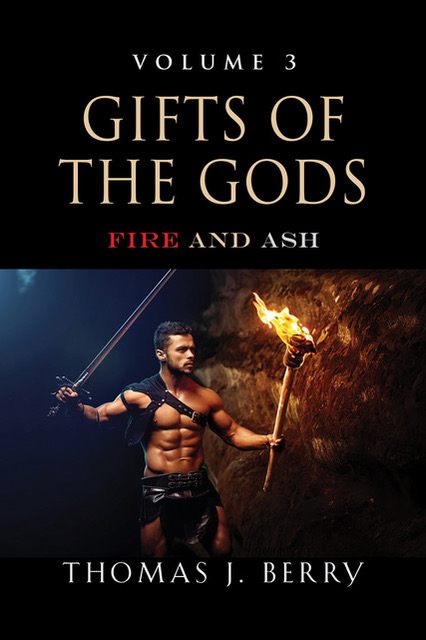
Gift of the Gods Fire and Ash
I have
enjoyed writing historical fiction novels for many years and like to bring to
life interesting stories that will pique someone’s interest. But I never want
to be predictable so I adjust my writing styles and points of view for each
project.I’ve penned a real-life murder
mystery during the War of 1812 and a grand epic saga during the siege of the
Alamo.Three incredible WWII veterans
allowed me to share their marvelous stories during an indelible time in our
recent past.Bolstered by the great reception
to these works, I embarked on a new challenge – to write a trilogy of stories
around a single conflict in history.It
was a daunting task!I spent weeks
searching for just the right era and moment in time.
I was
first introduced to the Spartans in my teenage years but knew little about them
beyond their warrior concept and frugal living standards.Athens, of course, was home to the
philosopher, Socrates, and the famous leader, Pericles.Large statues and monuments still stand in
the Acropolis today where democracy was first born.Now as I sought the right source material for
my trilogy, I took a deep dive into those ancient texts and came away with a
passion I never knew I had.
People of
the modern world have almost forgotten about those ancestors of long ago, but I
knew it was important to bring them back…and learn from them.America and Russia have been at odds for over
a century now and that inherent conflict is visible in everything we do.Democracy and socialism were battling each
other 2,500 years ago and struggled to overcome the same prejudices that we
experience today.This conflict came to
a sudden head during the Peloponnesian War in the 5th century BC,
and that is where my story begins…almost.
Some of
you may have seen the 2006 movie, 300, with Gerard Butler as King
Leonidas of Sparta.His small group of
hearty warriors fought to the death against the great Persian hordes led by
Xerxes, their larger-than-life god-king.The Persians were depicted in the movie almost as one-dimensional
monsters while the heroic Spartans gave them a good run for 2 hours before
finally succumbing.It was a great flick
– I loved it…except there was more to the story and I knew it was intricately
connected to my own, which takes place 50 years afterward.In order to tell my story on Sparta’s war
with Athens, I first needed to set the record straight on this one.
Source: Wikipedia
I invest
years of research into my historical novels in order to get the details
right.It’s worth the effort and is a
critical part of my writing.My
characters are fully developed people with interesting backgrounds.They have hopes and dreams, insecurities, and
strong passions, but most of all, they believe in themselves.No matter which side of the conflict they are
on, they trust that what they are doing in the moment is the proper course of
action.They are not wholly evil or
completely angelic.They are humans and
I treat them as such…frailties and all!Each
novel has real historical people within its pages mixing with fictional
characters who could easily have lived during that era.It’s important to note that because my novels
examine all sides of the war and from many different angles.From generals to slaves, widows to bachelors,
we see this timeline from many points of view.That’s the best kind of story to tell – an honest one.
The saga
of the Peloponnesian War, fortunately, lent itself to three unique installments
and for that, I was grateful.From
beginning to end, it covered a 27-year span, almost three full decades.The events also shifted locations from Greece
to Sicily to Persia – a perfect combination to tell a fast-moving tale in three
books.It was important that each novel
in the trilogy could be read as a stand-alone volume.Therefore, great care was made to isolate the
events and characters so their story could be told in a single book.
The final
piece of the writing would be the most challenging of all – trying to tell a
complex story over decades of time from many different viewpoints.The solution was to weave five main
characters into a single book and allow their stories to build upon each other
like a tapestry.Iron and Bronze
was the first novel in this series and built off the famous battle of King
Leonidas at the Thermopylae Pass.We see
Kalli, a young widow intent on training her son for Olympic boxing…and finding
herself in over her head.Doro is a
wealthy aristocrat from Athens whose life comes crashing down around him when
the war begins.Matty is a helot
slave in Sparta and risks everything for a new life.Marching alongside these characters are the
two emerging superpowers of the day.Sparta
and its mighty soldiers with a fearsome reputation, find themselves pitted
against Athens who sails the strongest navy the world has ever seen.
The second
novel, Silver and Gold, continues the saga after peace is finally
declared, but much like America and Russia today, tensions seethe just below
the surface.Alcibiades, a charismatic
Athenian general, brings the conflict to a new level when he sets his eye on
conquering the colonies on Sicily and the entire Mediterranean coastline.No one is safe anymore and the Spartans set
sail to this far-off land in a desperate bid to stop him.Does anyone remember Vietnam in the 60’s and
70’s?Two global powers battling it out
far from home with everything at stake.Andreas, a Spartan officer of mixed parentage, must overcome his lowly
status to help the Sicilians defend against this invading armada or die
trying.Cathryn is a young mother native
to the island and sees her world turned upside down by the rising conflict.Kyril, a boxing prodigy who fought in the
Delian Games, joins the powerful Athenian fleet only to discover the awful
truth hidden beyond the horizon.
This last
adventure, Fire and Ash, brings the war to a dramatic conclusion as
Sparta seeks to cut Athens off from its rich colonies on the Persian
coast.Some of the war’s biggest naval
battles are fought off the shores where Xerxes once called home and the irony
is not lost on them as both sides now seek to make an alliance with their
former adversary.Memo, an Athenian
officer living in exile looks to find a way back into the graces of his beloved
city while Aleki, an older Spartan officer, struggles to adapt in a young man’s
army.Timandra, an exotic dancer in a
Persian court, finds love with a handsome foreigner and risks everything to
keep him safe.In the end, only one city
will reign supreme over the Ancient world and the struggle between democracy
and socialism will finally be decided.
It is my
fervent hope that readers will not only find enjoyment in these pages but learn
something new as well.These are types
of books I’ve always enjoyed myself and I know there is a strong audience for
them.Remember, if we can learn the
past, we can shape a better future for ourselves!
Thomas Berry received a Bachelor of Arts degree in Philosophy from St.
Bonaventure University. He takes
pleasure in extensively researching both historical fiction and non-fiction
stories. In his spare time, he enjoys
long-distance running and has completed several marathons. He currently lives with his wife and children
in New Jersey. You can learn more about
Thomas and his historical novels on his website, www.thomas-berry.com.
In 2015, the Greek Ministry of Culture announced the long-awaited results of the analysis on the bones found inside the 4th century BC tomb uncovered in Amphipolis in northern Greece. The news was quite unexpected – the bones belonged to not one, but five individuals, pointing to the likelihood that it is a family tomb. However, their has been a setback in their analysis since then. What’s next for the Amphipolis tomb and the remains that were found within?
The tomb is located within Kasta Hill in what was once the ancient city of Amphipolis, conquered by Philip II of Macedon, father of Alexander the Great, in 357 BC. Experts have known about the existence of the burial mound in Amphipolis, located about 100 km (62.14 miles) northeast of Thessaloniki, since the 1960s, but work only began in earnest there in 2012, when archaeologists discovered that Kasta Hill had been surrounded by a nearly 500-meter (1640.42 ft.) wall made from marble. It was only in 2015 that they discovered the incredible chambers decorated with marble sphinxes and caryatids, an intricate mosaic floor, and a limestone sarcophagus containing hundreds of bone fragments.
Amphipolis Tomb by Greektoys.org (update) on Sketchfab.
According to the Ministry’s Press Release , archaeologists recovered a total of 550 bone fragments, both crushed and intact, including a skull in good condition. After a meticulous process of piecing the fragments together, scientists identified 157 complete bones.
Following the macroscopic study of bone material, which was undertaken by a multidisciplinary team from the Universities of Aristotle and Democritus, researchers were able to determine that the minimum number of individuals is five – a woman aged around 60 years, two men aged 35-45 years, a newborn infant, and the cremated remains of another individual of unknown age and gender. In addition, they found a number of animal bones, most likely belonging to a horse.
Person 1: Female, approximately 60 years Scientists were able to identify person 1 as female based on the pelvic bones, the bones of the skull, the mandible, and the morphological features of the bones. Age was determined based on the loss of posterior teeth, degenerative lesions, particularly in the spine, and the presence of metabolic diseases such as osteoporosis and frontal hyperostosis. Her height is estimated at 157 cm (5.15 ft.)
Most of the bones found can be attributed to the female, and they were located approximately 1 meter (3.28 ft.) above the floor of the cist.
Bones belonging to the 60-year-old female in the Amphipolis tomb. Credit: Ministry of Culture
Persons 2 and 3: Two men, 35 to 45 years Two of the individuals identified are known to have been men, one around 35 years of age, and the other closer to 45 years of age. The younger of the two men, whose height is estimated at 168 cm (5.51 ft.), bears traces of cut marks on the left upper thoracic spine, two sides and cervical vertebra. His injuries are consistent with violent injury caused by a sharp instrument, such as a knife, which apparently caused his death (no healing indications could be distinguished.)
The slightly older man, whose bones were found higher than the first man, measures around 162 cm (5.31 ft.) in height and has evidence of a fully healed fracture in his right radius, close to the right wrist. Both men show degenerative osteoarthritis and spondylitis.
Cut marks were found in multiple places in the bones of person 2 in the Amphipolis tomb. Credit: Ministry of Culture
Person 4: Newborn infant The fourth individual identified was a newborn infant, whose sex could not be determined. The determination of age was made based on the length and width of the left humerus and left mandible.
Bones found in the Amphipolis tomb belonging to newborn infant. Credit: Ministry of Culture
Person 5: Cremated individual of unknown age and sex The fifth person is represented by only a few burnt fragments. While age and sex cannot be determined, the bones are believed to belong to an adult individual.
Person 5 bones (Amphipolis tomb) that have undergone the influence of high temperature, after burning. Credit: Ministry of Culture
The scientific team planned to continue to carry out in-depth studies of the bones, including DNA analysis, to obtain more detailed information about the individuals including their diet, their affinity and place of origin, whether they grew up in Amphipolis or had moved from elsewhere, when they were buried/cremated, and whether the individuals are related to each other. The hope was that the results would enable the researchers to piece together the social and historical context and finally determine the identity of the individuals buried inside this incredibly important funerary monument.
However, an update on the research project shows that three and a half years after the fascinating discovery in 2015, the work has come to a standstill. A lack of funding for the project has raised some eyebrows on the current government’s views on the archaeological site. Currently the human remains are being stored in the Amphipolis Museum. They’ve been there ever since the initial macroscopic analysis was completed.
Despite the obstacle in discovering more about the people who were buried inside, there is movement at the Amphipolis tomb. In fact, heavy restoration work has been underway to have the site ready to open to the public in 2020 .
Top Image: Marble sphinx and limestone sarcophagus found at Amphipolis. Source: Greek Ministry of Culture
Beer is the most consumed alcoholic beverage in the world; it is also the most popular drink after water and tea . In the modern world, however, little consideration is typically given to how beer developed with respect to taste. Even less is given to why beer is thought of in the way that it is.
But today, Canada is in the middle of a beer renaissance. A relative explosion of craft breweries has led to a renewed interest in different methods of brewing and in different types of beer recipes.
In turn, this has driven interest into historical methods of brewing. It is a rather romantic idea: That very old brewing processes are somehow superior to those of the modern world. While almost all of the beer on the market today is quantitatively and qualitatively better than that produced in the ancient world, attempts made by both historians and breweries recently have had some good results.
For example, the collaboration between University of Pennsylvania archaeologist Patrick McGovern and Dogfish Head Brewery that resulted in their “Midas Touch”, based on the sediment found in vessels discovered in the Tomb of Midas in central Turkey, and the Sleepy Giant Brewing Company’s ancient beers created as part of Lakehead University’s Research and Innovation Week.
Beer made an old-fashioned way is shown at Barn Hammer Brewing Company in Winnipeg in March 2018. THE CANADIAN PRESS/David Lipnowski
Why re-create ancient beer and mead?
From an academic point of view, researchers have realized eating and drinking are important social, economic and even political activities. In the ancient world, food, drink and their consumption were important indicators of culture, ethnicity and class. Romans were set apart from non-Romans in several ways: Those living in cities versus those who didn’t, those who farmed in one place versus those who moved around, and so on.
One of the other ways in which this distinction was made was in the different foods people ate and in the liquids they drank. This is clear in the ancient Graeco-Roman debate surrounding those who drank wine and those who drank beer.
Although the saying “you are what you eat” is a fact in terms of physiology, the Romans also believed that “you are what you drink.” So Romans drank wine, non-Romans drank beer.
These indicators (real or not) even exist today: The English drink tea, Americans drink coffee; Canadians drink rye, the Scottish drink scotch.
So the re-creation of ancient beer and mead (an alcoholic beverage made by fermenting honey and other liquids) allows us to examine many things. Among them are these cultural and ethnic considerations, but there are other important and interesting questions that can be answered. How has the brewing process transformed? How have our palates changed?
Mead beaker. Matt Gibbs, Author provided (No reuse)
The “Roman” recipes and their recreation
The Romans left us a variety of different recipes for food and drink. Two of them form the basis of an ongoing research project between the co-owners of Barn Hammer Brewing Company — Tyler Birch and Brian Westcott — and myself that attempts to answer some of these questions.
The first is a recipe for beer that dates to the fourth century Common Era (CE). It appears in the work of Zosimus, an alchemist, who lived in Panopolis, Egypt, when it was part of the Roman empire. The second is a recipe for a mead probably from Italy and dating to the first century CE, written by a Roman senator called Columella.
Beer mash. Matt Gibbs, Author provided (No reuse)
Both recipes are quite clear concerning ingredients, with the exception of yeast. Yeast, or more appropriately a yeast culture, was often made from dough saved from a day’s baking. Alternatively, one could simply leave mixtures out in the open. But the processes and measurements in them are more difficult to recreate.
The brewing of the beer, for instance, required the use of barley bread made with a sourdough culture: Basically a lump of sourdough bread left uncovered. To keep the culture alive while being baked required a long, slow baking process at a low temperature for 18 hours.
Zosimus never specified how much water or bread was needed for a single batch; this was left open to the brewers’ interpretation. A mix of three parts water to one part bread was brewed and left to ferment for nearly three weeks.
The brewing of the mead was a much easier process. Closely following Columella’s recipe, we mixed honey and wine must . The recipe in this case provided some measurements, and from there we were able to extrapolate a workable mix of roughly three parts must to one part honey.
We then added wine yeast and sealed the containers. These were placed in Barn Hammer’s furnace room for 31 days in an attempt to imitate the conditions of a Roman loft.
What did we learn?
First of all, it’s worth noting that the principles of brewing have not changed significantly; fundamentally, the process of brewing both beer and mead is arguably the same now as it was 2,000 years ago. But as true as that may be, even now the production of Zosimus’ beer — particularly the baking of the bread — was labour-intensive.
Mead decanting. (Author provided)
This led to another question: Did the link between baking and brewing depicted so clearly in ancient Egyptian material culture and archaeology persist even centuries later?
Second, we recreated beer and mead from the Roman Empire as faithfully as we were able. The data all suggest that the beer is a beer, and the mead is a mead, right down to the pH level: The beer, for instance, stands at pH 4.3 which is what one would expect from a beer after fermentation.
Third, as the photos here make clear, the mead looked like red wine, the beer was quite pale but cloudy. Neither case was particularly surprising, but what was interesting was the difference between the first tasting of the beer and the second 10 days later.
In the former, the beer looked like a sourdough milkshake; in the latter, the beer looked like a pale craft ale, and one that would not be out of place in the modern craft beer market.
Fourth, with respect to taste, the beer was sour but quite smooth, and had a relatively low ABV - Alcohol By Volume: the measurement that tells you what percentage of beer or mead is alcohol — around three to four per cent. The sour taste resulted in diverse opinions: Some people liked it; others hated it. The mead was incredibly sweet; it smelled like a fortified wine due to presence of Fusel alcohols , and had an ABV upwards of 12 per cent.
While general tastes may have changed, there are modern palates that appreciate ancient beer and mead. Is this a physiological question? Perhaps, but what seems clear is that ancient indicators based on what people drank are likely more indicative not only of the Romans’ beliefs and opinions about non-Romans, but also their prejudices against them.
Ultimately, what the project suggests so far is that while the brewing process may not have changed that much, in some ways neither have we.
Top image: Left to right- Barn Hammer Brewing Company Head Brewer Brian Westcott, Matt Gibbs of the University of Winnipeg and Barn Hammer owner Tyler Birch teamed up to re-create an ancient beer. THE CANADIAN PRESS/David Lipnowski/ The Conversation
The article ‘ We brewed an ancient Graeco-Roman beer and here’s how it tastes ’ by Matt Gibbs was originally published on The Conversation and has been republished under a Creative Commons license.
The Hand of Hercules is the name given to a massive fragment of an ancient statue that was unearthed by archaeologists in Amman, the capital of Jordan. This fragment is believed to have once been a part of a colossal marble statue of the demi-god Hercules, as it was found at the site of the Roman Temple of Hercules. Apart from this hand (or more accurately, three fingers of a hand), the only other piece of the statue that has remained is its elbow. The statue’s hand and its elbow can be seen by those visiting the remains of Amman’s Temple of Hercules today.
Monumental Statues Filled the Ancient City of Amman
During the 1 st century B.C., the area of modern day Jordan came under Roman rule. At that time, Amman was one of the Ten Cities of the Decapolis, and was known by its Greek name as Philadelphia. During the period of Roman rule, which lasted for about four centuries, many public monuments were built in Amman. Some of these, like the Roman Theatre and Roman Odeon can still be seen in the city today.
Temple of Hercules
Another building, the Temple of Hercules, was also built during this time, though it has not been as well preserved as the other two aforementioned structures. Like the Roman Theatre and the Roman Odeon, the Temple of Hercules was constructed during the reign of Marcus Aurelius. It has been suggested that the temple was never completed, as only a part of the structure was adorned with columns, whilst the rest was left bare.
Ruins of the Temple of Hercules in Amman ( CC by 3.0 )
Still, the parts of the temple that have survived through the ages have provided scholars with some information about the monument. For instance, the part of the temple where the columns had been erected is the portico. These columns, six in total, would have originally stood at a height of about 10 m. The columns had fallen over the centuries, and were re-erected in 1993. In addition, the area covered by the temple has been measured. With these pieces of information, a model of the temple has been made, and is today displayed in the American Center for Oriental Research (ACOR) in Amman.
A model of the temple of Hercules. Credit: ACOR, Jordan
A Site More Ancient than Ancient!
It has been suggested that the Temple of Hercules was built on the site of an older temple dedicated to a native god. Within the area where the temple’s inner sanctum would have been, there is a bare patch of rock that has been left exposed. It has been postulated that this may have been the sacred rock that was the centrepiece of the 9 th century B.C. Ammonite Temple of Milcom (known also as Moloch or Molech).
Where is the Rest of Hercules?
Apart from the hand and the elbow of the statue, little more was found at the site – just a scattering of coins – which leaves open the question, where is the rest of Hercules? And can we be certain that it even was a statue of Hercules? Even the experts themselves are not entirely certain if the temple in Amman was indeed dedicated to Hercules. Nevertheless, given that a large number of coins bearing the image of Hercules have been found in the city below, it has been speculated that the temple was probably dedicated to him, and the hand most likely was part of a statue of the demi-god.
One of the Largest Known Marble Sculptures
Based on the remaining three fingers and elbow, it has been estimated that the complete statue of Hercules would have stood at a height of 43 feet (13 meters), which would make it one of the largest marble statues to have been sculpted in history. It has been suggested that the statue of Hercules eventually collapsed as a result of a catastrophic earthquake, which would strike the area from time to time. The statue would have probably been fragmented, and the pieces reused by locals for other purposes. Thus, all that remains today of this colossal statue are its three fingers and one of its elbows.
Could the Statue of Hercules in Amman looked like this statue of Hercules currently housed in the Met Museum ?
Top image: A photo of the Hand of Hercules. (CC by SA 3.0 )
The winged helmet is a type of helmet that is found in mythology as well as history. In the realm of mythology, such helmets are associated with the Greek god Hermes (known also as Mercury by the Romans), as well as the Norse gods. Historically, the winged helmet is often associated with the Celts and Vikings, though erroneously so. Variations of the winged helmet were also used by different peoples during various periods of history.
Greek and Roman Winged Helmet
In mythology, the winged helmet is perhaps most famously associated with the Greek god Hermes, and his Roman counterpart Mercury. The Greeks and Romans believed that this was the emissary and messenger of the gods. In this role, Hermes is required to travel swiftly from one place to another. Thus, to aid him in this, Hermes has a pair of winged sandals, which is said to have been made by Hephaestus using imperishable gold. Hermes’ status as a traveller is further enhanced by the hat said to be worn by him, either a broad-brimmed traveller’s hat, known as a petasos, or a winged cap.
Hermes carrying Pandora down from Mount Olympus wearing traveller hat. (A medal based on a design by John Flaxman). ( Public Domain )
Winged Helmets of the Norse Gods
Apart from Hermes and Mercury, the Norse gods are also depicted as wearing winged helmets. Such gods as Odin and Thor are often portrayed with such helmets. Additionally, the Valkyries (beings who chose, and brought those slain on the field of battle to Valhalla) are also commonly shown with winged helmets. It may be said, however, that the depiction of Norse mythological figures with winged helmets may be traced back to the artists of the Romantic Movement.
The vivid imagination of these Romantic artists not only influenced the artistic portrayal of the Norse gods , but also that of actual, historical Viking warriors. Today, it is common for people to imagine that the Vikings wore winged helmets (horned helmets are another popular, though equally erroneous, motif). This misconception is extended also to the Celts, the cartoon character Asterix being its most famous example. In a way, the winged helmet has become a symbol of the ‘barbarians of the north’.
hors Helmet at the Marvel booth at San Diego Comic-Con. ( CC BY-ND 2.0 )
Were Winged Helmets Actually Used?
Despite these representations in art, there is a dearth of archaeological evidence to support the imaginings of the Romantic artists. For instance, there has been no discovery so far of actual winged helmets, as we would imagine, from either the Viking or the Celtic realms. It has been suggested that the notion of northern barbarians wearing winged helmets comes from ancient Greek and Roman texts. The priests of the Celts, for instance, are said to have used winged helmets during certain religious ceremonies. Still, such headgear would not have been used by warriors in battle, as they would have been cumbersome, and would be more of a liability than an asset.
A 3 rd century B.C. Celtic winged helmet from Romania. Image: CC BY-SA 3.0 )
Be that as it may, there is at least one example of a winged helmet from the world of the ancient Celts. This helmet was found in Romania, and has been dated to the 3 rd century BC. This ‘winged helmet’ is in fact a typical Montefortino helmet with a bird, possibly an eagle or a raven, mounted on the top as a crest. The ingenious design allowed the wings of the bird to flap up and down as the wearer moved. It is unclear, however, if this helmet was worn on the battlefield, or was used in a non-military context, i.e. as a status symbol, or for certain ceremonies. Another example of a winged helmet is a 4 th century Attic helmet from southern Italy, which has two small wings on the sides. This helmet is believed to have been used for ceremonial purposes.
Greek helmet made in South Italy, 350-300 BC. Bronze. The elaborate decoration on this helmet suggests that it was strictly ceremonial and not intended to be worn into battle. ( CC BY 2.0 )
Finally, it may be said that the winged helmet belonged not only to the ancient worlds but is also thought to be found in the Medieval world, in particular in the Teutonic realm. The knights of the Teutonic Order are known to have used a type of helmet known as the great helm, and popular imagination has added either horns or wings to this form of headgear. Like the ancients, it is unlikely that such helmets were used in battle. An example of a medieval great helm with wings is that belonging to the von Pranckh family of Austria, and serves as a ‘funeral helmet’.
Great helmet with decoration of Albert of Prankh, Austria, 14th century (Replica) ( CC BY-SA 3.0 )
Top image: Illustration of a winged helmet. Credit: Game of Thrones Ascent Wiki
Greek mythology begins with the Creation Myth , which is contained within many different sources of ancient Greek texts. The most complete one is Theogony from the Greek poet Hesiod, who lived around the 8 th century BCE. Hesiod combines all Greek myths and traditions to create this mythical cosmogony.
According to Theogony, in the beginning only chaos and void existed throughout the entire universe (The Greek word chaos does not have the same meaning in which it is used today, but simply meant empty space or a dark void.).
Chaos was followed by Gaia (which means earth) and Eros (which is love). It is not specified if Gaia and Eros were born from Chaos or whether they were pre-existing; however, Hesiod mentions that Gaia (Earth) came into existence in order to become the home of the gods. This is similar to other myths, like Sumerian myths, which describe how the earth was initially created for the gods to dwell.
Chaos also gave birth to Erebus, who was the darkness of the underworld, and Nyx (night).
Gaia gave birth to Uranus (heavens) and Okeanos (ocean).
The story continues showing how the gods mated with each other to complete the whole of creation. Nyx and Erebus mated, and Hemere (day) and Aether (air) were born. Nyx also gave birth to other gods like Moros, Thanatos (death), Nemesis, Hypnos (sleep), Eris and Keres.
Uranus and Gaia became the first gods to rule. Uranus then mated with Gaia and produced Cyclopes and the twelve Titans (a race of giants). One of the Titans was Cronus (Saturn).
And from here the pantheon of the famous gods of Greek mythology begins.
Uranus was jealous of his children and condemned them to stay in the womb of Gaia; however, Gaia, with the help of Cronus, punishes Uranus by castrating him. His genitals and his blood fell into Earth and created another set of gods—Aphrodite, Erinyes, giants and nymphs.
Uranus and Gaia spoke a prophecy to Cronus, telling him that one of his sons would overpower him. As a result, Cronus decided to swallow their children. Gaia was able to save baby Zeus (Jupiter), who was raised on the Greek island Crete until he, with the help of Metis (another Titan), made Cronus to regurgitate the swallowed children. Led by Zues, the six brothers and sisters (Demeter, Hera, Hestia, Hades and Poseidon) rebelled against their father against whom they were victorious, throwing Cronus forever into the Tartarus (the dark world under Earth).
After that, the rebel gods of ancient Greece divided the universe between them. Zeus was the supreme god, ruling over all others, and all of them lived on the peak of Mount Olympus in Greece.
Greek mythology is full of fights between the gods, similar to other myths and religions—and so far we still have not seen the creation of man.
In the above mentioned battle, three Titans did not support Cronus: Prometheus, Epimetheus and Okeanos. Prometheus later joined Zeus. All the Titans were sent into Tartarus (the underworld), with the exception of Prometheus and Epimetheus.
Prometheus was the one to create man out of earth (mud), and the goddess Athena breathed life into the man. Here we see another common pattern repeating in the creation, where the spirit is given to the body so that it will become alive.
Epimetheus was the one to whom Prometheus assigned the duty to give all living creatures of the planet different qualities/skills; however, Epimetheus had already given all the good skills and qualities to other creatures, and nothing was left for man. Consequently, Prometheus made man to stand upright—as only the gods had done—and gave him fire.
This made Zeus angry because he was not very fond of man, though man was Prometheus’s favourite creation. Zeus thus decreed that man must present a portion of each animal they sacrificed to the gods, but Prometheus tricked Zeus and, as a result, Zeus took fire away from man. Prometheus then stole fire back and returned it to man. For that Zeus punished both man and Prometheus.
The punishment that Zeus inflicted to man was to create Pandora (with the help of god Hephaestus), the first woman. He gave Pandora as a gift a box that she was not allowed to open. The box was full of misfortunes, diseases and plagues, while at the bottom of the box there was also hope.
Prometheus was condemned to be tormented on the Caucasus Mountain where he was chained on a rock in unbreakable chains. Every night an eagle would appear and eat his liver. During the day the liver was reborn, and every night the eagle would return and eat it again.
Later on a Centaur, Chiron, and a semi-god, Hercules, would release Prometheus from his torment.
It is clear that Greek mythology contains parallels to other mythologies and religions, such as water being the beginning of all life, the on-going fighting between gods and, most importantly, the denial of the gods to allow humans to have knowledge.
Weapons control is a hot topic in the United States. With the recent shooting in Florida in February 2018, discussions of gun control are at an all-time high. Yet this discussion is not limited to the US; with the age of media, there has been an influx of reporting on violence as well, and the debate regarding weapons control has spread worldwide. Gun control is the primary topic of interest, and because of this, one might wonder whether previous cultures ever experienced a need for rules regarding weapon holding. Of particular interest is whether the idealized culture of ancient Greece met with this same debate.
In ancient Greece, (and of course its close Egyptian, Hittite, and later Roman neighbors), weapons were a prominent aspect of life. War was a consistent threat—whether from an exterior source or from within. Weapons were often kept nearby, or on one’s person, and leaders were always—even now—protected by some form of guard. Weapons are not a new topic of conversation.
Interestingly enough, conversations on weapons control are not new either.
Paintings of Ancient Macedonian soldiers, arms, and armaments, from the tomb of Agios Athanasios, Thessaloniki in Greece, 4th century BC. (Public Domain)
Weapons Weren’t for Everyone
The ancient Greeks, to whom the United States has often turned for guidance in various affairs, are one of the earliest known examples of enforcing weapon control. Once again, due to the constantly changing nature of pre-democratic Greece, and the various wars in which the Greeks played a prominent role (the Persian Wars, the Peloponnesian Wars, the Pyrrhic Wars, etc.), weapons were intricately tied into Greek culture. However even the Greeks saw a limit to the necessity for weapons within a civilized state.
Weapons were bought and owned by the rich; for one to participate in most Greek armies (as they were individualized by city-state) a soldier needed to possess enough money to buy their own swords, shields, spears, etc. In essence, weapons could be considered synonymous with wealth. Men could sport weapons freely in wartime, and could have an unlimited (as far as research can tell) number of weapons in their homes; there is no record of a limit to the number or types of standard weapons. However, the Greeks did set a limit on the prominence of weapon exposure in ancient Greece.
Knelt warrior with de-cladded sword – possibly Achilles waiting for Troilus. Tondo of an Attic black-figure kylix, ca. 560 BC. (Public Domain)
Greek warriors had to obtain their own weapons. Greeks Argued Against Mixing Arms and Politics Evidenced in literature from the Archaic period forward (800 BC–480 BC), men could not enter the agora, or marketplace, with a knife strapped to their waists; men could not walk into any form of religious space with a sword, other than a ceremonial one (usually carried by the presiding priest).
Further, men could also not enter any form of political space with a weapon. In fact, this point has long been punctuated by the story of an ancient Greek man called Charondas, the same man who demanded that a law be put into place banning the carrying of weapons within the Assembly (political body) of the Greek colony of Catania in Sicily.
Charondas, as the story goes, insisted that all those who entered the Assembly must leave their weapons outside the political center of the city; in most city-states, this Assembly was located in or near the agora. However accidents happen; with weapons, accidents often lead to death. Unfortunately for him, even Charondas was not exempt from this fate.
Nineteenth-century painting by Philipp Foltz depicting the Athenian politician Pericles delivering his famous funeral oration in front of the Assembly. (Public Domain)
Returning to the Assembly after spending some time out of the city, Charondas forgot to swing by his home and leave his own weapon (which he was carrying for protection during his travels) there. Upon entering the Assembly, his mistake was realized by his associates, and he was ridiculed for forgetting his own law. To prove his dedication to the law, he rectified his error by removing his dagger from his person and committing suicide.
Keeping the Community Safe?
Charondas’ dedication to the protection of the members of the Assembly is undeniable. The importance of maintaining a community free of threatening articles is also undeniable.
There are various pros and cons to adopting and adapting ideas from the social and political world of ancient Greece. As weapons are currently a hot topic, perhaps there might be some interest in opening a discussion regarding the control of weapon possession and use in the ancient world. After all, many modern democracies drew initial inspiration from the ancient Greek δημοκρατία; now might be an important time to revisit those earlier values.
A lithograph plate showing ancient Greek warriors with a variety of different weapons and armor. (Public Domain)
Top Image: Ancient Greek warriors with armor and weapons. Source: Public Domain
After 300: The Posthumous Vengeance of King Leonidas of Sparta
Mythologically descended from the hero Herakles, the Agiad dynasty of ancient Sparta reigned alongside the Eurypontids almost since the beginning of the city-state. When war was on the borders of their land, and that of their neighboring city-states, it was to the current Heraklean descendent that those city-states turned. Even the Athenians, who were long-time rivals of the Spartan warriors looked to the current Agiad king for guidance in the darkest time of the war. That king, unsurprisingly, was King Leonidas I. A
King Amongst Kings
The better remembered of the two warrior-kings of the ancient Greek city-state Sparta, King Leonidas I lived and ruled between the 6th and 5th centuries BC. His time on the throne was short-lived, but his legacy has lasted lifetimes. Leonidas is the king who many other kings aspire to emulate; King Leonidas gave everything to defend and protect his homeland. Called upon to lead the allied forces of the Greek city-states based on his military record alone, it is said that King Leonidas tried to protect his soldiers, ordering them to leave the battlefield to fight another day. They did not, as one might guess, as they were Spartans; one way or another, Spartans return from battle—either with their swords, or on them, as the saying goes. Leonidas' words of protection at the battle of Thermopylae fell on deaf ears, and the Greeks were slaughtered that fateful day in 480 BC
Leonidas at Thermopylae by Jacques-Louis David (Public Domain)
What happened after the massacre, however? What happened after the death of the one of the greatest military leaders? Without Leonidas, Sparta was down one king; it had been tradition for two kings to rule the city-state, one from each of the two primary families, the Agiads and the Eurypontids. With his death at the hands of the army of Xerxes, king of Persia, and his head paraded around on a spike, Sparta was left short-handed. What was the next step?
Revenge.
Leonidas I of Sparta (CC BY-SA 4.0)
Wrath of the Gods
If one believes in the ancient Greek gods—as the city-states clearly did—it is impossible not to see the vengeance those gods encouraged through their mortal soldiers following the death of Herakles' descendent. With the death of King Leonidas and the insult to his person, the Persians had essentially painted a bright red, divinely taunting target on their backs. Over the next year, the Persians and Greeks engaged in their final land and sea battles, of which the Persians suffered as often as not. Salamis and Plataea, two of the most decisive Greek victories, officially turned the tide in favor of the Greeks. In fact, a better vengeance could not have been written for King Leonidas. The Greeks, who had not forgotten the slaughter of Thermopylae, returned the favor in spades at the Battle of Plataea.
A romantic version painting of the Battle of Salamis by artist Wilhelm von Kaulbach. (Public Domain)
The ancient historian Herodotus (5th century BC) is one of the primary sources of this battle. Following a stalemate around the Persian camp constructed in Plataea, the Persians were unintentionally (though it was lucky for the Greeks) lulled into a sense of victory. Having cut off the Greeks from their supply lines, the Persians believed the few Greeks who retreated to regain those connections represented the whole army; the subsequent Persian attack quickly proved them wrong. The Greek allies literally had the high ground, and a defeat of those Persian forces, led by Mardonius, was relatively swift. The Greek forces then, loosely interpreted from ancient texts, exacted their revenge for the slaughter of Leonidas and his men by massacring the Persian camp at Plataea. Later that afternoon, the Greeks finished the job at the final battle of Mycale.
King Leonidas I Monument at Thermopyles. (CC BY-SA 3.0)
Exacting Revenge
One could attribute this "retribution" as constructed by King Leonidas' son Pleistarchus, intended to take the throne upon Leonidas' death. Yet in an interesting turn of events, Pleistarchus was too young to rule at his father's death, and the boy's guardian Pausanias, was actually on the second Spartan throne. Thus the decisive, somewhat brutal, actions against the Persians at Plataea and Mycale may or may not have been an act of vengeance in the name of the father Leonidas, but were almost certainly for the Herculean general who sacrificed everything for his home, and the homes of those allied with him. (One should remember that Sparta and Athens were only on good terms when they were teamed up against Persia. They placed their animosities aside during the Persian War, Athenians willingly following Spartans, and Spartans trusting to delegate to Athenians. This alliance would crumble soon after the war, but Leonidas' actions are even more inspiring for the prejudices put aside.)
Greek and Persian warriors depicted fighting on an ancient kylix. 5th century BC. (Public Domain)
United States of Leonidas
King Leonidas' sacrifice might not have resulted in the battle to end all Persian-Greek battles, however it did inspire a great deal of "nationality", a concept not yet fully formed in the ancient world. Yet the Greek city-states saw a common enemy, and shared a common goal, and for a brief period of time, respected and valued the same man—homeland and culture aside. The increased sense of unity Leonidas inadvertently forged between the Spartans, Thebans, Athenians, etc. led to an increased determination; the Greeks left no man standing at Plataea and Mycale if they could find one. The victory of the Greeks over the Persians resonated for centuries, and Leonidas' name is remembered far better than those of the men who returned home with their shields rather than on them. Because of this (and the later cockiness of the Athenians), the Spartans and their allies successfully defeated the Athenians in the Peloponnesian War, the next great battle on their horizon.
Top image: King Leonidas by David Baldo (deviantart)
The first is that it is not only thanks to the Greeks that our culture is so infused with theirs. Just because they invented and built things does not mean, by right, that those inventions, ideas and creations will always continue to be admired. It’s in the way that the legacies of ancient Greece have been taken up, admired, re-formulated and manipulated by every culture between theirs and ours, that we must also look for our answer to the question of why we are so indebted to the Greeks in particular.
For example, the Roman emperor Hadrian loved all things Greek: he completed the temple of Olympian Zeus in Athens, despite the fact that no Greek had been able to complete this massive temple in about 650 years of trying. The emperor had created a legacy that, in truth, augmented the reality of what the Greek world actually achieved.
The second idea is that, in that continual process of reformulation and manipulation, we have on occasion completely misinterpreted the ancient Greek world. Take paint for instance. Our very sense of the ‘Classical’ from the Renaissance onwards, has been based on the ‘fact’ that ancient Greek temples and buildings were made out of marble and stood shining off-white in the sunlight.
But ever since the first modern travellers visited Greece in the 17th century, we have discovered evidence that this is, in fact, completely wrong. Greek temples were painted bright blue, red, green: our very definition of the opposite of Classical! And so strongly implanted in our cultural psyche is this – incorrect – understanding of the Classical world, that even today we find it difficult to accept what the reality actually was.
Thirdly, we need to realise that the ancient Greek world has not always been such a source of inspiration and, equally, that it has not always been a source of inspiration for things we would choose to admire now.
By the seventh century AD, for example, the term ‘democracy’ had a ‘mob-rule’ feel about it, which made ancient Athens a very unpopular model for any society, right through until the until the late 18th century. In the English Civil War, for instance, Cromwell was encouraged to follow the example of the ancient Spartans, not the Athenians.
In the formulation of the constitution of the US in the 18th century, the Roman model of a Senate and Capitol was followed, rather than the Athenian boule (a council of citizens appointed to run the daily affairs of the city) and ekklesia (the principal assembly of the democracy of ancient Athens). More worryingly, the same Spartan model that was urged on Cromwell was the model taken by the Nazis as the way to create an Aryan race; Nazi youth camps were directly modelled on the training system for young Spartans.
Finally, although we may like to think that we have taken the inventions and ideas of the ancient Greeks and improved upon them, this is not always the case.
Take ancient Athenian democracy, again, as an example. In ancient Greece, this was based on slavery, and excluded women. Today, we rightly pride ourselves on the fact that neither of these is true. We have improved on the original Greek legacy to the degree that some argue we should not call their system a democracy at all. But equally, we must remember that the ancient Greeks probably would not call our system much of a real democracy either!
We have a representative democracy with a very apathetic voter turn-out at elections; they had a system where every citizen voted directly on every major issue, and in which approximately two-thirds of the citizen population sat, at some point in their adult lives, on the supreme governing council, the boule, of the city. None of this makes the Athenian system better than ours or vice versa. But it should make us think twice about we mean by the ‘legacy’ of democracy.
Overall, the crucial thing we must always remember is that the legacy of the ancient Greeks is a constantly moveable feast, caught between icon and enigma, and one that we – alongside every generation between us and them – have been, are still, and will always be, absolutely implicit in creating as much as the ancient Greeks themselves.
Michael Scott is the author of several books on ancient Greek and Roman society and has presented numerous TV documentaries on ancient history.