Showing posts with label travel. Show all posts
Saturday, November 11, 2017
Ancient Journeys: What was Travel Like for the Romans?
Ancient Origins
It was not uncommon for the ancient Romans to travel long distances all across Europe. Actually during the Roman Empire, Rome had an incredible road network which extended from northern England all the way to southern Egypt. At its peak, the Empire's stone paved road network reached 53,000 miles (85,000 kilometers)! Roman roads were very reliable, they were the most relied on roads in Europe for many centuries after the collapse of the Roman Empire. It could be argued that they were more reliable than our roads today considering how long they could last and how little maintenance they required.
A Roman street in Pompeii. ( CC BY-SA 3.0 )
Travel by road
Unlike today, travel by road was quite slow and... exhausting! For example, going from Rome to Naples would take over six days in Roman times according to ORBIS, the Google Maps for the ancient world developed by Stanford University. By comparison, it takes about two hours and 20 minutes to drive from Rome to Naples today.
Funeral relief (2nd century ) depicting an Ancient Roman carriage. ( CC BY-SA 3.0 )
Romans would travel in a raeda, a carriage with four noisy iron-shod wheels, many wooden benches inside for the passengers, a clothed top (or no top at all) and drawn by up to four horses or mules. The raeda was the equivalent of the bus today and Roman law limited the amount of luggage it could carry to 1,000 libra (or approximately 300 kilograms).
Rich Romans traveled in the carpentum which was the limousine of wealthy Romans. The carpentum was pulled by many horses, it had four wheels, a wooden arched rooftop, comfortable cushy seats, and even some form a suspension to make the ride more comfortable. Romans also had what would be the equivalent of our trucks today: the plaustrum. The plaustrum could carry heavy loads, it had a wooden board with four thick wheels and was drawn by two oxen. It was very slow and could travel only about 10-15 miles (approximately 15 to 25 kilometers) per day.
Carpentum replica at the Cologne Museum . ( CC BY-SA 3.0 )
The fastest way to travel from Rome to Naples was by horse relay or the cursus publicus , which was like a state-run postal service and a service used to transport officials (such as magistrates or people from the military). A certificate issued by the emperor was required in order for the service to be used. A series of stations with fresh and rapid horses were built at short regular intervals (approximately eight miles or 12 kilometers) along the major road systems. Estimates of how fast one could travel using the cursus publicus vary. A study by A.M. Ramsey in "The speed of the Roman Imperial Post" (Journal of Roman Studies) estimates that a typical trip was made at a rate of 41 to 64 miles per day (66 - 103 kilometers per day). Therefore, the trip from Rome to Naples would take approximately two days using this service.
Because of their iron-shod wheels, Roman carriages made of a lot of noise. That's why they were forbidden from big Roman cities and their vicinity during the day. They were also quite uncomfortable due to their lack of suspension, making the ride from Rome to Naples quite bumpy. Fortunately, Roman roads had way stations called mansiones (meaning "staying places" in Latin) where ancient Romans could rest. Mansiones were the equivalent of our highway rest areas today. They sometimes had restaurants and pensions where Romans could drink, eat and sleep. They were built by the government at regular intervals usually 15 to 20 miles apart (around 25 to 30 kilometers). These mansiones were often badly frequented, with prostitutes and thieves roaming around. Major Roman roads also had tolls just like our modern highways. These tolls were often situated at bridges (just like today) or at city gates.
Travel by sea and river
Man sailing a corbita, a small coastal vessel with two masts. ( Public Domain )
There were no passenger ships or cruise ships in ancient Rome. But there were tourists. It was actually not uncommon for well-to-do Romans to travel just for the sake of traveling and visiting new places and friends. Romans had to board a merchant ship. They first had to find a ship, then get the captain's approval and negotiate a price with him. There were a large number of merchant ships traveling regular routes in the Mediterranean. Finding a ship traveling to a specific destination, for example in Greece or Egypt, at a specific time and date wasn't that difficult.
Ancient Roman river vessel carrying barrels, assumed to be wine, and people. ( CC BY-SA 3.0 )
Romans would stay on the deck of the ship and sometimes there would be hundreds of people on the deck. They would bring their own supplies aboard including food, games, blankets, mattresses, or even tents to sleep in. Some merchant ships had cabins at the stern that could accommodate only the wealthiest Romans. It is worth noting that very wealthy Romans could own their own ships, just like very wealthy people own big yachts today. Interestingly, a Roman law forbade senators from owning ships able to carry more than 300 amphorae jars as these ships could also be used to trade goods.
How clay amphorae vessels may have been stacked on a galley. ( CC BY-SA 3.0 )
Traveling by ship wasn't very slow, even compared to modern day standards. For example, going from Brindisium in Italy to Patrae in Greece would take over three days, versus about one day today. Romans could also travel from Italy to Egypt in just a few days. Commercial navigation was suspended during the four winter months in the Mediterranean. This was called the mare clausum . The sea was too rough and too dangerous for commercial ships to sail. Therefore, traveling by sea was close to impossible during the winter and Romans could only travel by road. There were also many navigable rivers that were used to transport merchandise and passengers, even during the winter months.
Traveling during the time of the ancient Romans was definitely not as comfortable as today. However, it was quite easy to travel thanks to Rome's developed road network with its system of way stations and regular ship lines in the Mediterranean. And Romans did travel quite a lot!
Featured image: An ancient Roman road at Leptis Magna, Libya.( CC BY-SA 3.0 )
By: Victor Labate
References
Romae Vitam. Roman roads.
Watler Scheidel, Elijah Meeks. ORBIS The Stanford Geospatial Network Model of the Roman World. Orbis.Stanford.edu
Romae Vitam. Roman carriages.
Romae Vitam. Roman ships.
Saturday, August 26, 2017
Ancient Journeys: What was Travel Like for the Romans?
Ancient Origins
It was not uncommon for the ancient Romans to travel long distances all across Europe. Actually during the Roman Empire, Rome had an incredible road network which extended from northern England all the way to southern Egypt. At its peak, the Empire's stone paved road network reached 53,000 miles (85,000 kilometers)! Roman roads were very reliable, they were the most relied on roads in Europe for many centuries after the collapse of the Roman Empire. It could be argued that they were more reliable than our roads today considering how long they could last and how little maintenance they required.
A Roman street in Pompeii. (CC BY-SA 3.0)
Travel by road
Unlike today, travel by road was quite slow and... exhausting! For example, going from Rome to Naples would take over six days in Roman times according to ORBIS, the Google Maps for the ancient world developed by Stanford University. By comparison, it takes about two hours and 20 minutes to drive from Rome to Naples today.
Funeral relief (2nd century ) depicting an Ancient Roman carriage. (CC BY-SA 3.0)
Romans would travel in a raeda, a carriage with four noisy iron-shod wheels, many wooden benches inside for the passengers, a clothed top (or no top at all) and drawn by up to four horses or mules. The raeda was the equivalent of the bus today and Roman law limited the amount of luggage it could carry to 1,000 libra (or approximately 300 kilograms).
Rich Romans traveled in the carpentum which was the limousine of wealthy Romans. The carpentum was pulled by many horses, it had four wheels, a wooden arched rooftop, comfortable cushy seats, and even some form a suspension to make the ride more comfortable. Romans also had what would be the equivalent of our trucks today: the plaustrum. The plaustrum could carry heavy loads, it had a wooden board with four thick wheels and was drawn by two oxen. It was very slow and could travel only about 10-15 miles (approximately 15 to 25 kilometers) per day.
Carpentum replica at the Cologne Museum. (CC BY-SA 3.0)
The fastest way to travel from Rome to Naples was by horse relay or the cursus publicus, which was like a state-run postal service and a service used to transport officials (such as magistrates or people from the military). A certificate issued by the emperor was required in order for the service to be used. A series of stations with fresh and rapid horses were built at short regular intervals (approximately eight miles or 12 kilometers) along the major road systems. Estimates of how fast one could travel using the cursus publicus vary. A study by A.M. Ramsey in "The speed of the Roman Imperial Post" (Journal of Roman Studies) estimates that a typical trip was made at a rate of 41 to 64 miles per day (66 - 103 kilometers per day). Therefore, the trip from Rome to Naples would take approximately two days using this service.
Because of their iron-shod wheels, Roman carriages made of a lot of noise. That's why they were forbidden from big Roman cities and their vicinity during the day. They were also quite uncomfortable due to their lack of suspension, making the ride from Rome to Naples quite bumpy. Fortunately, Roman roads had way stations called mansiones (meaning "staying places" in Latin) where ancient Romans could rest. Mansiones were the equivalent of our highway rest areas today. They sometimes had restaurants and pensions where Romans could drink, eat and sleep. They were built by the government at regular intervals usually 15 to 20 miles apart (around 25 to 30 kilometers). These mansiones were often badly frequented, with prostitutes and thieves roaming around. Major Roman roads also had tolls just like our modern highways. These tolls were often situated at bridges (just like today) or at city gates.
Travel by sea and river
Man sailing a corbita, a small coastal vessel with two masts. (Public Domain)
There were no passenger ships or cruise ships in ancient Rome. But there were tourists. It was actually not uncommon for well-to-do Romans to travel just for the sake of traveling and visiting new places and friends. Romans had to board a merchant ship. They first had to find a ship, then get the captain's approval and negotiate a price with him. There were a large number of merchant ships traveling regular routes in the Mediterranean. Finding a ship traveling to a specific destination, for example in Greece or Egypt, at a specific time and date wasn't that difficult.
Ancient Roman river vessel carrying barrels, assumed to be wine, and people. (CC BY-SA 3.0)
Romans would stay on the deck of the ship and sometimes there would be hundreds of people on the deck. They would bring their own supplies aboard including food, games, blankets, mattresses, or even tents to sleep in. Some merchant ships had cabins at the stern that could accommodate only the wealthiest Romans. It is worth noting that very wealthy Romans could own their own ships, just like very wealthy people own big yachts today. Interestingly, a Roman law forbade senators from owning ships able to carry more than 300 amphorae jars as these ships could also be used to trade goods.
How clay amphorae vessels may have been stacked on a galley. (CC BY-SA 3.0)
Traveling by ship wasn't very slow, even compared to modern day standards. For example, going from Brindisium in Italy to Patrae in Greece would take over three days, versus about one day today. Romans could also travel from Italy to Egypt in just a few days. Commercial navigation was suspended during the four winter months in the Mediterranean. This was called the mare clausum. The sea was too rough and too dangerous for commercial ships to sail. Therefore, traveling by sea was close to impossible during the winter and Romans could only travel by road. There were also many navigable rivers that were used to transport merchandise and passengers, even during the winter months.
Traveling during the time of the ancient Romans was definitely not as comfortable as today. However, it was quite easy to travel thanks to Rome's developed road network with its system of way stations and regular ship lines in the Mediterranean. And Romans did travel quite a lot!
Featured image: An ancient Roman road at Leptis Magna, Libya.(CC BY-SA 3.0)
By: Victor Labate
Monday, August 21, 2017
10 dangers of the medieval period
History Extra
1) Plague
The plague was one of the biggest killers of the Middle Ages – it had a devastating effect on the population of Europe in the 14th and 15th centuries. Also known as the Black Death, the plague (caused by the bacterium called Yersinia pestis) was carried by fleas most often found on rats. It had arrived in Europe by 1348, and thousands died in places ranging from Italy, France and Germany to Scandinavia, England, Wales, Spain and Russia.
The deadly bubonic plague caused oozing swellings (buboes) all over the body. With the septicaemic plague, victims suffered from skin that was darkly discoloured (turning black) as a result of toxins in the bloodstream (one reason why the plague has subsequently been called the ‘Black Death’). The extremely contagious pneumonic plague could be contracted by merely sneezing or spitting, and caused victims’ lungs to fill up.
The Black Death killed between a third and half of the population of Europe. Contemporaries did not know, of course, what caused the plague or how to avoid catching it. They sought explanations for the crisis in God’s anger, human sin, and outsider/marginal groups, especially Jews. If you were infected with the bubonic plague, you had a 70–80 per cent chance of dying within the next week. In England, out of every hundred people, perhaps 35–40 could expect to die from the plague.
As a result of the plague, life expectancy in late 14th-century Florence was just under 20 years – half of what it had been in 1300. From the mid-14th-century onwards, thousands of people from all across Europe – from London and Paris to Ghent, Mainz and Siena – died. A large number of those were children, who were the most vulnerable to the disease.
2) Travel
People in the medieval period faced a host of potential dangers when travelling.
A safe, clean place to sleep upon demand was difficult to find. Travellers often had to sleep out in the open – when travelling during the winter, they ran the risk of freezing to death. And while travelling in groups provided some safety, one still might be robbed or killed by strangers – or even one’s fellow travellers.
Nor were food and drink provided unless the traveller had found an inn, monastery, or other lodging. Food poisoning was a risk even then, and if you ran out of food, you had to forage, steal, or go hungry.
Medieval travellers could also be caught up in local or regional disputes or warfare, and be injured or thrown into prison. Lack of knowledge of foreign tongues could also lead to problems of interpretation.
Illness and disease could also be dangerous, and even fatal. If one became unwell on the road, there was no guarantee that decent – or indeed any – medical treatment could be received.
Travellers might also fall victim to accident. For example, there was a risk of drowning when crossing rivers – even the Holy Roman emperor, Frederick I, drowned in 1190 when crossing the Saleph river during the Third Crusade. Accidents might also happen upon arrival: in Rome during the 1450 jubilee, disaster struck when some 200 people in the huge crowd crossing the great bridge of Sant’ Angelo tumbled over the edge and drowned.
While it was faster to travel by sea than land, stepping onto a boat presented substantial risks: a storm could spell disaster, or navigation could go awry, and the medieval wooden ships used were not always equal to the challenges of the sea. However, by the later Middle Ages, sea travel was becoming faster and safer than ever before. An average traveller in the medieval period could expect to cover 15–25 miles a day on foot or 20–30 on a horse, while sailing ships might make 75–125 miles a day.
3) Famine
Famine was a very real danger for medieval men and women. Faced with dwindling food supplies due to bad weather and poor harvests, people starved or barely survived on meagre rations like bark, berries and inferior corn and wheat damaged by mildew.
Those eating so little suffered malnutrition, and were therefore very vulnerable to disease. If they didn’t starve to death, they often died as a result of the epidemics that followed famine. Illnesses like tuberculosis, sweating sickness, smallpox, dysentery, typhoid, influenza, mumps and gastrointestinal infections could and did kill.
The Great Famine of the early 14th century was particularly bad: climate change led to much colder than average temperatures in Europe from c1300 – the ‘Little Ice Age’. In the seven years between 1315 and 1322, western Europe witnessed incredibly heavy rainfall, for up to 150 days at a time.
Farmers struggled to plant, grow and harvest crops. What meagre crops did grow were often mildewed, and/or terribly expensive. The main food staple, bread, was in peril as a result. This also came at the same time as brutally cold winter weather.
At least 10 per cent – perhaps close to 15 per cent – of people in England died during this period.
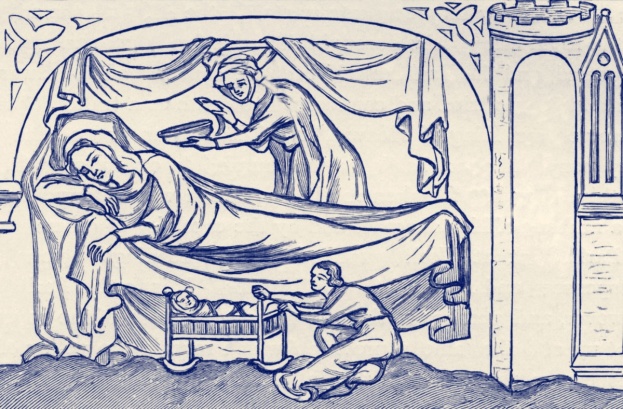
4) Childbirth
Today, with the benefits of ultrasound scans, epidurals and fetal monitoring, the risk for mother and baby during pregnancy and childbirth is at an all-time low. However, during the medieval period, giving birth was incredibly perilous.
Breech presentations of the baby during labour often proved fatal for both mother and child. Labour could go on for several days, and some women eventually died of exhaustion. While Caesarean sections were known, they were unusual other than when the mother of the baby was already dead or dying, and they were not necessarily successful.
Midwives, rather than trained doctors, usually attended pregnant women. They helped the mother-to-be during labour and, if needed, were able to perform emergency baptisms on babies in danger of dying. Most had received no formal training, but relied on practical experience gleaned from years of delivering babies.
New mothers might survive the labour, but could die from various postnatal infections and complications. Equipment was very basic, and manual intervention was common. Status was no barrier to these problems – even Jane Seymour, the third wife of Henry VIII, died soon after giving birth to the future Edward VI in 1537.
5) Infancy and childhood
Infancy was particularly dangerous during the Middle Ages – mortality was terribly high. Based on surviving written records alone, scholars have estimated that 20–30 per cent of children under seven died, but the actual figure is almost certainly higher.
Infants and children under seven were particularly vulnerable to the effects of malnutrition, diseases, and various infections. They might die due to smallpox, whooping cough, accidents, measles, tuberculosis, influenza, bowel or stomach infections, and much more. The majority of those struck down by the plague were also children. Nor, with chronic malnutrition, did the breast milk of medieval mothers carry the same immunity and other benefits of breast milk today.
Being born into a family of wealth or status did not guarantee a long life either. We know that in ducal families in England between 1330 and 1479, for example, one third of children died before the age of five.
6) Bad weather
The vast majority of the medieval population was rural rather than urban, and the weather was of the utmost importance for those who worked or otherwise depended on the land. But as well as jeopardising livelihoods, bad weather could kill.
Consistently poor weather could lead to problems sowing and growing crops, and ultimately the failure of the harvest. If summers were wet and cold, the grain crop could be destroyed. This was a major problem, as cereal grains were the main food source for most of the population.
With less of this on hand, various problems would occur, including grain shortages, people eating inferior grain, and inflation, which resulted in hunger, starvation, disease, and higher death rates.
This was especially the case from the 14th through to the 16th centuries, when the ice pack grew. By 1550, there had been an expansion of glaciers worldwide. This meant people faced the devastating effects of weather that was both colder and wetter.
Medieval men and women were therefore eager to ensure that weather conditions stayed favourable. In Europe, there were rituals for ploughing, sowing seeds, and the harvesting of crops, as well as special prayers, charms, services, and processions to ensure good weather and the fertility of the fields. Certain saints were thought to protect against the frost (St Servais), have power over the wind (St Clement) or the rain and droughts (St Elias/Elijah) and generally the power of the saints and the Virgin Mary were believed to protect against storms and lightning.
People also believed the weather was not merely a natural occurrence. Bad weather could be caused by the behaviour of wicked people, like murder, sin, incest, or family quarrels. It could also be linked to witches and sorcerers, who were thought to control the weather and destroy crops. They could, according to one infamous treatise on witches – the Malleus Maleficarum, published in 1486 – fly in the air and conjure storms (including hailstorms and tempests), raise winds and cause lightning that could kill people and animals.
7) Violence
Whether as witnesses, victims or perpetrators, people from the highest ranks of society to the lowest experienced violence as an omnipresent danger in daily life.
Medieval violence took many forms. Street violence and brawls in taverns were not uncommon. Vassals might also revolt against their lords. Likewise, urban unrest also led to uprisings – for example, the lengthy rebellion of peasants in Flanders of 1323–28, or the Peasants’ Revolt of 1381 in England.
Medieval records demonstrate the presence of other types of violence also: rape, assault and murder were not uncommon, nor was accidental homicide. One example is the case of Maud Fras, who was hit on the head and killed by a large stone accidentally dropped on her head at Montgomery Castle in Wales in 1288.
Blood feuds between families that extended over generations were very much evident. So was what we know today as domestic violence. Local or regional disputes over land, money or other issues could also lead to bloodshed, as could the exercise of justice. Innocence or guilt in trials were at times decided by combat ordeals (duels to the death). In medieval Wales, political or dynastic rivals might be blinded, killed or castrated by Welsh noblemen to consolidate their positions.
Killing and other acts of violence in warfare were also omnipresent, from smaller regional wars to larger-scale crusades from the end of the 11th century, fought by many countries at once. Death tolls in battle could be high: the deadliest clash of the Wars of the Roses, the battle of Towton (1461), claimed between 9,000 and 30,000 lives, according to contemporary reports.
8) Heresy
It could also be dangerous to disagree. People who held theological or religious opinions that were believed to go against the teachings of the Christian church were seen as heretics in medieval Christian Europe. These groups included Jews, Muslims and medieval Christians whose beliefs were considered to be unorthodox, like the Cathars.
Kings, missionaries, crusaders, merchants and others – especially from the late 11th century – sought to ensure the victory of Christendom in the Mediterranean world. The First Crusade (1096–99) aimed to capture Jerusalem – and finally did so in 1099. Yet the city was soon lost, and further crusades had to be launched in a bid to regain it.
Jews and Muslims also suffered persecution, expulsion and death in Christian Europe. In England, anti-Semitism resulted in massacres of Jews in York and London in the late 12th century, and Edward I banished all Jews from England in 1290 – they were only permitted to return in the mid-1600s.
From the eighth century, efforts were also made to retake Iberia from Muslim rule, but it was not until 1492 that the entire peninsula was recaptured. This was part of an attempt in Spain to establish a united, single Christian faith and suppress heresy, which involved setting up the Spanish Inquisition in 1478. As a result, the Jews were expelled from Spain in 1492, and Muslims were only allowed to stay if they converted to Christianity.
Holy wars were also waged on Christians who were widely considered to be heretics. The Albigensian Crusade was directed at the Cathars (based chiefly in southern France) from 1209–29 – and massacres and more inquisitions and executions followed in the later 13th and 14th centuries.
9) Hunting
Hunting was an important pastime for medieval royalty and the aristocracy, and skill in the sport was greatly admired. The emperor Charlemagne was recorded as greatly enjoying hunting in the early ninth century, and in England William the Conqueror sought to establish royal forests where he could indulge in his love of the hunt. But hunting was not without risks.
Hunters could easily be injured or killed by accidents. They might fall from their horse, be pierced by an arrow, be mauled by the horns of stags or tusks of boars, or attacked by bears.
Status certainly did not guarantee safety. Many examples exist of kings and nobles who met tragic ends as a result of hunting. The Byzantine emperor Basil I died in 886 after apparently having his belt impaled on the horns of a stag and being dragged more than 15 miles before being freed.
In 1100, King William II (William Rufus) was famously killed by an arrow in a supposed hunting accident in the New Forest. Likewise, in 1143, King Fulk of Jerusalem died in a hunting accident at Acre, when his horse stumbled and his head was crushed by his saddle.
10) Early or sudden death Sudden or premature death was common in the medieval period. Most people died young, but death rates could vary based on factors like status, wealth, location (higher death rates are seen in urban settlements), and possibly gender. Adults died from various causes, including plague, tuberculosis, malnutrition, famine, warfare, sweating sickness and infections.
Wealth did not guarantee a long life. Surprisingly, well-fed monks did not necessarily live as long as some peasants. Peasants in the English manor of Halesowen might hope to reach the age of 50, but by contrast poor tenants in same manor could hope to live only about 40 years. Those of even lower status (cottagers) could live a mere 30 years.
By the second half of the 14th century, peasants there were living five to seven years longer than in the previous 50 years. However, the average life expectancy for ducal families in England between 1330 and 1479 generally was only 24 years for men and 33 for women. In Florence, laypeople in the late 1420s could expect to live only 28.5 years (men) and 29.5 years (women).
Dying a ‘good’ death was very important to medieval people, and was the subject of many books. People often worried about ‘sudden death’ (whether in battle, from natural causes, by execution, or an accident) and what would happen to those who died without time to prepare and receive the last rites. Written charms, for example, were thought to provide protection against sudden death – whether against death in battle, poison, lightning, fire, water, fever or other dangers.
Dr Katharine Olson is a lecturer in medieval and early modern history at Bangor University. She specialises in the religious, cultural, social, political and intellectual history of medieval and early modern Britain, Ireland, Europe and the Atlantic world, c1100–1750.
Thursday, August 18, 2016
A time traveller’s guide to medieval shopping
History Extra
This image shows a 15th-century continental town (taken from the Livre de Gouvernement des Princes by Gilles de Rome). It shows an apothecary shop well-stocked with red and white jars of medicinal substances; a barber using a cut-throat razor; and a tailor and his apprentice working on clothes. Credit Bridgeman Art Library
The poet WH Auden once suggested that, in order to understand your own country, you need to have lived in at least two others. But what about your own time? By the same reckoning, you need to have experienced at least two other centuries. This presents us with some difficulties. But through historical research, coming to terms with another century is not impossible.
We can approach the past as if it really is ‘a foreign country’ – somewhere we might visit. And we do not actually need to travel in time to appreciate it – just the idea of visiting the past allows us to see life differently, and more immediately. Come shopping in the late 14th century and see for yourself.
All around him people are moving, gesturing, talking. So many have come in from the surrounding villages that this town of about 3,000 inhabitants is today thronged with twice as many. Here are men in knee-length brown tunics driving their cattle before them. Here are their wives in long kirtles with wimples around their heads and necks. Those men in short tunics and hoods are valets in a knight’s household. Those in long gowns with high collars and beaver-fur hats are wealthy merchants. Across the marketplace more peasants are leading in their flocks of sheep, or packhorses and carts loaded with crates of chickens.
Crowds are noisy. People are talking so much that chatter could almost be the whole purpose of the market – and in many ways it is. This is the one open public area in the town where people can meet and exchange information. When a company performs a mystery play, it is to the marketplace that they will drag the cart containing their stage, set and costumes. When the town crier rings his bell to address the people of the town, it is in the marketplace that the crowd will gather to hear him. The marketplace is the heart of any town: indeed, the very definition of a town is that it has a market.
What can you buy? Let’s start at the fishmongers’ stalls. You may have heard that many sorts of freshwater and sea fish are eaten in medieval England. Indeed, more than 150 species are consumed by the nobility and churchmen, drawn from their own fishponds as well as the rivers and seas.
But in most markets it is the popular varieties which you see glistening in the wet hay-filled crates. Mackerel, herring, lampreys, cod, eels, Aberdeen fish (cured salmon and herring), and stockfish (salt cod) are the most common varieties. Crabs and lobsters are transported live, in barrels. In season you will see fresh salmon – attracting the hefty price of four or five shillings each. A fresh turbot can cost even more, up to seven shillings.
Next we come to an area set aside for corn: sacks of wheat, barley, oats and rye are piled up, ready for sale to the townsmen. Then the space given over to livestock: goats, sheep, pigs and cows. A corner is devoted to garden produce – apples, pears, vegetables, garlic and herbs – yet the emphasis of a medieval diet is on meat, cheese and cereal crops. In a large town you will find spicerers selling such exotic commodities as pepper, cinnamon, cloves, nutmeg, liquorice, and many different types of sugar.
These are only for the wealthy. When your average skilled workman earns only two shillings (2s) in a week, he can hardly afford to spend four shillings (4s) on a pound of cloves or 20 pence (20d) on a pound of ginger.
The rest of the marketplace performs two functions. Producers come to sell fleeces, sacks of wool, tanned hides, furs, iron, steel and tin for resale further afield. The other function is to sell manufactured commodities to local people: brass and bronze cooking vessels, candlesticks and spurs, pewterware, woollen cloth, silk, linen, canvas, carts, rushes (for hall floors), glass, faggots, coal, nails, horse shoes and planks of wood.
Planks, you ask? Consider the difficulties of transporting a tree trunk to a saw pit, and then getting two men to saw it into planks with only a handsaw between them.
Everyone in medieval society is heavily dependent on each other for such supplies, and the marketplace is where all these interdependencies meet.

A vendor removes the udders from a cow in this contemporary depiction of a 14th-century butcher’s shop. (Bridgeman Art Library)
“Dame, what hold ye the ell (45 inches) of this
cloth? Or what is worth the cloth whole?
In short, so to speak, how much the ell?”
“Sire, reason; ye shall have it good and cheap.”
“Yea, truly, for cattle. Dame, ye must me win.
Take heed what I shall pay.”
“Four shillings for the ell, if it please you.”
“For so much would I have good scarlet.”
“But I have some which is not of the best
which I would not give for seven shillings.”
“But this is no such cloth, of so much money,
that know ye well!”
“Sire, what is it worth?”
“Dame, it were worth to me well three shillings.”
“That is evil-boden.”
“But say certainly how shall I have it without
a part to leave?”
“I shall give it ye at one word: ye shall pay five
shillings, certainly if ye have them for so many
ells, for I will abate nothing.”
And so you open your purse, which hangs from the cords attached to your belt and find five shillings. Except that there is no shilling coin in the late 14th century. The smallest gold coins are the half-noble (3s 4d) and the quarter-noble (1s 8d), so if you have one each of these, you can make up the sum. Alternatively you will have to make it up from the silver coins: groats (4d), half-groats, pennies, halfpence and farthings (¼d).

Merchants at work at the annual Lendit Fair, which was held near St Denis, Paris each June from the 12th century. (Credit Bridgeman Art Library)
There are reasons to be grateful for the supervision of trade. Short measures are a notorious problem, and turners normally have to swear to make wooden measures of the appropriate size. Clerks in borough courts will tell you of cooking pots being made out of soft metal and coated with brass, and loaves of bread baked with stones in them to make them up to the legally required weight.
Wool is stretched before it is woven, to make it go further (but then it shrinks). Pepper is sold damp, making it swell, weigh more, and rot sooner. Meat is sometimes sold even though it is putrid, wine even though it has turned sour, and bread when it has gone green.
If you are the victim of malpractice, go straight to the authorities. The perpetrator will be pilloried – literally. The pillory is the wooden board which clasps the guilty man’s head and hands, and shamefully exposes him to the insults of the crowd.
A butcher selling bad meat can expect to be dragged through the streets of the town on a hurdle and then placed in the pillory with the rotten meat burnt under him. A vintner caught selling foul wine is dragged to the pillory on a hurdle, forced to drink a draught of the offending liquor, and then set in the pillory where the remainder is poured over his head.
The sweetness of the revenge makes up for the sourness of the wine.
Shopping in the 14th century will often remind you of how much we have in common with our medieval forebears. It will likewise alert you to the huge differences between us. We are not the same as our ancestors. Look at how young they are – the median age is just 21 – and look at the meagre diet of the poor, their rotten teeth as they smile, their resilience in the face of death.
Consider how rough and smelly the streets are, and how small the sheep and cattle are in the marketplace. When a fight breaks out over some stolen goods, and the bedels rush to intervene, you may see how the spirit of the people is so similar to our own and yet how much the process of managing that spirit has changed. For if the stolen goods are of sufficient value, the thieves will be summarily tried and hanged the same day. This is what makes history so interesting – the differences between us across the centuries, as well as the similarities.
At dusk – just before the great gates of the city are closed for the night, and you see everyone leaving the adjacent taverns – you may begin to think that Auden was on to something. To understand ourselves, we must first see society differently – and to remember that history is the study of the living, not the dead.
Ale, ordinary: ¾d–1d per gallon
Wine from Bordeaux: 3d–4d per gallon
Bacon: 15d per side
Chicken: 2d each
Cod, fresh: 20d each
Sugar, loaf of: 18d per lb
Apples: 7d per hundred
Eggs: 33d for 425
A furred gown: 5s 4d
* Prices from the account books of Henry of Lancaster, Earl of Derby.
Wages/salaries in the 1390s
The king’s physician: £40 per year
Officers in the royal household: £20 per year
Mason: £8 per year (6d per day)
Carpenter: 4¼d per day
Thatcher: 4¼d per day
Labourer: 3¼d per day
Valets in a lord’s household: £1 10s per year
Manservant in a yeoman’s household: £1 per year
Maidservant in a yeoman’s household: 10s per year
In old money, there were 12 pence (d) to the shilling (s) and 20 shillings to the pound (£).
We can approach the past as if it really is ‘a foreign country’ – somewhere we might visit. And we do not actually need to travel in time to appreciate it – just the idea of visiting the past allows us to see life differently, and more immediately. Come shopping in the late 14th century and see for yourself.
The marketplace
“Ribs of beef and many a pie!” you hear someone call over your shoulder. Turning, you see a young lad walking through the crowd bearing a tray laden with wooden bowls of cooked meats from a local shop.All around him people are moving, gesturing, talking. So many have come in from the surrounding villages that this town of about 3,000 inhabitants is today thronged with twice as many. Here are men in knee-length brown tunics driving their cattle before them. Here are their wives in long kirtles with wimples around their heads and necks. Those men in short tunics and hoods are valets in a knight’s household. Those in long gowns with high collars and beaver-fur hats are wealthy merchants. Across the marketplace more peasants are leading in their flocks of sheep, or packhorses and carts loaded with crates of chickens.
Crowds are noisy. People are talking so much that chatter could almost be the whole purpose of the market – and in many ways it is. This is the one open public area in the town where people can meet and exchange information. When a company performs a mystery play, it is to the marketplace that they will drag the cart containing their stage, set and costumes. When the town crier rings his bell to address the people of the town, it is in the marketplace that the crowd will gather to hear him. The marketplace is the heart of any town: indeed, the very definition of a town is that it has a market.
What can you buy? Let’s start at the fishmongers’ stalls. You may have heard that many sorts of freshwater and sea fish are eaten in medieval England. Indeed, more than 150 species are consumed by the nobility and churchmen, drawn from their own fishponds as well as the rivers and seas.
But in most markets it is the popular varieties which you see glistening in the wet hay-filled crates. Mackerel, herring, lampreys, cod, eels, Aberdeen fish (cured salmon and herring), and stockfish (salt cod) are the most common varieties. Crabs and lobsters are transported live, in barrels. In season you will see fresh salmon – attracting the hefty price of four or five shillings each. A fresh turbot can cost even more, up to seven shillings.
Next we come to an area set aside for corn: sacks of wheat, barley, oats and rye are piled up, ready for sale to the townsmen. Then the space given over to livestock: goats, sheep, pigs and cows. A corner is devoted to garden produce – apples, pears, vegetables, garlic and herbs – yet the emphasis of a medieval diet is on meat, cheese and cereal crops. In a large town you will find spicerers selling such exotic commodities as pepper, cinnamon, cloves, nutmeg, liquorice, and many different types of sugar.
These are only for the wealthy. When your average skilled workman earns only two shillings (2s) in a week, he can hardly afford to spend four shillings (4s) on a pound of cloves or 20 pence (20d) on a pound of ginger.
The rest of the marketplace performs two functions. Producers come to sell fleeces, sacks of wool, tanned hides, furs, iron, steel and tin for resale further afield. The other function is to sell manufactured commodities to local people: brass and bronze cooking vessels, candlesticks and spurs, pewterware, woollen cloth, silk, linen, canvas, carts, rushes (for hall floors), glass, faggots, coal, nails, horse shoes and planks of wood.
Planks, you ask? Consider the difficulties of transporting a tree trunk to a saw pit, and then getting two men to saw it into planks with only a handsaw between them.
Everyone in medieval society is heavily dependent on each other for such supplies, and the marketplace is where all these interdependencies meet.
A vendor removes the udders from a cow in this contemporary depiction of a 14th-century butcher’s shop. (Bridgeman Art Library)
Haggling
Essential items such as ale and bread have their prices fixed by law. Yet for almost everything that’s been manufactured you will have to negotiate. Caxton’s 15th-century dialogue book is based on a 14th-century language guide, and gives the following lesson in how to haggle with a cloth vendor:“Dame, what hold ye the ell (45 inches) of this
cloth? Or what is worth the cloth whole?
In short, so to speak, how much the ell?”
“Sire, reason; ye shall have it good and cheap.”
“Yea, truly, for cattle. Dame, ye must me win.
Take heed what I shall pay.”
“Four shillings for the ell, if it please you.”
“For so much would I have good scarlet.”
“But I have some which is not of the best
which I would not give for seven shillings.”
“But this is no such cloth, of so much money,
that know ye well!”
“Sire, what is it worth?”
“Dame, it were worth to me well three shillings.”
“That is evil-boden.”
“But say certainly how shall I have it without
a part to leave?”
“I shall give it ye at one word: ye shall pay five
shillings, certainly if ye have them for so many
ells, for I will abate nothing.”
And so you open your purse, which hangs from the cords attached to your belt and find five shillings. Except that there is no shilling coin in the late 14th century. The smallest gold coins are the half-noble (3s 4d) and the quarter-noble (1s 8d), so if you have one each of these, you can make up the sum. Alternatively you will have to make it up from the silver coins: groats (4d), half-groats, pennies, halfpence and farthings (¼d).
Merchants at work at the annual Lendit Fair, which was held near St Denis, Paris each June from the 12th century. (Credit Bridgeman Art Library)
Regulations
A well-run market is crucial to the standing of a town. Thus it is heavily regulated. The actual policing tends to be undertaken by the town’s bedels or bailiffs, who enforce regulations like “no horses may be left standing in the marketplace on market days” and “every man is to keep the street in front of his tenement clean”. Most towns have between 40 and 70 regulations, and those breaking them are taken to the borough court and fined.There are reasons to be grateful for the supervision of trade. Short measures are a notorious problem, and turners normally have to swear to make wooden measures of the appropriate size. Clerks in borough courts will tell you of cooking pots being made out of soft metal and coated with brass, and loaves of bread baked with stones in them to make them up to the legally required weight.
Wool is stretched before it is woven, to make it go further (but then it shrinks). Pepper is sold damp, making it swell, weigh more, and rot sooner. Meat is sometimes sold even though it is putrid, wine even though it has turned sour, and bread when it has gone green.
If you are the victim of malpractice, go straight to the authorities. The perpetrator will be pilloried – literally. The pillory is the wooden board which clasps the guilty man’s head and hands, and shamefully exposes him to the insults of the crowd.
A butcher selling bad meat can expect to be dragged through the streets of the town on a hurdle and then placed in the pillory with the rotten meat burnt under him. A vintner caught selling foul wine is dragged to the pillory on a hurdle, forced to drink a draught of the offending liquor, and then set in the pillory where the remainder is poured over his head.
The sweetness of the revenge makes up for the sourness of the wine.
Shopping in the 14th century will often remind you of how much we have in common with our medieval forebears. It will likewise alert you to the huge differences between us. We are not the same as our ancestors. Look at how young they are – the median age is just 21 – and look at the meagre diet of the poor, their rotten teeth as they smile, their resilience in the face of death.
Consider how rough and smelly the streets are, and how small the sheep and cattle are in the marketplace. When a fight breaks out over some stolen goods, and the bedels rush to intervene, you may see how the spirit of the people is so similar to our own and yet how much the process of managing that spirit has changed. For if the stolen goods are of sufficient value, the thieves will be summarily tried and hanged the same day. This is what makes history so interesting – the differences between us across the centuries, as well as the similarities.
At dusk – just before the great gates of the city are closed for the night, and you see everyone leaving the adjacent taverns – you may begin to think that Auden was on to something. To understand ourselves, we must first see society differently – and to remember that history is the study of the living, not the dead.
Facts
Prices in the 1390s*Ale, ordinary: ¾d–1d per gallon
Wine from Bordeaux: 3d–4d per gallon
Bacon: 15d per side
Chicken: 2d each
Cod, fresh: 20d each
Sugar, loaf of: 18d per lb
Apples: 7d per hundred
Eggs: 33d for 425
A furred gown: 5s 4d
* Prices from the account books of Henry of Lancaster, Earl of Derby.
Wages/salaries in the 1390s
Officers in the royal household: £20 per year
Mason: £8 per year (6d per day)
Carpenter: 4¼d per day
Thatcher: 4¼d per day
Labourer: 3¼d per day
Valets in a lord’s household: £1 10s per year
Manservant in a yeoman’s household: £1 per year
Maidservant in a yeoman’s household: 10s per year
In old money, there were 12 pence (d) to the shilling (s) and 20 shillings to the pound (£).
Thursday, October 15, 2015
10 dangers of the medieval period
History Extra
1) Plague
The plague was one of the biggest killers of the Middle Ages – it had a devastating effect on the population of Europe in the 14th and 15th centuries. Also known as the Black Death, the plague (caused by the bacterium called Yersinia pestis) was carried by fleas most often found on rats. It had arrived in Europe by 1348, and thousands died in places ranging from Italy, France and Germany to Scandinavia, England, Wales, Spain and Russia.The deadly bubonic plague caused oozing swellings (buboes) all over the body. With the septicaemic plague, victims suffered from skin that was darkly discoloured (turning black) as a result of toxins in the bloodstream (one reason why the plague has subsequently been called the ‘Black Death’). The extremely contagious pneumonic plague could be contracted by merely sneezing or spitting, and caused victims’ lungs to fill up.
The Black Death killed between a third and half of the population of Europe. Contemporaries did not know, of course, what caused the plague or how to avoid catching it. They sought explanations for the crisis in God’s anger, human sin, and outsider/marginal groups, especially Jews. If you were infected with the bubonic plague, you had a 70–80 per cent chance of dying within the next week. In England, out of every hundred people, perhaps 35–40 could expect to die from the plague.
As a result of the plague, life expectancy in late 14th-century Florence was just under 20 years – half of what it had been in 1300. From the mid-14th-century onwards, thousands of people from all across Europe – from London and Paris to Ghent, Mainz and Siena – died. A large number of those were children, who were the most vulnerable to the disease.
2) Travel
People in the medieval period faced a host of potential dangers when travelling.A safe, clean place to sleep upon demand was difficult to find. Travellers often had to sleep out in the open – when travelling during the winter, they ran the risk of freezing to death. And while travelling in groups provided some safety, one still might be robbed or killed by strangers – or even one’s fellow travellers.
Nor were food and drink provided unless the traveller had found an inn, monastery, or other lodging. Food poisoning was a risk even then, and if you ran out of food, you had to forage, steal, or go hungry.
Medieval travellers could also be caught up in local or regional disputes or warfare, and be injured or thrown into prison. Lack of knowledge of foreign tongues could also lead to problems of interpretation.
Illness and disease could also be dangerous, and even fatal. If one became unwell on the road, there was no guarantee that decent – or indeed any – medical treatment could be received.
Travellers might also fall victim to accident. For example, there was a risk of drowning when crossing rivers – even the Holy Roman emperor, Frederick I, drowned in 1190 when crossing the Saleph river during the Third Crusade. Accidents might also happen upon arrival: in Rome during the 1450 jubilee, disaster struck when some 200 people in the huge crowd crossing the great bridge of Sant’ Angelo tumbled over the edge and drowned.
While it was faster to travel by sea than land, stepping onto a boat presented substantial risks: a storm could spell disaster, or navigation could go awry, and the medieval wooden ships used were not always equal to the challenges of the sea. However, by the later Middle Ages, sea travel was becoming faster and safer than ever before.
An average traveller in the medieval period could expect to cover 15–25 miles a day on foot or 20–30 on a horse, while sailing ships might make 75–125 miles a day.
3) Famine
Famine was a very real danger for medieval men and women. Faced with dwindling food supplies due to bad weather and poor harvests, people starved or barely survived on meagre rations like bark, berries and inferior corn and wheat damaged by mildew.Those eating so little suffered malnutrition, and were therefore very vulnerable to disease. If they didn’t starve to death, they often died as a result of the epidemics that followed famine. Illnesses like tuberculosis, sweating sickness, smallpox, dysentery, typhoid, influenza, mumps and gastrointestinal infections could and did kill.
The Great Famine of the early 14th century was particularly bad: climate change led to much colder than average temperatures in Europe from c1300 – the ‘Little Ice Age’. In the seven years between 1315 and 1322, western Europe witnessed incredibly heavy rainfall, for up to 150 days at a time.
Farmers struggled to plant, grow and harvest crops. What meagre crops did grow were often mildewed, and/or terribly expensive. The main food staple, bread, was in peril as a result. This also came at the same time as brutally cold winter weather.
At least 10 per cent – perhaps close to 15 per cent – of people in England died during this period.
4) Childbirth
Today, with the benefits of ultrasound scans, epidurals and fetal monitoring, the risk for mother and baby during pregnancy and childbirth is at an all-time low. However, during the medieval period, giving birth was incredibly perilous.Breech presentations of the baby during labour often proved fatal for both mother and child. Labour could go on for several days, and some women eventually died of exhaustion. While Caesarean sections were known, they were unusual other than when the mother of the baby was already dead or dying, and they were not necessarily successful.
Midwives, rather than trained doctors, usually attended pregnant women. They helped the mother-to-be during labour and, if needed, were able to perform emergency baptisms on babies in danger of dying. Most had received no formal training, but relied on practical experience gleaned from years of delivering babies.
New mothers might survive the labour, but could die from various postnatal infections and complications. Equipment was very basic, and manual intervention was common. Status was no barrier to these problems – even Jane Seymour, the third wife of Henry VIII, died soon after giving birth to the future Edward VI in 1537.
5) Infancy and childhood
Infancy was particularly dangerous during the Middle Ages – mortality was terribly high. Based on surviving written records alone, scholars have estimated that 20–30 per cent of children under seven died, but the actual figure is almost certainly higher.Infants and children under seven were particularly vulnerable to the effects of malnutrition, diseases, and various infections. They might die due to smallpox, whooping cough, accidents, measles, tuberculosis, influenza, bowel or stomach infections, and much more. The majority of those struck down by the plague were also children. Nor, with chronic malnutrition, did the breast milk of medieval mothers carry the same immunity and other benefits of breast milk today.
Being born into a family of wealth or status did not guarantee a long life either. We know that in ducal families in England between 1330 and 1479, for example, one third of children died before the age of five.
6) Bad weather
The vast majority of the medieval population was rural rather than urban, and the weather was of the utmost importance for those who worked or otherwise depended on the land. But as well as jeopardising livelihoods, bad weather could kill.Consistently poor weather could lead to problems sowing and growing crops, and ultimately the failure of the harvest. If summers were wet and cold, the grain crop could be destroyed. This was a major problem, as cereal grains were the main food source for most of the population.
With less of this on hand, various problems would occur, including grain shortages, people eating inferior grain, and inflation, which resulted in hunger, starvation, disease, and higher death rates.
This was especially the case from the 14th through to the 16th centuries, when the ice pack grew. By 1550, there had been an expansion of glaciers worldwide. This meant people faced the devastating effects of weather that was both colder and wetter.
Medieval men and women were therefore eager to ensure that weather conditions stayed favourable. In Europe, there were rituals for ploughing, sowing seeds, and the harvesting of crops, as well as special prayers, charms, services, and processions to ensure good weather and the fertility of the fields. Certain saints were thought to protect against the frost (St Servais), have power over the wind (St Clement) or the rain and droughts (St Elias/Elijah) and generally the power of the saints and the Virgin Mary were believed to protect against storms and lightning.
People also believed the weather was not merely a natural occurrence. Bad weather could be caused by the behaviour of wicked people, like murder, sin, incest, or family quarrels. It could also be linked to witches and sorcerers, who were thought to control the weather and destroy crops. They could, according to one infamous treatise on witches – the Malleus Maleficarum, published in 1486 – fly in the air and conjure storms (including hailstorms and tempests), raise winds and cause lightning that could kill people and animals.
7) Violence
Whether as witnesses, victims or perpetrators, people from the highest ranks of society to the lowest experienced violence as an omnipresent danger in daily life.Medieval violence took many forms. Street violence and brawls in taverns were not uncommon. Vassals might also revolt against their lords. Likewise, urban unrest also led to uprisings – for example, the lengthy rebellion of peasants in Flanders of 1323–28, or the Peasants’ Revolt of 1381 in England.
Medieval records demonstrate the presence of other types of violence also: rape, assault and murder were not uncommon, nor was accidental homicide. One example is the case of Maud Fras, who was hit on the head and killed by a large stone accidentally dropped on her head at Montgomery Castle in Wales in 1288.
Blood feuds between families that extended over generations were very much evident. So was what we know today as domestic violence. Local or regional disputes over land, money or other issues could also lead to bloodshed, as could the exercise of justice. Innocence or guilt in trials were at times decided by combat ordeals (duels to the death). In medieval Wales, political or dynastic rivals might be blinded, killed or castrated by Welsh noblemen to consolidate their positions.
Killing and other acts of violence in warfare were also omnipresent, from smaller regional wars to larger-scale crusades from the end of the 11th century, fought by many countries at once. Death tolls in battle could be high: the deadliest clash of the Wars of the Roses, the battle of Towton (1461), claimed between 9,000 and 30,000 lives, according to contemporary reports.
8) Heresy
It could also be dangerous to disagree. People who held theological or religious opinions that were believed to go against the teachings of the Christian church were seen as heretics in medieval Christian Europe. These groups included Jews, Muslims and medieval Christians whose beliefs were considered to be unorthodox, like the Cathars.Kings, missionaries, crusaders, merchants and others – especially from the late 11th century – sought to ensure the victory of Christendom in the Mediterranean world. The First Crusade (1096–99) aimed to capture Jerusalem – and finally did so in 1099. Yet the city was soon lost, and further crusades had to be launched in a bid to regain it.
Jews and Muslims also suffered persecution, expulsion and death in Christian Europe. In England, anti-Semitism resulted in massacres of Jews in York and London in the late 12th century, and Edward I banished all Jews from England in 1290 – they were only permitted to return in the mid-1600s.
From the eighth century, efforts were also made to retake Iberia from Muslim rule, but it was not until 1492 that the entire peninsula was recaptured. This was part of an attempt in Spain to establish a united, single Christian faith and suppress heresy, which involved setting up the Spanish Inquisition in 1478. As a result, the Jews were expelled from Spain in 1492, and Muslims were only allowed to stay if they converted to Christianity.
Holy wars were also waged on Christians who were widely considered to be heretics. The Albigensian Crusade was directed at the Cathars (based chiefly in southern France) from 1209–29 – and massacres and more inquisitions and executions followed in the later 13th and 14th centuries.
9) Hunting
Hunting was an important pastime for medieval royalty and the aristocracy, and skill in the sport was greatly admired. The emperor Charlemagne was recorded as greatly enjoying hunting in the early ninth century, and in England William the Conqueror sought to establish royal forests where he could indulge in his love of the hunt. But hunting was not without risks.Hunters could easily be injured or killed by accidents. They might fall from their horse, be pierced by an arrow, be mauled by the horns of stags or tusks of boars, or attacked by bears.
Status certainly did not guarantee safety. Many examples exist of kings and nobles who met tragic ends as a result of hunting. The Byzantine emperor Basil I died in 886 after apparently having his belt impaled on the horns of a stag and being dragged more than 15 miles before being freed.
In 1100, King William II (William Rufus) was famously killed by an arrow in a supposed hunting accident in the New Forest. Likewise, in 1143, King Fulk of Jerusalem died in a hunting accident at Acre, when his horse stumbled and his head was crushed by his saddle.
10) Early or sudden death
Sudden or premature death was common in the medieval period. Most people died young, but death rates could vary based on factors like status, wealth, location (higher death rates are seen in urban settlements), and possibly gender. Adults died from various causes, including plague, tuberculosis, malnutrition, famine, warfare, sweating sickness and infections.Wealth did not guarantee a long life. Surprisingly, well-fed monks did not necessarily live as long as some peasants. Peasants in the English manor of Halesowen might hope to reach the age of 50, but by contrast poor tenants in same manor could hope to live only about 40 years. Those of even lower status (cottagers) could live a mere 30 years.
By the second half of the 14th century, peasants there were living five to seven years longer than in the previous 50 years. However, the average life expectancy for ducal families in England between 1330 and 1479 generally was only 24 years for men and 33 for women. In Florence, laypeople in the late 1420s could expect to live only 28.5 years (men) and 29.5 years (women).
Dying a ‘good’ death was very important to medieval people, and was the subject of many books. People often worried about ‘sudden death’ (whether in battle, from natural causes, by execution, or an accident) and what would happen to those who died without time to prepare and receive the last rites. Written charms, for example, were thought to provide protection against sudden death – whether against death in battle, poison, lightning, fire, water, fever or other dangers.
Dr Katharine Olson is a lecturer in medieval and early modern history at Bangor University. She specialises in the religious, cultural, social, political and intellectual history of medieval and early modern Britain, Ireland, Europe and the Atlantic world, c1100–1750.
Subscribe to:
Comments (Atom)