Showing posts with label plague. Show all posts

Monday, September 29, 2025

Book Spotlight: The Blackest Time by Ken Tentarelli


Set in the 1300s during the devastating black plague, The Blackest Time is a powerful tale of compassion, love, and the human spirit’s ability to endure immense adversity.

Gino, the central character, is a young man who leaves his family’s farm to find work in a pharmacy in Florence. His experiences show us how people coped in the most horrific time in history.

Shortly after Gino arrived in the city, two years of incessant rain destroyed crops in the countryside, leading to famine and despair in the city. Gino offers hope and help to the suffering— he secures shelter for a woman forced to leave her flooded farm, rescues a young girl orphaned by the plague, and aids others who have lost everything.

The rains had barely ended when the plague hit the city, exposing the true character of its people. While some blamed others for the devastation, the story focuses on the compassionate acts of neighbors helping each other overcome fear and suffering. Doctors bravely risk infection to care for their patients. A woman healer, wrongly accused of witchcraft and driven from the city, finds a new beginning in a village where her skills were appreciated.

Despite the hardships, love blossoms between Gino and a young woman he met at the apothecary. Together they survive, finding strength in each other and hope in a world teetering on the edge.

The Blackest Time is a testament to the strength of the human spirit in overcoming unimaginable tragedy.


 Buy Link:

 Universal Buy Link:  https://books2read.com/u/bPO08J


Ken Tentarelli is a frequent visitor to Italy. In travels from the Alps to the southern coast of Sicily, he developed a love for its history and its people.

He has studied Italian culture and language in Rome and Perugia, background he used in his award-winning series of historical thrillers set in the Italian Renaissance. He has taught courses in Italian history spanning time from the Etruscans to the Renaissance, and he's a strong advocate of libraries and has served as a trustee of his local library and officer of the library foundation.

When not traveling, Ken and his wife live in beautiful New Hampshire.

Author Links:

Website:   https://KenTentarelli.com

Facebook:  https://www.facebook.com/ken.tentarelli.3/

Instagram:    https://www.instagram.com/kententarelliauthor/

Book Bub:  https://www.bookbub.com/authors/ken-tentarelli

Amazon Author Page: 

https://www.amazon.com/stores/Ken-Tentarelli/author/B07PDYZ34Q

Goodreads: https://www.goodreads.com/author/show/18920645.Ken_Tentarelli


Thursday, February 1, 2018

Introduction of farming led to ‘Black Death’-type population collapse


History Extra


The introduction of farming into Western Europe 7,500 years ago led to dramatic population collapse, according to new research.

 In a study published in the journal Nature Communications, researchers from University College London (UCL) found evidence of decreases in population size as great as 60 per cent.

Looking at the distribution of nearly 8,000 radiocarbon dates from archaeological sites in several regions, and using novel statistical analysis, the team noticed that while there was evidence of a dramatic increase in human activity shortly after farming was introduced, it was not sustained.

Instead the team found, in many regions, proof of population collapse on a similar scale to the Black Death.

While the exact cause of these population decreases remains unknown, the team says farming could have driven population growth to unsustainable levels.

Alternatively, soils could have become eroded, or depleted of nutrients.

Professor Stephen Shennan, lead author of the study, said: “The introduction of farming is widely believed to have led to sustained population growth, but the new evidence we’ve uncovered suggests this large-scale ‘boom-and-bust’ pattern.

“The reasons behind this trend still remain unknown, but they could have been to do with farming itself.”

  Dr Adrian Timpson, a co-author of the study, said: “The reasons why these populations collapsed so dramatically remains unknown.

“One possibility could be changes in climate, which can affect the suitability and productivity of crops in different regions. But when we looked into this further, we found no conclusive proof of a link.”

Monday, August 21, 2017

10 dangers of the medieval period


History Extra


1) Plague
 The plague was one of the biggest killers of the Middle Ages – it had a devastating effect on the population of Europe in the 14th and 15th centuries. Also known as the Black Death, the plague (caused by the bacterium called Yersinia pestis) was carried by fleas most often found on rats. It had arrived in Europe by 1348, and thousands died in places ranging from Italy, France and Germany to Scandinavia, England, Wales, Spain and Russia.

 The deadly bubonic plague caused oozing swellings (buboes) all over the body. With the septicaemic plague, victims suffered from skin that was darkly discoloured (turning black) as a result of toxins in the bloodstream (one reason why the plague has subsequently been called the ‘Black Death’). The extremely contagious pneumonic plague could be contracted by merely sneezing or spitting, and caused victims’ lungs to fill up.

 The Black Death killed between a third and half of the population of Europe. Contemporaries did not know, of course, what caused the plague or how to avoid catching it. They sought explanations for the crisis in God’s anger, human sin, and outsider/marginal groups, especially Jews. If you were infected with the bubonic plague, you had a 70–80 per cent chance of dying within the next week. In England, out of every hundred people, perhaps 35–40 could expect to die from the plague.

 As a result of the plague, life expectancy in late 14th-century Florence was just under 20 years – half of what it had been in 1300. From the mid-14th-century onwards, thousands of people from all across Europe – from London and Paris to Ghent, Mainz and Siena – died. A large number of those were children, who were the most vulnerable to the disease.

 2) Travel
 People in the medieval period faced a host of potential dangers when travelling.

 A safe, clean place to sleep upon demand was difficult to find. Travellers often had to sleep out in the open – when travelling during the winter, they ran the risk of freezing to death. And while travelling in groups provided some safety, one still might be robbed or killed by strangers – or even one’s fellow travellers.

 Nor were food and drink provided unless the traveller had found an inn, monastery, or other lodging. Food poisoning was a risk even then, and if you ran out of food, you had to forage, steal, or go hungry.

 Medieval travellers could also be caught up in local or regional disputes or warfare, and be injured or thrown into prison. Lack of knowledge of foreign tongues could also lead to problems of interpretation.

 Illness and disease could also be dangerous, and even fatal. If one became unwell on the road, there was no guarantee that decent – or indeed any – medical treatment could be received.

 Travellers might also fall victim to accident. For example, there was a risk of drowning when crossing rivers – even the Holy Roman emperor, Frederick I, drowned in 1190 when crossing the Saleph river during the Third Crusade. Accidents might also happen upon arrival: in Rome during the 1450 jubilee, disaster struck when some 200 people in the huge crowd crossing the great bridge of Sant’ Angelo tumbled over the edge and drowned.


While it was faster to travel by sea than land, stepping onto a boat presented substantial risks: a storm could spell disaster, or navigation could go awry, and the medieval wooden ships used were not always equal to the challenges of the sea. However, by the later Middle Ages, sea travel was becoming faster and safer than ever before. An average traveller in the medieval period could expect to cover 15–25 miles a day on foot or 20–30 on a horse, while sailing ships might make 75–125 miles a day.

 3) Famine
 Famine was a very real danger for medieval men and women. Faced with dwindling food supplies due to bad weather and poor harvests, people starved or barely survived on meagre rations like bark, berries and inferior corn and wheat damaged by mildew.

 Those eating so little suffered malnutrition, and were therefore very vulnerable to disease. If they didn’t starve to death, they often died as a result of the epidemics that followed famine. Illnesses like tuberculosis, sweating sickness, smallpox, dysentery, typhoid, influenza, mumps and gastrointestinal infections could and did kill.

 The Great Famine of the early 14th century was particularly bad: climate change led to much colder than average temperatures in Europe from c1300 – the ‘Little Ice Age’. In the seven years between 1315 and 1322, western Europe witnessed incredibly heavy rainfall, for up to 150 days at a time.

 Farmers struggled to plant, grow and harvest crops. What meagre crops did grow were often mildewed, and/or terribly expensive. The main food staple, bread, was in peril as a result. This also came at the same time as brutally cold winter weather.

 At least 10 per cent – perhaps close to 15 per cent – of people in England died during this period.

 4) Childbirth
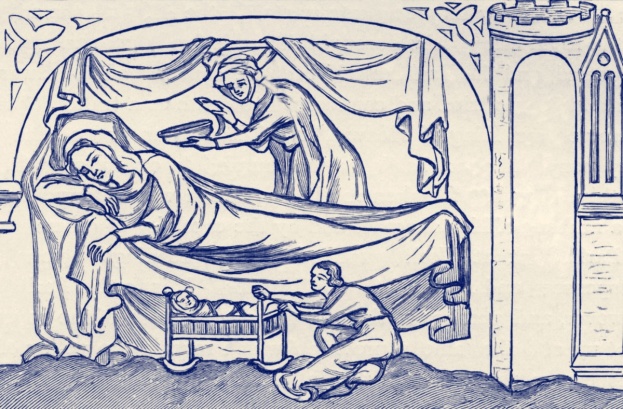
 Today, with the benefits of ultrasound scans, epidurals and fetal monitoring, the risk for mother and baby during pregnancy and childbirth is at an all-time low. However, during the medieval period, giving birth was incredibly perilous.

 Breech presentations of the baby during labour often proved fatal for both mother and child. Labour could go on for several days, and some women eventually died of exhaustion. While Caesarean sections were known, they were unusual other than when the mother of the baby was already dead or dying, and they were not necessarily successful.

 Midwives, rather than trained doctors, usually attended pregnant women. They helped the mother-to-be during labour and, if needed, were able to perform emergency baptisms on babies in danger of dying. Most had received no formal training, but relied on practical experience gleaned from years of delivering babies.

 New mothers might survive the labour, but could die from various postnatal infections and complications. Equipment was very basic, and manual intervention was common. Status was no barrier to these problems – even Jane Seymour, the third wife of Henry VIII, died soon after giving birth to the future Edward VI in 1537.


5) Infancy and childhood
 Infancy was particularly dangerous during the Middle Ages – mortality was terribly high. Based on surviving written records alone, scholars have estimated that 20–30 per cent of children under seven died, but the actual figure is almost certainly higher.

 Infants and children under seven were particularly vulnerable to the effects of malnutrition, diseases, and various infections. They might die due to smallpox, whooping cough, accidents, measles, tuberculosis, influenza, bowel or stomach infections, and much more. The majority of those struck down by the plague were also children. Nor, with chronic malnutrition, did the breast milk of medieval mothers carry the same immunity and other benefits of breast milk today.

 Being born into a family of wealth or status did not guarantee a long life either. We know that in ducal families in England between 1330 and 1479, for example, one third of children died before the age of five.

 6) Bad weather
 The vast majority of the medieval population was rural rather than urban, and the weather was of the utmost importance for those who worked or otherwise depended on the land. But as well as jeopardising livelihoods, bad weather could kill.

 Consistently poor weather could lead to problems sowing and growing crops, and ultimately the failure of the harvest. If summers were wet and cold, the grain crop could be destroyed. This was a major problem, as cereal grains were the main food source for most of the population.

 With less of this on hand, various problems would occur, including grain shortages, people eating inferior grain, and inflation, which resulted in hunger, starvation, disease, and higher death rates.

 This was especially the case from the 14th through to the 16th centuries, when the ice pack grew. By 1550, there had been an expansion of glaciers worldwide. This meant people faced the devastating effects of weather that was both colder and wetter.

 Medieval men and women were therefore eager to ensure that weather conditions stayed favourable. In Europe, there were rituals for ploughing, sowing seeds, and the harvesting of crops, as well as special prayers, charms, services, and processions to ensure good weather and the fertility of the fields. Certain saints were thought to protect against the frost (St Servais), have power over the wind (St Clement) or the rain and droughts (St Elias/Elijah) and generally the power of the saints and the Virgin Mary were believed to protect against storms and lightning.

 People also believed the weather was not merely a natural occurrence. Bad weather could be caused by the behaviour of wicked people, like murder, sin, incest, or family quarrels. It could also be linked to witches and sorcerers, who were thought to control the weather and destroy crops. They could, according to one infamous treatise on witches – the Malleus Maleficarum, published in 1486 – fly in the air and conjure storms (including hailstorms and tempests), raise winds and cause lightning that could kill people and animals.

 7) Violence
 Whether as witnesses, victims or perpetrators, people from the highest ranks of society to the lowest experienced violence as an omnipresent danger in daily life.

 Medieval violence took many forms. Street violence and brawls in taverns were not uncommon. Vassals might also revolt against their lords. Likewise, urban unrest also led to uprisings – for example, the lengthy rebellion of peasants in Flanders of 1323–28, or the Peasants’ Revolt of 1381 in England.

 Medieval records demonstrate the presence of other types of violence also: rape, assault and murder were not uncommon, nor was accidental homicide. One example is the case of Maud Fras, who was hit on the head and killed by a large stone accidentally dropped on her head at Montgomery Castle in Wales in 1288.

 Blood feuds between families that extended over generations were very much evident. So was what we know today as domestic violence. Local or regional disputes over land, money or other issues could also lead to bloodshed, as could the exercise of justice. Innocence or guilt in trials were at times decided by combat ordeals (duels to the death). In medieval Wales, political or dynastic rivals might be blinded, killed or castrated by Welsh noblemen to consolidate their positions.

 Killing and other acts of violence in warfare were also omnipresent, from smaller regional wars to larger-scale crusades from the end of the 11th century, fought by many countries at once. Death tolls in battle could be high: the deadliest clash of the Wars of the Roses, the battle of Towton (1461), claimed between 9,000 and 30,000 lives, according to contemporary reports.

 8) Heresy
 It could also be dangerous to disagree. People who held theological or religious opinions that were believed to go against the teachings of the Christian church were seen as heretics in medieval Christian Europe. These groups included Jews, Muslims and medieval Christians whose beliefs were considered to be unorthodox, like the Cathars.

 Kings, missionaries, crusaders, merchants and others – especially from the late 11th century – sought to ensure the victory of Christendom in the Mediterranean world. The First Crusade (1096–99) aimed to capture Jerusalem – and finally did so in 1099. Yet the city was soon lost, and further crusades had to be launched in a bid to regain it.

 Jews and Muslims also suffered persecution, expulsion and death in Christian Europe. In England, anti-Semitism resulted in massacres of Jews in York and London in the late 12th century, and Edward I banished all Jews from England in 1290 – they were only permitted to return in the mid-1600s.

 From the eighth century, efforts were also made to retake Iberia from Muslim rule, but it was not until 1492 that the entire peninsula was recaptured. This was part of an attempt in Spain to establish a united, single Christian faith and suppress heresy, which involved setting up the Spanish Inquisition in 1478. As a result, the Jews were expelled from Spain in 1492, and Muslims were only allowed to stay if they converted to Christianity.

 Holy wars were also waged on Christians who were widely considered to be heretics. The Albigensian Crusade was directed at the Cathars (based chiefly in southern France) from 1209–29 – and massacres and more inquisitions and executions followed in the later 13th and 14th centuries.


9) Hunting
 Hunting was an important pastime for medieval royalty and the aristocracy, and skill in the sport was greatly admired. The emperor Charlemagne was recorded as greatly enjoying hunting in the early ninth century, and in England William the Conqueror sought to establish royal forests where he could indulge in his love of the hunt. But hunting was not without risks.

 Hunters could easily be injured or killed by accidents. They might fall from their horse, be pierced by an arrow, be mauled by the horns of stags or tusks of boars, or attacked by bears.

 Status certainly did not guarantee safety. Many examples exist of kings and nobles who met tragic ends as a result of hunting. The Byzantine emperor Basil I died in 886 after apparently having his belt impaled on the horns of a stag and being dragged more than 15 miles before being freed.

 In 1100, King William II (William Rufus) was famously killed by an arrow in a supposed hunting accident in the New Forest. Likewise, in 1143, King Fulk of Jerusalem died in a hunting accident at Acre, when his horse stumbled and his head was crushed by his saddle.

 10) Early or sudden death Sudden or premature death was common in the medieval period. Most people died young, but death rates could vary based on factors like status, wealth, location (higher death rates are seen in urban settlements), and possibly gender. Adults died from various causes, including plague, tuberculosis, malnutrition, famine, warfare, sweating sickness and infections. 

Wealth did not guarantee a long life. Surprisingly, well-fed monks did not necessarily live as long as some peasants. Peasants in the English manor of Halesowen might hope to reach the age of 50, but by contrast poor tenants in same manor could hope to live only about 40 years. Those of even lower status (cottagers) could live a mere 30 years.

 By the second half of the 14th century, peasants there were living five to seven years longer than in the previous 50 years. However, the average life expectancy for ducal families in England between 1330 and 1479 generally was only 24 years for men and 33 for women. In Florence, laypeople in the late 1420s could expect to live only 28.5 years (men) and 29.5 years (women).

 Dying a ‘good’ death was very important to medieval people, and was the subject of many books. People often worried about ‘sudden death’ (whether in battle, from natural causes, by execution, or an accident) and what would happen to those who died without time to prepare and receive the last rites. Written charms, for example, were thought to provide protection against sudden death – whether against death in battle, poison, lightning, fire, water, fever or other dangers.

 Dr Katharine Olson is a lecturer in medieval and early modern history at Bangor University. She specialises in the religious, cultural, social, political and intellectual history of medieval and early modern Britain, Ireland, Europe and the Atlantic world, c1100–1750.

Wednesday, March 29, 2017

Your 60-second guide to the Black Death

History Extra


Death strangling victim of Black Death, 1376. (Artist Werner Forman, image Alamy)

Q: What was the Black Death?
 A: In the Middle Ages the Black Death, or ‘pestilencia’, as contemporaries called various epidemic diseases, was the worst catastrophe in recorded history. Some dubbed it ‘magna mortalitas’ (great mortality), emphasising the death rate.

 It destroyed a higher proportion of the population than any other single known event. One observer noted ‘the living were scarcely sufficient to bury the dead.’ No one could be sure what caused it.

 Q: When did the Black Death break out?
 A: The disease arrived in western Europe in 1347 and in England in 1348. It faded away in the early 1350s.

 Q: Where did it originate, and what areas did it affect?
 A: Breaking out in ‘the east’, as medieval people put it, it came north and west after striking the eastern Mediterranean and Italy, Spain and France.

 It then came to Britain, where it struck Dorset and Hampshire along the south coast of England simultaneously. It then spread north and east, then on to Scandinavia and Russia.

 Q: How did it spread?
 A: The disease spread from animal populations to humans through the agency of fleas from dying rats. Plague bacteria stifled the vital organs of those infected.

 Its lethality arose from the onslaught of three types: bubonic, pneumonic and, occasionally, septicaemic plague.

 Q: Who was affected?
 A: Old and young, men and women: all of society – royalty, peasants, archbishops, monks, nuns and parish clergy.

 Both artisan and artistic skills were lost or severely affected, from cathedral building in Italy to pottery production in England. Artists such as the Lorinzetti brothers of Siena were victims, and the English royal masons, the Ramseys, died.

 There were shortages of people to till the land and tend cattle and sheep.

 Q: What were the symptoms?
 A: Symptoms included swellings – most commonly in the groin, armpits and neck; dark patches, and the coughing up of blood.

Medieval observers – and their modern counterparts in 19th-century China and 20th-century Vietnam, observing more recent outbreaks – noted that different strains of the disease took from five days to as little as half a day to cause death.

 Q: How many people were killed?
 A: In Europe in three or four years, 50 million people died. The population was reduced from some 80 million to 30 million. It killed at least 60 per cent of the population in rural and urban areas.

 Some communities such as Quob in Hampshire were wiped out; many rural communities went into decline and were in time deserted. We know that some populations survived, but medieval people had no such knowledge – all they knew was that everyone would certainly die.

 Q: Was it a one-off occurrence?
 A: No. There have been three identified so-called ‘pandemics’. First, there was a significant international epidemic in the sixth century AD. Second, starting with The Black Death – its deadliest attack - plague later returned to Britain in 1361 (when it affected especially younger and elderly people); 1374, and regularly until it disappeared shortly after the Great Plague of 1665. Third, the disease broke out once more in Asia in the 1890s, and established new foci, where it is still found in animal populations today.

Q: What remedies were used?
 A: Medieval people believed that the disease came from God, and so responded with prayers and processions. Some contemporaries realised that the only remedy for plague was to run away from it – Boccaccio’s Decameron is a series of tales told among a group of young people taking refuge from the Black Death outside Florence.

 There was no known remedy, but people wanted medicines: Chaucer commented that the Doctor of Physic made much ‘gold’ out of the pestilence. The plague bacteria were identified in Asia in the 1890s, and the connection with animals and fleas established.

 Modern antibiotics can combat plague, but these are under threat from mutating diseases and immunity to antibiotics’ effects.

Q: Will it return?
 A: In fact, the disease has never gone away. An outbreak in Surat in India in the early 1990s caused panic across the world. The death of a herdsman in Kyrgyzstan in 2013 from bubonic plague was wildly exaggerated in the media. With our better understanding of historic plague, other diseases among animals such as bird-flu and swine-flu are carefully monitored today in case they develop into person-to-person infections resulting in high mortality as witnessed in the Black Death.

Friday, September 30, 2016

10 things you (probably) didn’t know about the Black Death

History Extra

Plague victims in Perugia. From a 14th century manuscript of the vernacular text 'La Franceschina'. (Photo By DEA / A. DAGLI ORTI/De Agostini/Getty Images)

Here, writing for History Extra, medieval historian Samuel Cohn shares 10 lesser-known facts…

1) The Black Death (October 1347 to c1352) did not eradicate a third of Europe’s population

Open almost any textbook on western civilisation and it will claim that the Black Death felled one-third of Europe’s population. In fact, in some places such as a village on an estate in Cambridgeshire manorial rolls attest that 70 per cent of its tenants died in a matter of months in 1349, and the city of Florence tax records drawn up shortly before and after the Black Death suggest that its toll may have been about the same in 1348.
Yet, the plague skipped over or barely touched other villages, even within Cambridgeshire, and may not have infected at all vast regions such as ones in northern German-speaking lands. Given the state of record-keeping and preservation, we will probably never be able to estimate the Black Death’s European toll with any precision.

2) The Black Death was not a disease of the black rat transmitted to humans by fleas

Not only textbooks but serious monographs on the Black Death and its successive waves of plague into the early 19th century in Europe go on about rats (usually the black ones) and fleas without qualification. But what is the evidence?
No contemporary observers described any epizootic [animal epidemic] of rats or of any other rodents immediately before or during the Black Death, or during any later plagues in Europe – that is, until the ‘third pandemic’ at the end of the 19th century. Yet in subtropical regions of Africa and China, descriptions of ‘rat falls’ accompanying a human disease with buboes in the principal lymph nodes reach back at least to the 18th century.
As for fleas, unlike during the ‘third pandemic’, when plague cases and deaths followed closely the seasonal fertility cycles of various species of rat fleas, no such correlations are found with the Black Death or later European plagues before the end of the 19th century. 

3) The Black Death was not a disease of poverty

Not only do contemporary chroniclers list important knights, ladies, and merchants who died during the Black Death, but administrative records also point to a wide swath of the population felled in 1348–49. Furthermore, many wealthy and well-fed convents, friaries, and monasteries across Europe lost more than half of their members; some even became extinct.
However, by the third or fourth wave of plague in the last decades of the 14th century, burial records and tax registers reveal that the disease had evolved into one of the poor.


A Venetian plague doctor, c1800. (Photo By DEA PICTURE LIBRARY/De Agostini/Getty Images)

4) The Black Death was not a disease only of large cities and towns and villages in the lowlands

In 1348–49, some of the worst-hit regions were in mountainous and in relatively isolated zones, such as in Snowdonia in Wales or the mountain village of Mangona in the Alpi fiorentine, north of Florence, whose communications with cities were less frequent than places further down the slopes and closer to cities.
The experiences of these isolated villages may have been similar to small mining villages in Pennsylvania or in South Africa, or Inuit settlements in Newfoundland under attack by another highly contagious pandemic, the Great Influenza of 1918–19, in which they experienced mortalities from 10 to 40 per cent – many times higher than in New York City or London.

5) The Black Death did not afflict all major European cities and towns on principal trade routes

For reasons that are difficult to explain, cities such as Milan and Douai in Flanders, both major hubs of commerce and industry, appear to have escaped the Black Death in 1348 almost totally unscathed.
In the case of Milan, only one household fell victim to the disease, at least according to chronicles, and the plague was successfully contained. Meanwhile, Douai chronicles, monastic necrologies, and archival records (recording, for example, the deaths of magistrates, and last wills and testaments) show no certain signs of the plague entering that city until the plague of 1400.

6) The Black Death did not result everywhere in the massacre of Jews or the blaming of other minorities

In German-speaking lands, France along the Rhine, and parts of Spain, municipal governments, castellans, bishops, and the Holy Roman Emperor accused Jews of spreading the Black Death by poisoning foodstuffs and water sources, and massacred entire communities of men, women, and babies for these supposed crimes.
The accusations and massacres, however, were not universal between 1348 and 1351. Massacres did not arise in the British Isles (where, at least in England, Jews had been expelled in 1290 by Edward I), and no clear evidence pinpoints any such violence in Italy (except for the Catalans in Sicily). Nor are any massacres recorded in the Middle East.

7) The first ‘quarantine’ was not invented in Venice – rather it was a ‘trentine’ first legislated in Ragusa

The phrase ‘quarantine’ (the exclusion and isolation of those coming from infected regions, or of others suspected of carrying plague, to avoid them mixing with uninfected populations for a certain number of days) was coined in Venice in the early 15th century, based on a 40-day period of isolation (with Biblical resonances). But the city of Ragusa [present-day Dubrovnik] had beaten the Venetians to the punch in 1377 with a plague ‘quarantine’ of 30 days.
By the early modern period, ‘quarantine’ often had been curtailed further. The period deemed necessary to isolate suspected carriers in Milan during its plague of 1557–75, for instance, had dropped to eight daysfor certain categories of suspicion.


Clothes infected by the Black Death being burnt, c 1340. An illustration from the 'Romance of Alexander' in the Bodleian Library, Oxford. (Photo by Hulton Archive/Getty Images)

8)  All human attempts to end the plague in Europe were not in vain

Cities that managed to keep plague beyond their borders were those that devised and implemented quarantine: border controls at city gates, harbours, and mountain passes; individual health passports (which identified a person and certified where he or she came from), and other related measures such as spy networks to signal when a plague had erupted in a foreign city or region.
Ragusa was a pioneer in this regard, with its earliest ‘quarantine’ and its increasingly sophisticated measures to isolate the infected and control its borders during the late 14th and 15th centuries. Its last plague was in 1533, while in England it was 1665–56, in the Baltic region 1709–13, and Northern Africa and the Middle East the 19th century. Many Italian regions followed Ragusa’s lead, and after them, other regions of western and central Europe.

9) Despite the thousands who sacrificed their lives assisting spiritually or physically the afflicted during the Black Death, the church awarded none of them with blessed or saintly status

From October 1347 in Sicily to the early 1350s further north, contemporary chroniclers decried peoples abandonment of sick family members, and criticised clergymen and doctors who were ‘cowardly’ in reneging on their responsibilities to escape the plague’s vicious contagion. However, occasionally contemporary writers also praised those who stayed on to nurse the afflicted, and who often lost their lives in so doing.
Curiously, the church did not recognise any of these martyrs during the Black Death with elevations to beatitude or sanctity.
The first to be so recognised did not appear until the 15th century, and those who intervened to help those afflicted by the plague (that is, during their own lifetimes and not as post-mortem miraculous acts) remained rare even during 16th and 17th centuries.

10) The Black Death travelled 30 to 100 times faster over land than the bubonic plagues of the 20th century

It is thought that the Black Death spread at a rate of a mile or more a day, but other accounts have measured it in places to have averaged as far as eight miles a day.
By contrast, scientists in South Africa, New Orleans, and other places affected by bubonic plague in the early 20th century devised experiments to clock their plague’s spread, and found it moving no faster than eight miles a year. It spread so slowly because modern bubonic plague was a rodent disease and often one dependent on the house rat.
These extreme differences in the spread of the Black Death and the bubonic plagues of modern times are seen despite the revolutions in transport with steam power, railway, and, by the early 20th century, automobiles.
Samuel Cohn is professor of medieval history at the University of Glasgow. He is the author of Cultures of Plague: Medical Thinking at the End of the Renaissance (Oxford University Press, 2010) and The Black Death Transformed: Disease and Culture in Early Renaissance Europe (Edward Arnold Publishers Ltd, 2002).

Saturday, September 10, 2016

Everything you know about 17th-century London is wrong

History Extra

Guy Fawkes and the Gunpowder Plotters, 1605. Contrary to popular belief, Guy Fawkes was not executed for masterminding the Gunpowder Plot. (Photo by Print Collector/Getty Images)

In a city as historically dense as London, facts and faces can get jumbled as readily as oats in a box of muesli. Take the statue of Lady Justice on top of the Old Bailey [the Central Criminal Court of England and Wales], for example: many believe that she is blindfolded; she is not. Tourists look for the Union Flag above Buckingham Palace as a sign that the queen is at home; in fact it means she’s away. Even cast-iron ‘truths’ can turn out to be distortions: while the Tower of London did indeed see famous beheadings in the Tudor period, more than half of all executions in the fortress were conducted in the 20th century.
Of all eras, the 17th century seems to have generated more mistruths than most. This was a period that saw the beginnings of the press (newspapers), the first stirrings of scientific discourse and the city’s great chroniclers such as Pepys, Evelyn and, latterly, Defoe. It was also a time of tumultuous events, with plague, war, fire and political upheaval striking the nation as rarely before. Many of us carry around a working knowledge of these heady days, but how much of it is accurate? Here are four myths busted…


Guy Fawkes was not executed for masterminding the Gunpowder Plot

The century began with a bang. Almost. Guy Fawkes and co-conspirators famously plotted to blow up the Houses of Parliament, and the king with them. But it didn’t quite happen as many of us believe...
Every year, thousands of people make life-size effigies of the Catholic Yorkshireman, then set him on fire for the delight of their children. This is the man who plotted not just to bring down the system, but to blow up the king and his government too. In 1605, his actions were branded as treachery and treason. Today, we would call him a terrorist. But does Fawkes truly deserve the animosity of centuries?
His story is well known to every British school child. Guy Fawkes, real name Guido Fawkes, was angry at the state for its anti-Catholic prejudice. He brought together a team of conspirators intent on killing King James and his cronies during the State Opening of Parliament. Under the cover of night they broke into the House of Lords and loaded the cellar with barrels of gunpowder. The plot was, however, discovered on the eve of success, thanks to an anonymous tip-off. Fawkes was arrested, tortured and eventually gave the names of his auxiliaries. All were eventually captured and executed.
But this story is wrong in almost every respect.
Fawkes was not the ringleader. He was merely the first to be captured when the guards caught him red-handed and alone in the gunpowder cellar. The true mastermind was Robert Catesby. He led the team of 13 conspirators – Fawkes had no special place in the hierarchy, but was chosen to light the fuse at the assassination attempt. Nor was he born as Guido. That was a nickname he adopted while fighting for the Catholic Spanish in the Eighty Years’ War. Plain old Guy was his birth name.
And contrary to popular belief, the conspirators did not break into the Houses of Parliament. In fact, they took a lease out on the undercroft and had lawful access to the space. The gunpowder stash was built up over a number of months before the plague-delayed opening of Parliament on 5 November.
Fawkes did indeed receive the death penalty for High Treason, and was dragged to the gallows in Old Palace Yard to be hanged, drawn and quartered. This terrifying procedure would first see the condemned man dangle by the neck until barely conscious. After being cut down, his genitals would be sliced off and his belly opened. His entrails would then be scooped out and burnt with his testicles. Finally, the fading man would be chopped into parts, which would, in gory sequel, be displayed in public locations as a warning to others.
It didn’t quite happen like that, though. Before the executioner could begin the gruesome act, Fawkes leapt from the gallows, breaking his neck and sparing himself the excruciating fate the law had set out for him. In short, he was not executed, but took his own life.
Other conspirators also escaped the chop. Ringleader Robert Catesby and several others were killed in a gunfight with authorities in Staffordshire, while another plotter died from illness at the Tower of London before he could stand trial.


The Great Fire of London was not the greatest of all London’s fires

September 1666, and it seemed to Londoners that the whole world was aflame. Samuel Pepys described the scene:
“We stayed till, it being darkish, we saw the fire as only one entire arch of fire from this to the other side the bridge, and in a bow up the hill for an arch of above a mile long: it made me weep to see it. The churches, houses, and all on fire and flaming at once; and a horrid noise the flames made, and the cracking of houses at their ruin.”
The Great Fire of London, as it came to be known, certainly devastated the City of London. An estimated 80,000 people lived there; 70,000 became homeless. Almost all the City of London’s churches were destroyed, including the medieval St Paul’s Cathedral. To those who bore witness, it must have felt like the greatest calamity in the city’s history.
In many ways, however, the Great Fire was just another of many such tragedies, because London has fallen to conflagration on numerous occasions. The earliest came at the hands of Boudica in around 60 AD, less than 20 years after the founding of the Roman town. Suetonius, the Governor of Britain, had to decide where to make his stand against Boudica’s rebellion. London was not ideal as a battleground and he pulled all troops out of the town. The city was defenceless, and the Queen of the Iceni was merciless. If Roman accounts are to be believed, she slaughtered thousands of inhabitants and set the town ablaze. If you dig deep enough, anywhere in the City of London you can still find a thick destruction layer of ash and red debris from this conflagration.
Other fires followed. Archaeology suggests another great Roman fire around 125 AD, in which all but the most sturdy buildings were consumed. We do not know the death toll. 1087, the year that William the Conqueror died, also saw a mighty blaze comparable to the Great Fire. It, too, destroyed St Paul’s Cathedral, wrecking “other churches and the largest and fairest part of the whole city”. The calamity was repeated just two generations later in the great fire of 1135. In fact, fires were such a common occurrence that the medieval city must have remained as pockmarked as its disease-ravaged denizens.

Samuel Pepys. Colourised version of the painting by John Hayls. (Photo by Culture Club/Getty Images)
The most tragic blaze occurred in 1212. It started in Southwark, taking hold of St Mary Overie (what today we call Southwark Cathedral). Londoners rushed from the city onto the newly built London Bridge to lend assistance, and to gawp. Alas, the wind was up. Sparks from the fire arced across the Thames to the northern end of the bridge, where they took hold. Trapped between the two fires, the horrified onlookers succumbed to smoke inhalation, or jumped to their ends in the treacherous Thames. Later accounts put the subsequent death toll as high as 3,000. Although likely to be an exaggeration, there is no doubt that this incident ranks as one of London’s worst disasters. By comparison, the Great Fire of 1666 is thought to have claimed just six lives, according to official records (but amid such confusion, and with the limitations of 17th century communication, it would be impossible to accurately account for everybody. Many more people surely lost their lives in the crowded tenements of the City of London).
The early fires of London are mostly obscure today. We remember the 1666 conflagration partly because it was so well recorded by Pepys and others, but also because it served as the fountainhead for so much of the modern city. The cathedral and churches of Sir Christopher Wren soon arose like gleaming white phoenixes. Brick and stone replaced wood and straw as the chief building materials. The fire also accelerated the growth of what would become the West End. The fields of Covent Garden and Holborn had already disappeared beneath a tide of development. The fire served as a fillip for more house building around the periphery of the City of London. In the years immediately following the fire, districts such as Soho and Bloomsbury began to spread out as wealthy merchants and nobles sought new housing away from the ancient centre. Like a rose bush pruned, London must be disfigured before it can grow.


The Great Fire of London did not wipe out the Great Plague

Which brings us on to one of the great canards in London’s history. Did the 1666 fire really put an end to the Great Plague? It’s a claim that’s tempted educators for centuries. The timing looks perfect: everybody falls ill in 1665, then a vast, cleansing fire wipes out the disease in 1666. A neat and tidy ‘just-so’ story, but correlation does not always imply causation.
For starters, the plague had eased considerably by September 1666, the month of the fire. Already by February that year the Royal Court and entourage had moved back to the capital. In March, the Lord Chancellor deemed London as crowded as it had ever been seen. When the Great Fire swept through London half a year later, it struck a city that was already well on the road to recovery. It should also be remembered that the fire only damaged the City proper. The suburbs, including plague-intensive regions such as St Giles, were completely untouched by the blaze. The fire had no direct effect on the disease in these quarters.
While the Great Fire did not wipe out the plague, it did help bring about conditions that would be less favourable to further outbreaks. The city was rebuilt to better standards, and (slightly) more sanitary conditions prevailed. These improvements were no doubt a contributory factor in keeping plague at bay in the centuries since.

'The Pestilence 1665’. Illustration of figures burying bodies in the aftermath of the plague. (Photo by Guildhall Library & Art Gallery/Heritage Images/Getty Images)
A few other myths persist about the Great Plague of 1665–66. It was by no means the only disease to ravage England, nor the worst. The so-called Black Death of 1348–1350 wiped out a much higher percentage of the population – perhaps a third of England. By contrast, the 1665 plague was largely centred on London. It killed 15 per cent of those in the capital, and therefore an even smaller percentage across the country as a whole.
Earlier 17th century epidemics, notably in 1603 and 1625, were not quite so virulent as the Great Plague of 1665, but they weren’t far off. The 1665 epidemic gets more attention for several reasons. It was the last big outbreak of plague in this country. Many contemporary accounts survive, unlike earlier medieval plagues. And it just so happened to occur at a time when plenty of other major events were taking place. That the plague struck London not long after the restoration of the monarchy and just before the Great Fire of 1666 helps secure its place in our historical memory.

Plague doctors did not go about their business in beaked masks

Finally, we can also pooh-pooh one of the most terrifying icons of the plague: the beaked helmet. Visual depictions of the disease often show sinister figures roaming the streets in these eccentric headpieces. They served as a kind of primitive gas mask for plague doctors. The beak-like appendage would be stuffed with lavender and other sweet smelling aromatics in a bid to ward off the foul odours often blamed for the plague. Accentuating the macabre look, the doctors would also sport a broad-brimmed hat and ankle-length overcoat. A wooden cane completed the costume, and allowed physicians to examine patients without the need for personal contact.

A plague doctor in protective clothing, c1656. Engraving by Paul Furst after J Colombina. (Photo by Hulton Archive/Getty Images)

While this protective gear is well documented on the continent, particularly in Italy, there is no good evidence that the costume was ever worn in London. It can’t be entirely ruled out, but one would have thought that such a distinctive ensemble would have made it onto the pages of Pepys’s diary, or some other first-hand account of the plague.
Matt Brown is the author of Everything You Know About London Is Wrong (Batsford, 2016).

Tuesday, September 6, 2016

Coffee, plague and the Great Fire: the pleasures and perils of Restoration London

History Extra


Great Plague of 1665, London. Contemporary engraving. (Photo by PHAS/UIG via Getty Images)

Two of the greatest disasters in London’s history both occurred in the 1660s: plague and fire struck the city in successive years. Neither was a novelty. The bubonic plague was endemic – there were outbreaks in 1603 and 1625 that killed tens of thousands – but neither was as bad as the Great Plague of 1665. By some estimates it caused the deaths of a quarter of London’s population. Fire, meanwhile, was a permanent danger in a 17th-century city but it is difficult to exaggerate the damage caused by the Great Fire. “In three days the most flourishing city in the world is a ruinous heap,” one official wrote, and he was right. More than 13,000 houses were gone and so too were 87 parish churches, St Paul’s Cathedral, 44 Livery Company halls and three of the city gates. Almost miraculously there was only a handful of deaths recorded – less than 10 according to most authorities.
If you were a Londoner in the 17th century, however, death was an ever-present possibility. All sorts of things could carry you off. Examination of just one of the weekly ‘bills of mortality’, the official death statistics of the day, for 1665 is revealing. Given the year it is no surprise that by far the greatest number of fatalities – more than 7,000 – were caused by the plague. Other diseases, however, also took their toll. Just over 100 deaths were ascribed to ‘spotted fever’; 134 to ‘consumption’; 64 to ‘convulsion’ and 51 to ‘griping in the guts’. Three unfortunates were so troubled by ‘wind’ that it proved fatal to them. Some 43 women died in childbirth. In addition there were the one-off accidents: one man was “burnt in his bed by a candle at St Giles Cripplegate”; another was “killed by a fall from the belfry at All-Hallows-the-Great”.

Doctors perform a caesarean section, c1650. Some 43 women in London died in childbirth in 1665. (Photo by Hulton Archive/Getty Images)

Disease

Plague was only the scariest of an assortment of diseases that might befall you. Smallpox was prevalent, killing thousands and disfiguring many more. The unmistakable ‘pockmarks’, signs that a person had survived the disease, would have been visible on the faces of a remarkably high proportion of London’s citizens, perhaps as many as half. Tuberculosis was another prolific killer, its symptoms exacerbated by the smoke and poor air of the city. It is easy to forget just how many of the medical advances we take for granted today were made in the past 150 years. Three-and-a-half centuries ago physicians were largely helpless in the face of most illnesses. It is little wonder, then, that people resorted to remedies and ‘cures’ that now seem bizarre. The London Pharmacopoeia, or list of drugs, issued by the College of Physicians in 1618 and reprinted several times later in the century, suggested such dubious ingredients for its prescriptions as dog excrement, moss from a recently buried skull and the saliva of a fasting man.

Smog

The city itself was not a healthy place. Pollution of all kinds was ever present. Smog was not just a consequence of the Industrial Revolution. The burning of sea-coal in domestic fires meant that 17th-century London was as foul-smelling and filled with sulphurous smoke as the Victorian city. John Evelyn claimed that nearly half the deaths in the city were caused by it and that “the inhabitants are never free from coughs and importunate rheumatisms, spitting of impostumated and corrupt matter”.
The city streets were mostly narrow, packed and filthy. A 1662 Act of Parliament admitted that “the common highways leading unto and from the cities of London and Westminster” were “miry and foul” and were thus “noisome, dangerous and inconvenient to the inhabitants”. Drainage was poor – in some areas non-existent – and faeces, both human and animal, befouled the roads. The dangers of being deluged by filth and rubbish thrown from windows were such that the wise pedestrian strove to walk under the projecting upper storeys of the houses. Jostling for the best positions next to the walls could lead to fights and even, on occasions, deaths.

Crime

The streets were also ill-lit and dark, perfect for footpads and robbers. Although their heyday was in the following century, highwaymen (muggers) had begun to demand that travellers on the edges of the city should stand and deliver. One of the most famous was Claude Duval, who began his career as a ‘gentleman of the road’ in 1666. Many of the stories told of Duval are later inventions by writers with a romantic imagination, but it may well be true that he once invited the wife of one of his victims to dance a coranto with him on the roadside and then charged her husband £100 for the entertainment the dancing had provided. He was captured in January 1670, drunk, in a pub called the Hole-in-the-Wall in Chandos Street, found guilty of robbery and, despite attempts to persuade the king to pardon him, was hanged at Tyburn.

The highwayman John Cottingham robbing a mail wagon, c1680. (Photo by Hulton Archive/Getty Images)
Duval was an aristocrat of crime. More typical were the petty pickpockets who stole purses and handkerchiefs or the housebreakers who ran off with bed linen, clothes and anything else they could carry. Punishment for such crimes was draconian. In theory at least, if the value of stolen goods exceeded 12 pence, theft was punishable by death. In practice, many judges and magistrates found reasons to avoid the letter of the law but plenty of people – men, women and even children – were condemned to “dancing on air” at Tyburn largely because their poverty and desperation had driven them to theft.


Unexpected pleasures

And yet, despite all the perils of 17th-century London, life in the great city was not all gloom and doom. Its citizens found much to amuse and delight them. Pleasures that had been banned under Cromwell’s Commonwealth returned with Charles II’s restoration. John Aubrey reported that “Maypoles which in the late hypocritical times ‘twas forbidden to set up now were set up in every cross-way” and “the tallest maypole ever seen” was erected in the Strand. The late hypocritical times had, of course, not been kind to the theatre but the stage enjoyed a renaissance under Charles. The king loved plays in general and, in particular, some of the actresses who appeared in them. (Nell Gwynne famously began her career selling oranges to theatregoers, progressed to roles in comedies and ended up in the royal bed. And she was not the only actress to catch the king’s eye.) A new theatre was built in Drury Lane and another was created in Lincoln’s Inn Fields by converting an old tennis court.  

Nell Gwynne, c1670. (Photo by Edward Gooch/Getty Images)
Music was another source of entertainment, from street musicians and strolling ballad-singers to makeshift concerts at gatherings of friends. The diarist Samuel Pepys was passionately fond of music, which he called “the thing of the world I love most”. He played the flageolet, a kind of early flute, and was possessed of a fine singing voice. Even he, however, drew the line at the bagpipes which, he reckoned, produced “mighty barbarous music”. He paid for his wife to take dancing lessons, although he grew very jealous of Mr Pembleton, the dancing master, who was, he decided, becoming far too friendly with his pupil. Eventually, he himself also took lessons from Pembleton and was soon reporting merry evenings when the three of them “danced three or four country dances”.

Cruel entertainment

Cruder and crueller entertainments than country dancing could be found in Southwark, the centre of the theatrical world in Shakespeare’s time and also home to less attractive pursuits. Bear-baiting, in which a hobbled and occasionally blind bear was set upon by a pack of dogs, was enjoyed by many. So too was bull-baiting. In his diary entry for 14 August 1666, Pepys records his visit to the Bear Garden with his wife and a friend where they saw “some good sport of the bull’s tossing of the dogs”. The diarist did have the grace to admit that it was “a very rude and nasty pleasure”. Four years later another great diarist of the period, John Evelyn, “went with some friends to the Bear Garden where was cock-fighting, dog-fighting, bear and bull-baiting, it being a famous day for all these butcherly sports”. While he was there, “one of the bulls tossed a dog full into a lady’s lap as she sat in one of the boxes”.

Bear Garden, Southwark, London, after its third rebuilding, 1648. By this time plays and prize-fighting had been added to the original entertainment of bear-baiting. Woodcut based on a detail in the Bohemian etcher and engraver Wenceslaus Hollar's view of London. (Photo by Ann Ronan Pictures/Print Collector/Getty Images)
Perhaps the lady was not too bothered. After all, this was an age in which the average Londoner necessarily had a strong stomach. Executions provided a form of public theatre, as they were to do for nearly 200 years to come. In the years after Charles II’s restoration, those who had condemned his father to death were pursued relentlessly by the regime. Many were executed and the heads of some of these regicides were stuck on top of the city gates, often remaining there for years. Oliver Cromwell was posthumously disinterred from his supposedly final resting place in Westminster Abbey and his skull placed on a spike above Westminster Hall, where it stayed for more than 20 years. Many citizens and visitors to the city flocked to see it.
More edifying excursions could be made to outlying villages like Islington and Highgate, to New Spring Gardens (later Vauxhall Gardens) south of the river and to the royal parks. For those with an inquisitive mind, cabinets of curiosities were the museums of the day. One, advertised as open for business in the Strand in June 1661, offered the sight of “an entire Egyptian mummy with all the hieroglyphics”. The collection of the botanist John Tradescant included a deerskin cloak that had once supposedly belonged to the Native American chieftain Powhatan, father of Pocahontas, and which is now in Oxford’s Ashmolean Museum. Another magnet for visitors was the royal menagerie, housed in the Tower of London, which was home to the city’s more exotic animals. Pepys took a party of women and children there in May 1662 and “showed them the lions”.


Food and drink

For those who could afford it, food was rich and plentiful. One meal for 12 persons from 1663 consisted of “a fricassee of rabbits and chicken, a leg of mutton boiled, three carps in a dish, a great dish of a side of lamb, a dish of roasted pigeons, a dish of four lobsters, three tarts, a most rare lamprey pie, and a dish of anchovies”. Vegetables are not mentioned, either because they were not on the table at all or because they were considered too ordinary to describe. The poor, of course, could only dream of dining so lavishly. They would have rarely eaten meat at all, although oysters, today considered rather upmarket, were then so plentiful that they were a staple food for Londoners of all classes.
In pre-refrigeration days, it was difficult to keep food fresh. Pepys was mortified when he invited a colleague to dinner, and a sturgeon was brought to the table, “upon which I saw very many little worms creeping”.
New drinks had recently arrived in town. Hot chocolate came from the New World via Spain, but the most successful novelty was coffee. The first coffeehouse in London was opened in an alley off Cornhill in 1652 by a Greek man named Pasqua Rosee (who was originally from Sicily and had lived in Smyrna). Ten years later there were nearly 100 of them. They were used almost exclusively by men.

Men enjoying a drink and a chat in a coffee shop, 1674. (Photo by Hulton Archive/Getty Images)
One of the unfortunate consequences of the fashion for this “newfangled, abominable, heathenish liquor”, according to The Women’s Petition Against Coffee, a pamphlet published in 1674, was the sapping of the nation’s virility. “Our gallants,” the pamphlet’s writer claimed, “are become mere cock-sparrows” who “are not able to stand to it, and in the very first charge fall down flat before us.” Better, perhaps, to stick to more traditional drinks like beer and ale, which were consumed at home and in the hundreds of taverns that catered to the city’s thirsty population.
The Londoners of the 1660s had to face crises unmatched in the city’s history until the Second World War. They struggled to survive in a dangerous world, one in which life was cheap and death could be just around the corner, but they did so with the energy and capacity for enjoyment for which the inhabitants of this great city have always been known. 
Nick Rennison is the author of The Book of London Lists (Canongate, 2006) and co-editor, with Travis Elborough, of A London Year (Frances Lincoln, 2013).

Sunday, March 20, 2016

History Trivia - Saturn/Jupiter/Mars-conjunction

March 20


1345 Saturn/Jupiter/Mars-conjunction was thought to have been the caused the plague epidemic

Thursday, October 15, 2015

10 dangers of the medieval period


History Extra

1) Plague 

The plague was one of the biggest killers of the Middle Ages – it had a devastating effect on the population of Europe in the 14th and 15th centuries. Also known as the Black Death, the plague (caused by the bacterium called Yersinia pestis) was carried by fleas most often found on rats. It had arrived in Europe by 1348, and thousands died in places ranging from Italy, France and Germany to Scandinavia, England, Wales, Spain and Russia.
The deadly bubonic plague caused oozing swellings (buboes) all over the body. With the septicaemic plague, victims suffered from skin that was darkly discoloured (turning black) as a result of toxins in the bloodstream (one reason why the plague has subsequently been called the ‘Black Death’). The extremely contagious pneumonic plague could be contracted by merely sneezing or spitting, and caused victims’ lungs to fill up.
The Black Death killed between a third and half of the population of Europe. Contemporaries did not know, of course, what caused the plague or how to avoid catching it. They sought explanations for the crisis in God’s anger, human sin, and outsider/marginal groups, especially Jews. If you were infected with the bubonic plague, you had a 70–80 per cent chance of dying within the next week. In England, out of every hundred people, perhaps 35–40 could expect to die from the plague.
As a result of the plague, life expectancy in late 14th-century Florence was just under 20 years – half of what it had been in 1300. From the mid-14th-century onwards, thousands of people from all across Europe – from London and Paris to Ghent, Mainz and Siena – died. A large number of those were children, who were the most vulnerable to the disease.

2) Travel

People in the medieval period faced a host of potential dangers when travelling.
A safe, clean place to sleep upon demand was difficult to find. Travellers often had to sleep out in the open – when travelling during the winter, they ran the risk of freezing to death. And while travelling in groups provided some safety, one still might be robbed or killed by strangers – or even one’s fellow travellers.
Nor were food and drink provided unless the traveller had found an inn, monastery, or other lodging. Food poisoning was a risk even then, and if you ran out of food, you had to forage, steal, or go hungry.
Medieval travellers could also be caught up in local or regional disputes or warfare, and be injured or thrown into prison. Lack of knowledge of foreign tongues could also lead to problems of interpretation.
Illness and disease could also be dangerous, and even fatal. If one became unwell on the road, there was no guarantee that decent – or indeed any – medical treatment could be received.
Travellers might also fall victim to accident. For example, there was a risk of drowning when crossing rivers – even the Holy Roman emperor, Frederick I, drowned in 1190 when crossing the Saleph river during the Third Crusade. Accidents might also happen upon arrival: in Rome during the 1450 jubilee, disaster struck when some 200 people in the huge crowd crossing the great bridge of Sant’ Angelo tumbled over the edge and drowned.

While it was faster to travel by sea than land, stepping onto a boat presented substantial risks: a storm could spell disaster, or navigation could go awry, and the medieval wooden ships used were not always equal to the challenges of the sea. However, by the later Middle Ages, sea travel was becoming faster and safer than ever before.
An average traveller in the medieval period could expect to cover 15–25 miles a day on foot or 20–30 on a horse, while sailing ships might make 75–125 miles a day.

3) Famine

Famine was a very real danger for medieval men and women. Faced with dwindling food supplies due to bad weather and poor harvests, people starved or barely survived on meagre rations like bark, berries and inferior corn and wheat damaged by mildew.
Those eating so little suffered malnutrition, and were therefore very vulnerable to disease. If they didn’t starve to death, they often died as a result of the epidemics that followed famine. Illnesses like tuberculosis, sweating sickness, smallpox, dysentery, typhoid, influenza, mumps and gastrointestinal infections could and did kill.
The Great Famine of the early 14th century was particularly bad: climate change led to much colder than average temperatures in Europe from c1300 – the ‘Little Ice Age’. In the seven years between 1315 and 1322, western Europe witnessed incredibly heavy rainfall, for up to 150 days at a time.
Farmers struggled to plant, grow and harvest crops. What meagre crops did grow were often mildewed, and/or terribly expensive. The main food staple, bread, was in peril as a result. This also came at the same time as brutally cold winter weather.
At least 10 per cent – perhaps close to 15 per cent – of people in England died during this period.

4) Childbirth

Today, with the benefits of ultrasound scans, epidurals and fetal monitoring, the risk for mother and baby during pregnancy and childbirth is at an all-time low. However, during the medieval period, giving birth was incredibly perilous.
Breech presentations of the baby during labour often proved fatal for both mother and child. Labour could go on for several days, and some women eventually died of exhaustion. While Caesarean sections were known, they were unusual other than when the mother of the baby was already dead or dying, and they were not necessarily successful.
Midwives, rather than trained doctors, usually attended pregnant women. They helped the mother-to-be during labour and, if needed, were able to perform emergency baptisms on babies in danger of dying. Most had received no formal training, but relied on practical experience gleaned from years of delivering babies.
New mothers might survive the labour, but could die from various postnatal infections and complications. Equipment was very basic, and manual intervention was common. Status was no barrier to these problems – even Jane Seymour, the third wife of Henry VIII, died soon after giving birth to the future Edward VI in 1537.

5) Infancy and childhood

Infancy was particularly dangerous during the Middle Ages – mortality was terribly high. Based on surviving written records alone, scholars have estimated that 20–30 per cent of children under seven died, but the actual figure is almost certainly higher.
Infants and children under seven were particularly vulnerable to the effects of malnutrition, diseases, and various infections. They might die due to smallpox, whooping cough, accidents, measles, tuberculosis, influenza, bowel or stomach infections, and much more. The majority of those struck down by the plague were also children. Nor, with chronic malnutrition, did the breast milk of medieval mothers carry the same immunity and other benefits of breast milk today.
Being born into a family of wealth or status did not guarantee a long life either. We know that in ducal families in England between 1330 and 1479, for example, one third of children died before the age of five.


6) Bad weather

The vast majority of the medieval population was rural rather than urban, and the weather was of the utmost importance for those who worked or otherwise depended on the land. But as well as jeopardising livelihoods, bad weather could kill.
Consistently poor weather could lead to problems sowing and growing crops, and ultimately the failure of the harvest. If summers were wet and cold, the grain crop could be destroyed. This was a major problem, as cereal grains were the main food source for most of the population.
With less of this on hand, various problems would occur, including grain shortages, people eating inferior grain, and inflation, which resulted in hunger, starvation, disease, and higher death rates.
This was especially the case from the 14th through to the 16th centuries, when the ice pack grew. By 1550, there had been an expansion of glaciers worldwide. This meant people faced the devastating effects of weather that was both colder and wetter.
Medieval men and women were therefore eager to ensure that weather conditions stayed favourable. In Europe, there were rituals for ploughing, sowing seeds, and the harvesting of crops, as well as special prayers, charms, services, and processions to ensure good weather and the fertility of the fields. Certain saints were thought to protect against the frost (St Servais), have power over the wind (St Clement) or the rain and droughts (St Elias/Elijah) and generally the power of the saints and the Virgin Mary were believed to protect against storms and lightning.
People also believed the weather was not merely a natural occurrence. Bad weather could be caused by the behaviour of wicked people, like murder, sin, incest, or family quarrels. It could also be linked to witches and sorcerers, who were thought to control the weather and destroy crops. They could, according to one infamous treatise on witches – the Malleus Maleficarum, published in 1486 – fly in the air and conjure storms (including hailstorms and tempests), raise winds and cause lightning that could kill people and animals.

7) Violence

Whether as witnesses, victims or perpetrators, people from the highest ranks of society to the lowest experienced violence as an omnipresent danger in daily life.
Medieval violence took many forms. Street violence and brawls in taverns were not uncommon. Vassals might also revolt against their lords. Likewise, urban unrest also led to uprisings – for example, the lengthy rebellion of peasants in Flanders of 1323–28, or the Peasants’ Revolt of 1381 in England.
Medieval records demonstrate the presence of other types of violence also: rape, assault and murder were not uncommon, nor was accidental homicide. One example is the case of Maud Fras, who was hit on the head and killed by a large stone accidentally dropped on her head at Montgomery Castle in Wales in 1288.
Blood feuds between families that extended over generations were very much evident. So was what we know today as domestic violence. Local or regional disputes over land, money or other issues could also lead to bloodshed, as could the exercise of justice. Innocence or guilt in trials were at times decided by combat ordeals (duels to the death). In medieval Wales, political or dynastic rivals might be blinded, killed or castrated by Welsh noblemen to consolidate their positions.
Killing and other acts of violence in warfare were also omnipresent, from smaller regional wars to larger-scale crusades from the end of the 11th century, fought by many countries at once. Death tolls in battle could be high: the deadliest clash of the Wars of the Roses, the battle of Towton (1461), claimed between 9,000 and 30,000 lives, according to contemporary reports.


8) Heresy

It could also be dangerous to disagree. People who held theological or religious opinions that were believed to go against the teachings of the Christian church were seen as heretics in medieval Christian Europe. These groups included Jews, Muslims and medieval Christians whose beliefs were considered to be unorthodox, like the Cathars.
Kings, missionaries, crusaders, merchants and others – especially from the late 11th century – sought to ensure the victory of Christendom in the Mediterranean world. The First Crusade (1096–99) aimed to capture Jerusalem – and finally did so in 1099. Yet the city was soon lost, and further crusades had to be launched in a bid to regain it.
Jews and Muslims also suffered persecution, expulsion and death in Christian Europe. In England, anti-Semitism resulted in massacres of Jews in York and London in the late 12th century, and Edward I banished all Jews from England in 1290 – they were only permitted to return in the mid-1600s.
From the eighth century, efforts were also made to retake Iberia from Muslim rule, but it was not until 1492 that the entire peninsula was recaptured. This was part of an attempt in Spain to establish a united, single Christian faith and suppress heresy, which involved setting up the Spanish Inquisition in 1478. As a result, the Jews were expelled from Spain in 1492, and Muslims were only allowed to stay if they converted to Christianity.
Holy wars were also waged on Christians who were widely considered to be heretics. The Albigensian Crusade was directed at the Cathars (based chiefly in southern France) from 1209–29 – and massacres and more inquisitions and executions followed in the later 13th and 14th centuries.

9) Hunting

Hunting was an important pastime for medieval royalty and the aristocracy, and skill in the sport was greatly admired. The emperor Charlemagne was recorded as greatly enjoying hunting in the early ninth century, and in England William the Conqueror sought to establish royal forests where he could indulge in his love of the hunt. But hunting was not without risks.
Hunters could easily be injured or killed by accidents. They might fall from their horse, be pierced by an arrow, be mauled by the horns of stags or tusks of boars, or attacked by bears.
Status certainly did not guarantee safety. Many examples exist of kings and nobles who met tragic ends as a result of hunting. The Byzantine emperor Basil I died in 886 after apparently having his belt impaled on the horns of a stag and being dragged more than 15 miles before being freed.
In 1100, King William II (William Rufus) was famously killed by an arrow in a supposed hunting accident in the New Forest. Likewise, in 1143, King Fulk of Jerusalem died in a hunting accident at Acre, when his horse stumbled and his head was crushed by his saddle.

10) Early or sudden death

Sudden or premature death was common in the medieval period. Most people died young, but death rates could vary based on factors like status, wealth, location (higher death rates are seen in urban settlements), and possibly gender. Adults died from various causes, including plague, tuberculosis, malnutrition, famine, warfare, sweating sickness and infections.
Wealth did not guarantee a long life. Surprisingly, well-fed monks did not necessarily live as long as some peasants. Peasants in the English manor of Halesowen might hope to reach the age of 50, but by contrast poor tenants in same manor could hope to live only about 40 years. Those of even lower status (cottagers) could live a mere 30 years.
By the second half of the 14th century, peasants there were living five to seven years longer than in the previous 50 years. However, the average life expectancy for ducal families in England between 1330 and 1479 generally was only 24 years for men and 33 for women. In Florence, laypeople in the late 1420s could expect to live only 28.5 years (men) and 29.5 years (women).
Dying a ‘good’ death was very important to medieval people, and was the subject of many books. People often worried about ‘sudden death’ (whether in battle, from natural causes, by execution, or an accident) and what would happen to those who died without time to prepare and receive the last rites. Written charms, for example, were thought to provide protection against sudden death – whether against death in battle, poison, lightning, fire, water, fever or other dangers.
Dr Katharine Olson is a lecturer in medieval and early modern history at Bangor University. She specialises in the religious, cultural, social, political and intellectual history of medieval and early modern Britain, Ireland, Europe and the Atlantic world, c1100–1750.