Showing posts with label Athens. Show all posts

Friday, December 4, 2020

The Inspiration behind Gift of the Gods Fire and Ash by Thomas J. Berry


 Five men and women in Ancient Greece are set on a dangerous journey of self-discovery during the bitter conflict of the Peloponnesian War.

While mighty Athens struggles to rebuild after a devastating campaign abroad, the feared warriors of Sparta prepare to deliver the final blow in a decades-long war. No one is safe anymore as the conflict shifts across the Aegean to the shores of wealthy Persia. Old colonies, once loyal to Athens, are eager to rebel and the Great King is willing to pay anything to regain his control over them. These coastal plains set the stage for massive battles and heartbreaking defeats. This time there will be only one true victor.

The news coming out of Sicily ripples across the cities of Ancient Greece like a thunderbolt and it is left to the poor and desperate to pick up the pieces of their shattered lives. One young mother is suddenly faced with a horrible tragedy and struggles against all odds to make a new life for her family. An eager boy looking for adventure enlists in the new Athenian ranks but finds life on campaign a lot more than he bargained for. A Spartan officer in the twilight of his years struggles to adapt to a young man's army and an exiled Athenian strives to earn his way back into the graces of his beloved city. The harem girls in a Persian court meet a handsome foreigner and one risks everything for a chance at love.

As the conflict between Athens and Sparta builds to a final showdown, five men and women struggle to come to terms with their changing world. What will they find in the ashes when peace finally comes?


An Author's Inspiration

Gift of the Gods Fire and Ash

I have enjoyed writing historical fiction novels for many years and like to bring to life interesting stories that will pique someone’s interest. But I never want to be predictable so I adjust my writing styles and points of view for each project.  I’ve penned a real-life murder mystery during the War of 1812 and a grand epic saga during the siege of the Alamo.  Three incredible WWII veterans allowed me to share their marvelous stories during an indelible time in our recent past.  Bolstered by the great reception to these works, I embarked on a new challenge – to write a trilogy of stories around a single conflict in history.  It was a daunting task!  I spent weeks searching for just the right era and moment in time. 

I was first introduced to the Spartans in my teenage years but knew little about them beyond their warrior concept and frugal living standards.  Athens, of course, was home to the philosopher, Socrates, and the famous leader, Pericles.  Large statues and monuments still stand in the Acropolis today where democracy was first born.  Now as I sought the right source material for my trilogy, I took a deep dive into those ancient texts and came away with a passion I never knew I had. 

People of the modern world have almost forgotten about those ancestors of long ago, but I knew it was important to bring them back…and learn from them.  America and Russia have been at odds for over a century now and that inherent conflict is visible in everything we do.  Democracy and socialism were battling each other 2,500 years ago and struggled to overcome the same prejudices that we experience today.  This conflict came to a sudden head during the Peloponnesian War in the 5th century BC, and that is where my story begins…almost.

Some of you may have seen the 2006 movie, 300, with Gerard Butler as King Leonidas of Sparta.  His small group of hearty warriors fought to the death against the great Persian hordes led by Xerxes, their larger-than-life god-king.  The Persians were depicted in the movie almost as one-dimensional monsters while the heroic Spartans gave them a good run for 2 hours before finally succumbing.  It was a great flick – I loved it…except there was more to the story and I knew it was intricately connected to my own, which takes place 50 years afterward.   In order to tell my story on Sparta’s war with Athens, I first needed to set the record straight on this one.


Source: Wikipedia

I invest years of research into my historical novels in order to get the details right.  It’s worth the effort and is a critical part of my writing.  My characters are fully developed people with interesting backgrounds. They have hopes and dreams, insecurities, and strong passions, but most of all, they believe in themselves.  No matter which side of the conflict they are on, they trust that what they are doing in the moment is the proper course of action.  They are not wholly evil or completely angelic.  They are humans and I treat them as such…frailties and all!  Each novel has real historical people within its pages mixing with fictional characters who could easily have lived during that era.  It’s important to note that because my novels examine all sides of the war and from many different angles.  From generals to slaves, widows to bachelors, we see this timeline from many points of view.  That’s the best kind of story to tell – an honest one.

The saga of the Peloponnesian War, fortunately, lent itself to three unique installments and for that, I was grateful.  From beginning to end, it covered a 27-year span, almost three full decades.  The events also shifted locations from Greece to Sicily to Persia – a perfect combination to tell a fast-moving tale in three books.  It was important that each novel in the trilogy could be read as a stand-alone volume.  Therefore, great care was made to isolate the events and characters so their story could be told in a single book.  


The final piece of the writing would be the most challenging of all – trying to tell a complex story over decades of time from many different viewpoints.  The solution was to weave five main characters into a single book and allow their stories to build upon each other like a tapestry.  Iron and Bronze was the first novel in this series and built off the famous battle of King Leonidas at the Thermopylae Pass.  We see Kalli, a young widow intent on training her son for Olympic boxing…and finding herself in over her head.  Doro is a wealthy aristocrat from Athens whose life comes crashing down around him when the war begins.  Matty is a helot slave in Sparta and risks everything for a new life.  Marching alongside these characters are the two emerging superpowers of the day.  Sparta and its mighty soldiers with a fearsome reputation, find themselves pitted against Athens who sails the strongest navy the world has ever seen. 


The second novel, Silver and Gold, continues the saga after peace is finally declared, but much like America and Russia today, tensions seethe just below the surface.  Alcibiades, a charismatic Athenian general, brings the conflict to a new level when he sets his eye on conquering the colonies on Sicily and the entire Mediterranean coastline.  No one is safe anymore and the Spartans set sail to this far-off land in a desperate bid to stop him.  Does anyone remember Vietnam in the 60’s and 70’s?   Two global powers battling it out far from home with everything at stake.  Andreas, a Spartan officer of mixed parentage, must overcome his lowly status to help the Sicilians defend against this invading armada or die trying.  Cathryn is a young mother native to the island and sees her world turned upside down by the rising conflict.  Kyril, a boxing prodigy who fought in the Delian Games, joins the powerful Athenian fleet only to discover the awful truth hidden beyond the horizon.
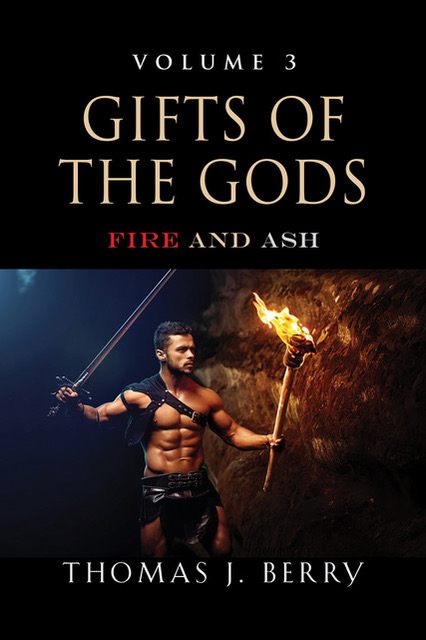

This last adventure, Fire and Ash, brings the war to a dramatic conclusion as Sparta seeks to cut Athens off from its rich colonies on the Persian coast.  Some of the war’s biggest naval battles are fought off the shores where Xerxes once called home and the irony is not lost on them as both sides now seek to make an alliance with their former adversary.  Memo, an Athenian officer living in exile looks to find a way back into the graces of his beloved city while Aleki, an older Spartan officer, struggles to adapt in a young man’s army.  Timandra, an exotic dancer in a Persian court, finds love with a handsome foreigner and risks everything to keep him safe.  In the end, only one city will reign supreme over the Ancient world and the struggle between democracy and socialism will finally be decided.

It is my fervent hope that readers will not only find enjoyment in these pages but learn something new as well.  These are types of books I’ve always enjoyed myself and I know there is a strong audience for them.  Remember, if we can learn the past, we can shape a better future for ourselves!

Buy Links

Amazon UKAmazon USAmazon CAAmazon AUBookLocker

About the Author

Thomas J. Berry

Thomas Berry received a Bachelor of Arts degree in Philosophy from St. Bonaventure University.  He takes pleasure in extensively researching both historical fiction and non-fiction stories.  In his spare time, he enjoys long-distance running and has completed several marathons.  He currently lives with his wife and children in New Jersey.  You can learn more about Thomas and his historical novels on his website, www.thomas-berry.com.

Connect with the Author

TwitterInstagramGoodreads


Sunday, February 25, 2018

What did the ancient Greeks do for us?


History Extra


The first is that it is not only thanks to the Greeks that our culture is so infused with theirs. Just because they invented and built things does not mean, by right, that those inventions, ideas and creations will always continue to be admired. It’s in the way that the legacies of ancient Greece have been taken up, admired, re-formulated and manipulated by every culture between theirs and ours, that we must also look for our answer to the question of why we are so indebted to the Greeks in particular.

 For example, the Roman emperor Hadrian loved all things Greek: he completed the temple of Olympian Zeus in Athens, despite the fact that no Greek had been able to complete this massive temple in about 650 years of trying. The emperor had created a legacy that, in truth, augmented the reality of what the Greek world actually achieved.

The second idea is that, in that continual process of reformulation and manipulation, we have on occasion completely misinterpreted the ancient Greek world. Take paint for instance. Our very sense of the ‘Classical’ from the Renaissance onwards, has been based on the ‘fact’ that ancient Greek temples and buildings were made out of marble and stood shining off-white in the sunlight.

But ever since the first modern travellers visited Greece in the 17th century, we have discovered evidence that this is, in fact, completely wrong. Greek temples were painted bright blue, red, green: our very definition of the opposite of Classical! And so strongly implanted in our cultural psyche is this – incorrect – understanding of the Classical world, that even today we find it difficult to accept what the reality actually was.


Thirdly, we need to realise that the ancient Greek world has not always been such a source of inspiration and, equally, that it has not always been a source of inspiration for things we would choose to admire now.

By the seventh century AD, for example, the term ‘democracy’ had a ‘mob-rule’ feel about it, which made ancient Athens a very unpopular model for any society, right through until the until the late 18th century. In the English Civil War, for instance, Cromwell was encouraged to follow the example of the ancient Spartans, not the Athenians.

In the formulation of the constitution of the US in the 18th century, the Roman model of a Senate and Capitol was followed, rather than the Athenian boule (a council of citizens appointed to run the daily affairs of the city) and ekklesia (the principal assembly of the democracy of ancient Athens). More worryingly, the same Spartan model that was urged on Cromwell was the model taken by the Nazis as the way to create an Aryan race; Nazi youth camps were directly modelled on the training system for young Spartans.

Finally, although we may like to think that we have taken the inventions and ideas of the ancient Greeks and improved upon them, this is not always the case.

Take ancient Athenian democracy, again, as an example. In ancient Greece, this was based on slavery, and excluded women. Today, we rightly pride ourselves on the fact that neither of these is true. We have improved on the original Greek legacy to the degree that some argue we should not call their system a democracy at all. But equally, we must remember that the ancient Greeks probably would not call our system much of a real democracy either!

We have a representative democracy with a very apathetic voter turn-out at elections; they had a system where every citizen voted directly on every major issue, and in which approximately two-thirds of the citizen population sat, at some point in their adult lives, on the supreme governing council, the boule, of the city. None of this makes the Athenian system better than ours or vice versa. But it should make us think twice about we mean by the ‘legacy’ of democracy.

Overall, the crucial thing we must always remember is that the legacy of the ancient Greeks is a constantly moveable feast, caught between icon and enigma, and one that we – alongside every generation between us and them – have been, are still, and will always be, absolutely implicit in creating as much as the ancient Greeks themselves.

Michael Scott is the author of several books on ancient Greek and Roman society and has presented numerous TV documentaries on ancient history.

Tuesday, April 4, 2017

Will It Work? Greece Is Willing to Loan Archaeological Treasures in Exchange for the Parthenon Marbles

Ancient Origins


Despite a strong desire to return the Parthenon Marbles to their rightful home in Athens atop the Acropolis, the Greek government decided against taking legal action against the UK last year. Some probably though the battle for the marbles was lost, but now Greece is using another approach – they are offering ancient archaeological “jewels” in exchange for the Parthenon Marbles.

 Greece Proposes a Generous Offer to the UK
In another attempt to find a peaceful solution, Greece has invited the British Museum to return the Parthenon Marbles, also known as Elgin Marbles, as a parabolic act in the battle against the anti-democratic forces that keep rising all over Europe, seeking the dissolution of the continent’s unity. The Greek government has the magnanimous offer to consistently loan some of Ancient Greece’s archaeological wonders to British institutions in exchange of the precious Parthenon Marbles.


The Parthenon Marbles on display in the British Museum, London. (public domain)

How the Controversy Began and the Parthenon Marbles Became Known as the “Elgin Marbles”
As Ancient Origin’s writer Mark Miller thoroughly analyzed in a previous article, when the British Empire’s power was at its peak and Greece was under Ottoman rule, many artifacts and artworks, including reliefs and statues from the Parthenon in Athens were taken to Britain. For years, Greece has been trying to get those valuable artifacts back.

In the opinion of very few historians (mostly British), Thomas Bruce, the Earl of Elgin, took those marbles legally when he was ambassador to the Ottoman Empire from 1799 to 1803. He claimed that he got permission from the Ottomans to take the artwork. However, few historians agree that such an act was legal during periods of slavery and occupation, so the question is: how moral and ethical would this be considered in our contemporary Western World that supposedly values freedom and democracy more than anything?


An idealized view of the Temporary Elgin Room at the Museum in 1819, with portraits of staff, a trustee and visitors. (Public Domain)

Almost two hundred years after Elgin’s act, the Parthenon Marbles remain some of the most controversial artifacts in the British Museum, with more and more British people suggesting that the Parthenon Marbles should return to Greece. Similarly, opinion is divided regarding Lord Elgin. For some he was the savior of the endangered Parthenon sculptures, while others say he was a looter and pillager of Greek antiquities.


The Parthenon in Athens, Greece, from where the marble friezes were taken. (public domain)

Between 1930 and 1940, the Parthenon sculptures were cleaned with wire brush and acid in the British Museum, causing permanent damage of their ancient surface. In 1983, Melina Mercouri, Minister of Culture for Greece, requested the return of the sculptures, and the debate over their return has raged ever since. The controversy around the Parthenon marbles is just one among many concerning artifacts the British took, or some say stole, during the British Empire’s reign.

Detail from the Parthenon Marbles. (Chris Devers /CC BY NC ND 2.0)

A Solution Said to Help Western Culture’s Democratic Values
Lydia Koniordou, the Greek Minister of Culture and Sport, thinks that a civilized and democratic solution on this long-lasting controversy would send a message about Europe’s devotion to democracy during a time that many European countries – including Greece and England – are witnessing the uncontrollable rise of far-right forces and nationalistic parties. As Ms. Koniordou told Independent:

 “The reunification of the Parthenon Marbles will be a symbolic act that will highlight the fight against the forces that undermine the values and foundations of the European case against those seeking the dissolution of Europe. The Parthenon monument represents a symbol of Western civilization. It is the emblem of democracy, dialogue and freedom of thought.”

Greece has been restoring the Parthenon for many years now and has also constructed a new, impressive museum, specially designed to exhibit the sculptures, even though more than half of them are still held by several museums in Europe.


View of the replica west and south frieze of the Parthenon. (Acropolis Museum)

Professor Louis Godart, the newly elected chairman of the International Association for the Reunification of the Parthenon Sculptures (IARPS), made a statement, as Independent reports, where he pointed out the imperative need of these precious artifacts to finally go back home:

“It’s unthinkable that a monument which has been torn apart 200 years ago, which represents the struggle of the world's first democracy for its own survival, is divided into two. We must consider that the Parthenon is a monument that represents our democratic Europe so it is vital that this monument be returned to its former glory.”

It is also worth noting that during Elgin’s years in Greece his staff removed the sculptures so violently and inelegantly that the heads of a centaur and a human in a dramatic fight scene are in Athens, while their bodies are in London. Preservation of art? Probably not the best words to describe this act.

Top Image: The left-hand group of surviving figures from the East Pediment of the Parthenon, exhibited as part of the Elgin Marbles in the British Museum. Source: Andrew Dunn/CC BY SA 2.0

By Theodoros Karasavvas

Wednesday, December 21, 2016

Archaeologists Explore Incredible Ancient City in Supposed Backwater Region of Greece

Ancient Origins


A collaboration between Greek, Swedish, and British researchers has resulted in some interesting discoveries at a previously unexplored 2,500-year-old city in Thessaly, Greece. Their findings are beginning to change the way archaeologists look at the region – an area which was previously believed to be “backwater during Antiquity.”

The Vlochos Archaeological Project (VLAP), which explored the site, reports that the group of researchers consists of scientists from the Ephorate of Antiquities of Karditsa (Greece), the University of Gothenburg (Sweden) and the University of Bournemouth (UK). They have just completed their first season exploring the ruins at a village called Vlochos in Thessaly, about a five-hour drive north of Athens.


The Cultural Past of Ancient Thessaly
Thessaly was one of the traditional regions of Ancient Greece. During the Mycenaean period, Thessaly was known as Aeolia, a term that continued to be used for one of the basic tribes of Greece, the Aeolians. Meteora: the Impressive Greek Monasteries Suspended in the Air Five Legendary Lost Cities that have Never Been Found

At its greatest extent, ancient Thessaly was a wide area stretching from Mount Olympus (home of the Greek Gods) to the north to the Spercheios Valley to the south. It was home to extensive Neolithic and Chalcolithic cultures around 6000 BC-2500 BC. Mycenaean settlements have also been found in Thessaly – for example, tablets bearing Mycenaean Greek inscriptions, written in Linear B, were found at the Kastron of Palaia Hill, in Volos.

In Greek mythology, Thessaly was the homeland of the heroes Achilles, Jason, and of course, the legendary tribe of Myrmidons. Homer's Iliad said that the Myrmidons were led by Achilles during the Trojan War. According to Greek myths, they were created by Zeus from a colony of ants and therefore took their name from the Greek word for ant, myrmex.


Thetis giving her son Achilles weapons forged by Hephaestus. Detail on an Attic black-figure hydria from 575–550 BC. ( Public Domain )

An Untapped Find The head of the team, Robin Rönnlund, told The Local that some of the remains in the area were known but had been dismissed before as part of an irrelevant little settlement on a hill. It wasn’t until Rönnlund and his colleagues began searching the location that it turned out to be way bigger in size and archaeological significance than they could have dreamed.


Aerial view showing the outline of fortress walls, towers, and city gates. ( University of Gothenburg)

As Rönnlund explained to The Local , “It feels great. I think it is [an] incredibly big [deal], because it's something thought to be a small village that turns out to be a city, with a structured network of streets and a square. A colleague and I came across the site in connection with another project last year, and we realized the great potential right away. The fact that nobody has ever explored the hill before is a mystery."


Archaeologist Johan Klange measuring the Classical-Hellenistic fortifications on the hill of Strongilovoúni. ( VLAP)

 Finds from 500 BC The team discovered the ruins of towers, walls, and city gates on the summit and slopes of the hill. Additionally, during their first two weeks of field work in September, they found ancient pottery and coins, dating back to around 500 BC. After that, the city is thought to have prospered from the 4th to 3rd century BC before it was abandoned – possibly when the Romans took over the area.


Fragment of red-figure pottery discovered at the site. It is from the late 6th century BC and probably by Attic painter Paseas. ( University of Gothenburg )

 Rönnlund hopes that his team won’t need to excavate the site. Instead, they would prefer to use methods such as ground-penetrating radar, which will allow them to leave it in the same condition as they found it.

A second field project is planned for August next year and Rönnlund is optimistic about the future finds and results. He said :

"Very little is known about ancient cities in the region, and many researchers have previously believed that western Thessaly was somewhat of a backwater during Antiquity. Our project therefore fills an important gap in the knowledge about the area and shows that a lot remains to be discovered in the Greek soil.”


The site with the road leading up towards it. ( Swedish Institute at Athens )


Top Image: The city’s acropolis is barely visible on the hill on a cloudy day. Source: University of Gothenburg

By Theodoros Karasavvas

Sunday, June 12, 2016

First Ancient Oracle Well to Apollo unearthed in Athens


Ancient Origins


Archeologists discovered an oracle well, which is at least 1,800-years-old and may be the first ancient oracle to Apollo found in Athens. Moreover, the prophecy at the sanctuary seems to be much older.


According to Haaretz, the oracle well was found by the team led by Dr. Jutta  Stroszeck, director of the Kerameikos excavation on behalf of the German Archaeological Institute at Athens. It is the first time that an oracular edifice to Apollo has been discovered in Athens. Although, for centuries it was believed that the center of Apollo's cult was located in Delphi, the most recent discovery may challenge this theory. The oracle well was located in the Temple of Artemis Soteira.
The area around the sanctuary is still watered by the Eridanos River, which flows through the city from east to west. The oracle well was used for hydromancy, a method of divination by means of water.
A woman practicing hydromancy. ‘Circle Invidiosa’ by John William Waterhouse
Stroszeck explained to Haaretz:
“Water, and in particular drinking water, was sacred. In Greek religion, it was protected by nymphs, who could become very mischievous when their water was treated badly."
In ancient times people used the oracle’s guidance not only to know the future. They also asked for simple everyday matters, such as solutions to problems, possibilities of healing disease, finding a lover, etc.
The oracle well was walled with clay cylinders. The researchers discovered more than twenty inscriptions in Greek. All of them included the same phrase:  "Come to me, O Paean, and bring with you the true oracle". The word ''Paean' 'is the epithet that designated the god Apollo, the male deity associated with art, purification and oracular activity.
Apollo, God of Light, Eloquence, Poetry and the Fine Arts with Urania, Muse of Astronomy
Apollo, God of Light, Eloquence, Poetry and the Fine Arts with Urania, Muse of Astronomy (public domain)
The oracle well stayed hidden for many centuries under another very important part of the ancient temple. In 2012, the researchers discovered that an omphalos had been meticulously mounted on a marble slab that, in turn, covered an opening. It was lifted carefully using a crane and the circular well was located below. According to the writer of Ancient Origins, DHWTY, ''an omphalos is a powerful symbolic artifact made from stone. Considered the ‘navel of the world’, the central point from which terrestrial life originated, an omphalos was an object of Hellenic religious symbolism believed to allow direct communication with the gods.
Although the omphalos stone at Delphi is the most famous of its kind, it is by far not the only one. Omphalos stones have been found in various sites such as Thebes and Karnak in Egypt and in buildings of the Vinca culture in Southeastern Europe. Yet, these stones probably functioned differently from the Delphic omphalos stone. For instance, many buildings of the Vinca culture contained an omphalos stone, indicating that they may have held some ritual significance to the people of that ancient culture.''
Marble omphalos (navel of the world), representing the stone Zeus threw from the heavens).
Marble omphalos (navel of the world), representing the stone Zeus threw from the heavens). Credit: Jutta Stroszeck
The oracle was discovered in Kerameikos in central Athens, northwest of the Acropolis. The works there have taken a place since the 19th century. The excavation site consists of a large sanctuary, which contained thousands of precious artifacts. The name of the site, Kerameikos, comes from the Greek word for pottery or ‘ceramics’. It was a settlement of potters, vase painters and other people connected with creating famous Attic vases. Nearby the site was the ancient agora and the famous Academy of Plato. Moreover, it was a location of the most important cemetery of ancient Athens. The oldest tombs, come from the Early Bronze Age (2700-2000 BC). The burials were continued and the cemetery expanded during the sub-Mycenaean period (1100-1000 BC), Geometric period (1000-700 BC) and Archaic period (700-480 BC). It was also in use during the Early Christian period (338 BC – c. 600 AD).
Kerameikos archaeological park, Athens
Kerameikos archaeological park, Athens (public domain)
Archeologists also researched a 2,500-year-old bathhouse. The bath served the citizens of Athens and the travelers. It was discovered during the current excavation season. The researchers believe that it is the spa mentioned by the Greek rhetorician Isaios, and referred to by Aristophanes. It was in use between the 5th and the 3rd centuries BC. It was often used by the students of Plato's Academy, as well as the craftsmen.
Top image: The oracular well dedicated to Apollo. It dates to about 1800 years ago but may have been used for eons before. Credit: Jutta Stroszeck.
By Natalia Klimzcak

Monday, March 14, 2016

The Parthenon of Athens: An Epic Monument, Or a Mystery in Measurements?

Ancient Origins

The Parthenon, proudly standing on the Athenian Acropolis, is considered by many historians and archaeologists alike as the undisputed symbol of Athenian democracy and the cradle of Western civilization.

The monument is also considered one of the finest buildings of all time by a large number of architects worldwide, attracts millions of tourists each year, and was designed by the most famous sculptor of antiquity, Phidias, while two of the most influential architects ever, Ictinus and Callicrates, supervised the practical construction work of the temple.

The Mysteries of the Ancient Temple

Contemporary scientists have admitted—despite the Parthenon being the most imitated building in history—that even with modern technology and contemporary architectural techniques, it’s virtually impossible to rebuild the exact same building in all its detail.
The Acropolis in Athens, Greece, featuring the Parthenon.
The Acropolis in Athens, Greece, featuring the Parthenon. (BigStock image)
But why is the Parthenon so special? What makes it so different from all the others? What kind of details and secrets did the peoples of antiquity know that have been lost to time? Why can’t we construct an identical building to the original Parthenon even though technology, machinery, and architecture have progressed so much since then? There are too many riddles to the construction of the Parthenon, only a few of which can even remotely begin to be unraveled.
To begin with, the Parthenon might have needed decades to be restored in modern times, but the Athenian citizens mysteriously built it inside of a decade, between 447 and 438 BCE.
The temple was built under Pericles’s rule. Marble bust of Pericles, Roman copy after a Greek original from ca. 430 BC.
The temple was built under Pericles’s rule. Marble bust of Pericles, Roman copy after a Greek original from ca. 430 BC. (Public Domain)
The iconic monument is a peripteral octastyle Doric temple with Ionic architectural features, surrounded by a colonnade of eight columns across and seventeen along the length, counting the corner columns twice.
The main entrance of the temple faces east while the interior length is 100 Attic feet, thus 30.80 meters (101 feet). And though these numbers might seem random to most, the fact is many historians believe great proportions are expressed in these numbers.
The beautiful ancient Acropolis and Parthenon of Greece.
The beautiful ancient Acropolis and Parthenon of Greece. (BigStock image)

Messages in Measurements

An Attic foot is equivalent to 0.30803 meters, or 1/2F (φ), where F (φ) = 1.61803, also known as the Golden Ratio. The Golden Number F, the number 1.618, is often found in nature, in (human) facial features, in the measurements of the human body, in flowers and other plants, in art, in most living organisms on earth, in shells, in beehives, among many other things, but most important, it’s often associated with the structure of the universe and planetary orbit in our solar system.
Furthermore, in aesthetic science the Golden Ratio is considered the most accurate standard for the expression of perfection. So, could all this just be a mere coincidence? Not likely, since inside the Parthenon we find something more impressive—the Fibonacci Sequence, which in mathematics describes the phenomenon of a number being equal to the sum of the previous two: 1, 1, 2, 3, 5, 8, 13, 21, 34, 55, 89, 144, etc. Even more strange, the ratio of the successive pairs tends to the so-called Golden Ratio, or Number F (φ).
The Golden Ratio
The Golden Ratio (CC BY-SA 2.0)
Additionally, inside the temple can also be found the number for Pi (π), 3.1416, which appears in the mathematical relation 2F2/10, but more impressively, we meet the number e = 2.72, which is the most important mathematical constant and is the base of the natural logarithm.
What makes things more complicated is that the three numbers included in the Parthenon are also included in all of nature and are present in all creation, and nothing can function without them.

Mathematical Mysteries

As one would expect, the questions deriving from the aforementioned facts are many. Did the creators of the Parthenon know these numbers and their importance? And if so, how did they manage to include them in such detail and accuracy in a building which we can’t replicate today even with all our technology and know-how?
How could the ancient Greeks, or more precisely, Ictinus, Callicrates, and Phidias be aware of the Golden Ratio when Midhat J. Gazalé and so many other scholars assure us that it was not until Euclid came along that the Golden Ratio's mathematical properties were studied?
Phidias Showing the Frieze of the Parthenon to his Friends.
Phidias Showing the Frieze of the Parthenon to his Friends. (Public Domain)
How did they know of the Fibonacci Sequence when it was first officially recorded in 1202, almost 1,700 years after the Parthenon was constructed? And most importantly, how could the Parthenon's façade, as well as many of its particular elements, be circumscribed by golden rectangles when the computer technology we take for granted today didn’t exist back then to create such forms?
To all these questions many more can be added as one searches to discover the specific details of the functions and mysteries of the sacred temple; such as, how was the building lighted when there were no windows and, even more oddly, no traces of soot have been found, which excludes the use of torches?

Signals in the Sunlight

Another mystery that many experts in various fields have unsuccessfully tried to answer is why, during the day when there is sunlight, do the drop shadows created around the temple always appear to point to other specific destination points in Greece? Which exact points they show and why this happens, or if there’s any special meaning behind this occurrence, has been investigated by scientists for ages, but opinions vary greatly and do not converge with one another, thus preventing us from reaching a solution.
Despite all the scientific, paranormal and mythical mysteries surrounding its legend, the Parthenon remains the cradle of Western civilization—and undoubtedly one of the most significant monuments of humankind as a whole—that continues to attract millions of curious visitors every year. The only sure thing is that we can only learn and benefit from the iconic monument, its unlocked codes and artistic features, which hopefully will be answered in the near future.
Bonus Facts:
  • The Parthenon is often called sacred because it was dedicated to the goddess Athena, whom the people of Athens considered their patron and guardian of the city.
  • The temple was built under Pericles’s rule, who is considered to be the greatest Athenian statesman ever and the one who gets credited with the birth of democracy as well.
  • The most impressive and glorious part of the Parthenon unfortunately doesn’t exist anymore. It was a gigantic statue of Athena designed and sculpted by Phidias. It was created with elephant ivory and gold and, of course, was dedicated to her.
  • Phidias was also the craftsman who sculpted the statue of Zeus at Olympia, which was one of the Seven Wonders of the ancient world.
  • The Parthenon is considered to be the most copied building in history. Some of the most famous buildings that have been based on it include The New York Stock Exchange, the Reichstag building in Berlin, and the main entrance of the White House.
Reconstruction of the Acropolis and Areus Pagus in Athens, Leo von Klenze, 1846.
Reconstruction of the Acropolis and Areus Pagus in Athens, Leo von Klenze, 1846. (Public Domain)
Featured image: The majestic and mysterious Parthenon in Athens, Greece. (BigStock image)
By Theodoros I

Wednesday, November 18, 2015

Researchers locate Submerged Lost Ancient City where Athens and Sparta Fought a Battle

Ancient Origins

Researchers have found the location of the lost island city of Kane, known since ancient times as the site of a naval battle between Athens and Sparta in which the Athenians were victorious but later executed six out of eight of their own commanders for failing to aid the wounded and bury the dead.
Some historians say the loss of leadership may have contributed to Athens’ loss of the Peloponnesian War. But a scholar who wrote a book on the battle says the Spartans would have won whether or not Athens executed the generals.
The ancient city of Kane was on one of three Arginus Islands in the Aegean Sea off the west coast of Turkey. The exact location of the city was lost in antiquity because earth and silt displaced the water and connected the island to the mainland.
Geo-archaeologists working with other experts from Turkish and German institutions discovered Kane, where the Athens and Sparta did battle in 406 BC. Athens won the Battle of Arginusae, but its citizens tried and executed six of eight of the city-state’s victorious commanders.
Depiction of a battle between Athens and Sparta in the Great Peloponnese War, 413 BC.
Depiction of a battle between Athens and Sparta in the Great Peloponnese War, 413 BC. (Image source)
 “The Athenian people soon regretted their decision, but it was too late,” writes J. Rickard at History of War. “The execution of six victorious generals had a double effective—it removed most of the most able and experienced commanders, and it discouraged the survivors from taking command in the following year. This lack of experience may have played a part in the crushing Athenian defeat at Aegospotami that effectively ended the war.”
Debra Hamel, a classicist and historian who wrote the book The Battle of Arginusae, however, says she thinks Athens would have lost anyway.
“Sparta at that point was being funded by Persia, so they could replace ships and hire rowers indefinitely,” Dr. Hamel wrote to Ancient Origins in electronic messages. “Athens did not have those resources. Allies had revolted. They weren’t taking in the money they had in earlier days.”
Google Earth image shows the general vicinity of the islands, near Bademli Village in Turkey on the Aegean Sea.
Dr. Hamel, via e-mail, describes how the Battle of Arginusae was likely fought:
The Battle of Arginusae was only fought at sea. …  The state-of-the-art vessel of the period was the trireme, a narrow ship about 120 feet [36.6 meters] long that was powered by 170 oarsmen, who sat in three rows on either side of the ship. There was a bronze-clad ram that extended about six and a half feet [2 meters] at waterline from the prow of the vessel. The purpose of the ram was to sink enemy ships. The goal of a ship's crew—the 170 oarsmen and various officers onboard—was to maneuver a trireme so that it was in position to punch a hole in the side of an enemy ship while avoiding getting rammed oneself. In order to do this you needed to have a fast ship--one that wasn't waterlogged or weighed down by marine growths--and you needed a well-trained crew.
Athens sent 150 ships, the Spartans 120. The Athenian line was about 2 miles (3.2 kilometers) long or longer because it was interrupted by one of the Arginusae islands. The Spartan line was a bit less than 1.5 miles [2.4 km] long, Dr. Hamel estimates.
Greek trireme, drawing by F. Mitchell; note the battering ram on the prow to the right at the waterline.
Greek trireme, drawing by F. Mitchell; note the battering ram on the prow to the right at the waterline. (Wikimedia Commons)
Dr. Hamel’s book on the battle explores not just the battle but its aftermath too. Winning the battle “was a great triumph, saving Athens—at least temporarily—from almost certain defeat in the war,” she wrote in e-mail. “The victory was cause for celebration, but paradoxically, because of what happened afterwards, it was also one of the worst disasters to befall Athens in the war: A series of legal proceedings led ultimately to the Athenians' execution of (most of) their victorious generals. This was the stuff of tragedy.
Because the Battle of Arginusae is tied intimately with the legal proceedings that it led to, I was able to discuss in my book not only the battle itself and the intricacies of naval warfare (which are really very interesting), but also the proceedings back in Athens and Athens' democracy and democratic institutions. All of this was necessary to round out the story for readers who are approaching the book without any prior knowledge of the period.
Later, from 191 to 190 BC, Roman forces used the city of Kane’s harbor in the war against Antiochas III’s Seleucid Empire. That war lasted from 192 to 188 BC and ended when Antiochus capitulated to Rome’s condition that he evacuate Asia Minor. Most of Antiochus’ cities in Asia Minor had been conquered by the Romans anyway. He also agreed to pay 15,000 Euboeic talents. The Romans did not leave a garrison in Asia Minor but wanted a buffer zone on their eastern frontier.
The island on which Kane was situated, which is known from ancient historians’ texts, is in the sea off İzmir Province’s Dikili district Researchers, led by the German Archaeology Institute, included those from the cities of İzmir, Munich, Kiel, Cologne, Karlsruhe, Southampton and Rostock. Prehistorians, geographers, geophysics experts and topographers all worked on the project.
“During surface surveys carried out near Dikili’s Bademli village, geo-archaeologists examined samples from the underground layers and learned one of the peninsulas there was in fact an island in the ancient era, and its distance from the mainland was filled with alluviums over time,” reports Hurriyet Daily News. “Following the works, the quality of the harbors in the ancient city of Kane was revealed. Also, the location of the third island, which was lost, has been identified.”
Featured image: Main: Google Earth image shows the general vicinity of the islands, near Bademli Village in Turkey on the Aegean Sea. Inset: A representation of an ancient Greek ship on pottery (Photo by Poecus/Wikimedia Commons)
By Mark Miller

Tuesday, October 20, 2015

History Trivia - First Crusaders arrive in Antioch

October 20

 480 BC The Greeks defeated the Persians in a naval battle at Salamis, an island in the Saronic Gulf near Athens. It marked the high-point of the second Persian invasion of Greece which had begun in 480 BC.

 1097 First Crusaders arrived in Antioch. The first siege, by the crusaders against the Muslim city, lasted from October 21, 1097, to June 2, 1098. 

1524 Thomas Linacre, physician and classical scholar, who founded the Royal College of Physicians in London died. 


Friday, September 4, 2015

Site in Athens revealed as an ancient temple of twin gods Apollo and Artemis

Ancient Origins


An ancient well has been uncovered in Kerameikos in central Athens, Greece, with inscriptions calling upon Apollo, the Greek god of prophecy. Archaeologists speculate that Kerameikos seers used the well to try to foretell the future using hydromancy rituals.
It is the first known place in Athens where Apollo was invoked to divine the future, in this case by consulting the waters to see if the god would deliver messages or visions in them.  (“Hydro” means water and “mancy” means divination or prophet).  The archaeological team working at the site, from the German Archaeological Institute, says the oracle (a shrine consecrated to the worship and consultation of a prophetic deity) was in use in early Roman times.
“The finding is exceptionally significant as it identifies the spot as the first and unique Apollo divination site in Athens, confirming the worshipping of the ancient god along with his sister Artemis and restoring the accurate interpretation of the site as a shrine rendered by K. Mylonas in the late 19th century to a third goddess, Hecate,” says the Archaeology News Network.
The wall of the well has the phrase:  ΕΛΘΕ ΜΟΙ Ω ΠΑΙΑΝ ΦΕΡΩΝ ΤΟ ΜΑΝΤΕΙΟΝ ΑΛΗΘΕC, which means 'Come to me, Paean [a common epithet refering to Apollo], and bring the truthful prophecy.’ The site has 20 inscriptions with the same content, which reveals the place as the only oracle of Apollo in Athens where he was worshipped along with Artemis, a goddess of the wilds, chastity and girls.
Apollo and Artemis on a Greek cup from about 470 BC. Apollo, who was the Archer, is on the left. Artemis, the huntress, is shown with the bow.
Apollo and Artemis on a Greek cup from about 470 BC. Apollo, who was the Archer, is on the left. Artemis, the huntress, is shown with the bow. (Wikimedia Commons)
Kerameikos was also a settlement of potters and a burial ground from about 2700 BC. The uncovering of the well and apparent shrine to Apollo and Artemis from the Roman era shed new light on the full significance of the site.
The worship of the god and goddess together at the same site seems to point to a yin and yang type of dichotomy: Apollo, famous for his pursuit of nymphs, was worshiped as the protector of domestic flocks and herds and the patron of the founding of colonies and cities. While Artemis, who protected girls, seems to recall an earlier time as the goddess of hunting and nature.
A 5th century BC funerary stele with griffins and other figures from Kerameikos cemetery
A 5th century BC funerary stele with griffins and other figures from Kerameikos cemetery (Photo by Marsyas/Wikimedia Commons)
The book The Goddess Within quotes A History of Greek Religion: “Artemis was the most popular goddess of Greece, but the Artemis of popular belief was quite a different person from the proud virgin of mythology, Apollo’s sister. Artemis is the goddess of wild Nature, she haunts the woods, the groves, the luscious meadows. A favorite subject of archaic art is the figure formerly called ‘the Persian Artemis,’ now the ‘Mistress of Animals,’ a woman holding in her hands four-footed animals or birds of different kinds.”
While the site of Kerameikos is the only known oracle to Apollo in Athens, he had other oracles, including at Delphi on Mount Paranassus, where he slew the Python that protected the place, which had been considered magical from great antiquity.
At Delphi, a Pythia or priestess, first young virgins and later crones, would repeat prophecies or oracles Apollo revealed to her. This was a different kind of oracle than the one at Kerameikos, which involved water.
“Priestess of Delphi”, by John Collier.
“Priestess of Delphi”, by John Collier. Photo source: Wikimedia.
The Facts on File Encyclopedia of World Mythology and Legend says Apollo was sometimes called Loxias, which means crooked or ambiguous, because his prophecies were hard to understand. However, Plutarch seems to contradict this in his work Moralia:
The prophetic priestesses are moved [by the god] each in accordance with her natural faculties.  . . .  As a matter of fact, the voice is not that of a god, nor the utterance of it, nor the diction, nor the meter, but all these are the woman's; he [Apollo] puts into her mind only the visions, and creates a light in her soul in regard to the future; for inspiration is precisely this.
In an article titled “The Delphic Oracle” at the Theosophical Society’s website, Eloise Hart writes that the oracles were unusually clear and direct. And other websites that recount some of the prophecies showed how they came true, though modern people may ask whether historical events were later attributed to an earlier Pythia. The Delphic injuction “Know Thyself” was carved into the lintel of Apollo’s temple at Delphi. Could there be a pithier (Pythia) admonition?
Hydromancy, as opposed to the serpent oracle, involved reading the movements, flows and changes in water as well as the visions that a seer might see in them. Similarly, when fortunetellers gaze into crystals they may see visions, ghosts or future events.
Featured image: This is the mouth of the well where modern archaeologists believe ancient Athenians invoked Apollo to tell the future in the water. (Photo by Greek Ministry of Culture)
By Mark Miller

Friday, June 26, 2015

Athenian Wealth: Millions of Silver Coins Stored in Parthenon Attic

Live Science


New research indicates millions of silver coins, the reserves of ancient Athens, were once kept in the attic of the Parthenon (shown here as it appears today).
Millions of silver coins may have been stored in the attic of the Parthenon,one of the most famous structures from the ancient world, a research team says.
The attic of the Parthenon is now destroyed and the coins would have been spent in ancient times. The researchers made the discovery by reconstructing the size of the attic, analyzing ancient records to extrapolate how large the reserves may have been and re-examining archaeological work carried out decades ago.  
Their evidence suggests that millions of coins made up the cash reserves of the city-state of Athens and much of this hoard was stored in the attic of the Parthenon. During the fifth century B.C., when the Parthenon was built, Athens was a wealthy city-state whose people erected fantastic buildings and fought a series of devastating wars against their rival Sparta. This vast reserve of coins would have helped fund those endeavors. [In Photos: Amazing Ruins of the Ancient World]

While the Parthenon's attic is now destroyed, researchers estimate its floor would have spanned an area more than three times that of a tennis court, with dimensions of 62 feet wide by 164 feet long (19 by 50 meters) and about 10 feet (3 m) high at the center. The coin reserves were likely placed there around 434 B.C., when the Parthenon was dedicated to Athena, the patron goddess of Athens.
Incredible riches
A silver tetradrachm dating to between 480 B.C. and 420 B.C., held at the Museum of Fine Arts of Lyon.
Millions of silver tetradrachms (like the example shown here at the Museum of Fine Arts of Lyon) may have been kept in the attic of the Parthenon.
Credit: Photo by Marie-Lan Nguyen, CC Attribution 2.5 Generic
In the fifth century B.C., Athens was one of the richest and most powerful city-states in Greece. Boasting a large navy, it exacted tribute from other Greek cities in exchange for military protection. Ancient writers say the Athenians kept vast coin reserves on the Acropolis, but don't say exactly where.
For instance, one decree dated to around 433 B.C. refers to "3,000 talents" being transferred to the Acropolis for safekeeping, a colossal sum of money, researchers say. The highest-denomination coin minted in Athens at the time was a silver tetradrachm, and it took 1,500 tetradrachms to make one talent, the researchers noted. This means the "3,000 talents" mentioned in the decree would be worth 4.5 million tetradrachms. Such a huge number of coins would have weighed about 78 metric tons, or nearly 172,000 lbs., researchers say. To put that in perspective, that's heavier than the M1 Abrams battle tank used today by American soldiers.
Remarkably, ancient writers said the Athenian reserves could, at times, reach up to 10,000 talents (potentially 260 metric tons).
Researchers caution that Athens may have minted some of its coins in gold (which was worth about 14 times more than silver). If that were the case, the number of coins (and the overall weight of the reserves) would be somewhat less, since it takes fewer gold coins to form one talent.
"Gold coinage was always minimal in Athens, in part because Athens mined silver locally," study researcher Spencer Pope, a professor at McMaster University in Hamilton, Canada, told Live Science in an email. As such, the ancient writer Aeschylus called Athens and its nearby area a "fountain of silver," Pope added.
The ultimate money stash
Ancient records mention nothing about where on the Acropolis the coins were stored, nor do they reveal the purpose of the Parthenon's attic. "The sources are silent on the use of this space," said Pope at a presentation recently in Toronto during the annual meeting of the Classical Association of Canada.
However, there are several reasons why researchers believe the attic was used to store most of Athens' immense coin wealth. [Photos: Mysterious Tomb from Ancient Greece]
While the attic is now virtually destroyed, the remains of a staircase that would've led up to the attic still survive. This staircase appears to have had a utilitarian rather than a ceremonial use, suggesting it could have been used to bring coins to and from the attic.
Additionally, the sheer floor size of the attic not only would have provided room to store the coins, but also would have meant the coins' weight could be spread over a wide area. Assuming the attic was floored with thick cypress wood beams, it would have been able to support the weight of the coins, the researchers say.
Because the Parthenon was located centrally, people would've had an easier time securing and accessing the money there. And criminals would be less likely to steal the coins, as the Parthenon was a temple for Athena — meaning any theft from it would be considered a crime against the goddess.
"The attic of the Parthenon is the only suitable space large enough to hold all of the coins in the Treasury," Pope said in an email. "While we cannot rule out the possibility that coins were distributed across numerous buildings, we should recall that the attic is the most secure space."
Researchers say that the coins may have been stored in boxes whose dimensions could be standardized to make counting easier.
Pope co-wrote the scientific paper with Peter Schultz, a professor at Concordia College at Minnesota, and David Scahill, a researcher at the American School of Classical Studies at Athens.