Showing posts with label Cnut. Show all posts

Friday, November 18, 2016

8 things you (probably) didn’t know about King Cnut

History Extra

A 15th-century stained glass window from Canterbury Cathedral, depicting King Cnut. (CM Dixon/Print Collector/Getty Images)

1) Cnut descended from some notable Danish rulers

 
The Danish royal dynasty from which Cnut descended was actually relatively young – it had been established by his great-grandfather, Gorm the Old. Gorm was a confirmed pagan worshipper who respected the old Norse gods such as Thor, Odin and Freya. 
 
Gorm’s son Harald was of a different disposition – he adopted Christianity and firmly established the religion in Denmark for the first time. Harald was known for an unusual distinguishing physical characteristic – his teeth appeared to be blue. This may be because they were just in poor condition and were discoloured as a result. Another possible explanation is that Harald may have filed his teeth and carved grooves in them, which he then coloured with blue dye. At any rate, he became known as Harald Bluetooth. Modern Bluetooth technology (a joint initiative between various Scandinavian companies) was named after Harald for the part that he played in trying to unify Denmark and Norway during his reign. 
 
Harald Bluetooth was the father of Sweyn Forkbeard (who in turn was the father of Cnut). Harald and Sweyn came to blows and there was a bitter civil war between them. Harald was eventually defeated and died soon after fleeing from Denmark.
 

2) Cnut’s first experience of invading England ended in personal disaster

 
In 1013, Cnut accompanied his father Sweyn Forkbeard on an invasion of England. As far as we know, this was the first time he had been to the country. Sweyn was not just raiding England; by this time, he was trying to conquer it. It soon looked like Sweyn was about to become king of the country; he had been so successful in battle that the current king Æthelred had fled. But then, just as it appeared that Sweyn’s triumph was complete, he suddenly died.
 
Cnut, probably then just a teenager, seems to have been caught with his guard down. He assumed that he would merely assume the role left vacant by his father’s death. But he was faced by an unexpected English backlash. An army caught him unawares and a catastrophic defeat followed. Cnut barely escaped. 
 
However, when he left England by ship, Cnut left behind a number of hostages – minus their ears and noses. It was a stark warning to those who did not support him that they could be in for a seriously difficult time in the future.
 

Silver penny depicting Cnut. (CM Dixon/Print Collector/Getty Images)
 

3) For a brief period in 1016, England had two kings at the same time

 
Opportunity arose for Cnut in 1016. Following the death of Anglo-Saxon king Æthelred ‘the Unready’, his son Edmund Ironside became king of England. However, Ironside did not have unanimous support, even from the English. Some seem to have reasoned that Cnut, who had returned to the country with a newly-raised army, was a better bet. Cnut and Edmund fought a vicious and drawn-out war. After several major clashes, the conflict’s final climactic battle was fought at Ashingdon (‘Assandun’) in Essex. 
 
Cnut was triumphant and Ironside was forced to flee for his life. Cnut caught up with him in Gloucestershire in October 1016. However, rather than fight yet another battle, the two men agreed to divide England between them. Edmund was to have the kingdom of Wessex and Cnut the rest of England. Whether or not this unusual arrangement would have ever worked in the long-run we shall never know. Conveniently for Cnut, Ironside died just a few weeks later, on 30 November 1016. Cnut was now the undisputed king of England.
 

4) Cnut forked out huge sums to get rid of Viking raiders

 
‘Danegeld’ was the term used for money paid to troublesome Viking raiders, in order to make them go away. The late king Æthelred was infamous for his frequent Danegeld payments, but it was not Æthelred who made the largest Danegeld payment, but Cnut.
 
The idea of paying off raiders was not new; it had been used in Carolingian Francia two centuries earlier and even the heroic Alfred the Great had used it as a tactic. However, there were problems with the approach. Even if one party of raiders went away, another would soon take their place and the payments would need to be repeated, which was clearly an expensive scenario. Meanwhile, some raiders, such as Sweyn Forkbeard, might go away for a short time before simply coming back again.
 
When Cnut first became king, he was faced with the problem of what to do with thousands of unemployed Viking raiders. His solution was to pay them to go away. The cost was enormous – Cnut raised 10,000 Troy lbs [a measurement used to measure gold and silver] of silver from London and 72,500 Troy lbs from the rest of England to finance his policy. This was a mammoth sum at the time; while it is difficult to meaningfully convert into modern currency, it amounted to more than 30,000kg of silver. Cnut’s payment was greater than any previous Danegeld sum (the former highest was 48,000 pounds, paid in 1012 during the reign of Æthelred). But although it must have caused great pain to the taxpayers of England, the policy largely seems to have worked, as Viking raids diminished substantially.  
 

A coin depicting Anglo-Saxon king Æthelred, who was “infamous for his frequent Danegeld payments”. (Hoberman Collection/UIG via Getty Images)
 

5) Cnut inherited Denmark from his older brother, not his father

 
At the time of Cnut’s rule, the laws of Viking succession were fairly flexible. When a great leader such as Sweyn Forkbeard died, it was not unusual for his patrimony to be divided between his sons, rather than the eldest taking everything. In theory, this helped prevent disputes involving disgruntled younger sons, though in reality these disagreements were still common. 
 
Because Sweyn Forkbeard died while he and Cnut were in England, another of his sons, Harald, took over control of Denmark. Cnut was forced to fight for the country he was in, otherwise he would have been left with nothing. In 1018, Harald died without an obvious heir, leaving Denmark available for his brother Cnut. He seems to have taken the country without too much difficulty and held on to it for the rest of his reign.
 
Norway was a different matter. Although Sweyn Forkbeard had conquered the country at the end of the 11th century, it was never fully assimilated into his territories and he lost control of it after an uprising there. In 1030 Cnut won a decisive victory against his opponent, King Olaf II of Norway, at the battle of Stiklestad, but his subsequent reign in the country was short-lived. Those he appointed to be his representatives there were not popular, partly due to a period of extended famine, and they were ejected from the country. Norway was never securely integrated into Cnut’s kingdom.
 

6) Cnut’s wife, Emma, was the only woman to marry two different kings of England  

 
Emma’s first husband was the luckless Æthelred ‘the Unready’. The royal couple had several children, one of whom would later become King Edward the Confessor. When Æthelred died in 1016, Emma seems to have left the country and returned to Normandy.
 
When she returned to England in 1017, it was as Cnut’s wife. Emma was a loyal lieutenant for Cnut and their marriage was a great political success. Emma seems to have had a strong instinct for political survival. Cnut and Emma had several children together, including Harthacnut, who later became king of both England and Denmark for a short time.
 
However, marital alliances at the time could be complicated. When Cnut married Emma, he already had a partner, Ælfgifu of Northampton. Whether they were ever married or not is unclear. It was quite normal at that period for kings and noblemen to have a concubine rather than an official wife and it would appear that Ælfgifu fell into that category. Their relationship did produce several children. One of them, Harold ‘Harefoot’, was king of England for a short time. 
 
Ælfgifu and Emma were bitter rivals for decades, and they both outlived Cnut. 
 

Cnut and his wife Emma, in an engraving from an 11th-century manuscript. (DeAgostini/Getty Images)

7) Despite being Danish, Cnut was an Anglophile

 
Cnut was an astute statesman. Rather than rejecting the former Anglo-Saxon kings of England, he went out of his way to show support for them. He did this by visiting or making gifts to shrines associated with Anglo-Saxon kings, such as Shaftesbury Abbey, where King Edward the Martyr lay buried, or Wilton Abbey, linked with St Edith, sister of Æthelred. He even paid his respects to his old adversary, Edmund Ironside, at Glastonbury Abbey. This Anglophile policy was a smart political move on Cnut’s part, as it was well regarded by his English subjects.
 
He also adopted a new law code, which was regarded as introducing a strong but fair regime to England. Cnut based these laws on those of the Anglo-Saxon king Edgar, whose reign was regarded as a golden age.
 
Cnut also not only adopted English policies, but also introduced them to his overseas territories with a good degree of success. He took full advantage of the English coinage system, which was renowned for its quality at the time. He ensured that this quality was maintained and introduced a vastly improved coinage into Denmark. There are a number of cases recorded where the moneyers working in Denmark were of English origin. 


8) Cnut made his reputation as a passionate supporter of the church 

 
Cnut was in many senses a Viking, and is probably best known as such today. He led his army using Viking tactics and launched raids on enemy territory using instantly recognisable longships. He was also fond of skalds [Scandinavian bards, or minstrels] who related old Viking sagas and tales.
 
Yet, it was as a patron of the church that Cnut made his reputation; this was quite a turnaround given the fact that Vikings had become renowned as scourges of the institution and frequent raiders of monasteries and other religious establishments.
 
This reflected the fact that these were changing times for the Viking world. Christianity had gained a foothold in much of Europe centuries previously, but was a more recent introduction to the Viking world. Cnut’s family, especially his grandfather Harald Bluetooth, had been patrons of the church. However, Cnut’s reign in England, then one of Europe’s richest countries, allowed him to take this policy to new heights. He was able to make a number of generous gifts to the church and strengthen the fledgling religion in Denmark.
 
Cnut’s recognition of the church reached its height in 1027, when he journeyed to Rome to attend the coronation of the Holy Roman Emperor, Conrad II. While there he met Pope John XIX. The fact that a Viking ruler could meet the head of the church and be treated as an equal of other mainstream European leaders shows just how much the world had changed.  
 
WB Bartlett is the author of King Cnut & The Viking Conquest of England 1016, published by Amberley in October 2016. 

Wednesday, October 19, 2016

Cnut's invasion of England: setting the scene for the Norman conquest

History Extra

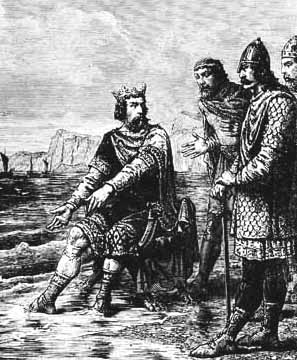
King Cnut (Canute) failing to hold back the waves, early 11th century (c1900). Artist: Trelleek. © Heritage Image Partnership Ltd / Alamy

In the summer of 1013, the Danish king Svein, accompanied by his son Cnut, launched an invasion of England – the first of the two successful conquests England would witness in the 11th century, but by far the less well known.
Scandinavian armies had been raiding in England on and off for more than 30 years, extracting huge sums of money from the country and putting King Æthelred under ever-increasing pressure, but Svein’s arrival in 1013 seems to have been something different – a carefully-planned, full-scale invasion. After years of raiding England, Svein knew enough about the English political situation to exploit its weaknesses: Æthelred's court was fractured by internal rivalries, a poisonous atmosphere attributed to the influence of his untrustworthy advisor Eadric, and Svein was able to make a strategic alliance with some of those who had fallen from the king's favour.
The invasion progressed with devastating speed: within a few weeks all the country north of Watling Street – the ancient dividing-line between the north and south of England – had submitted to the Danish king. Next the south was subdued by violence, and before the end of the year Æthelred and his family had been forced to flee to Normandy.
Svein, now king of England and Denmark, ruled from Christmas to Candlemas, but died suddenly on 3 February 1014. The Danish fleet chose Cnut to succeed him, but the English nobles had other ideas: they contacted Æthelred, still in refuge in Normandy, and invited him to come back as king. They said, the Anglo-Saxon Chronicle tells us, “that no lord could be dearer to them than their natural lord, if he would govern more justly than he had done before”. In response, Æthelred promised to be a better king, to forgive those who had deserted him, and to “remedy all the things of which they disapproved”. On these terms the agreement was made, and Æthelred returned to England. This time he managed to drive out Cnut, and the fleet went back to Denmark.
But a year later the young Danish king was back, hoping to repeat his father’s conquest. Despite his promises, Æthelred did not forgive those who had sided with the Danes: he viciously punished the northern leaders who had made an alliance with Svein, and in doing so caused his son, Edmund Ironside, to rebel against him. When Cnut returned in 1015, Æthelred was ill and England was divided: large parts of the country submitted to the Danes, while Edmund struggled to put an army together.
Only after Æthelred died in April 1016 did southern England finally unite behind Edmund, and six months of war followed, with the two armies fighting battles all over the south. The last was fought at a place called Assandun in Essex on 18 October 1016 – by strange coincidence, 50 years almost to the day before the battle of Hastings – and there the Danes were victorious. Edmund died six weeks later (likely by wounds received in battle or by disease, but some sources say he was murdered), and Cnut was finally sole king of England.
The immediate aftermath of Cnut's conquest was violent, although not much more so than the last years of Æthelred's reign. Potential opponents were summarily killed, and the remaining members of the royal family were driven into exile. Cnut married Æthelred's widow, Emma, sister of the duke of Normandy, and between them they founded a new dynasty – part Danish, part Norman, but presenting itself as English. There had been Danish kings ruling in England before, some of them famous Vikings whose names were still something to conjure with in the 11th century: Cnut's poets, extolling his conquest in Old Norse verse, compared him to the fearsome Ivar the Boneless and the sons of Ragnar Lothbrok, and in one sense, Cnut was heir to the conquests of these larger-than-life Danish kings.
But at the same time Cnut presented himself as a conciliatory conqueror, eager to learn from the land he had captured: by gifts to churches and monasteries he made amends for the damage his father and previous Danish kings had done, and he ruled in English and through English laws – even as his poets praised him for driving Æthelred's family out of England. When he made a diplomatic visit to Rome in 1027, he was welcomed as the Christian ruler of a new North Sea empire. Almost the only thing many people know about Cnut is that he made a grand display of his inability to control the tide, and this story – first recorded in the 12th century – is not quite as silly as it is sometimes assumed to be: power over the sea was the very basis of Cnut's authority, and a story in which Cnut yields that sea-power to God might have helped to explain the remarkable transformation of a Viking king into a Christian monarch.
When Cnut died in 1035, after ruling for nearly 20 years, he was buried in Winchester, the traditional seat of power of the kings of Wessex. His empire did not long survive him. After the early death of Harthacnut, Cnut’s son by Emma, Æthelred's son Edward regained the English throne – “as was his natural right”, the Anglo-Saxon Chronicle says. During his reign Edward had to deal with those, like Earl Godwine and his sons, who had risen to power under Cnut, but before long the impact of the Danish Conquest was to be overshadowed by the second, more famous conquest of the 11th century.
Compared to the Norman victory in 1066 – perhaps the single most famous date in medieval English history – the Danish Conquest has always seemed less important, with few enduring consequences. But the story of Svein’s well-planned invasion and Cnut’s successful reign tells us some interesting things about regional divisions within England, and England’s relationship with Scandinavia and the rest of Europe in the 11th century: in many ways – not least by destabilising the English monarchy and driving Edward into exile in Normandy – the Danish Conquest set the stage for much of what happened in 1066.
Dr Eleanor Parker is Mellon Postdoctoral Fellow in Anglo-Norman England at the University of Oxford.

Wednesday, June 1, 2016

Cnut's invasion of England: setting the scene for the Norman conquest

History Extra

King Cnut (Canute) failing to hold back the waves, early 11th century (c1900). Artist: Trelleek. © Heritage Image Partnership Ltd / Alamy

In the summer of 1013, the Danish king Svein, accompanied by his son Cnut, launched an invasion of England – the first of the two successful conquests England would witness in the 11th century, but by far the less well known.
Scandinavian armies had been raiding in England on and off for more than 30 years, extracting huge sums of money from the country and putting King Æthelred under ever-increasing pressure, but Svein’s arrival in 1013 seems to have been something different – a carefully-planned, full-scale invasion. After years of raiding England, Svein knew enough about the English political situation to exploit its weaknesses: Æthelred's court was fractured by internal rivalries, a poisonous atmosphere attributed to the influence of his untrustworthy advisor Eadric, and Svein was able to make a strategic alliance with some of those who had fallen from the king's favour.
The invasion progressed with devastating speed: within a few weeks all the country north of Watling Street – the ancient dividing-line between the north and south of England – had submitted to the Danish king. Next the south was subdued by violence, and before the end of the year Æthelred and his family had been forced to flee to Normandy.
Svein, now king of England and Denmark, ruled from Christmas to Candlemas, but died suddenly on 3 February 1014. The Danish fleet chose Cnut to succeed him, but the English nobles had other ideas: they contacted Æthelred, still in refuge in Normandy, and invited him to come back as king. They said, the Anglo-Saxon Chronicle tells us, “that no lord could be dearer to them than their natural lord, if he would govern more justly than he had done before”. In response, Æthelred promised to be a better king, to forgive those who had deserted him, and to “remedy all the things of which they disapproved”. On these terms the agreement was made, and Æthelred returned to England. This time he managed to drive out Cnut, and the fleet went back to Denmark.
But a year later the young Danish king was back, hoping to repeat his father’s conquest. Despite his promises, Æthelred did not forgive those who had sided with the Danes: he viciously punished the northern leaders who had made an alliance with Svein, and in doing so caused his son, Edmund Ironside, to rebel against him. When Cnut returned in 1015, Æthelred was ill and England was divided: large parts of the country submitted to the Danes, while Edmund struggled to put an army together.
Only after Æthelred died in April 1016 did southern England finally unite behind Edmund, and six months of war followed, with the two armies fighting battles all over the south. The last was fought at a place called Assandun in Essex on 18 October 1016 – by strange coincidence, 50 years almost to the day before the battle of Hastings – and there the Danes were victorious. Edmund died six weeks later (likely by wounds received in battle or by disease, but some sources say he was murdered), and Cnut was finally sole king of England.
The immediate aftermath of Cnut's conquest was violent, although not much more so than the last years of Æthelred's reign. Potential opponents were summarily killed, and the remaining members of the royal family were driven into exile. Cnut married Æthelred's widow, Emma, sister of the duke of Normandy, and between them they founded a new dynasty – part Danish, part Norman, but presenting itself as English. There had been Danish kings ruling in England before, some of them famous Vikings whose names were still something to conjure with in the 11th century: Cnut's poets, extolling his conquest in Old Norse verse, compared him to the fearsome Ivar the Boneless and the sons of Ragnar Lothbrok, and in one sense, Cnut was heir to the conquests of these larger-than-life Danish kings.
But at the same time Cnut presented himself as a conciliatory conqueror, eager to learn from the land he had captured: by gifts to churches and monasteries he made amends for the damage his father and previous Danish kings had done, and he ruled in English and through English laws – even as his poets praised him for driving Æthelred's family out of England. When he made a diplomatic visit to Rome in 1027, he was welcomed as the Christian ruler of a new North Sea empire. Almost the only thing many people know about Cnut is that he made a grand display of his inability to control the tide, and this story – first recorded in the 12th century – is not quite as silly as it is sometimes assumed to be: power over the sea was the very basis of Cnut's authority, and a story in which Cnut yields that sea-power to God might have helped to explain the remarkable transformation of a Viking king into a Christian monarch.
When Cnut died in 1035, after ruling for nearly 20 years, he was buried in Winchester, the traditional seat of power of the kings of Wessex. His empire did not long survive him. After the early death of Harthacnut, Cnut’s son by Emma, Æthelred's son Edward regained the English throne – “as was his natural right”, the Anglo-Saxon Chronicle says. During his reign Edward had to deal with those, like Earl Godwine and his sons, who had risen to power under Cnut, but before long the impact of the Danish Conquest was to be overshadowed by the second, more famous conquest of the 11th century.
Compared to the Norman victory in 1066 – perhaps the single most famous date in medieval English history – the Danish Conquest has always seemed less important, with few enduring consequences. But the story of Svein’s well-planned invasion and Cnut’s successful reign tells us some interesting things about regional divisions within England, and England’s relationship with Scandinavia and the rest of Europe in the 11th century: in many ways – not least by destabilising the English monarchy and driving Edward into exile in Normandy – the Danish Conquest set the stage for much of what happened in 1066.
Dr Eleanor Parker is Mellon Postdoctoral Fellow in Anglo-Norman England at the University of Oxford. She blogs about medieval England at www.aclerkofoxford.blogspot.co.uk. You can follow her on Twitter @ClerkofOxford

Monday, November 30, 2015

History Trivia - Cnut, king of Denmark, claims the throne of all England

November 30 

1016 Cnut, king of Denmark, claimed the throne of all England after Edmund 'Ironside', king of England, died.

1630 16,000 inhabitants of Venice died this month of plague.


1648 English army captured King Charles I.
 

Saturday, August 29, 2015

Lucky treasure seeker unearths 1,000-year-old Viking coin hoard in Wales

Ancient Origins

About 1,000 years ago an unlucky soul apparently buried his treasure—a cache of Viking coins—in a field in Wales and never dug it up again. Perhaps the medieval person died before retrieving it or forgot exactly where it was buried. The treasure may also have been part of a burial. Whatever the case, the apparent bad luck of the medieval hoarder turned out to be good luck for a Welshman with a metal detector.
The hoard includes coins and coin fragment and ingots going back to the time of King Cnut the Great. Treasure hunter Walter Hanks of Llanllyfni was using a metal detector in Llandwrog in March when he got a hit, reports Wales Online.
Llandrwrog is in Gwynedd, which was a Welsh kingdom around the time the coins were buried.  The find will help scholars build a better picture of the 11th century economy of Gwynedd, said Dr. Mark Redknap of the Department of History and Archaeology at the National Museum Wales.
“Canute Reproving His Courtiers,” an etching by R.E. Pine, depicts a legend told about Canute that says he thought he could stop the tide from rising, but when he could not he hung his crown on a crucifix and never wore it again.
“Canute Reproving His Courtiers,” an etching by R.E. Pine, depicts a legend told about Canute that says he thought he could stop the tide from rising, but when he could not he hung his crown on a crucifix and never wore it again. (Wikimedia Commons)
Found among the collection of coins were fragments of three or four pennies with the visage of Cnut, all likely from the Chester mint. Cnut or Canute was king of England from 1016 to 1035. He also ruled over Denmark, Norway and part of Sweden from 985 to 1035.
Redknap told Wales Online:
‘There are three complete finger-shaped ingots and one fragmentary finger-shaped metal ingot. Nicking on the sides of the ingots is an intervention sometimes undertaken in ancient times to test purity, and evidence that they had been used in commercial transactions before burial. At least four hoards on the Isle of Man indicate that bullion retained an active role in the Manx economy from the 1030s to 1060s, and the mixed nature of the Llandwrog hoard falls into the same category. As such it amplifies the picture we are building up of the wealth and economy operating in the kingdom of Gwynedd in the 11th century.’
The hoard includes 14 silver pennies minted in Dublin under the Irish-Scandinavian king Sihtric Anlafsson, who ruled from 989 to 1036. Archaeologists say such Irish coins are rarely unearthed on the British mainland. Eight of these coins were dated 995 AD and six were thought to be from 1018.
The treasure found by a Welshman with a metal detector includes silver pennies and coin fragments from the time of King Cnut of England and Scandinavia.
The treasure found by a Welshman with a metal detector includes silver pennies and coin fragments from the time of King Cnut of England and Scandinavia. (Wales Online photo)
Researchers told Wales Online they think the coins were deliberately buried. The Wales Online story does not mention any human bones or remains found near the coin hoard.
The cache has been declared treasure by northwest Wales Coroner Dewi Pritchard-Jones. The National Museum Wales did not give a value for the coins, but the museum wants to buy them with financing from the Heritage Lottery Fund. The coins and ingots will be taken to the British Museum for safekeeping in the meantime.
“The independent Treasure Valuation Committee, will commission an expert valuer to offer their view on current market/collector value and the committee will consider this, before making their recommendation,” said a museum spokesman. “Finders and landowners are consulted and are able to offer comment or commission their own valuations, if they wish. Usually what happens is that the value is split equally between the finder and the landowner with each getting 50% of the current market value.”
Featured image: The treasure found by a Welshman with a metal detector includes silver pennies and coin fragments from the time of King Cnut of England and Scandinavia. Credit: Robin Maggs
By Mark Miller