Showing posts with label Scotland. Show all posts

Friday, September 19, 2025

Book Spotlight: Tailored Truths by Nancy Jardine


An engrossing Victorian Scotland Saga (Silver Sampler Series Book 2)

Is self-supporting success enough for Margaret Law or will her future also include an adoring husband and children? She might secretly yearn for that though how can she avoid a repeat of relationship deceptions that disenchanted her so much during her teenage years?

Employment as a lady’s maid, and then as a private tutor in Liverpool in the 1860s bring thrilling opportunities Margaret could never have envisaged. Though when those posts end, her educational aspirations must be shelved again. Reliance on her sewing skills is paramount for survival when she returns to Dundee.

Meeting Sandy Watson means love, marriage and starting a family - though not necessarily in that order – are a striking development though it entails a move north to Peterhead. Yet, how can Margaret shed her fear of commitment and her independence and take the plunge?

Jessie, her sister-at-heart, is settled in Glasgow. Frequent letters are a life-line between them but when it all goes horribly wrong, the contents of Margaret’s correspondence don’t necessarily mirror her awful day-to-day realities.


 Buy Link:

 Universal Buy Link: https://mybook.to/TTsss 

 This title is available to read on #KindleUnlimited.


Nancy Jardine writes historical adventure fiction, historical saga, time travel historical adventure and contemporary mysteries. Research, grandchildren, gardening fill up her day in the castle country of Aberdeenshire, Scotland, when not writing or promoting her writing. Interacting with readers is a joy at Book and Craft Fairs where she signs/sells paperback versions of her novels. She enjoys giving author presentations on her books and on Ancient Roman Scotland.

Memberships include: Historical Novel Society; Scottish Association of Writers, Federation of Writers Scotland, Romantic Novelists’ Association and the Alliance of Independent Authors. She’s self-published with Ocelot Press.

 Author Links:

 Website: https://www.nancyjardine.com/

Twitter / X: https://x.com/nansjar

Facebook: https://www.facebook.com/NancyJardinewrites/

Instagram: https://www.instagram.com/nansjar2023/

Threads: https://www.threads.com/@nansjar2023

Bluesky: https://bsky.app/profile/nansjar23.bsky.social

Pinterest: https://uk.pinterest.com/nanjar/

Book Bub: https://www.bookbub.com/profile/nancy-jardine

Amazon Author Page: viewauthor.at/findmybookshere

Goodreads:  https://www.goodreads.com/author/show/5139590.Nancy_Jardine


Wednesday, June 5, 2024

Book Spotlight: Novice Threads by Nancy Jardine


A thirst for education.  Shattered dreams. Fragile relations.

1840s Scotland

Being sent to school is the most exhilarating thing that’s ever happened to young Margaret Law. She sharpens her newly-acquired education on her best friend, Jessie Morison, till Jessie is spirited away to become a scullery maid. But how can Margaret fulfil her visions of becoming a schoolteacher when her parents’ tailoring and drapery business suddenly collapses and she must find a job?

Salvation from domestic drudgery – or never-ending seamstress work – comes via Jessie whose employer seeks a tutor for his daughter. Free time exploring Edinburgh with Jessie is great fun, but increasing tension in the household claws at Margaret’s nerves.

Margaret also worries about her parents' estrangement, and the mystery of Jessie's unknown father.

When tragedy befalls the household in Edinburgh, Margaret must forge a new pathway for the future – though where will that be?


 Buy Links:

 This title is available to read on #Kindle Unlimited.

 Universal Buy Link: https://mybook.to/NTsss


Nancy writes historical and contemporary fiction. 1st Century Roman Britain is the setting of her Celtic Fervour Series. Victorian and Edwardian history has sneaked into two of her ancestry-based contemporary mysteries, and her current Silver Sampler Series is set in Victorian Scotland.

Her novels have achieved Finalist status in UK book competitions (People's Book Prize; Scottish Association of Writers) and have received prestigious Online Book Awards.

Published with Ocelot Press, writing memberships include – Historical Novel Society; Romantic Novelists Association; Scottish Association of Writers; Federation of Writers Scotland; Alliance of Independent Authors.

Author Links:

Website: http://www.nancyjardine.com/

Twitter: https://twitter.com/nansjar

Facebook: https://www.facebook.com/NancyJardinewrites/

LinkedIn: https://www.linkedin.com/in/nancy-jardine-a919b03a/

Instagram: https://www.instagram.com/nansjar2023/

Bluesky: https://bsky.app/profile/nansjar23.bsky.social

Pinterest: https://www.pinterest.co.uk/nanjar/

Book Bub: https://www.bookbub.com/profile/nancy-jardine

Amazon Author Page: viewauthor.at/findmybookshere

Goodreads: https://www.goodreads.com/author/show/5139590.Nancy_Jardine


Tuesday, January 17, 2023

Spotlight on Virginia Crow, author of Caledon


Follow the tour HERE

"Go out and tell all those you meet, Caledon has risen. Caledon will be protected and defended. And to you who would cause her harm, be prepared. A new fight has come."

After the destruction of the Jacobite forces at Culloden, Scotland is divided, vulnerable and leaderless, with survivors from both sides seeking to make sense of the battles they have fought against their fellow Scots.

James Og flees Drumossie, seeking the protection of his uncle's house in Sutherland. It is here that James learns that the Northern Highlands hold a secret power only he can wield: Caledon. When Ensign John Mackay begins hunting Og's family, James realises he must harness this power to defeat the enemies of Scotland.

But, as the ageless Caledon awakes, so too does an ancient evil. When it allies with Mackay, the small Clan of Caledon faces enemies at every turn, discovering that even those closest to them may seek to destroy them.


 Buy Links:

 Universal Link

.•*´¨) ¸.•*¨) ( ¸.•´

Five Fun Facts about Caledon

Number One – The title for Caledon was chosen from a line of the song The Highlander’s Lament. The final verse goes:


Farewell, farewell, dear Caledon
Land of the Gael no longer
Strangers have trod thy glory on
In guile and treachery stronger
The brave and just sink in the dust
On ruin's brink they quiver
Heaven's pitying eye is closed on thee
Adieu, adieu for ever

It was written by the Scottish author James Hogg (1770-1835), whose own experience of the Highlands demonstrated how prolonged the prejudice against the Jacobites was. My favourite version of the song was sung by The Corries, but Barbara Dickson and Archie Fisher also famously recorded it.

 BIG BURN WATERFALL

Number Two – The Source is real! The inspiration for Caledon comes from a real place called The Big Burn, which is in the small Scottish town of Golspie. It’s a frequently overlooked spot, people much preferring the opulence of Dunrobin Castle or the climb up to the mannie on the hill (who I refuse to give capital letters to!), but there is real magic in that gorge!

Number Three – Pine martens actually can swim! It’s strange the things you end up researching! One of the animals within Caledon is a pine marten, and I needed it to swim out at one point in the story (no spoilers here, so I’m not telling you when!). I was relieved to find that the little critters are actually competent swimmers. If they hadn’t been, I would have had to change that whole section of the story. We get a pine marten in our garden, and I can’t help but wonder if it is the Eile checking up on me!


Number Four – Caledon was my way of putting northern Scotland on the literary and Jacobite map. Most people forget that the Jacobite movement did not only occur on the route Bonnie Prince Charlie took. In fact, there were a number of skirmishes in the north, including one in the Kyle of Tongue (which cost the Jacobites their treasury) and one at Littleferry, which is a crucial backdrop for Caledon.


THE KYLE OF TONGUE TODAY

Number Five – The first book was originally much shorter. Caledon was only meant to be six of the eight parts, but my Beta readers objected so much to the ending that I had to bring in the beginning of the second book to appease them! I liked the mystery of the original ending, but they were displeased with it. It didn’t matter too much, as Caledon is a six-book series, so it was quite straightforward to rejig the bridge between books one and two. But never let it be said that I can’t take advice!


Virginia Crow

Virginia grew up in Orkney, using the breath-taking scenery to fuel her imagination and the writing fire within her. Her favourite genres to write are fantasy and historical fiction, sometimes mixing the two together. She enjoys swashbuckling stories such as The Three Musketeers by Alexandre Dumas and is still waiting for a screen adaption that lives up to the book!

When she's not writing, Virginia is usually to be found teaching music. She believes wholeheartedly in the power of music, especially as a tool of inspiration. She also helps out with the John o' Groats Book Festival, which is celebrating its 4th year.

She now lives in the far-flung corner of Scotland. A doting spaniel-owner to Orlando and Jess, Virginia soaks up in inspiration from the landscape as she ventures out with her canine companions.

She loves cheese, music, and films, but hates mushrooms.

Social Media Links:

 Website   Twitter   Facebook    Instagram   BookBub    Amazon Author Page   Goodreads


Tuesday, July 19, 2022

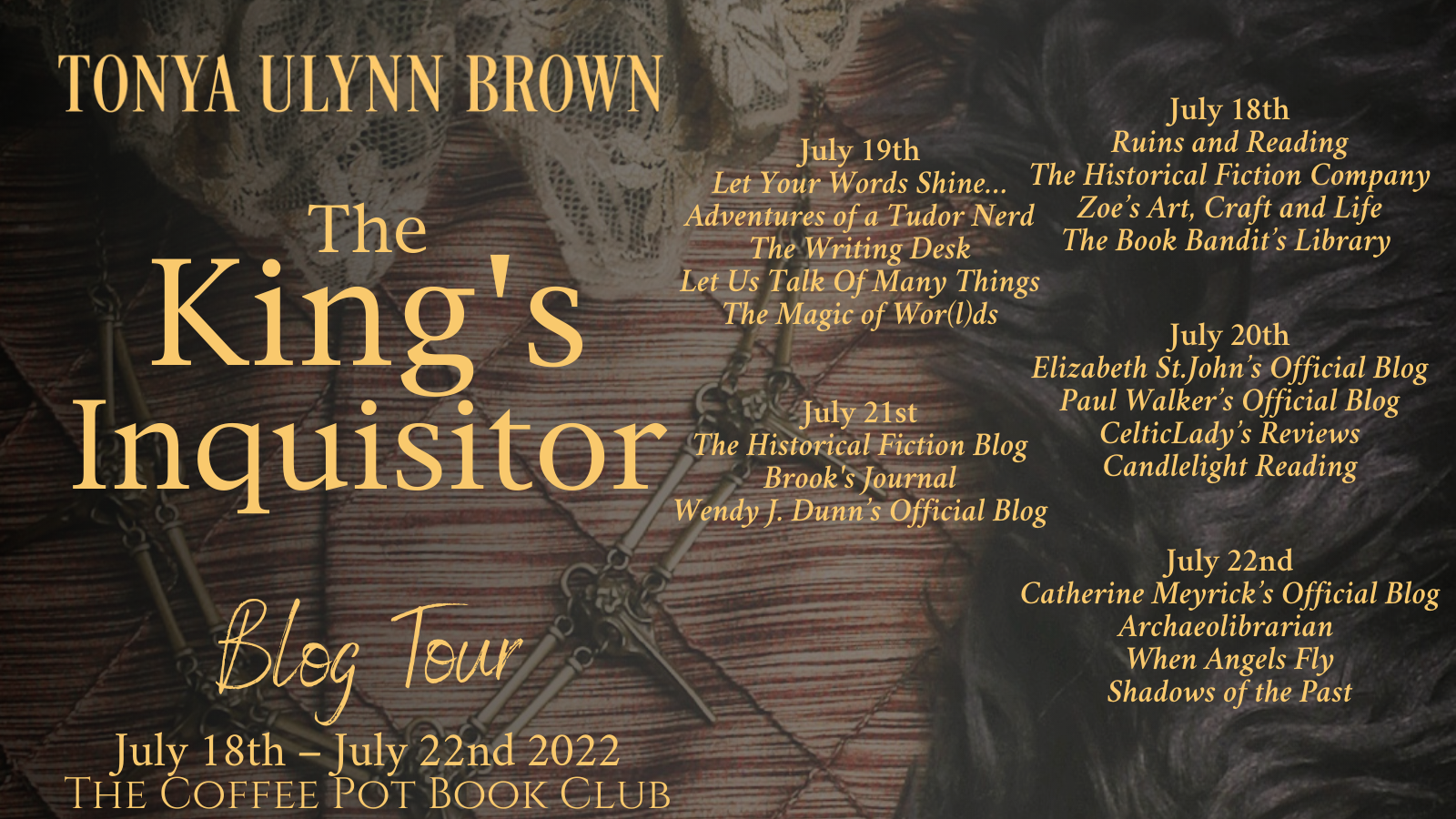
Book Spotlight and Excerpt: The King’s Inquisitor by Tonya Ulynn Brown


The queen of Scotland is dead. Her almoner’s son, William Broune, has fulfilled his father’s wish that he should serve the king, James VI, at court. William finds himself caught between loyalty to the king or loyalty to his conscience. As William is forced to serve as the king’s inquisitor in the North Berwick witch trials, he must make a decision. Will he do what the king asks, and earn the wife, title, and prestige he has always desired, or will he let a bold Scottish lass influence him to follow his heart and do the right thing?

If William doesn’t make the right choice, he may be among the accused.

Trigger warnings: Some violent imagery.


 Buy Links

 This book is available to read on #KindleUnlimited

 Universal Link

 ¸.•*´¨) ¸.•*¨) ( ¸.•´

 EXCERPT

“Mother,” I started slowly. She looked up at me from her plate, a smear of lemon glaze stuck to the corner of her mouth. “Do ye recall how I told ye of a plot to put the king in danger and remove him from the throne?

Mother, to her credit, shot her eyes to William, then back at me. I was thankful that she was in her senses and knew enough to be leery of mentioning such things in front of people we barely knew. Especially when it pertained to the help we were trying to give the accused witches. A slight nod of her head told me that she knew exactly to what I referred. 

“I had to share the information with someone we could trust. I told Sir William of what information I had in hopes that he could prevent the plot from coming to fruition.”

Mother swallowed the bite of wafer that she had been chewing. “But Ailsa dear, I thought ye said that Master Broune was not to be trusted?” 

William coughed, almost spitting his tea down his beautiful velvet doublet.

“I don’t know that I said those exact words—” 

“Nay, not those exact words. But ye said he wanted something, and we must be very careful what we say or do around him.” She sat, wide-eyed, clueless as to the fact that she had just embarrassed me and shared something that I had spoken in private. 

“Mother,” I began, but William cut me off. 

“Mistress Blackburn, Ailsa is right. I do want something. I want to be your friend. You can trust me. I will not betray any confidence that has been shared.” He looked as if he would have said more, but he was suddenly taken with a sneeze that practically rattled our cups.     

Mother was unphased. She fluttered her eyelashes again and said in a sickeningly sweet voice. “That is kind of ye, but ye might not say as much when ye find out how Ailsa came about the information.”      

“Mother!” I was horrified. What was she doing? William wiped his nose with a scrap of cloth he had tucked into his pocket and looked at me, the shock on his face reflecting my own. Mother said no more as she stuffed another wafer into her mouth and took a gulp of tea.

“I have already shared it with him, Mother.” 

“Aye, that is why I am—” Another sneeze overtook him, cutting his words short.

“Oh dear, ye aren’t catching a cold, are ye, son?”

“Mother, don’t call him son.” I was mortified. This visit was quickly turning into a disaster, as so many of my encounters with this man seemed to do. “He is the king’s man. Ye must address him with respect.” 

“It’s all right,” he began before a third sneeze shook his body. His eyes were beginning to water, the rims reddening in irritation. Just then, Sadie mewed at him from below as she wrapped her tail around his calf and rubbed her head against the soft leather of his boot. “Ah, there is the culprit.” He leaned away from Sadie as if she had the plague and tucked his legs beneath his chair.

“What do ye mean, sir? She is the sweetest feline ye will ever lay eyes on.” I picked Sadie up and rubbed my cheek against her head.     

“I mean I have a reaction to such animals. Their fur causes my eyes to itch, my nose to run, and a series of sneezes to ensue.”

“Oh.” I gulped, understanding taking hold. I quickly took the feline to the door and shewed her outside to get some fresh air. “I am sorry. I did not know.”

“How could you know?” Achoo. Another sneeze bellowed forth. 

“My, ye do shake the crockery,” Mother observed. I giggled.

“My apologies,” he said sniffling as he wiped his nose again. Inwardly I beamed; for once this man was not in full possession of his composure. Finally!

“Sometimes my eyes itch. In the spring when the flowers are at their first bloom. This always helps me.” I handed him a cloth that I had wetted and rung out. I had folded it into a rectangle and motioned to his face. “Lay it over your eyes.”

“Here now, Ailsa,” Mother crooned. “Let him lay upon the bed for a moment. It’s hard to keep the cloth over your eyes when ye are sitting upright.” She grasped him under his upper arm and pulled him from his chair. I marveled that this small woman could lead such a large man, like an ox with a ring through his nose.     

“I don’t think that is necessary,” William began.

“Ye will do well to just obey, sir,” I advised, struggling to hold down my amusement.

“You’re laughing at me,” William accused, pulling the cloth from his eyes, and sitting back up on the side of the bed to glare at me. A red, glassy glare.

“Ignore her,” my mother commanded, pushing him back down.     

“Mistress Blackburn, my boots, they are dirty. I don’t want to soil your bed linens.”

“Oh pish,” Mother waved away his concern with her hand. “Here, we can solve that.” And with a huff, she pulled his boot from his right foot.

“Mother!” All decorum was completely gone.

“Mistress—” 

“Shh,” Mother hushed, but I could clearly see that William was uncomfortable. 

 “Mother, Sir William is very particular about his clothing. I don’t think he wants his boots removed. Just leave him be for a moment. The wet cloth will help, and he’ll be good as new.”

Mother huffed in disagreement but said nothing more. I watched as William’s chest slowed to a steady pace, his breaths calming and relaxation taking over. He was silent for several minutes, and I was afforded the opportunity to admire him unashamedly, without being seen. A dimpled chin and strong jawline, covered with the first appearances of dark whiskers could still be seen from beneath the cloth, and thin, smooth lips parted slightly as he pulled breath into his lungs. 

Heat crept up my neck as the awkwardness of the situation began to take hold. I could have probably observed him for another hour or so and wished for an instant that I had taken up drawing lessons along with Bess’s mother. He would have made a fine study in the human form, but instead I finally said, “At least ye aren’t sneezing anymore.”     

“Aye, I do believe the warm cloth has helped.” He sat up and removed it from his eyes. The rims had returned to a faint pink, and his cobalt blue eyes fastened onto me. 

“My apologies for my mother’s overbearing nature,” I whispered, trying my best to tamp down another smile. “Sometimes she won’t take no for an answer.”

“She means well.” He handed the cloth back to me and picked up his boot, shoving his foot into it. Something in my chest warmed to his gentleness concerning my mother. Most men of his position would have been put off by her antics. Indeed, I wasn’t sure what had gotten into her. But I was thankful for his understanding, even if I didn’t understand her myself. 


  Tonya Ulynn Brown

Tonya Ulynn Brown is an elementary school teacher. She holds a Master’s degree in Teaching and uses her love of history and reading to encourage the same love in her students. Tonya finds inspiration in the historical figures she has studied and in the places she has traveled. Her interest in medieval and early modern British history influences her writing. She resides in rural southeastern Ohio, USA with her husband, Stephen, two boys, Garren and Gabriel, and a very naughty Springer Spaniel. 

 Social Media Links:

Website    Twitter   Facebook   Linked-in    Instagram   Pinterest   BookBub   

Amazon Author Page   Goodreads


Monday, December 7, 2020

Book Spotlight and Excerpt: The Last Blast of the Trumpet by Marie Macpherson


Conflict, Chaos and Corruption in Reformation Scotland.
 
He wants to reform Scotland, but his enemies will stop at nothing to prevent him.
 
Scotland 1559: Fiery reformer John Knox returns to a Scotland on the brink of civil war. Victorious, he feels confident of his place leading the reform until the charismatic young widow, Mary Queen of Scots returns to claim her throne. She challenges his position and initiates a ferocious battle of wills as they strive to win the hearts and minds of the Scots. But the treachery and jealousy that surrounds them both as they make critical choices in their public and private lives has dangerous consequences that neither of them can imagine.
 
In this final instalment of the trilogy of the fiery reformer John Knox, Macpherson tells the story of a man and a queen at one of the most critical phases of Scottish history.
 
Praise for The Last Blast of the Trumpet
  
‘Macpherson has done for Knox what Hilary Mantel did for Cromwell.’
 
Scottish Field
 
‘This richly realized portrait of a complex man in extraordinary times is historical fiction at its finest.’
 
Linda Porter, author of Crown of Thistles; Katherine the Queen, Royal Renegades; Mistresses: Sex and Scandal at the Court of Charles II
 
‘Marie Macpherson has once again given us a cavalcade of flesh and blood characters living the early days of the Scottish Reformation in a complex tale told with economy and wit.’
 
S.G. MacLean, author of The Seeker Series and Alexander Seaton mysteries
 
Buy Links:
 
Amazon UKAmazon USBarnes and Noble


Excerpt

The Last Blast of the Trumpet
Marie Macpherson


Part 1 Chapter One
 
The Wrath of the People
 
The Parish Church of the Holy Cross of St John the Baptist, Perth, 11 May 1559
 
‘John Knox has come.’
 
The words took flight, leaping from lip to lip, echoing round the kirk, ringing to the rafters, and striking terror into his soul. The seething mass of humanity surged forward only to be shoved back by metal-clad men-at-arms. Knox stood rooted to the threshold. The kirk was crammed full: he hadn’t expected such a crowd nor such a clamour. Panic gripped his throat and crushed his lungs.
 
An elbow nudged him and a voice muttered in his ear, ‘The folk have tramped from all the airts to show their support for their preachers and to await your guidance, master.’
 
Swallowing deeply, Knox steeled himself to follow in the wake of Sir Patrick Lyndsay’s lean, lofty figure cutting a swathe through the swarm that parted like the Red Sea before Moses. The biblical comparison inspired him. In the midst of the throng, folk stood on tiptoe, craning their necks to catch sight of him; those at the front stretched out their hands. Faces rough-hewn by the unforgiving Scottish climate glowed with expectation and excitement. His ain folk, he thought: humble hinds and herdsmen in fusty sheepskin blankets, ploughmen and draymen in worsted tunics jostled cheek by jowl with masons and skinners in worn leather jerkins and aprons, in stark contrast to the docile, dutiful gentry of his Geneva brethren.  More like the Berwick horde before he’d tamed them, Knox reminded himself. He should not fear this unruly flock but seek to win them over.
 
‘Is thon the mighty preacher everyone’s talking about?’ a voice piped up. ‘He’s gey wee.’
 
Lyndsay grabbed the offender by the throat. ‘Short in stature he may be, but his voice makes the heart dirl like thunder. Afore I rip out your blasphemous tongue, shift your fat arse and let him pass.’
 
Cowed, the man slunk away while the rest of the crowd fell silent. Patrick, Master of Lyndsay, a blunt and fierce soldier, was not a man to be crossed.
 
‘Never fash, Preacher Knox, my men-at-arms will guard the kirk doors lest the priors of Perth dare to thwart your sermon. And I’ll no shrink from turning them loose on the rabble if trouble breaks out.’
 
Rather than inspire confidence, the warrior’s words filled Knox with foreboding. ‘I want no violence used on the brethren. We need to show that we come in peace.’
 
Lyndsay’s hefty shoulders lifted in a non-committal shrug before he stomped off down the nave. Knox headed for the foot of the pulpit where he was greatly cheered to see a well-kent face amongst the group.
 
John Willock, the minister who had married him to his beloved Marjory, now clasped him to his broad chest. ‘We give thanks that the Lord has sent you here in our hour of need to stand fast with our brothers in Christ,’ he said and introduced his fellow preachers. John Christison was another former friar, while Paul Methven, a baker, and William Harlaw, a tailor, were self-educated guildsmen who had taken up the cause. ‘All good men and true.’
 
‘Not in the eyes of Marie de Guise who’s charged us with sedition and heresy,’ Methven growled. ‘Her daughter’s marriage to the French dauphin has emboldened the French sow and she’s cracking the whip.’ The blunt-spoken baker clenched fists swollen from constant kneading. ‘The regent has broken her promise to permit us to practise our faith. Just before Easter she commanded everyone to attend mass, make confession in a priest’s lug and take the sacrament on the tongue.’
 
‘It’s true. With an eye on the Vatican’s support, the regent has taken to heart the papal dogma of extra ecclesiam nulla salus,’ John Christison added.
 
Knox gave a nod of understanding. ‘Outside the Roman Church there is no salvation. Paul IV is a severe and unbending prelate. Thon Antichrist vowed that even if his own father were a heretic, he’d gather the wood to burn him.’
 
Willock clasped Knox’s hand. ‘Now’s the time to break from the fetters of Rome, brother. Scotland is on the brink of civil strife and we’re in dire need of a skipper to take the helm.’
 
‘What about thon Lords of the Congregation?’ Knox asked. The signatories to the bond had led him a merry dance over the past few years. He’d lost count of the number of times they had called him back to Scotland, assuring him the time was ripe to return. After several false starts and delays in Dieppe, he’d finally arrived home and, with barely time to regain his land legs, he’d been whisked into the midst of the maelstrom.
 
‘Many of the lords are biding their time, waiting to see which way the die falls,’ Willock replied. ‘The regent still has the support of her stepson, Lord James Stewart, the Earl of Argyll as well as the Hamiltons. Her commander-in-chief, Châtelherault, is one of those who benefits from a lavish French pension.’
 
Knox gave a contemptuous snort. ‘So, the glister of the profit has blinded their eyes. It was ever thus.’
 
‘Nevertheless, the Ayrshire lords, including Glencairn and Ochiltree, have aye stood firm.’
‘Never mind thon band of noble ne’er-do-weils,’ Methven broke in. ‘Craftsmen and guildsmen like us champion the poor and needy who’re clamouring for reform. It’s not only the roasting of our martyr, Pastor Milne, that has provoked our brethren but your warning call, Mr Knox. The folk have taken to heart your words.’
 
Baffled, Knox asked, ‘What do you mean?’
 
‘Do you no mind? The Beggars’ Summons posted on the gate of every friary and monastery throughout the land on the first of January?’ Methven handed him a tattered scrap of paper.
 
Knox quickly scanned the summons. Written on behalf of the blind, the crooked, the bedridden, widows and orphans and all other poor folk, it ordered the flocks of friars to hand over their ill-gotten gains and quit their religious houses by Whitsun. Or else be forced out on Flitting Friday, the 12th day of May.
 Knox looked up. ‘But that’s tomorrow. Who’s going to evict them?’ The eyes of all gazing upon him gave the answer.
 
Lyndsay stepped forward. ‘The faithful await a signal from you, master.’
 
Knox felt trapped, the knot in his stomach tightened. Everyone believed he’d written this anonymous warning and looked to him for the next step. He should speak the truth but his thrapple felt so dry he doubted he could utter a sound. The same fear that had seized him before his first sermon at St Andrews now threatened to strangle him into silence. His back throbbed from injuries sustained in the galleys, firing tentacles of pain up the back of his neck and into the base of the skull. The words from Ezekiel came unbidden into his mind: I will make your tongue cleave to the roof of your mouth so that you will be dumb and unable to rebuke them, for they are a rebellious people.
 
Knox had come home expecting to head a religious reformation not lead troops into battle.


Marie Macpherson

Scottish writer Marie Macpherson grew up in Musselburgh on the site of the Battle of Pinkie and within sight of Fa’side Castle where tales and legends haunted her imagination. She left the Honest Toun to study Russian at Strathclyde University and spent a year in the former Soviet Union to research her PhD thesis on the 19th century Russian writer Mikhail Lermontov, said to be descended from the Scottish poet and seer, Thomas the Rhymer. Though travelled widely, teaching languages and literature from Madrid to Moscow, she has never lost her enthusiasm for the rich history and culture of her native Scotland.

Writing historical fiction combines her academic’s love of research with a passion for storytelling. Exploring the personal relationships and often hidden motivations of historical characters drives her curiosity.

The Knox Trilogy is a fictional biography of the fiery reformer, John Knox, set during the 16th century Scottish Reformation. Prizes and awards include the Martha Hamilton Prize for Creative Writing from Edinburgh University and Writer of the Year 2011 awarded by Tyne & Esk Writers. She is a member of the Historical Writers’ Association (HWA), the Historical Novel Society (HNS) and the Society of Authors (SoA).

WebsiteTwitterFacebook • Instagram

Penmore Press


Sunday, May 27, 2018

No Atomic Blast. Fire Melted the Stones of Iron Age Forts Say Investigators

Ancient Origins


In Scotland, archaeologists believe that they have solved the mystery of an Iron Age fort in which stones had melted in a process termed vitrification. The team of experts studied the vitrified fort, known as Dun Deardail, in the Highlands, near Ben Nevis and have concluded that they can explain how its stones became molten and melted.

 Vitrified Forts
Dun Deardail has been dated to have been built around 500 BC, based on carbon testing. It was occupied by the Celts and later by the fierce Picts who used it as a fortress. The outline of the original fort can still be seen today as grassy embankments and it sits a-top a hill, that once had strategic significance in the area. It is perhaps one of the best known of the vitrified forts in Scotland, along with Ord Hill, and has fascinated people for centuries. Many people visit the spectacular site set in stunning landscape every year.


Dun Deardail. At the top of this hill is the vitrified Iron Age fort. ( CC BY SA 2.0 )

There are many similar vitrified forts in France and Ireland. It is estimated by the National Geographic that there are about 70 vitrified forts in Scotland and 200 in total in Europe. Scientists believe that to vitrify stone slabs that a heat of 2,000 degrees Fahrenheit or 1,100 degrees Celsius , is required. The question as to how Iron Age people managed to ignite such conflagrations with their crude technologies and limited capabilities has only added to the mystery.

The experts from the Forest Enterprise Scotland, working with Stirling University and local volunteers, believe that they have solved the enigma, reports the Scotsman. They believe that a large-scale wooden structure over the stone walls was set alight and the blaze reached such a temperature that it burned the stones. Have the team solved the mystery of the vitrified forts?


Dun Carloway Broch, Lewis, Scotland. Another fort that has areas of vitrification. ( Public Domain )

Solving the Mystery
In order to solve the riddle of the vitrification of forts in Scotland and elsewhere in Europe, a series of investigations have been carried out since at least the 1930s. These tried to duplicate the conditions that would have led to stone vitrifying. None of their results were especially convincing and the reasons for the melting of stone forts continued to be a mystery. The failure to provide a satisfactory theory encouraged all kinds of wild speculation. For example, the popular author, Arthur C Clark argued that the stones were melted and fused by some Iron Age superweapon if not an early atomic bomb.


Now the team led by an archaeologist from the University of Stirling have offered what they believe is the most plausible explanation for the phenomenon of the vitrification of stone citadels. The study has shown that a timber superstructure, which included ramparts and towers, was set alight and the resulting blaze heated the stones. The fire was so intense that is was able to melt stones because of the anaerobic environment that developed as the flames burned down into the stones. The absence of oxygen in the anaerobic conditions, made the fire much more intense and allowed it to reach the temperatures that would have burned the slabs until they melted and fused


Fused stones. This was once part of a wall to the original hill fort at Dunnideer which gave the hill its name. ( CC BY-SA 2.0 )

The team is not only excited by the potential discovery of the cause of the vitrification process but also by the insights that it offers into the nature of Iron Age forts and society. The theory can help us to visualize what these forts looked like. They were impressive bastons with stone walls and according to Matt Ritchie, archaeologist with Forestry Enterprise Scotland they had ‘ roofed rampart walls many metres high’ . He also believes that the extensive wooden structures were used to store the precious food supply of the community.

 It seems that the archaeologists and the team of volunteers have explained one of the most perplexing mysteries from the Iron Age. They have offered a rational and plausible explanation for the vitrification of forts without the need for far-fetched theories. However, according to Ritchie ‘ of course the mystery of why the forts were burned remains unresolved’ . It has been speculated that they were burned during war, as part of a religious ceremony or to mark the death of a monarch.

Top image: Dunnideer Castle, built on the site of a hillfort with a remaining vitrified rampart. ( CC BY-SA 2.0 )

By Ed Whelan

Wednesday, April 25, 2018

‘Very Angry Badger’ Wreaks Havoc at Historic Castle in Scotland


Ancient Origins


A 16th century Scottish castle survived decades of battles, attacks, civil war and treason but has been forced to close due to one very angry badger, which has taken up residence in Cellar Tunnel.

Sturdy Construction
Craignethan Castle is an early artillery fortification in South Lanarkshire, Scotland, built around 1530 AD by the influential Hamilton family. While much of it is in ruins, an impressive tower and fortifications have stood the test of time, and thousands of visitors enjoy the castle and its picturesque grounds every year.

Badger in the Basement
However, part of the castle was forced to close to the public on 12 April after a new invader took control of the cellar tunnel – a “very angry badger”, The Independent reports.

Historic Scotland didn’t elaborate on why the badger is so angry, but it has been wreaking havoc in the tunnel, digging through loose soil in the stonework and turning some of the areas into rubble. Staff have been unsuccessfully trying to lure it out with cat food and honey, but the badger was having none of it. Clean-Up Historic Scotland confirmed via Twitter that the castle’s most recent invader has now vacated the premises and they are “doing a little housekeeping” following its visit. “While our furry friend left the building over the weekend, we can confirm the #CraignethanCastle cellar tunnel remains closed this week,” Historic Scotland tweeted. “Our work team on-site need to repair some of the stone masonry the badger damaged. The rest of the castle is open for visitors.”


The original tower house, Craignethan Castle. Image: CC BY-SA 2.0

Castle History
Craignethan Castle was built by Sir James Hamilton of Finnart, once head of the second most powerful family in Scotland. He was one of the richest landowners in southern Scotland but was executed by King James V in 1540, after the king became convinced he was plotting against him, an accusation that is believed to be untrue.

In its heyday, the castle hosted many important visitors including Mary, Queen of Scots, who was sheltered there prior to her defeat at the Battle of Langside in 1568.

The castle was attacked in 1579 and given up without a siege. Its defences were demolished and the castle passed to the Hays family and remained with them until placed in State care in 1949. Today it is looked after by Historic Environment Scotland.

Top image: Craignethan Castle. Source: CC BY 3.0

By April Holloway

Thursday, April 12, 2018

Robert the Bruce: champion of Scotland or murderous usurper?


History Extra


On 10 February 1306, the most important political murder in Scottish history took place. John Comyn, “the Red”, was slaughtered by Robert Bruce, Earl of Carrick, and his followers in an outburst of violence in the church of the Franciscans, the Greyfriars, at Dumfries.

 Comyn and Bruce were leading members of the Scottish nobility. They had been rivals and had recently fought on opposing sides in the wars between Edward I of England and the Scots. In early 1306 with Edward finally recognised as ruler of Scotland, the two lords met together in the Greyfriars church. At first the men seemed friendly and Bruce talked alone with Comyn before the high altar.

Suddenly the mood changed. Bruce accused his rival of treachery. Making to walk away, Robert Bruce then turned back with sword drawn and struck Comyn. Bruce’s followers then rushed in, raining blows on John Comyn who fell to the floor. Comyn’s uncle, who joined the melee, was cut down. Bruce left the church. Mounted on Comyn’s horse he led his followers the short distance to Dumfries Castle where King Edward’s justices were holding court.

Breaking in, Bruce arrested the king’s men but then he heard news that Comyn was still alive. He dispatched two of his men to the friary. They found John Comyn tended by the friars in the vestry, wounded but not dying.

After allowing him to hear confession, Bruce’s men dragged Comyn back into the church and killed him on the altar steps, spattering the altar itself with blood. While Comyn’s corpse was abandoned to the friars, Bruce rode from Dumfries to begin the uprising against Edward I which would climax with his crowning as king of Scots six weeks later.

Those seeking to understand these events saw Comyn’s death as a deliberate step on Bruce’s path to the throne. The English investigation of the murder in 1306 concluded that Comyn was killed because “he would not assent to the treason that Bruce planned against the king of England, it is believed”. In English chronicles of the period, Bruce lured Comyn to Dumfries to kill him. In Scottish accounts, by contrast, Bruce and Comyn agreed to work together for Scotland’s freedom. Comyn, however, betrayed Bruce’s plans to Edward I and was killed in revenge for his treachery.

All these versions agree in identifying Bruce in February 1306 as a man preparing to launch a bid for the kingship and killing Comyn to clear the way. The portrayal of Bruce as either cold-blooded killer or clear-sighted champion of his people suited the conflicting perceptions of later years. It placed the murder at the heart of a planned coup which would also involve Bruce’s seizure of the throne and his war against the English king, a war which ultimately secured recognition of Scotland’s independence.

However, these interpretations also relied on a heavy dose of hindsight. If viewed from the perspective of February 1306 do the conclusions of these accounts seem quite so clear? Was Bruce at that time focused on the seizure of the throne? Was the killing of Comyn on holy ground, an act bound to appal and alienate many Scots, a deed of calculated revolution? Did the immediate aftermath of Comyn’s death, the six weeks before Bruce was crowned king, witness the unfolding of a planned coup? The answers lie in the evidence which emerged before Bruce assumed the reputation and role of hero king or bloody usurper.

The difficult years
In early 1306 Robert Bruce was not an obvious champion of Scottish liberties. He was in his early 30s and his career had been shaped by the decade-long wars between Edward I (ruled England 1272–1307) and the Scots.

The king of England had taken advantage of a succession crisis in Scotland after the death of Alexander III (who ruled Scotland 1249–86). Bruce’s position in this conflict was defined by family interests. Part of this was the Bruce claim to the Scottish throne. This had been rejected in favour of the rival rights of John Balliol in 1292 but with Balliol in exile from 1296 the Bruces did not abandon hope of a crown.

While Bruce was conscious of his family’s royal aspirations, it was his responsibilities as a nobleman which exerted most influence on his activities. As earls of Carrick and lords of Annandale in south-west Scotland and a number of English estates, the Bruces had to preserve lands in two warring kingdoms and protect their friends and tenants in the difficult years since 1296. In these years Bruce had played a shifting role. He had briefly led resistance to Edward I in 1297 and had been a guardian of Scotland between 1298 and 1300 but after both episodes had submitted to the English king.

 From 1302 to 1304 he had been active in Edward’s government of Scotland. Bruce’s shifts of side were motivated less by a machiavellian hopes of winning the throne than by the duty to preserve his family’s lands and tenants from the worst effects of war.

His actions were normal amongst the Scottish nobility and were entirely understandable to contemporaries. They do not, though, reveal Bruce as a man committed to the abstract defence of Scotland. Instead they suggest a young lord whose concerns were with more limited and pragmatic issues of lordship and loyalty.

In the months before February 1306 Robert Bruce continued to face these concerns in new circumstances. In 1304 Edward I finally compelled his leading Scottish enemies to submit to his rule. He was now the master of Scotland and during the next year Scotland’s nobles sought his favour and petitioned him for lands and offices. Bruce was one of this group.

In April 1304 his father had died and Bruce approached the king to receive his family’s lordship of Annandale. The succession of enquiries into the Bruces’ ancient rights in their estates probably encouraged Bruce to find allies. To this end, in June 1304 he entered a bond or private alliance with William Lamberton, the bishop of St Andrews.

Deep political rivals
While this was later used by the English to suggest a conspiracy between Bruce and one of the leaders of the Scottish church, its terms do not support this. Instead it was a formal statement of friendship between lords who had recently been on opposite sides in the war but now saw the need to co-operate.

Needing to secure his inheritance and under government scrutiny, Bruce would have found such an alliance valuable, especially as Lamberton became head of Edward’s Scottish council. Issues of land, lordship and influence within this Edwardian Scotland seem to have preoccupied Robert Bruce in 1304–5.

The same issues explain Bruce’s presence in Dumfries on 10 February and his meeting with John Comyn. The king’s justices were holding court in Dumfries and as local landowners it would be natural for Bruce and Comyn to be present. For them to meet in private to discuss the court’s business would also be normal.

However any meeting between these two men came with considerable baggage. There is a garbled tale in several accounts of an indenture between Bruce and Comyn which may indicate a promise of mutual support like that between Bruce and Bishop Lamberton. In the case of Bruce and John however, any written expressions of friendship overlay deep animosity.

The two men were open political rivals. Comyn’s family were long-standing opponents of the Bruces and between 1302 and 1304, while Bruce served King Edward, Comyn had led the king’s enemies. They were also personal enemies. In 1299 Bruce and Comyn were the guardians of Scotland, leading the war against the English. When a dispute broke out between followers of the two men, Comyn turned on Bruce and seized him by the throat.

Accusations of treason were flung at Bruce before the two men were separated. The mistrust and violence between Bruce and Comyn in 1299 may have flared again in February 1306, perhaps sparked by a similarly minor disagreement.

Seeking a deal
The closely contemporary account of Walter of Guisborough hints at this scenario. Bruce and Comyn met to discuss “certain matters touching both of them”. During the conversation Bruce charged Comyn with influencing King Edward against him.

This suggests less the betrayal of a conspiracy than competition for royal favour between rivals which had cost Bruce lands and offices and may have broken a written promise of friendship. Old antagonisms spurred Bruce into an attack on Comyn and others present joined in the fight. The result was not assassination but a bloody scuffle.

The aftermath of the killing suggests that even then Bruce only slowly developed the intention of seizing the throne. It would be six weeks before he was crowned and in this period the consequences of Comyn’s death and the nature of Bruce’s intentions only gradually unfolded.

Vital evidence of this comes from an English report, crucially written in early March before Bruce took the throne. It shows Bruce remaining in the south-west, taking castles and trying to recruit followers in the manner of previous aristocratic rebellions. The report also reveals that Bruce was negotiating with Edward I and his officials and in these talks indicated that he had taken castles “to defend himself with the longest stick that he had”.

This was not the unequivocal defiance of a king in waiting but suggests a man trying to safeguard his position but still seeking a deal, perhaps a pardon for Comyn’s death. However the report shows that such aims were changing.

The writer identifies the key figure in this as Wishart, the bishop of Glasgow. Robert Wishart was a veteran defender of Scottish liberties and in early March, as Bruce’s “chief adviser”, he absolved Bruce from his sins and “freed him to secure his heritage”. This could only mean that Bruce was now determined to bid for the throne. Wishart provided the spiritual support. By releasing Bruce from his oath to Edward and from the sacrilege of slaying Comyn on holy ground the bishop made Bruce a credible leader of the Scots.

It had taken weeks for this move and it was only in March that Bruce started to widen his appeal and win support. On 25 March Bruce was crowned King of Scots at Scone.

The ceremony was makeshift and, if it demonstrated that the new king had gathered support from clergy, nobles and people, a majority stayed away, refusing to recognise the usurper or unwilling to risk sharing in his likely defeat.

Edward I’s terrible retribution
Bruce had taken a huge gamble. He was on a path of no return and by October he and his friends had paid a heavy price. Defeated three times in battle by English and Scottish enemies, Bruce fled the Scottish mainland. Many of his supporters and family suffered worse fates as Edward I wreaked a terrible punishment on those he regarded as perjured rebels.

With stakes so high it would always have been a huge risk to plan a rebellion against Edward. It would not be surprising if Bruce, a wealthy and influential noble with a career of cautious self-interest to his name, baulked at such a gamble. Instead, through lingering personal antagonism which sparked an act of unpremeditated violence, Bruce put his future in jeopardy. By killing Comyn, Bruce had made enemies of John’s family and following. As well as this blood feud Bruce now faced the judgement of Edward I, not a lenient or forgiving ruler.

In these unpromising circumstances and influenced by Bishop Wishart, Bruce took the decision which changed his life and Scotland’s future. He laid claim to the title and authority of king, appealing to his family’s allies and to those Scots who wished to renew the war against the English king. Despite the defeats of 1306 it would be in this role that Bruce would return to Scotland the following year. From 1307 as King of Scots Robert Bruce would begin to win his realm.

Michael Brown is reader in medieval Scottish history at the University of St Andrews. His books include The Wars of Scotland 1214-1371, (Edinburgh University Press, 2004) and Bannockburn: The Scottish War and the British Isles, 1307-1323 (Edinburgh University Press, 2008).

Wednesday, March 14, 2018

High-tech scans reveal secrets of medieval burial stones in Scotland


Medievalists


PhD student Megan Kasten with the rediscovered stone. Image courtesy Lynne Black.

BY NATALIE ANDERSON

The latest digital photography techniques applied to the ancient burial stones at Inchinnan Parish Church in western Scotland have revealed that one of the stones, thought to be medieval in date, was originally carved much earlier and probably commemorated an important person within the Kingdom of Strathclyde.

As a part of the ‘St Conval to All Hallows’ community archaeology project, Clara Molina Sanchez (Spectrum Heritage) has been using a technique called Reflectance Transformation Imaging (RTI) on the burial stones to bring out the worn detail which is no longer visible to the naked eye. Megan Kasten (a PhD student from the University of Glasgow) has been studying the many carved stones at Govan Old church and wanted to compare these with the stones at Inchinnan. Earlier this month she examined the 3D models from Inchinnan closely and to her surprise noticed that one stone had a cross on the top third of the stone and faint panels of interlace.

The stones came originally from the site of All Hallows, Inchinnan, a small hill next to the Black Cart Water. The church there was demolished in the 1960s to make way for Glasgow Airport. The church site was traditionally the burial place of St Conval, possibly an early Christian saint who may have been buried at Inchinnan in the 6th century AD. This discovery adds to the existing three large carved stones decorated with crosses, carved animals and interlace that are characteristic of a group of sculpture that is typically referred to as the ‘Govan School’ of carving. These stones date to the 9th to 12th century when All Hallows, along with Govan and Dumbarton Rock, were places of burial for the elite of the Kingdom of Strathclyde. A medieval church was later built on the site and was the property of the Knights Templar and later the knights of St John. A new church was built on the site in 1828 and this was significantly enlarged in 1904 by Lord Blythswood.

All the stones have decorations and/or inscriptions, which are generally not visible to the naked eye. To make these carvings visible, two different digital documentation techniques were used. Firstly, photogrammetry was used to accurately capture the shape of the stones. In this case, the colour of the biological growth makes it harder to see the details on the surface, but, by ‘deactivating’ it, the different carvings of swords, crosses and inscriptions can now be seen.

The second technique, RTI (Reflectance Transformation Imaging) is a multi-image technique that provides very detailed information on the surface of a material. RTI files allow the user to explore the surface of the material virtually with different lighting conditions. In this case, a Virtual RTI was created from the photogrammetric models. And to do that, a digital dome made up of 93 lights was placed over the 3D models, thus creating an image for every light. These images were processed, which in turn produced an RTI file for each one of the stones. This made it possible to obtain information about the stones’ decorations that can also complement the photogrammetry itself. The combination of both techniques has been proven to be a very valuable tool to unveil details of the surface invisible otherwise to the naked eye.

Megan Kasten revealed her discovery at the final round-up meeting at Inchinnan on Saturday the 18th November. She said “this new addition is really exciting! We have few historical records for this time period, so each new discovery increases our understanding of the connections between important early medieval sites in the local area, like Inchinnan and Govan”

 Dr Sally Foster, Lecturer in Heritage and Conservation at the University of Stirling and Chair of the National Committee on Carved Stones in Scotland says, ‘The discovery of a previously unrecognised example of the ‘Govan School’ of early medieval sculpture is a wonderful example of the untapped potential of Scotland’s carved stone resource. It shows the power of interdisciplinary research, including the latest scientific techniques, to shed light on the long, complex and unexpected biographies of carved stones. It’s exactly the sort of research project that the National Committee on Carved Stones in Scotland’s ‘Listen to the Stones’ online booklet seeks to promote as part of Future Thinking on Carved Stones in Scotland.’


Inchinnan Historical Interest Group members. Image courtesy Lynne Black.

Dr Heather James (Calluna Archaeology) says ‘It has been great seeing the community and professionals working together to discover so much more about our fascinating heritage through this project’.

This re-discovery comes at the end of a season of archaeological work in 2017 at All Hallows developed and led by the Inchinnan Historical Interest Group and Dr Heather James of Calluna Archaeology. This project has involved geophysics, excavation, historical research, model making, film making, graveyard recording and has enabled several local schools and numerous volunteers to get a taste of archaeology.

The project is funded by the Heritage Lottery Fund, Historic Environment Scotland, Robert Barr Charitable Trust, Hugh Fraser Foundation, AMW Charitable Trust, Foundation Scotland – Dickon Trust Fund, Peter Coats Trust, Peter Brough Bequest Fund and the Glasgow Airport Authority Flightpath fund.