Showing posts with label castle. Show all posts
Saturday, May 26, 2018
Tintagel Castle and The Legendary Conception of King Arthur
Ancient Origins
Tintagel Castle is a castle located on Tintagel Island, a peninsula connected to the North Cornwall coast in England by a narrow strip of land. This castle is said to have been an important stronghold from around the end of Roman rule in Britain, i.e. the 4th century AD, or the 5th century AD until the end of the 7th century AD. Tintagel Castle is perhaps best known for the claim that it was the place where the legendary King Arthur was conceived.
The site where Tintagel Castle stands today is likely to have been occupied during the Roman era, as artifacts dating to this period have been found on the peninsula. Having said that, as structures dating to the Roman period have yet to be discovered, it is not entirely clear if Tintagel Island had been occupied during the Roman period.
The ruins of the upper mainland courtyards of Tintagel Castle, Cornwall. ( CC BY-SA 2.0 )
It may be said with more certainty that the site was occupied between the end of the Roman period and the 7th century AD. Earlier in 2016, geophysical surveys revealed the existence of walls and layers of buildings at the site. Excavation in the later part of the year yielded walls, said to belong to a palace, a meter in thickness. Additionally, numerous artifacts were also unearthed, including luxury objects imported from distant lands. Such objects include fragments of fine glass, a rim of Phocaean red-slip wear, and late Roman amphorae, which are reported to have been used for the transportation of wine and olive oil from the Mediterranean to Tintagel.
It has also been reported that this palace belonged to the rulers of an ancient south-west British kingdom known as Dumnonia. This kingdom is said to have had its center in modern day Devon, and included parts of present day Cornwall and Somerset. It has been suggested that the story of King Arthur’s conception at Tintagel has something to do with the Kingdom of Dumnonia, or at least with its memory.
During the 12th century, the writer Geoffrey of Monmouth wrote the Historia Regum Britanniae (translated into English as ‘The History of the Kings of Britain’), a pseudohistorical account of British history. One of the figures in this account was King Arthur, whom, according to Geoffrey, was conceived at Tintagel. It has been suggested that Geoffrey was inspired by the memory of Tintagel as a royal site in earlier centuries to link it with the place of the legendary king’s conception.
According to legend, Arthur’s father, Uther Pendragon, fell in love with / lusted after Igraine, the wife of Gorlois of Cornwall, whose fortress was at Tintagel. Uther managed to persuade Merlin to use his magic to fulfil his desire. Merlin transformed Uther into the image of Gorlois, and he was able to enter Tintagel Castle to seduce the queen. It was by this way that Arthur is said to have been conceived.
An illustration by N. C. Wyeth for The Boy's King Arthur (1922) ( Public Domain )
During the 1230s, Richard, 1st Earl of Cornwall, second son of King John of England, and brother of King Henry III of England, decided to build a castle on Tintagel Island.
It has been pointed out that the castle was built based purely on the Arthurian legend connected to that site, and that it was of no military value whatsoever. The castle was inherited by the earl’s descendants, though they are said to have made little use of it. By the middle of the 14th century, about a century after the castle was built, the Great Hall is said to have been roofless, and another century later, the castle had fallen into ruins.
Ruins of the Norman castle at Tintagel. ( CC BY 2.5 )
It is the ruins of Richard’s castle that can still be seen today. The castle remains as the property of the Duchy of Cornwall, and may be visited by the public. In 2016, it was reported that an artwork depicting Merlin was carved into the rock face close to the spot where Arthur was said, according to legend, to have been conceived. In addition, a footbridge (the design of which was selected from a competition) to connect the mainland and the castle is planned to be built. Whilst some have viewed these positively, as they are aimed at bringing in more tourists, others have called it a ‘Disneyfication’ of the site.
Top image: Tintagel Castle, Cornwall. Photo source: ( CC BY 2.0 )
By Wu Mingren
Wednesday, April 25, 2018
‘Very Angry Badger’ Wreaks Havoc at Historic Castle in Scotland
Ancient Origins
A 16th century Scottish castle survived decades of battles, attacks, civil war and treason but has been forced to close due to one very angry badger, which has taken up residence in Cellar Tunnel.
Sturdy Construction
Craignethan Castle is an early artillery fortification in South Lanarkshire, Scotland, built around 1530 AD by the influential Hamilton family. While much of it is in ruins, an impressive tower and fortifications have stood the test of time, and thousands of visitors enjoy the castle and its picturesque grounds every year.
Badger in the Basement
However, part of the castle was forced to close to the public on 12 April after a new invader took control of the cellar tunnel – a “very angry badger”, The Independent reports.
Historic Scotland didn’t elaborate on why the badger is so angry, but it has been wreaking havoc in the tunnel, digging through loose soil in the stonework and turning some of the areas into rubble. Staff have been unsuccessfully trying to lure it out with cat food and honey, but the badger was having none of it. Clean-Up Historic Scotland confirmed via Twitter that the castle’s most recent invader has now vacated the premises and they are “doing a little housekeeping” following its visit. “While our furry friend left the building over the weekend, we can confirm the #CraignethanCastle cellar tunnel remains closed this week,” Historic Scotland tweeted. “Our work team on-site need to repair some of the stone masonry the badger damaged. The rest of the castle is open for visitors.”
The original tower house, Craignethan Castle. Image: CC BY-SA 2.0
Castle History
Craignethan Castle was built by Sir James Hamilton of Finnart, once head of the second most powerful family in Scotland. He was one of the richest landowners in southern Scotland but was executed by King James V in 1540, after the king became convinced he was plotting against him, an accusation that is believed to be untrue.
In its heyday, the castle hosted many important visitors including Mary, Queen of Scots, who was sheltered there prior to her defeat at the Battle of Langside in 1568.
The castle was attacked in 1579 and given up without a siege. Its defences were demolished and the castle passed to the Hays family and remained with them until placed in State care in 1949. Today it is looked after by Historic Environment Scotland.
Top image: Craignethan Castle. Source: CC BY 3.0
By April Holloway
Thursday, April 6, 2017
Quarrying and Blasting May Destroy 2100-Year-Old Castle Site and Statue of Mother Goddess in Turkey
Ancient Origins
Blasting and quarrying of rock at a site near the ancient Kurul Castle in Turkey have endangered the structure and a precious statue of the ancient goddess Cybele.
The castle, which dates back about 2,100 years, is located in the northern province of Ordu near the Black Sea. King Mithridates VI of Armenia Minor and Pontus had the castle built during his reign, which spanned from 120 to 63 BC.
Kurul Rock archaeological site, Ordu, Turkey. ( Black Sea-silk Road Corridor )
The explosions going on daily near the castle have threatened the sculpture of Cybele, an ancient mother goddess of the region, says an article about the situation in Hurriyet Daily News online. The castle is situated on the peak of the mountain in Bayadi village.
The digs carried out there since 2010 are being conducted under the supervision of professor Yücel Şenyurt.
When the discovery of the statue of Cybele was made known to the world, about 15,000 people visited the castle to see it.
Examining the Cybele statue in Ordu, Turkey. ( Hurriyet Daily News )
Now, the archaeological excavations are still going on at the same time as the quarrying and blasting with dynamite, on the slopes of the Kurul Rocks above the Melet River. This quarrying could spell the end of, or great damage to, what remains of the Kurul Castle.
Governmental authorities, the quarrying company, and archaeologists are trying to sort out the situation and see to the protection of the site.
As Ancient Origins reported in January 2017, Cybele was a goddess of ecstatic and chthonic reproductive mysteries, the primary mother goddess of ancient Anatolia, and Phrygia's only known goddess thus far. She was a "Mistress of Animals," "Great Mother" and "Mother of the Mountain" and it appears that Cybele was adopted by the Greeks in Asia Minor (modern day Turkey), and then adapted as she spread from there to mainland Greece, followed by Rome.
Cybele protects from Vesuvius the towns of Stabiae, Herculaneum, Pompeii and Resina (1832) by François-Édouard Picot. ( Public Domain )
A statue of this important goddess is under threat by blasting and quarrying in Turkey.
In Phrygia, no records remain concerning her cult and worship, though there are numerous statues of overweight, seated women that archaeologists believe represent Cybele. Often she is also portrayed giving birth, indicative of her Mother Goddess status.
Cybele has components of various mother goddesses in ancient Greece: Gaia, Rhea, and Demeter, each notable in their own aspects. Gaia is the ancient Greek mother goddess, responsible for birthing the gods and various aspects of the cosmos with Uranus. Rhea plays a similar role in the universe as the mother of the Olympians, with ancient roots in Minoan and Mycenaean traditions. And Demeter is directly responsible for the changing of the seasons and thus the fertility of the earth.
Figurine of a seated Mother Goddess flanked by two lionesses found at Çatalhöyük, Turkey (about 6000-5500 BC), Museum of Anatolian Civilizations in Ankara. ( CC BY SA 2.5 ) Many say this is one of the earliest representations of Cybele.
Ancient Origins also reported on the king who built Kurul castle, Mithridates (spelled also as Mithradates) VI. His full name is Mithridates VI Eupator Dionysius. He was a famous king of Pontus, a Hellenistic kingdom in Asia Minor of Persian origin. Mithridates is best known for his conflict with the Roman Republic in the three Mithridatic Wars, in which the Pontic king fought against three prominent Roman generals – Lucius Cornelius Sulla, Lucius Licinius Lucullus, and Gnaeus Pompey Magnus.
A bust of the king of Pontus Mithridates VI as Heracles. Marble, Roman imperial period (1st century). ( CC BY 3.0 ) Mithridates VI built Kurul castle, which is now in danger in Turkey.
Top image: The Kurul Rock archaeological site ( @eslidemirel/imgrum) and this statue of Cybele ( T24) are in danger of being destroyed by nearby blasting and quarrying in Turkey.
By Mark Miller
Blasting and quarrying of rock at a site near the ancient Kurul Castle in Turkey have endangered the structure and a precious statue of the ancient goddess Cybele.
The castle, which dates back about 2,100 years, is located in the northern province of Ordu near the Black Sea. King Mithridates VI of Armenia Minor and Pontus had the castle built during his reign, which spanned from 120 to 63 BC.
Kurul Rock archaeological site, Ordu, Turkey. ( Black Sea-silk Road Corridor )
The explosions going on daily near the castle have threatened the sculpture of Cybele, an ancient mother goddess of the region, says an article about the situation in Hurriyet Daily News online. The castle is situated on the peak of the mountain in Bayadi village.
The digs carried out there since 2010 are being conducted under the supervision of professor Yücel Şenyurt.
When the discovery of the statue of Cybele was made known to the world, about 15,000 people visited the castle to see it.
Examining the Cybele statue in Ordu, Turkey. ( Hurriyet Daily News )
Now, the archaeological excavations are still going on at the same time as the quarrying and blasting with dynamite, on the slopes of the Kurul Rocks above the Melet River. This quarrying could spell the end of, or great damage to, what remains of the Kurul Castle.
Governmental authorities, the quarrying company, and archaeologists are trying to sort out the situation and see to the protection of the site.
As Ancient Origins reported in January 2017, Cybele was a goddess of ecstatic and chthonic reproductive mysteries, the primary mother goddess of ancient Anatolia, and Phrygia's only known goddess thus far. She was a "Mistress of Animals," "Great Mother" and "Mother of the Mountain" and it appears that Cybele was adopted by the Greeks in Asia Minor (modern day Turkey), and then adapted as she spread from there to mainland Greece, followed by Rome.
Cybele protects from Vesuvius the towns of Stabiae, Herculaneum, Pompeii and Resina (1832) by François-Édouard Picot. ( Public Domain )
A statue of this important goddess is under threat by blasting and quarrying in Turkey.
In Phrygia, no records remain concerning her cult and worship, though there are numerous statues of overweight, seated women that archaeologists believe represent Cybele. Often she is also portrayed giving birth, indicative of her Mother Goddess status.
Cybele has components of various mother goddesses in ancient Greece: Gaia, Rhea, and Demeter, each notable in their own aspects. Gaia is the ancient Greek mother goddess, responsible for birthing the gods and various aspects of the cosmos with Uranus. Rhea plays a similar role in the universe as the mother of the Olympians, with ancient roots in Minoan and Mycenaean traditions. And Demeter is directly responsible for the changing of the seasons and thus the fertility of the earth.
Figurine of a seated Mother Goddess flanked by two lionesses found at Çatalhöyük, Turkey (about 6000-5500 BC), Museum of Anatolian Civilizations in Ankara. ( CC BY SA 2.5 ) Many say this is one of the earliest representations of Cybele.
Ancient Origins also reported on the king who built Kurul castle, Mithridates (spelled also as Mithradates) VI. His full name is Mithridates VI Eupator Dionysius. He was a famous king of Pontus, a Hellenistic kingdom in Asia Minor of Persian origin. Mithridates is best known for his conflict with the Roman Republic in the three Mithridatic Wars, in which the Pontic king fought against three prominent Roman generals – Lucius Cornelius Sulla, Lucius Licinius Lucullus, and Gnaeus Pompey Magnus.
A bust of the king of Pontus Mithridates VI as Heracles. Marble, Roman imperial period (1st century). ( CC BY 3.0 ) Mithridates VI built Kurul castle, which is now in danger in Turkey.
Top image: The Kurul Rock archaeological site ( @eslidemirel/imgrum) and this statue of Cybele ( T24) are in danger of being destroyed by nearby blasting and quarrying in Turkey.
By Mark Miller
Monday, October 10, 2016
Roman Coins Discovered at Japanese Castle Raise Questions of Ancient Connections
Ancient Origins
Four Roman copper coins have been unearthed at Katsuren Castle on Okinawa Island, Japan. They are the first of their kind to be discovered in the country and have been dated to 300-400 AD. How the coins came to be at the castle is still a mystery.
According to Seeker, it was first believed that the coins were simply pennies dropped by U.S. soldiers, but washing them showed images of the Roman Emperor Constantine I. Archaeologist Hiroki Miyagi said that the discovery came as a shock and the Independent claims that the coins “were originally thought to be a hoax.”
Japan Times reports that the coins measure 1.6-2 cm (0.6-0.8 inches) in diameter. The designs on the coins are hard to see due to abrasion, however by using x-ray analysis, the researchers found depictions of a soldier holding a spear and the emperor Constantine I. The coins will be on display at Uruma City Yonagusuku Historical Museum in central Okinawa until Nov. 25.
Apart from the Roman coins, the researchers also found a coin from the 17th century Ottoman Empire. Five other possible coins have also been discovered at the castle since excavations began there in 2013.
Jcastle provides more of Amawari’s tale and says that:
Could this suggest Romans had connections or even direct influence on ancient Japan? MessageToEagle.com believes so, and writes “Ancient Romans obviously visited the Katsuren Castle in Japan.” They point to previous evidence of three Roman glass beads found in a 5th century Kyoto burial, as more proof of possible connections. Speaking on the beads, researcher Tomomi Tamura said “They are one of the oldest multilayered glass products found in Japan, and very rare accessories that were believed to be made in the Roman Empire and sent to Japan.”
Top Image: Katsuren Castle, Uruma, Okinawa Prefecture, Japan. (kanegen/CC BY 2.0) Insert: A 4th-century copper coin from ancient Rome found at the castle. (Uruma Board of Education)
By Alicia McDermott
According to Seeker, it was first believed that the coins were simply pennies dropped by U.S. soldiers, but washing them showed images of the Roman Emperor Constantine I. Archaeologist Hiroki Miyagi said that the discovery came as a shock and the Independent claims that the coins “were originally thought to be a hoax.”
Two artifacts found at Katsuren Castle: A Roman coin (Uruma Board of Education) and an Ottoman coin. (Uruma Board of Education)
Apart from the Roman coins, the researchers also found a coin from the 17th century Ottoman Empire. Five other possible coins have also been discovered at the castle since excavations began there in 2013.
- The Seven-Branched Sword: The Mystical Ceremonial Sword of Japan
- Beware of the Cat: Tales of the Wicked Japanese Bakeneko and Nekomata – Part 1
Excavations at the site. (Urama Board of Education)
Katsuren Castle was built sometime in the late 13th - early 14th century, and it was abandoned about 200 years later. The castle ruins received UNESCO recognition in 2000. Japan-guide.com tells one of the most famous legends of the castle. It is associated with Lord Amawari, who was the 10th lord of the castle. They write “Amawari was a sickly child that got abandoned in the mountains to die. However, the child survived and grew into a powerful leader who defeated an oppressive lord and took over Katsuren Castle.”Jcastle provides more of Amawari’s tale and says that:
“He is famous for fostering prosperous international trade and many shards of Chinese pottery and tiles were found on the site of Katsuren Castle. He was also a cunning and deceiving lord. It is said that he pushed the 9th lord Mochizuki Aji off the top of the walls when he tricked Mochizuki to come up there one night and thus assumed lordship of the castle. Mochizuki was considered to be a tyrant so Amawari was a savior to the people of Katsuren. As his strength grew, Lord Gosamaru was moved to Nakagusuku Castle to keep Awamari in check. Awamari deceived the king in Shuri that Gosamaru was the bigger threat and got his support to defeat Gosamaru. Later, he also planned to seize control of the whole kingdom and overtake the king at Shuri, but this time the king was warned in time and Amawari was defeated. Some stories say it was Amawari's wife (the king's daughter) who found out about the plot and warned her father in time. After Amawari, no powerful lords rose from Katsuren Castle.”
- A Surprising Japanese Interpretation of the Lost Years of Jesus Christ
- Glass shard found at Japanese shrine matches artifacts from Persian Royal Palace
The dress of Oji and Aji in Ryukyu Kingdom. (Public Domain)
Although the feudal lord was linked with international trade, no evidence of connections with Europe have been found before the present discovery of the coins. Miyagi offers one possible explanation for where the coins may have been before they arrived at the castle: "East Asian merchants in the 14 and 15th centuries mainly used Chinese currency, a round coin with a square hole in the middle, so it is unlikely that the Western coins were used as a means of currency. I believe they probably got the coins in Southeast Asia or China."Could this suggest Romans had connections or even direct influence on ancient Japan? MessageToEagle.com believes so, and writes “Ancient Romans obviously visited the Katsuren Castle in Japan.” They point to previous evidence of three Roman glass beads found in a 5th century Kyoto burial, as more proof of possible connections. Speaking on the beads, researcher Tomomi Tamura said “They are one of the oldest multilayered glass products found in Japan, and very rare accessories that were believed to be made in the Roman Empire and sent to Japan.”
A glass bead that was made by Roman craftsmen - found in an ancient tomb at Nagaokakyo near Kyoto. (Nara National Research Institute)
The board of education in the city of Uruma echoes Tomomi Tamura by saying that the recent discovery of the Roman coins is “precious historical material suggesting a link between Okinawa and the Western world.” How close that link may have been is still debated.Top Image: Katsuren Castle, Uruma, Okinawa Prefecture, Japan. (kanegen/CC BY 2.0) Insert: A 4th-century copper coin from ancient Rome found at the castle. (Uruma Board of Education)
By Alicia McDermott
Friday, October 7, 2016
Discovery of a Medieval Well Raises New Questions About Nazis and a Polish Castle
Ancient Origins
A team of Polish researchers has discovered a well which dates back to medieval times. It is located in the famous castle of Książ in Wałbrzych, Lower Silesia, Poland. Although they previously believed that it may have been a part of a system of tunnels created by Nazis, the real story of the well may be even more fascinating.
According to Gazeta Wyborcza, the well was found under the floor of a tower discovered last July. It is quadrilateral and without any visible damages. One side of the well is 2.5 meters (8.2 ft.) wide, and it is about 50 meters (164 ft.) deep. The tower which covered the mysterious well was discovered while cleaning the road area near the castle. It is dated back to the 18th century and was depicted on drawings of the castle. The well was examined with a camera, which confirmed that the discovery is very rare and will bring much more information after it is further explored by the researchers.
Wałbrzych, like many other places in Silesia, still hides many secrets. Recently, another group of researchers was trying to find the legendary Nazi train that is said to be filled with treasures. As April Holloway wrote on November 9, 2015:
Holloway continued:
By Natalia Klimczak
According to Gazeta Wyborcza, the well was found under the floor of a tower discovered last July. It is quadrilateral and without any visible damages. One side of the well is 2.5 meters (8.2 ft.) wide, and it is about 50 meters (164 ft.) deep. The tower which covered the mysterious well was discovered while cleaning the road area near the castle. It is dated back to the 18th century and was depicted on drawings of the castle. The well was examined with a camera, which confirmed that the discovery is very rare and will bring much more information after it is further explored by the researchers.
A photo taken inside of the well at Książ Castle in Wałbrzych, Poland. (ZWIK Łódź)
However, the future works will be demanding, and it's necessary to apply more analysis before the team will be able to continue. During the first exploration, they found chisels, but it is unknown what period they come from. It is possible that the medieval well was closed after the18th century, which makes the discovery extremely interesting.- Polish Pyramids: Ruins of Megalithic Tombs from the Time of Stonehenge Discovered in Poland
- Archaeologists unearth Vampire burial in Poland
A decorated room inside Książ Castle. (Dariusz Cierpiał/CC BY SA 3.0)
Essentially, every Polish city which belonged to the Germans in the past has stories related to lost loot. One of the most interesting tales is about the precious treasures of Daisy of Pless and her possible lover Emperor Wilhelm II. However, it's only a legend. The treasures from this story were stolen by the Russian army, and any that survived are currently exhibited in a museum.Wałbrzych, like many other places in Silesia, still hides many secrets. Recently, another group of researchers was trying to find the legendary Nazi train that is said to be filled with treasures. As April Holloway wrote on November 9, 2015:
''Headlines were made around the world as treasure hunters identified a legendary Nazi train packed with weapons, gold, money, and archives hidden in a long-forgotten tunnel in the Polish mountains. It is believed that the train may also contain the long-lost Amber Room of Charlottenburg Palace, an early 1700s room crafted from amber, gold, and precious jewels, estimated to now be worth $385 million.”
- Sigrid the Haughty, Queen Consort of Four Countries and Owner of a Strong Personality
- Timeless Stories Built on Grains of Salt: Examining the Masterpieces within a Polish Salt Mine
Hand-colored photograph of the original Amber Room, 1931. (Public Domain)
Holloway continued:
Researchers still haven’t been lucky enough to find the legendary train and its rich contents. However, they have already announced that the search will continue.“Poland’s Culture Ministry announced that the location of the Nazi train was revealed to Piotr Koper of Poland and Andreas Richter of Germany through a deathbed confession. The Telegraph reported that two treasure-hunters found the 100-meter-long armored train and immediately submitted a claim to the Polish government – under Polish law those who find treasures can keep 10 per cent of the value of their find. The Polish Ministry has confirmed the location of the train using ground-penetrating radar. The train is said to be located in an underground tunnel constructed by the Nazis along a 4km stretch of track on the Wroclaw-Walbrzych line. However, its exact location is being kept hidden, not least because it is believed to be booby trapped or mined and will need to be investigated through a careful operation conducted by the Army, Police, and Fire Brigade.''
Top Image: Książ castle in Wałbrzych, Lower Silesia, Poland. (Piotr Bieniecki/ CC BY SA 4.0) Detail: A photo taken inside the newly discovered well. (ZWIK Łódź)
By Natalia Klimczak
Tuesday, July 12, 2016
The Viking Fortress that Burned: Arson Investigator to Analyze 1,000-Year-Old Crime Scene
Ancient Origins
Archaeologists have asked police to send an arson investigator to the site of a 1,000-year-old Danish castle that apparently was deliberately burned, possibly as an act of retaliation against Viking King Harald Bluetooth, who was said to have driven his men too hard.
Archaeologists say they have found clear evidence that someone set fire to the Viking castle Vallø Borgring near Køge not far from Copenhagen. They are hoping to shed more light on the cold case with modern fire-investigation techniques. According to an article in the CPHPost.dk, the arsonists set fires at the northern and eastern gates of the castle, which was constructed in a ring.
Researchers say the half-constructed castle may have belonged to King Harald Bluetooth, who reigned in the late 900s. Historical documents state that the king drove his army too hard, so his men retaliated in a riot during which he was killed.
“Our theory right now is that other powerful men in the country attacked the castle and set fire to the gates,” Ulriksen is quoted as saying.
The researchers intend to ask the fire investigator to bring in dogs to sniff out human remains in the earth and possibly to help uncover other evidence of arson.
“Borgring” means ring fortress. It was built as a 10- to 11-meter-wide (32.8 to 36 feet) stockade with pointed wooden poles, excavations have shown. The fortress is 145 meters (475.7 feet) in diameter and visible from the air (see photo above and at the top of the article).
Five other Viking ring fortresses have been found in Denmark, possibly all built on the command of one person, but when this castle was discovered in 2014, it was the first in 60 years.
“The four other circular fortresses have been dated to the reign of Harald Bluetooth in the late 900s. The construction of this fortress is very similar to the one found in Hobro, and thus it is likely that Harald Bluetooth was the builder too, the Danish Castle Centre believes,” says CPHPost.dk in another article.
Carbon dating has confirmed the castle near Køge dates to around the time of Bluetooth. He reigned from around 958 to his death in 985, possibly at the hands of his son Sweyn Forkbeard. Harald was the son of Gorm the Old and Thyra Dannebod, founders of a new line of royalty who ruled from northern Jutland, the Danish peninsula that juts into the North Sea toward Sweden and Norway.
His name was used in the Bluetooth standard that connects electronic devices without wires.
Top image: Photo from a modern-day Viking fire festival (Photo: warosu.org)
By Mark Miller
Archaeologists say they have found clear evidence that someone set fire to the Viking castle Vallø Borgring near Køge not far from Copenhagen. They are hoping to shed more light on the cold case with modern fire-investigation techniques. According to an article in the CPHPost.dk, the arsonists set fires at the northern and eastern gates of the castle, which was constructed in a ring.

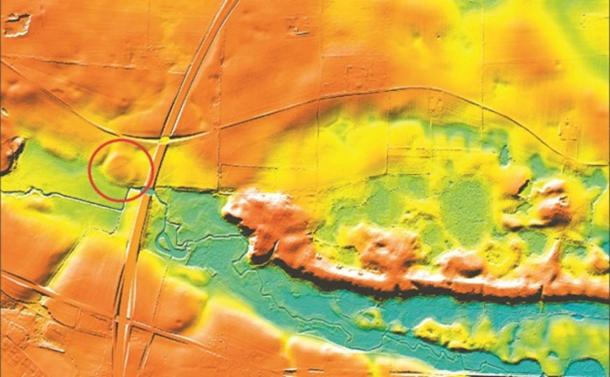
Drone operators discovered the fortress (circled in red) in 2014. (photo: Museum Sydøstdanmark)
Jens Ulriksen, head of the excavations at the fortress, told DR Nyheder: “All indications are that there has been a fire set at the gates of the castle. The outer posts of the east gate are completely charred, and there are signs of burning on the inside.”Researchers say the half-constructed castle may have belonged to King Harald Bluetooth, who reigned in the late 900s. Historical documents state that the king drove his army too hard, so his men retaliated in a riot during which he was killed.
“Our theory right now is that other powerful men in the country attacked the castle and set fire to the gates,” Ulriksen is quoted as saying.

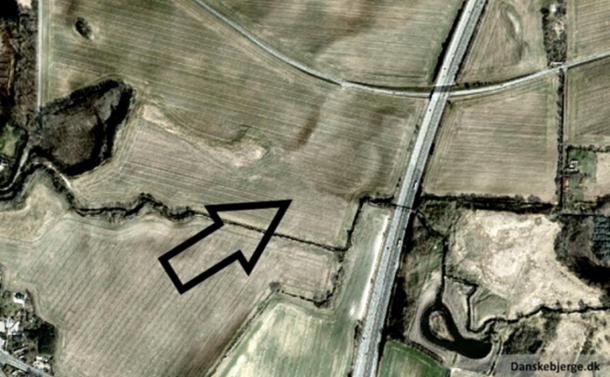
Another view of the landscape and the ring fortress without infrared (Photo: Danskebjerge)
It was possibly the last structure built by Bluetooth, researchers say, because construction on it was only half done when it burned.The researchers intend to ask the fire investigator to bring in dogs to sniff out human remains in the earth and possibly to help uncover other evidence of arson.
“Borgring” means ring fortress. It was built as a 10- to 11-meter-wide (32.8 to 36 feet) stockade with pointed wooden poles, excavations have shown. The fortress is 145 meters (475.7 feet) in diameter and visible from the air (see photo above and at the top of the article).
Five other Viking ring fortresses have been found in Denmark, possibly all built on the command of one person, but when this castle was discovered in 2014, it was the first in 60 years.
“The four other circular fortresses have been dated to the reign of Harald Bluetooth in the late 900s. The construction of this fortress is very similar to the one found in Hobro, and thus it is likely that Harald Bluetooth was the builder too, the Danish Castle Centre believes,” says CPHPost.dk in another article.

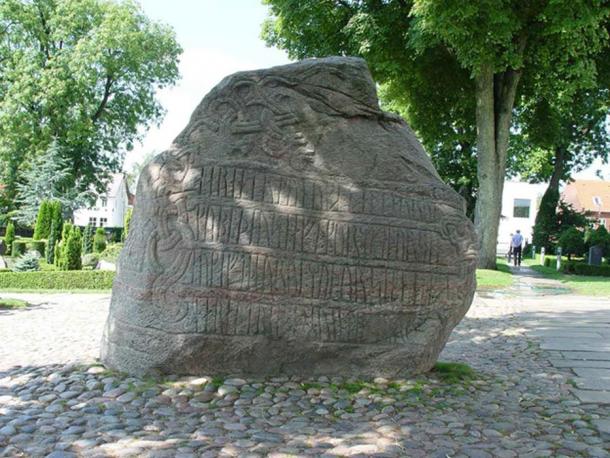
A runestone with an inscription to Harald Bluetooth (Wikimedia Commons/Jürgen Howaldt)
“Although, there were Vikings in other countries, these circular fortresses are unique to Denmark. Many have given up hope that there were many of them left,” Viking age scholar Lasse C.A. Sonne said in 2014.Carbon dating has confirmed the castle near Køge dates to around the time of Bluetooth. He reigned from around 958 to his death in 985, possibly at the hands of his son Sweyn Forkbeard. Harald was the son of Gorm the Old and Thyra Dannebod, founders of a new line of royalty who ruled from northern Jutland, the Danish peninsula that juts into the North Sea toward Sweden and Norway.

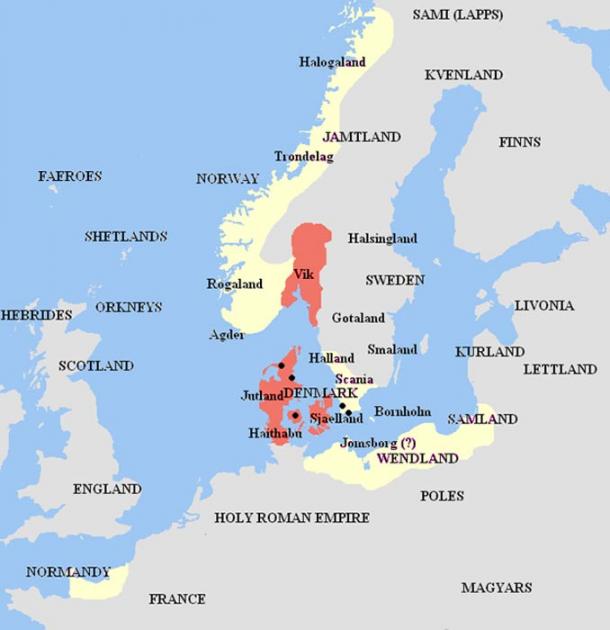
Harald's kingdom in red and his vassals and allies in yellow, as described in medieval Scandinavian sources (Wikimedia Commons/Bryangotts)
Harald continued the unification of Denmark begun by Gorm. He also was one of the principal figures in the conversion of the Danes to Christianity. Around 970 he conquered Norway. His descendants would rule England for a time.His name was used in the Bluetooth standard that connects electronic devices without wires.
Top image: Photo from a modern-day Viking fire festival (Photo: warosu.org)
By Mark Miller
Friday, April 1, 2016
7 of England’s best medieval buildings
History Extra

Dover Castle. (Photo by Olaf Protze/LightRocket via Getty Images)

The ruins of Rievaulx Abbey, North Yorkshire. (English Heritage/Heritage Images/Getty Images)

York Minster at night. (Rod Lawton/Digital Camera Magazine via Getty Images)

The White Tower at the Tower of London. (Arcaid/UIG via Getty)

A royal event at Westminster Hall in 2012. (Ben Stansall/WPA Pool/Getty)
Aerial view of Westminster Abbey at night. (Pawel Libera/LightRocket via Getty Images)
Westminster Abbey
London’s iconic Westminster Abbey has since the medieval period held a significant place in royal history. It has been the setting of every royal coronation since 1066, seen 16 royal weddings and is the final resting place of 17 English monarchs.
The stunning Gothic structure that stands today was constructed by Henry III between 1245 and 1272, and his motivations for undertaking the mammoth building project are intriguing. Writing for History Extra in 2011, historian David Carpenter has argued that Henry built the spectacular abbey to win the favour of the dead Anglo-Saxon king, Edward the Confessor, who had established a church on the site almost 200 years earlier, in 1065.
According to Carpenter, Henry was “passionately devoted to Edward”, who had been canonised in 1161, adopting him as his patron saint. He says Henry believed that “if he won the dead king’s saintly favour by building the magnificent abbey as an offering to him, Edward would support him in this life and shepherd him into the next. The Abbey was a very clear statement that Henry was backed by his saintly predecessor”.
Westminster Abbey is home to some remarkable medieval art, including England’s oldest altarpiece, the 13th-century Westminster Retable [a panel painted with religious imagery, including an image of Westminster Abbey’s patron saint St Peter]. After surviving the dissolution of the monasteries, the Reformation and the Civil War, this precious altarpiece was rediscovered 1725, covered in paint and being used as a cupboard door in the Abbey’s storage.
Another of Westminster Abbey’s outstanding medieval artefacts is the coronation chair, in which every monarch since Edward II (apart from Edward V and Edward VIII) has been crowned. During the Second World War the coronation chair was evacuated to Gloucester Cathedral, however, like the Westminster Retable, it has not always received such good care. Its back is marked with graffiti, carved by mischievous Westminster schoolboys in the 18th and 19th centuries.
Dover Castle
Known as ‘the key to England’, the defensive fortress of Dover Castle has a long and turbulent history. Standing at the site of the shortest sea crossing between England and the continent, Dover has always been a key strategic spot in the defence of the kingdom, and over the centuries its castle has witnessed several bloody conflicts.
The medieval structure that remains at Dover today was mostly constructed by King Henry II in the 1180s. Henry spent a vast fortune on the castle, which was not only intended to defend the British coast but also to entertain and impress distinguished guests. Between 1179 and his death in 1189, Henry spent £5,991 on Dover Castle – the greatest concentration of money spent on a single castle in English history.
Writing for History Extra, John Gillingham has argued that Henry poured such vast sums into the impressive structure in order to “save face” following the brutal killing of Thomas Becket in 1170. The archbishop had been murdered in Henry’s name, significantly damaging Henry’s reputation. According to Gillingham, constructing the imposing castle was “a visible assertion of Henry’s power in the face of a developing anti-monarchical cult.” It served as stopping point a for high-status pilgrims visiting Beckets’s tomb at Canterbury Cathedral and Henry dedicated its chapel to the canonised Archbishop.
During the reign of King John (r1199–1216), the castle defences were put to the test when it came under siege by French troops led by Prince Louis in 1216–17. It withstood 10 months of bombardment as the invasion forces targeted it with siege engines, tunneling and face-to-face combat.
Dover Castle. (Photo by Olaf Protze/LightRocket via Getty Images)
Rievaulx Abbey
A dramatic ruin set in the beautiful surroundings of rural North Yorkshire, Rievaulx Abbey was once a template for medieval monastic architecture across Europe. The Abbey underwent many stages of architectural development from the 12th to 15th centuries, reflecting the social and economic changes monastic communities underwent during the period.
Rievaulx was first established as a Cistercian monastery in 1132. The Cisterian order (founded by St Bernard of Clairvaux in 1098 in an attempt to reform monastic life in Europe) aimed to return holy communities to an austere life, abiding to strict religious guidelines set down by St Benedict in the sixth century. After the foundation of Britain’s first Cistercian abbey in 1128 (Waverley Abbey in Surrey) the waves of reform quickly spread, and other Cistercian communities such as Rievaulx were established across the country.
By the middle of the 12th century Rievaulx was a large and thriving self-sufficient community. In 1167 the Abbey’s community numbered around 140 monks and around 500 lay brothers. A larger site was needed to accommodate this growing community, leading to the building of a new chapter house and a dramatic, imposing church.
The Abbey site was designed to facilitate both religious and practical aspects of life. In addition to a great cloister where the monks could study and read, the Abbey also contained private quarters for more senior monks, as well as a parlour, dormitory and kitchen. Rievaulx also holds the earliest surviving infirmary complex on any British Cistercian site, built in the 1150s to care for sick and elderly members of the monastic community.
Like many abbeys, Rievaulx was targeted by Henry VIII’s dissolution of the monasteries in the 1530s. However, the Abbey’s religious population had dwindled over the centuries and by the time it was shut down and dismantled in 1538 only 23 monks remained there.
The ruins of Rievaulx Abbey, North Yorkshire. (English Heritage/Heritage Images/Getty Images)
York Minster
From humble beginnings as a small wooden church, York Minster underwent several transformations during the medieval period before evolving into the spectacular Gothic cathedral that stands today.
The first Christian church on the site was a modest wooden structure dating back to AD 627. By AD 640 King Oswald had replaced this with a small stone church. After surviving the Viking invasion in AD 866, York’s Anglo-Saxon church was ransacked by William the Conqueror’s forces in the Harrying of the North in 1069. After destroying the Anglo-Saxon church, William appointed his own Norman archbishop of York, who went about constructing a grand Norman Cathedral on the site.
In the 13th century Walter De Gray (archbishop of York between 1215 and 1255) decided to rebuild the cathedral for the final time. He embarked on a mammoth project to redesign it in a dramatic Gothic style, with a monumental arching roof, intended to convey a sense of soaring upwards towards the sky. Constructed between 1220 and 1472, the magnificent Gothic-style minster took more than 250 years to complete. Its Great East Window, glazed by John Thornton of Coventry between 1405 and 1408, is now the largest expanse of medieval glass to have survived in Europe.
York Minster has suffered many misfortunes over the centuries. In 1407 the central tower collapsed due to soft soil, and four fires [in 1753, 1829, 1840 and 1984] have wreaked significant damage. York Minster is now one of only seven cathedrals in the world to boast its own police force [a small, specialized cathedral constabulary who continue to operate independently of the rest of the city’s police force].
York Minster at night. (Rod Lawton/Digital Camera Magazine via Getty Images)
The White Tower
The imposing White Tower at the heart of the Tower of London complex dates back to the late 11th century. Built by William the Conqueror to secure his hold on London, it was designed to awe and subdue the local population.
The exact construction dates of the White Tower are unclear, but building was certainly underway in the 1070s and was completed by 1100. A key example of Norman architecture, the White Tower was the first building of its kind in England. William employed Norman masons and even had stone imported from Normandy for its construction. At 27.5m tall the Tower would have been visible for miles around.
Intended as a fortress and stronghold rather than a royal palace, the White Tower’s design favoured defence over hospitality. Its fortifications were updated throughout the medieval period and during the reign of Richard the Lionheart they doubled in size. This proved to be a wise move, as in Richard’s absence his brother John besieged the White Tower in an attempt to seize the throne. The Tower’s defences held fast but the forces defending it [led by Richard’s Chancellor William Longchamp] were compelled to surrender owing to a lack of supplies.
For those who fell from royal favour, the White Tower was a place of imprisonment and execution. From its foundation it was used as a prison – the first recorded prisoner held in the White Tower was Ranulf Flambard, bishop of Durham, in 1100. Under Edward III, the captured kings of Scotland and France were kept at the White Tower and it is believed that, centuries later, Guy Fawkes was tortured and interrogated in the White Tower’s basement.
Even monarchs were not immune to imprisonment at the White Tower: in 1399 Richard II was imprisoned there after being forced to renounce his throne by his cousin Henry Bolingbroke.
The White Tower at the Tower of London. (Arcaid/UIG via Getty)
Westminster Hall, Houses of Parliament
As the oldest building on the parliamentary estate, Westminster Hall has been central to the government of England since the 11th century. Built in 1097 by the Norman king William II (the son of William the Conqueror and known as Rufus), the Hall was a symbol of Norman majesty intended to impress the king’s new subjects.
Rufus’s construction project was remarkably ambitious. Covering a floor space of 1,547 square metres (with walls two metres thick), Westminster Hall was by far the largest hall in England at the time. It was so large that when surveying the vast hall just after its construction, one of Rufus’s attendants reportedly remarked it was far bigger than it needed to be. However, Rufus himself was less than impressed – he replied it was not half large enough, a mere bedchamber compared to what he had in mind.
Recent archaeological explorations at Westminster Hall have prompted some fascinating theories about the groundbreaking nature of its original construction. No evidence of columns used to support the vast roof has been uncovered, suggesting that it may have been self-supporting. This engineering would have been remarkably ahead of its time, as self-supporting roofs of this size were not seen elsewhere until the 13th and 14th centuries.
Writing for History Extra, Paul Binski suggests that the “miracle” of Westminster Hall “is not just its survival, but its courage. The builders of these great structures had brilliant know-how, but also guts”.
A royal event at Westminster Hall in 2012. (Ben Stansall/WPA Pool/Getty)
Norwich Guildhall
Situated in the centre of the medieval city, the Norwich Guildhall is a remarkable example of late medieval secular architecture. Built primarily between 1407 and 1412, its grandeur reflects the growing power and wealth of a new elite of merchants, traders and government agents during the period.
By the 15th century Norwich had become one of the wealthiest and most important towns in England. Following a 1404 charter granting the city greater self–governing powers it was decided that a Guildhall should be built in order to administer the powers more effectively.
The Guildhall fulfilled a role similar to that of a modern town hall, performing all the administrative functions the city required to govern the everyday lives of the city’s residents. The Guildhall served multiple purposes as a court, a tax collection hub and administrative centre. The Guildhall also contained an assembly chamber for council meetings, was equipped to hold prisoners and had a large ‘sword room’ used for storing weapons.
Today the Guildhall is the largest surviving medieval building intended for a civic purpose outside of London.
Labels:
abbey,
archeology,
castle,
England,
Medieval,
middle ages,
ruins,
UK
Subscribe to:
Comments (Atom)