Showing posts with label Henry V. Show all posts

Tuesday, July 2, 2024

Book Spotlight: The Agincourt King by Mercedes Rochelle


From the day he was crowned, Henry V was determined to prove the legitimacy of his house. His father's usurpation weighed heavily on his mind. Only a grand gesture would capture the respect of his own countrymen and the rest of Europe. He would follow in his great-grandfather Edward III's footsteps, and recover lost territory in France.

Better yet, why not go for the crown? Poor, deranged Charles VI couldn't manage his own barons. The civil war between the Burgundians and Armagnacs was more of a threat to his country than the English, even after Henry laid siege to Harfleur. But once Harfleur had fallen, the French came to their senses and determined to block his path to Calais and destroy him.

By the time the English reached Agincourt, they were starving, exhausted, and easy pickings. Or so the French thought. Little did they reckon on Henry's leadership and the stout-hearted English archers who proved, once again, that numbers didn't matter when God was on their side.


Buy Links:

This title is available to read on #KindleUnlimited.

Universal Buy Link: https://books2read.com/u/mq70Ze


Mercedes Rochelle is an ardent lover of medieval history, and has channeled this interest into fiction writing. Her first four books cover eleventh-century Britain and events surrounding the Norman Conquest of England. The next series is called “The Plantagenet Legacy” and begins with the reign of Richard II.

She also writes a blog: www.HistoricalBritainBlog.com to explore the history behind the story. Born in St. Louis, MO, she received by BA in Literature at the Univ. of Missouri St.Louis in 1979 then moved to New York in 1982 while in her mid-20s to "see the world". The search hasn't ended!

Today she lives in Sergeantsville, NJ with her husband in a log home they had built themselves.

 Author Links:

 Website: https://mercedesrochelle.com/

Blog:  https://historicalbritainblog.com/

Twitter / X: https://x.com/authorrochelle

Facebook:  https://www.facebook.com/mercedesrochelle.net

Book Bub: https://www.bookbub.com/authors/mercedes-rochelle

Amazon Author Page:  https://www.amazon.com/stores/Mercedes-Rochelle/author/B001KMG5P6

Goodreads: https://www.goodreads.com/author/show/1696491.Mercedes_Rochelle


Tuesday, June 7, 2022

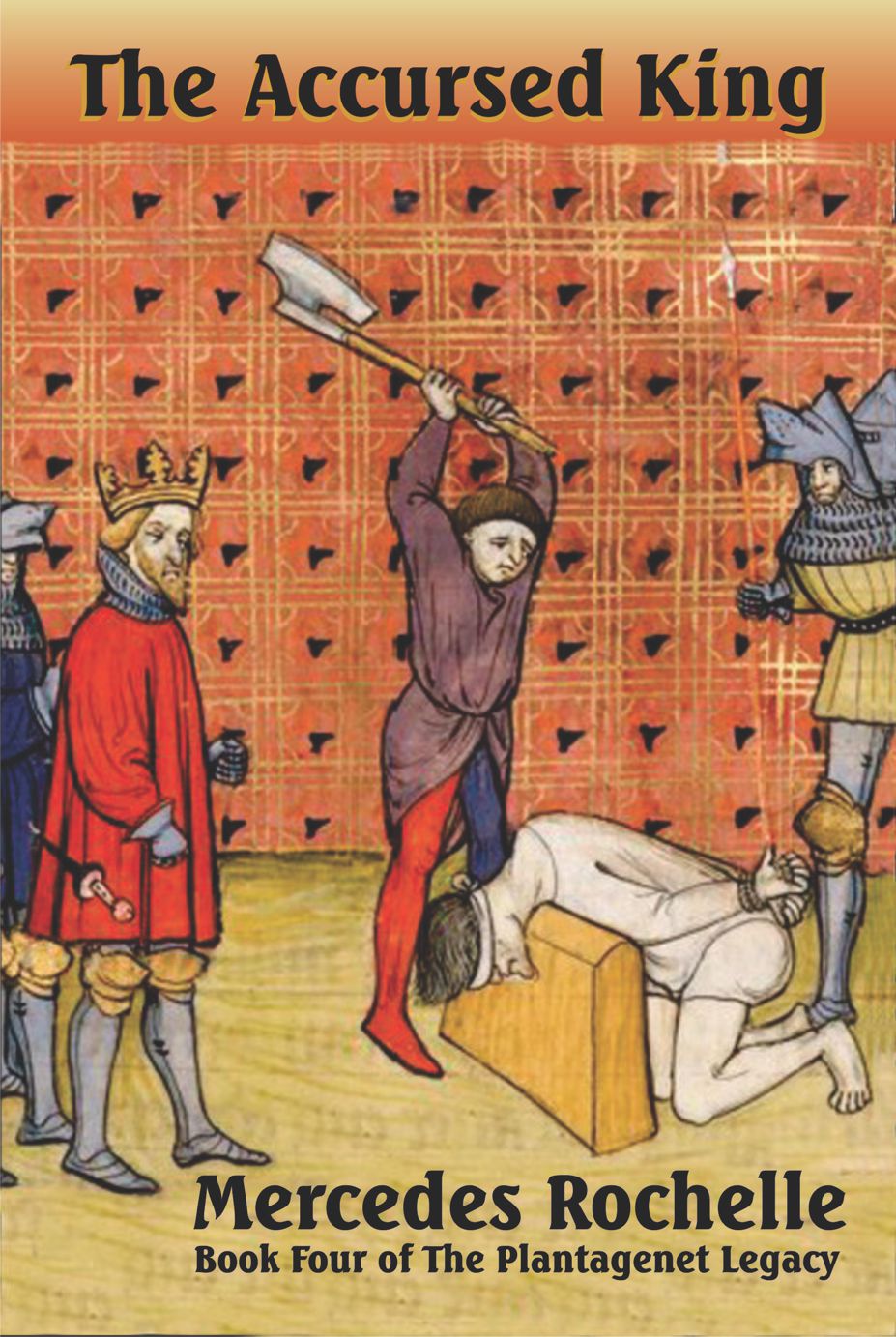
Book Spotlight: The Accursed King (The Plantagenet Legacy Book 4) by Mercedes Rochelle


What happens when a king loses his prowess? The day Henry IV could finally declare he had vanquished his enemies, he threw it all away with an infamous deed. No English king had executed an archbishop before. And divine judgment was quick to follow. Many thought he was struck with leprosy—God's greatest punishment for sinners. From that point on, Henry's health was cursed and he fought doggedly on as his body continued to betray him—reducing this once great warrior to an invalid. Fortunately for England, his heir was ready and eager to take over. But Henry wasn't willing to relinquish what he had worked so hard to preserve. No one was going to take away his royal prerogative—not even Prince Hal. But Henry didn't count on Hal's dauntless nature, which threatened to tear the royal family apart.


 Buy Links:

 This book is free to read with a #KindleUnlimited subscription.

 Amazon UK   Amazon US   Amazon CA   Amazon AU


Series Links:

A King Under Siege (Book 1): https://books2read.com/u/mKdzpV

The King’s Retribution (Book 2): https://books2read.com/u/mBzGwA

The Usurper King (Book 3): https://books2read.com/u/b6RZMW

The Accursed King (Book 4): https://books2read.com/u/3RLxZL


Mercedes Rochelle

Mercedes Rochelle is an ardent lover of medieval history, and has channeled this interest into fiction writing. Her first four books cover eleventh-century Britain and events surrounding the Norman Conquest of England. The next series is called The Plantagenet Legacy, about the struggles and abdication of Richard II, leading to the troubled reigns of the Lancastrian Kings. She also writes a blog: HistoricalBritainBlog.com, to explore the history behind the story. Born in St. Louis, MO, she received a  BA in Literature at the Univ. of Missouri St.Louis in 1979, then moved to New York in 1982 while in her mid-20s to see the world.” The search hasnt ended! Today she lives in Sergeantsville, NJ, with her husband in a log home they had built themselves.

 Social Media Links:

 Website   Twitter   Facebook   BookBub   Amazon Author Page   Goodreads


Monday, April 25, 2016

Behaving badly: Henry V's misspent youth

History Extra

Henry V: dithering also-ran or medieval hero? (Credit: Bridgeman Images)

On Friday 25 October 1415, in a muddy field in Picardy, the reputation of Henry V as a great warrior king was sealed. His victory over the French at Agincourt had a major effect on his position both at home and abroad. Even before he returned to England, a grateful parliament had granted him all revenue from customs duties – a sizeable income – for life. As for the French, they never again dared to face him in battle.
 
So Henry was able to conquer the whole of Normandy and advance on Paris, exploiting the divisions in France – between the Burgundian and Armagnac factions – that the defeat at Agincourt had exacerbated. The treaty of Troyes, signed in May 1420, sealed Henry’s acceptance as regent to Charles VI (‘The Mad’) and – through marriage to Charles’s daughter Katherine – heir to the throne of France. It seemed only a matter of time before he would rule over both England and France.
 
At the parliament held at Westminster in December 1420, the chancellor explained why the English had “special cause to honour and thank God” for the deeds and victories of the king. He had recovered the ancient rights of the English crown in France. He had destroyed heresy in the realm – a reference to his actions against Sir John Oldcastle and the Lollards (critics of the established church) in 1414. And, in his youth, he had put down rebellion in Wales.
 
In short, though Henry’s untimely death in 1422 curtailed the fulfilment of his plans, his career was, on the face of it, a complete success. As Thomas Walsingham, author of The St Albans Chronicle, expressed in a panegyric for the dead king: “He was a warrior, famous and blessed with good fortune who, in every war he undertook, always came away with victory.”
 
But had Henry always been so successful? Let us reflect on Henry’s life before he became king.
 

This 15th-century illustration depicts Henry, then Prince of Wales, paying homage to the French king Charles VI. The Treaty of Troyes, signed in 1420, saw Henry named Charles’s regent; by marrying the latter’s daughter, Katherine, Henry secured his position as heir to the French throne. (Credit: Bridgeman Images)
 
There are ample reasons to believe that Henry the prince was a far cry from Henry the king. In Henry IV, Parts 1 and 2, Shakespeare portrays him as a medieval ‘hooray Henry’. In those plays, the prince chooses bad company; though wealthy, he prefers the low life and petty criminality; and it is only at his father’s deathbed and his own subsequent coronation that he reforms himself – becoming as excessively ‘correct’ as he was once so ‘incorrect’ for his social and political position. But was this fact as well as Shakespearean fiction?
 
The first ‘published’ comments on Henry’s bad behaviour so far unearthed appear in the Latin lives written about him in the late 1430s. In the anonymous Vita et Gesta Henrici Quinti (often called the Pseudo-Elmham), Henry is described as being in his youth “an assiduous cultivator of lasciviousness…passing the bounds of modesty he was the fervent soldier of Venus as well as Mars; youthlike he was fired by her torches and in the midst of worthy works of war found leisure for excesses common to ungoverned age”. The work devotes much space to his last-minute repentance to his father for his bad behaviour.
 
We could dismiss all of this as simply a good story – except that it was dealt with at great length, and in a work known to have drawn information from one of Henry’s courtiers: Walter, Lord Hungerford.
 
In another work, the Vita Henrici Quinti by Tito Livio Frulovisi (now believed to have been derived from the Vita et Gesta), stories of a misspent youth and late change of heart are shorter, but remain. Given this work’s links with Henry’s last surviving brother, Humphrey, Duke of Gloucester, and the status of both works as eulogies for Henry V, we have to assume that the accounts of his youth are basically true – as are those of the well-publicised change of character at his accession.
 
There are many intriguing facets to Prince Henry. For one thing, he had not been born to be king. Until just after his 13th birthday, in September 1399, he was merely the eldest son of the eldest son of a collateral line of King Richard II . He stood to inherit, in time, the duchy of Lancaster created for his grandfather John of Gaunt (d1399), the third son of Edward III. He was also to be bequeathed the earldom of Derby held by his father, Henry Bolingbroke (d1413), and the titles brought to the family by his co-heiress mother, Mary (d1394), daughter of Humphrey de Bohun, Earl of Northampton, Essex and Hereford (d1373).
 
So the career that lay ahead for the “young lord Henry” or “Lord Henry, son of the Earl of Derby”, as he is described in the financial records of his father and grandfather, was that of a peer – but at the time it seemed that he might have to wait many years for his inheritance.
 
Tom Mison plays Prince Hal, with David Yelland as the old king, in a performance of Shakespeare’s Henry IV, Part I. The play portrays Hal as a medieval ‘hooray Henry’. (Credit: Rex)
As it was, his life was completely transformed – first, in October 1398, by the exile of his father by Richard II; and then, the following September, by Bolingbroke’s return to England and usurpation of the throne as Henry IV.
 
On 15 October 1399, two days after his father’s coronation, Henry was created Prince of Wales, Duke of Cornwall and Earl of Chester, and was acknowledged as heir to the throne. Later in October, the title Duke of Aquitaine was added and, on 10 November, that of Duke of Lancaster.
 
Given the fragile political position of the new dynasty, Prince Henry was a vital cog in its establishment and, as such, shared in its problems – indeed, he experienced them even before the usurpation. In May 1399 the young Henry was taken to Ireland by Richard II , seemingly in an attempt to ensure his father’s good behaviour. It failed: in the king’s absence, Bolingbroke invaded England.
 

Education in arms

Henry was then 12 years old, an age at which it was customary for noble boys to begin gaining experience of military service, though they were not expected to actually participate in the fighting. So in the summer of 1400 he was assigned a company of troops within the huge army – over 13,000 strong – that his father took to Scotland.
 
Then, as the army returned to England, the Welsh revolt began. The historian Adam Chapman has observed that it was no coincidence that Owain Glyndŵr declared himself Prince of Wales on 16 September 1400 – the 14th birthday of the formal holder of the title, Prince Henry. Only six months later, the latter found himself involved in his first siege, at Conwy.
 
It is not surprising that the teenage prince learned under the tutelage of advisors appointed by his father. The young Henry held a number of nominal commands but was always guided by others, including Henry Hotspur, son of the Earl of Northumberland, and Hotspur’s uncle, Thomas Percy, Earl of Worcester, who was appointed Prince Henry’s governor at the end of 1401.
 
Yet these were the very men who, in 1403, rebelled against Henry IV and his son. So the battle of Shrewsbury on 21 July, when he faced his erstwhile mentors, must have been a chastening experience for the prince – not least because he was wounded by an arrow that pierced his left cheek. The surgeon John Bradmore removed the arrowhead, but the wound put the prince out of action for a year or so.
 
Even as Henry entered his late teens, his father was reluctant to give him complete authority in the Welsh wars. The young prince was neither wholly committed nor effective, and constantly complained of being kept short of funds. Alongside praise for the prince’s good heart and courage, the speaker of the parliament of March 1406 also urged that he should maintaincontinual residence in Wales for the sake of the wars – an indication that he had not been attentive to his duties.
 
All did not go well with the prince’s campaigns. In 1407, at the siege of Aberystwyth, Henry theatrically negotiated its peaceful surrender, withdrawing his troops; Glyndwˆ r, though, simply occupied the castle. Aberystwyth remained in rebel hands until September 1408 and was recovered, as was Harlech in 1409, not by the prince in person but by those to whom he delegated.
 
This late 15th century illustration shows prisoners being taken at Agincourt. Some of Henry’s earlier military endeavours had not met with such success. (Credit: Alamy)

Sickly and sexed up

As the late Welsh historian Rees Davies observed, the prince’s personal role in Wales was limited. Chroniclers of the wars scarcely mention him at all. He seems to have preferred to stay in the relative safety of the English border towns and, increasingly, to spend his time in and around London.
 
In 1409 he was appointed constable of Dover Castle and warden of the Cinque Ports but so far no evidence has been found to show that he went to Dover or Calais, the captaincy of which he gained in March 1410. Yet in 1412, the prince was investigated for misappropriating the garrison’s wages.
 
The overall impression formed from the sources is that King Henry IV was slow to let his son have his head, but that, as the prince grew up, his father could not hold him back. It is notable how, once he turned 21, Prince Henry began to build up his own support. Fifty-one new grants of annuities were made in the year following Michaelmas 1407, a big increase on the average for the previous six years of less than ten.
 
Many of Henry’s circle were nonentities, which fans the notion that he associated with unsuitable people. It also seems that he promoted favourites such as Thomas, Earl of Arundel, and Richard Courtenay, whom Henry had appointed as bishop of Norwich after his accession. Comments made by Courtenay in 1415 tell us that Henry suffered from being overweight and in bad health, and that he was of the opinion that there were no decent doctors in England.
 
There’s more evidence for a sickly Prince Henry in his household accounts listing purchases of medicines. These records also suggest that he may have lived beyond his means, partly because of the large payments he made to retainers. Thomas Walsingham speaks of his retinue in 1412 being “larger than any seen before these days”. Intriguingly, too, in 1415 Courtenay observed that Henry had not had sexual relations with any woman since he came to the throne – the implication being that, as the Vita et Gesta suggests, he had been notably promiscuous before his accession.
 
As prince and heir, we would expect Henry to have had a place on the royal council. This was the case from at least the end of 1406, when he was 20. As the medievalist Christopher Allmand observes, Prince Henry attended a good proportion of meetings but was increasingly advancing the interests of key friends and relations – including his father’s half-brother, Henry Beaufort – and challenging the power of the chancellor, Thomas Arundel, archbishop of Canterbury. Indeed, Henry’s growing influence may have contributed to Arundel’s decision to resign from the chancellorship in December 1409.
 
Henry married Katherine of Valois, daughter of Charles VI of France, on 2 June 1420. This painting of 1487 is from the Chroniques de France ou de Saint Denis. (Credit: AKG images)
Yet, in November 1411, it seems that the prince’s influence over the council abruptly ended. There is no doubt that Henry’s relations with his father, and with his brother, Thomas, were bad: there were major differences of opinion on foreign policy, and a study of diplomatic relations with Burgundy suggests that the prince was making offers he was simply not entitled to issue. He was  also outraged not to be chosen to lead an expedition to Aquitaine in the summer of 1412.
 
The seriousness of the situation is reflected in a letter sent by Prince Henry from Coventry on 17 June 1412, a missive that was clearly intended to reach a wide audience. It addressed rumours accusing him of plotting to rebel against his father and seize the throne.
 
Father and son became reconciled but, according to the chronicler Thomas Walsingham, Henry IV refused to punish immediately those who had spread the rumours; instead, he ordered that sanctions should wait until the next parliament, when they could be tried by their peers. This could only mean that the prince’s detractors were noblemen. Interestingly, the Latin lives made much of Henry’s last-minute reform and confession to his father – does this suggest that, despite his protestations, he might have had a guilty conscience?
 
Henry the prince emerges as a complex character: not always living up to expectations, making enemies and choosing unsuitable friends. He was brave but flawed, and always prioritised his own desires. Six centuries after he assumed the throne, it’s worth remembering that the road to his achievement as all-conquering hero of Agincourt was often a rocky one.
 
Professor Anne Curry is the dean of the Faculty of Humanities at the University of Southampton.

Thursday, October 22, 2015

10 things you (probably) didn’t know about Henry V and the battle of Agincourt

History Extra

Henry V © Lebrecht Music and Arts Photo Library / Alamy

Now, in the 600th anniversary year of the famous battle, Teresa Cole explores the life and legacy of the medieval warrior king in her new book, Henry V: The Life of the Warrior King & the Battle of Agincourt 1415. Here, writing for History Extra, she reveals 10 lesser-known facts about Henry V…

1) Nobody knows when he was born

Henry V was born at Monmouth castle, perched high above the River Monnow, but there is no record of his birth, and even the year is uncertain. Some say his birthday was 9 August 1387, but an alternative date is 16 September 1386. The latter comes from a horoscope drawn up for the king and apparently commissioned by him just before the Agincourt campaign.
However, the French astrologer who drew the horoscope was later accused in Paris of being an English spy, and it is possible the work was just an excuse for the man to come to England and meet with Henry. The king apparently showed no interest in the horoscope afterwards.

2) He was in Ireland with Richard II when his father seized the throne

When his father, Henry Bolingbroke, seized the throne, the young Henry was in the custody of King Richard II as a hostage for his father’s good behaviour. Had it been a few centuries earlier he could have expected, at the least, to be blinded if not put to death.
Richard, however, was made of different stuff. He had treated the boy well, spent time with him, took him with him on the expedition to Ireland, and even knighted him on the way. Even when he heard of the attack on his crown, he made no threats against him.
It seems that, in return, Henry saw Richard as something of a father figure. According to one account, when his own father – now secure in the palace of Westminster – sent for him, Henry went instead to Richard in the Tower, and only at his insistence went on to his father. When Henry himself became king he had Richard’s body exhumed from its obscure grave and reburied in Westminster Abbey.


3) His first battle was nearly his last

Henry’s first battle [before he was king] was not against the French, but the English. At Shrewsbury on 21 July 1403 the 16-year-old Henry, Prince of Wales, lined up alongside his father to face the forces of the rebel lord, Henry Percy.
At Shrewsbury Henry led his forces well, and made a major contribution to the victory. In the course of the battle, however, he was shot in the face by an arrow that entered below his eye, missed both brain and spinal cord and stuck in the bone at the back of the skull. To remove the embedded arrowhead, special tongs had to be designed, made and carefully inserted nearly six inches into the wound to grip and extract the metal.
It took a further three weeks to cleanse and close up the hole – and all this in the days before anaesthetics.

4) He learnt his military tactics in Wales

The tactics used by Henry V in his French wars were first tried out in Wales. At about the same time that he became Prince of Wales (aged 13), Owain Glyndwr began a violent rebellion against the English. The king’s policy of attack and withdraw was unsuccessful, and Glyndwr rapidly spread his influence from north Wales to almost the whole country.
When, however, in his late teens, Henry was given a freer hand, he changed tactics. Now he concentrated on taking strategic castles which were then garrisoned and held securely, cutting off supply routes and enabling further advances. Gradually Glendower was forced back to two strongholds on the west coast – Aberystwyth and Harlech. Each was besieged and battered by traditional siege weapons, and, for what is thought to have been the first time in Britain, cannon were used.
Eventually Glyndwr’s supporters were starved into submission, and though Glyndwr himself was never captured, the war was ended. A few years after this, using the same tactics, Henry conquered first Normandy, and then a large part of northern France.

5) Legend has it his claim to France resulted from a Templar’s curse

In 1307, Philippe IV of France seized the property of the wealthy Order of Knights Templar, and tortured and put to death its members. The story is told that, as the last Grand Master died, he laid a curse on Philippe and his descendants, saying the king would die within a year. Eight months later Philippe died in a hunting accident.
Two years after that his son, Louis X died, aged 26, after a strenuous game of tennis. His son, John I, born five months later, lived only five days, and in the next 12 years the last direct male descendants of Philippe also died.
Those closest in line to the empty throne were Jeanne, daughter of Louis and Jeanne of Navarre, and Edward III of England, whose mother was Philippe’s daughter. Navarre and England, however, were equally unacceptable, and Philippe de Valois, a cousin of the last king [Charles IV], was crowned instead. Edward challenged this starting the so-called Hundred Years’ War, and it was his claim that was later revived by Henry V.

The battle of Agincourt. © 19th era / Alamy

6) Dick Whittington contributed to Henry’s wars

A large slice of the money needed to pay for the French campaigns was raised by loans rather than taxes. In May 1415 Henry sent letters appealing for money to individuals, and to towns. Typically a town would decide on the amount of the loan, and then every citizen would be assessed to contribute even a few pennies to the sum agreed.
Royal jewels, plate and regalia were handed out as security for repayment. Not only did this raise a large amount of money, but it meant almost everyone had an interest in the outcome of the French wars.
One individual in London who lent money to Henry was Sir Richard Whittington, a rich cloth merchant who was indeed the same Dick Whittington as in the children’s story. He was lord mayor of London three times.

7) ‘The Dauphin’ was three different people

With the French king subject to fits of madness, his son the dauphin plays a prominent role in the accounts of Henry’s campaigns. The impression is often given that ‘the dauphin’, who, if Shakespeare is to be believed, insulted Henry with a gift of tennis balls [a sign of mockery], was the same ‘dauphin’ who would later be crowned Charles VII by Joan of Arc at Rheims cathedral.
In fact there were three different dauphins over this period. The first was Louis of tennis ball fame, who, though kept away from the battle of Agincourt, died soon after, possibly of dysentery or pneumonia. Louis was followed by his brother John, who was the son-in-law of the Burgundian leader, John the Fearless.
This dauphin died suddenly in April 1417, some said by poison, and he was succeeded by his last remaining brother, Charles, who after the death of Henry V, and with a great deal of help from his mother-in-law, Yolande of Aragon, finally became Charles VII in 1429.

8) A French commander told Henry how to win at Agincourt

The French plan at Agincourt was to use massed cavalry to charge down the English archers. Henry V learnt of this from a French prisoner some days before the battle, and immediately took steps to counter it: every archer was to drive a sharpened stake into the ground in front of him on the battlefield to stop a charging horse.
The plan worked very well but was probably not Henry’s own plan. The French commander, Marshal Boucicaut, had earlier fought against the Turks at the battle of Nicopolis, and had seen a cavalry charge halted by a similar mass of sharpened stakes. He had written an account of this and it is possible that either Henry himself, or perhaps one of his commanders, Edward Duke of York, had read it and remembered the effectiveness of the tactic.

9) A number of those who died at Agincourt were suffocated

There are no reliable figures for the size of the French army at Agincourt, but they numbered many thousands, and in their eagerness to get at the English most of the leading figures were crammed into the front ranks.
When the action was triggered by a flight of arrows from the English side, the French charged forward in accordance with their battle plan. Funnelled into a narrower part of the field where Henry had taken up his position, the French were crammed together, and though many did not reach the English ranks, many more did. As these were cut down, those pressing behind climbed over them, and anyone who slipped or fell in the muddy ground had little chance of getting up again.
As the battle progressed the pile of bodies rose higher, and any who were wounded or simply knocked over were crushed beneath the weight of those coming behind. Very few were found alive when the heaps of bodies were at last unpicked after the battle.

10) Henry V died of dysentery and is buried in Westminster Abbey

Sieges were dangerous places for both those inside and out: insanitary conditions and a shortage of fresh water frequently led to outbreaks of dysentery among the besieged and the besiegers, and it is likely that Henry contracted his final illness at the siege of Meaux – though it took some time to weaken him and claim his life.
His body was brought back to England for burial, and after considerable ceremony he was laid to rest behind the altar in Westminster Abbey, close to his hero Edward the Confessor, and within yards of the tomb of Richard II. A magnificent chapel was erected around him, and a life-sized effigy placed on the tomb with a head of solid silver.
Sadly the silver was stolen in the 16th century, and the later Tudor building dwarfs his resting place. Thousands of tourists pass the spot without realising he is there, and all that can be seen of the effigy is the soles of its feet.

To find out more about Teresa Cole’s Henry V: The Life of the Warrior King & the Battle of Agincourt 1415 (Amberley Publishing, 2015) click here.

Wednesday, October 14, 2015

600-Year-Old Royal Ship of Henry V Found Buried in Hampshire River

Ancient Origins

600-Year-Old Royal Ship of Henry V Found Buried in Hampshire River

A wooden shipwreck believed to be one of King Henry V’s greatest ships has been tentatively identified in the River Hamble in southern England. The 600-year-old warship, known as the Holigost (Holy Ghost) was commission by the king in his war against France.
The finding was announced today by Historic England, after it was spotted in an aerial photograph by British maritime historian, Dr Ian Friel. A faint U-shaped outline in the mud at the edge of the river is prompting an investigation using sonar, remote sensing, and drone equipment to create a computerized image of what lies beneath the mud.
The location is just 50 meters from the wreck of Henry V’s flagship, The Grace Dieu, the largest ship in Europe at the time – it measures 66 meters long.
The aerial photograph showing a U-shaped outline (circled blue) on the bank of the River Hamble, located just 50 meters from Henry’s flagship The Grace Dieu (circled green).
The aerial photograph showing a U-shaped outline (circled blue) on the bank of the River Hamble, located just 50 meters from Henry’s flagship The Grace Dieu (circled green). Credit: Historic England.
Dr Friel first stated that the Holy Ghost wreck must be located in the River Hamble close to The Grace Dieu, more than 30 years ago. The Mail Online reports that after identifying the U-shape in grainy aerial photographs, he and a team of archaeologists visited the site at low tide and discovered something hard beneath the surface. But it is only now that Dr Friel has been able to present enough evidence to prompt a full-scale investigation by Historic England, who have said it is a “tangible link” to Henry V.
The River Hamble where the wreck of the Holy Ghost is believed to lie.
The River Hamble where the wreck of the Holy Ghost is believed to lie. Credit: Historic England
The Holy Ghost was constructed from the timbers of a captured Castilian ship, The Santa Clara, which had been overrun by English pirates in 1413. The ship was taken to Southampton, England, and rebuilt as part of King Henry V’s war machine. It was the third biggest ship in Henry’s navy, capable of carrying up to 200 crew and 750 tons of weapons and equipment.
The Holy Ghost joined the royal fleet in November, 1415, and fought in two major sea battles during the Hundred Years War – the Battle of Harfleur (1416) and the Battle of Chef de Caux (1417). The ship played a key role in conquering territory in France in the early 15th century. However, after suffering serious damage, the ship was docked in the naval anchorage in the River Hamble and abandoned.
Depiction of the royal fleet of King Edward I of England. From Jean de Wavrin's 'Chronicles of England'
Depiction of the royal fleet of King Edward I of England. From Jean de Wavrin's 'Chronicles of England', c.1470-80.
Archaeologists believe that the wreck of the Holy Ghost is likely to be better preserved than that of The Grace Dieu, and they are hoping that it could reveal a great deal about life aboard the ship, naval warfare, as well as 15th century shipbuilding.
“To investigate a ship from this period is immensely exciting,” said Duncan Wilson, Chief Executive of Historic England. “It holds the possibility of fascinating revelations in the months and years to come.”
Featured image: A painting showing what the Holy Ghost ship would have looked like. Credit: British Library / Historic England.
By April Holloway

Monday, September 16, 2013

History Trivia - Alexander the Great vanquishes Thebes

Sept 16

335 BC Alexander the Great destroyed every building in Thebes, Egypt, except the temples and the house of the poet Pindar.

1386 St. Ambrose of Camaldoli was born. Ambrose helped bring about a brief reunion of the Eastern and Western churches.

1387 King Henry V of England was born.

1400 Owain Glyndwr proclaimed himself Prince of Wales, launching the last Welsh rebellion against the English.

1494 Francisco Maurolico was born. He was a Benedictine monk, historian, and mathematician, Maurolico wrote a history of Sicily and significant works on Greek mathematics.