Ancient Origins
The Egyptian antiquities ministry have announced the results of a new survey on the tomb of Tutankhamun. They have apparently discredited a theory, that suggest there was a second chamber in the Pharaoh’s tomb. It had been speculated that this second undiscovered chamber was the tomb of the famous Queen Nefertiti. Mostafa Waziri, Secretary General of the Supreme Council of Antiquities announced the official result of the investigation and stated categorically that there is no second chamber. According to the Egyptian authorities, an Italian scientific team from the University of Turin found that there is " conclusive evidence of the non-existence of hidden chambers adjacent to or inside Tutankhamun's tomb ". Has this ended the speculation that there remains to be discovered another tomb alongside that of Tutankhamun’s?
The stone sarcophagus containing the mummy of King Tut is seen in his underground tomb. Credit: Nasser Nuri.
The Tomb of Tutankhamun
Tutankhamun was Pharaoh of Egypt during the New Kingdom period, a golden age in Egyptian history. His father was the controversial Pharaoh Akhenaten, but the identity of his mother is still unknown. Tutankhamun became Pharaoh several years after the death of his father and a succession of short lived rulers, whose religious innovations had badly divided the kingdom. Under the boy-king, his father’s Monotheism was abandoned, and the traditional Egyptian religion was restored. He later married his half-sister and died while still a very young man and this has led to various theories about his death, including that he was secretly assassinated.
The gold laden tomb of Tutankhamun was discovered by Howard Carter in the Valley of the Kings in 1922. It is arguably the most spectacular archaeological find in history and it produced an unprecedented trove of treasures that have astonished the world ever since they were brought into the light. The tomb and the life of Tutankhamun has remained a source of fascination for both the expert and the public ever since.
Researchers scanning the walls of King Tutankhamun’s burial chamber using Ground Penetrating Radar (GPR) equipment. (Ministry of Antiquities)
Second-Chamber Theory
British Egyptologist Nicholas Reeves had been the chief proponent of a theory that there was a second chamber in the tomb of Tutankhamun . He argued that it was likely to be the burial chamber of the famous Nefertiti , the wife of Tutankhamun's father, King Akhenaten and reputed to be one of the most beautiful women in history. Reeves argued that because Tutankhamun died unexpectedly that he was hurriedly buried in the outer chamber of Nefertiti’s tomb. This he argued means that the royal burial chamber of the queen was hidden behind the tomb of Tutankhamun and that many fabulous treasures were laying there waiting to be discovered. Reeves even believed that he had detected hidden doors behind the funerary painting on the walls of the Pharaoh’s tomb.
Previous scans of the north wall of King Tutankhamun's burial chamber indicated features beneath the intricately decorated plaster (highlighted) a researcher believes may be a hidden door, possibly to the burial chamber of Nefertiti. Credit: Factum Arte.
Inconclusive Survey Results
The theory prompted a group of researchers to test if Reeve’s assertions had any basis in fact. A team of Japanese experts used radar to scan the tomb of Tutankhamun and they claimed ‘with 95 percent certainty the existence of a doorway and a hall with artefacts’. This seemed to provide support to the theory of Reeves that there was a secret chamber and was presumably undiscovered. Initially the findings were supported by a former Egyptian minister of the antiquities, but this drew criticism from many experts.
In 2016 an American survey, used ground penetrating radar (GPR) on the tomb but was unable to confirm or to reject the second—chamber theory. A new Minister of antiquities convened a conference that ‘ decided to conduct a third GPR analysis to put an end to the debate’ . This third survey was led by Francesco Porcelli, of the Polytechnic University in Turin with the assistance of two private geophysics companies.
‘No Indication’
After an exhaustive survey, the Italian team have found no evidence that there was any second chamber or corridors in the tomb complex of Tutankhamun. The technology that was used by the team simply did not find any data that would indicate the existence of a chamber. According to the statement released by the Egyptian Ministry of Antiquities on its Facebook page:
the radargrams do not show any indication of plane reflectors, which could be interpreted as chamber walls or void areas behind the paintings
They state this with a high degree of confidence and they are effectively rejecting earlier investigations and the theory of Reeves.
The views of Reeves and others who supported his theory are as yet unknown. However, the statement, issued by the Egyptian Ministry of Antiquities would suggest that the argument for a second burial chamber has been decisively rejected. It will undoubtedly disappoint many who had hoped that the burial chamber of the legendary Queen Nefertiti could be once more revealed to the world.
Top image: Sarcophagus of Tutankhamun double image. ( Public Domain )
By Ed Whelan
Showing posts with label King Tut. Show all posts
Friday, May 11, 2018
Monday, August 15, 2016
Tutankhamun: who’s afraid of the pharaoh’s curse?
History Extra
Carter examines the nest of coffins shortly after the discovery. He was to spend the next decade documenting the finds. (Griffith Institute/Illustrated London News)
On 26 November 1922 Howard Carter stood before a sealed door blocking a dark corridor. Behind him stood his patron Lord Carnarvon. Both men knew that they were standing in the tomb of the 18th-Dynasty boy king Tutankhamun – the sealing on the now dismantled outer door had made that clear. But the outer door had also shown the unmistakable signs of more than one forced entry. Was Tutankhamun still lying undisturbed in his tomb? Or had the ancient robbers once again thwarted the modern archaeologists? Nervously, his hands trembling, Carter forced a small hole in the left hand corner of the doorway, lit a candle, and peered inside.
“Presently, as my eyes grew accustomed to the light, details of the room within emerged slowly from the mist, strange animals, statues and gold – everywhere the glint of gold. For the moment – an eternity it must have seemed to the others standing by – I was struck dumb with amazement, and when Lord Carnarvon, unable to stand the suspense any longer, inquired anxiously, ‘Can you see anything?’ it was all I could do to get out the words ‘Yes, wonderful things’.”
The next day the doorway was unblocked and an electric light installed. Carter and Carnarvon found themselves standing in the antechamber, an untidy room packed with everything that an Egyptian king could possibly need for an enjoyable afterlife. But Carter’s attention was fixed on the northern wall. Here, blocked, plastered, sealed and guarded by two large statues of Tutankhamun, was the doorway to the burial chamber. Once again, the sealed doorway had been breached by a robber’s hole.
Carter and Carnarvon knew that the anteroom must be emptied before the wall could be dismantled, but that would take many weeks of hard work. Desperate to know if the tomb was intact they returned that night and crawled through the robber’s hole. To their delight they found that the burial chamber was almost completely filled by a golden shrine, its seals still intact. Swearing each other to secrecy they crawled back and sealed the hole.
The burial chamber would be officially opened on 17 February 1923 in the presence of an invited audience of Egyptologists and government officials.
The public was fascinated by the activities in the Valley of the Kings. Those who could travel to Egypt did, though there was little for them to see. Those who could not visit in person relied upon the newspapers that carried almost daily reports from the Valley. Soon the small, sleepy town of Luxor was swamped with visitors and the expedition found itself living in near siege conditions. As a means of recovering some of the money that he had spent looking for Tutankhamun, Carnarvon decided to sign an exclusive deal with The Times. This incensed the reporters from the other newspapers, and did nothing to stop their demands for information. Denied official access to the tomb, they now printed sensational gossip in place of facts.

Carter, watched by assistant Arthur Callender and an Egyptian foreman, opens the golden shrines surrounding the sarcophagus. (Hulton Archive/Getty Images)
In late February 1923 the excavation was closed to allow the exhausted excavators a brief holiday. While Carter stayed in Luxor, Carnarvon and his daughter, Lady Evelyn Herbert, sailed south to spend a few days at Aswan. During this trip Carnarvon was bitten on the cheek by a mosquito. Then, soon after his return to Luxor, he accidentally sliced the scab off the bite while shaving. He soon started to feel unwell. With his condition worsening he travelled to Cairo for expert medical attention. But it was too late. Blood poisoning set in and pneumonia followed. A younger, fitter man may have been able to throw off the infection, but the 57-year-old Carnarvon was still suffering the effects of a severe motor accident in 1901 that had left him weak and vulnerable to chest infections. He died on 5 April 1923.
Here was a dramatic Tutankhamun story that everyone could report. News of the death travelled fast, stimulating intense debate. For the first time the general public, made sensitive to the plight of the defenceless dead by the First World War and the major flu epidemic that followed it, started to question the archaeologists’ easy assumption that the dead were a legitimate target. Would Carter be happy if someone attempted to dig up the recently deceased Queen Victoria, asked one indignant Times correspondent?
For some observers this was far more than a question of ethics. They believed that the excavation had put the lives of the archaeologists at risk. Anyone with a taste for popular fiction understood just how dangerous the ancient Egyptians could be. Victorian literature was filled with accounts of vengeful mummies who strangled, poisoned and possessed their victims, with one of the most sensational works, Lost in a Pyramid, or, The Mummy’s Curse, being penned by Louisa May Alcott, more famous today as the author of Little Women. Already, before Carnarvon’s death, novelist Marie Corelli had warned against tampering with the unknown: “I cannot but think that some risks are run by breaking into the last rest of a king of Egypt whose tomb is specifically and solemnly guarded, and robbing him of his possessions”.
Britain, in 1923, was a land looking for comfort. The old religious certainties, already weakened by the scientific advances of the Victorian age, had been further eroded by the horrors of the First World War. Now the country was experiencing a wave of interest in all aspects of the occult as seances and ouija boards offered a glimmer of hope that the bereaved could contact those who had “passed over”. Theosophy, an occult attempt to reach spiritual enlightenment partially inspired by the spiritual forces or “elementals” of the ancient Egyptians, was all the rage.
False reports started to emerge from the tomb. Many people believed that an engraved plaque – “Death comes on swift wings to he who disturbs the tomb of the pharaoh” – had been discovered and suppressed by Carter. It hadn’t; the plaque quite simply did not exist. Carter himself had little patience with the curse theorists. He made his feelings plain in an interview with the New York Times: “It is rather too much to ask me to believe that some spook is keeping watch and ward over the dead Pharaoh, ready to wreak vengeance on anyone who goes too near”. Inevitably, his vehement denial sparked rumours that Carter was collaborating with “the authorities” to hide the evidence of a dangerous curse.

Reporting the discovery, 13 January 1923. (Illustrated London News)
It was left to the more practically minded to point out that the sealed tomb could not have housed a bat colony, while the lack of water in the Valley of the Kings meant that there were no mosquitoes. This injection of common sense did little to halt speculation. Many “experts”, most notably Sir Arthur Conan Doyle, author of two popular tales of ancient Egypt, preferred the idea of an intangible curse implemented by “elementals”.
In 1934 Egyptologist Herbert Winlock attempted to disprove the curse theory by studying the statistics. He found that only six of the 26 people present at the opening of the tomb had died within a decade. Time was to prove that, of those who had first visited the burial chamber, only Carnarvon had died suddenly at the relatively young age of 57. Howard Carter died aged 64, some 16 years after Carnarvon, while Lady Evelyn, who had been present on the first, clandestine, visit to the burial chamber, did not die until 1980.
Professor Douglas Derry who, it might be argued, committed the gravest desecration by autopsying and dismembering the king’s body, reached the grand age of 87. In 2002 Mark Nelson of Monash University, Melbourne, confirmed Winlock’s results, finding that the 25 people most likely to have been exposed to the curse died at an average age of 70. To set these figures into context, life expectancy at birth for men born in 1900 was 47 years, while those who lived to the age of 65 might be expected to reach the age of 76.
Carter gained valuable experience working on the rock tombs of Beni Hassan, at the desert city of Amarna, and at Hatshepsut’s Deir el-Bahari mortuary temple. Then, in 1899, he was offered a permanent position with the Egyptian Antiquities Service. He spent five productive years in Luxor as antiquities inspector for Southern Egypt before moving to Cairo to become inspector for Northern Egypt. Here his career received an unexpected check. An argument with a group of drunken Frenchmen led to his resignation from the antiquities service, and in October 1905 he started a new life as an artist and antiquities dealer.

Howard Carter, Egypt, 1923. (Photo by Hulton Archive/Getty Images)
Carter lived a hand to mouth existence until he was introduced to Lord Carnarvon, a wealthy amateur Egyptologist in need of a professional partner. Together in 1917 they determined to discover the tomb of Tutankhamun. Carter was prepared to strip the Valley of the Kings down to the bedrock if necessary. Carnarvon, who was funding the mission, was at first equally enthusiastic, but by 1922 was having second thoughts. The partners agreed that the 1922–3 season of excavation would be the last. Digging started on 1 November 1922. Just three days later the entrance to Tutankhamun’s tomb was revealed.
His great discovery saw the end of Carter’s career as an excavator. He was to spend the next decade recording and preserving the tomb and its contents. When the tomb was finally empty, the publication of the results became his top priority. But his health was starting to fail and the publication was never completed. Howard Carter died in London on 2 March 1939.
of Carnarvon’s death the previous day, Cairo was plunged into darkness. No explanation could be found for this unexpected power failure although anyone who has visited the Egyptian capital will confirm that power cuts are by no means rare events. Far more intriguing is the story of Carnarvon’s three-legged fox terrier, Susie. Susie had been left behind in England. At exactly the moment of her master’s death, the dog sat up and howled. In later versions of the anecdote Susie actually died. However, it has proved impossible to trace this story to its source.
One violent death attributed to Tutankhamun was that of Professor HG Evelyn-White, classicist and archaeologist at Leeds University, who committed suicide in a taxi in 1924. The newspapers were thrilled to report that the Professor had left a suicide note stating: “I know there is a curse on me”. Another “curse victim” was Richard Bethell, an assistant to Howard Carter, who died of apparently natural causes at the Bath Club in 1929.
After hearing the sad news his father, Lord Westbury, an amateur Egyptologist, threw himself out of a seventh-story window. On the way to the cemetery Lord Westbury’s hearse knocked down and killed an eight-year-old boy. Many people believe that the British Museum owns a cursed coffin lid that has been blamed for a variety of disasters including the sinking of the Titanic. The lid, known to believers as the coffin of the magical priestess of Amen-Re, is an ordinary 21st-Dynasty coffin lid belonging to an unnamed lady.
Nevertheless, his burial has provided Egyptologists with the most substantial and diverse collection of royal artefacts ever recovered. They offer a rare opportunity to understand aspects of New Kingdom life, including crafts and technologies, art styles, clothing and foods, religion and funerary beliefs. Meanwhile the king’s body is the subject of a research project conducted by the Egyptian Antiquities Service under the supervision of Dr Zahi Hawass. If there is one disappointment, it is the almost complete lack of non-ritual written material in the tomb.
His personal history remains a mystery and we cannot name his parents with any degree of certainty.
Writer and broadcaster Dr Joyce Tyldesley is honorary research fellow at the School of Archaeology, Classics and Egyptology at Liverpool University, and teaches Egyptology at Manchester University.
“Presently, as my eyes grew accustomed to the light, details of the room within emerged slowly from the mist, strange animals, statues and gold – everywhere the glint of gold. For the moment – an eternity it must have seemed to the others standing by – I was struck dumb with amazement, and when Lord Carnarvon, unable to stand the suspense any longer, inquired anxiously, ‘Can you see anything?’ it was all I could do to get out the words ‘Yes, wonderful things’.”
The next day the doorway was unblocked and an electric light installed. Carter and Carnarvon found themselves standing in the antechamber, an untidy room packed with everything that an Egyptian king could possibly need for an enjoyable afterlife. But Carter’s attention was fixed on the northern wall. Here, blocked, plastered, sealed and guarded by two large statues of Tutankhamun, was the doorway to the burial chamber. Once again, the sealed doorway had been breached by a robber’s hole.
Carter and Carnarvon knew that the anteroom must be emptied before the wall could be dismantled, but that would take many weeks of hard work. Desperate to know if the tomb was intact they returned that night and crawled through the robber’s hole. To their delight they found that the burial chamber was almost completely filled by a golden shrine, its seals still intact. Swearing each other to secrecy they crawled back and sealed the hole.
The burial chamber would be officially opened on 17 February 1923 in the presence of an invited audience of Egyptologists and government officials.
The public was fascinated by the activities in the Valley of the Kings. Those who could travel to Egypt did, though there was little for them to see. Those who could not visit in person relied upon the newspapers that carried almost daily reports from the Valley. Soon the small, sleepy town of Luxor was swamped with visitors and the expedition found itself living in near siege conditions. As a means of recovering some of the money that he had spent looking for Tutankhamun, Carnarvon decided to sign an exclusive deal with The Times. This incensed the reporters from the other newspapers, and did nothing to stop their demands for information. Denied official access to the tomb, they now printed sensational gossip in place of facts.
Carter, watched by assistant Arthur Callender and an Egyptian foreman, opens the golden shrines surrounding the sarcophagus. (Hulton Archive/Getty Images)
In late February 1923 the excavation was closed to allow the exhausted excavators a brief holiday. While Carter stayed in Luxor, Carnarvon and his daughter, Lady Evelyn Herbert, sailed south to spend a few days at Aswan. During this trip Carnarvon was bitten on the cheek by a mosquito. Then, soon after his return to Luxor, he accidentally sliced the scab off the bite while shaving. He soon started to feel unwell. With his condition worsening he travelled to Cairo for expert medical attention. But it was too late. Blood poisoning set in and pneumonia followed. A younger, fitter man may have been able to throw off the infection, but the 57-year-old Carnarvon was still suffering the effects of a severe motor accident in 1901 that had left him weak and vulnerable to chest infections. He died on 5 April 1923.
Here was a dramatic Tutankhamun story that everyone could report. News of the death travelled fast, stimulating intense debate. For the first time the general public, made sensitive to the plight of the defenceless dead by the First World War and the major flu epidemic that followed it, started to question the archaeologists’ easy assumption that the dead were a legitimate target. Would Carter be happy if someone attempted to dig up the recently deceased Queen Victoria, asked one indignant Times correspondent?
For some observers this was far more than a question of ethics. They believed that the excavation had put the lives of the archaeologists at risk. Anyone with a taste for popular fiction understood just how dangerous the ancient Egyptians could be. Victorian literature was filled with accounts of vengeful mummies who strangled, poisoned and possessed their victims, with one of the most sensational works, Lost in a Pyramid, or, The Mummy’s Curse, being penned by Louisa May Alcott, more famous today as the author of Little Women. Already, before Carnarvon’s death, novelist Marie Corelli had warned against tampering with the unknown: “I cannot but think that some risks are run by breaking into the last rest of a king of Egypt whose tomb is specifically and solemnly guarded, and robbing him of his possessions”.
Britain, in 1923, was a land looking for comfort. The old religious certainties, already weakened by the scientific advances of the Victorian age, had been further eroded by the horrors of the First World War. Now the country was experiencing a wave of interest in all aspects of the occult as seances and ouija boards offered a glimmer of hope that the bereaved could contact those who had “passed over”. Theosophy, an occult attempt to reach spiritual enlightenment partially inspired by the spiritual forces or “elementals” of the ancient Egyptians, was all the rage.
False reports started to emerge from the tomb. Many people believed that an engraved plaque – “Death comes on swift wings to he who disturbs the tomb of the pharaoh” – had been discovered and suppressed by Carter. It hadn’t; the plaque quite simply did not exist. Carter himself had little patience with the curse theorists. He made his feelings plain in an interview with the New York Times: “It is rather too much to ask me to believe that some spook is keeping watch and ward over the dead Pharaoh, ready to wreak vengeance on anyone who goes too near”. Inevitably, his vehement denial sparked rumours that Carter was collaborating with “the authorities” to hide the evidence of a dangerous curse.
Reporting the discovery, 13 January 1923. (Illustrated London News)
Testing the curse theory
How could the long-dead Tutankhamun have killed anyone? The idea that his burial might have been booby trapped with poison was a popular one. It is theoretically possible that the sealed chamber could have housed a cocktail of microscopic spores and, indeed, a black fungus was found growing inside the tomb. However the Egyptian scientists simply did not have the knowledge necessary to set such a sophisticated trap. Could Carnarvon have been killed accidentally? Maybe he had been infected by poisonous bat-droppings? Or had been poisoned by a mosquito which had drunk embalming fluids?It was left to the more practically minded to point out that the sealed tomb could not have housed a bat colony, while the lack of water in the Valley of the Kings meant that there were no mosquitoes. This injection of common sense did little to halt speculation. Many “experts”, most notably Sir Arthur Conan Doyle, author of two popular tales of ancient Egypt, preferred the idea of an intangible curse implemented by “elementals”.
In 1934 Egyptologist Herbert Winlock attempted to disprove the curse theory by studying the statistics. He found that only six of the 26 people present at the opening of the tomb had died within a decade. Time was to prove that, of those who had first visited the burial chamber, only Carnarvon had died suddenly at the relatively young age of 57. Howard Carter died aged 64, some 16 years after Carnarvon, while Lady Evelyn, who had been present on the first, clandestine, visit to the burial chamber, did not die until 1980.
Professor Douglas Derry who, it might be argued, committed the gravest desecration by autopsying and dismembering the king’s body, reached the grand age of 87. In 2002 Mark Nelson of Monash University, Melbourne, confirmed Winlock’s results, finding that the 25 people most likely to have been exposed to the curse died at an average age of 70. To set these figures into context, life expectancy at birth for men born in 1900 was 47 years, while those who lived to the age of 65 might be expected to reach the age of 76.
------------------------------------------
Howard Carter: the accidental egyptologist
Howard Carter was a gifted artist who became an Egyptologist by accident. Born on 9 May 1874, the youngest of the seven surviving children of the animal painter Samuel Carter and his wife Martha, he was raised in the Norfolk village of Swaffham, where he came under the patronage of the Amhersts of Didlington Hall. William Amherst Tyssen-Amherst was a keen amateur Egyptologist with a private museum. It was on his recommendation that the Egypt Exploration Fund employed the 17 year-old Carter as a draughtsman.Carter gained valuable experience working on the rock tombs of Beni Hassan, at the desert city of Amarna, and at Hatshepsut’s Deir el-Bahari mortuary temple. Then, in 1899, he was offered a permanent position with the Egyptian Antiquities Service. He spent five productive years in Luxor as antiquities inspector for Southern Egypt before moving to Cairo to become inspector for Northern Egypt. Here his career received an unexpected check. An argument with a group of drunken Frenchmen led to his resignation from the antiquities service, and in October 1905 he started a new life as an artist and antiquities dealer.
Howard Carter, Egypt, 1923. (Photo by Hulton Archive/Getty Images)
Carter lived a hand to mouth existence until he was introduced to Lord Carnarvon, a wealthy amateur Egyptologist in need of a professional partner. Together in 1917 they determined to discover the tomb of Tutankhamun. Carter was prepared to strip the Valley of the Kings down to the bedrock if necessary. Carnarvon, who was funding the mission, was at first equally enthusiastic, but by 1922 was having second thoughts. The partners agreed that the 1922–3 season of excavation would be the last. Digging started on 1 November 1922. Just three days later the entrance to Tutankhamun’s tomb was revealed.
His great discovery saw the end of Carter’s career as an excavator. He was to spend the next decade recording and preserving the tomb and its contents. When the tomb was finally empty, the publication of the results became his top priority. But his health was starting to fail and the publication was never completed. Howard Carter died in London on 2 March 1939.
The curse: suspicious deaths or just coincidence?
On 6 April 1923 the Daily Express printed a story telling how, at the exact momentof Carnarvon’s death the previous day, Cairo was plunged into darkness. No explanation could be found for this unexpected power failure although anyone who has visited the Egyptian capital will confirm that power cuts are by no means rare events. Far more intriguing is the story of Carnarvon’s three-legged fox terrier, Susie. Susie had been left behind in England. At exactly the moment of her master’s death, the dog sat up and howled. In later versions of the anecdote Susie actually died. However, it has proved impossible to trace this story to its source.
One violent death attributed to Tutankhamun was that of Professor HG Evelyn-White, classicist and archaeologist at Leeds University, who committed suicide in a taxi in 1924. The newspapers were thrilled to report that the Professor had left a suicide note stating: “I know there is a curse on me”. Another “curse victim” was Richard Bethell, an assistant to Howard Carter, who died of apparently natural causes at the Bath Club in 1929.
After hearing the sad news his father, Lord Westbury, an amateur Egyptologist, threw himself out of a seventh-story window. On the way to the cemetery Lord Westbury’s hearse knocked down and killed an eight-year-old boy. Many people believe that the British Museum owns a cursed coffin lid that has been blamed for a variety of disasters including the sinking of the Titanic. The lid, known to believers as the coffin of the magical priestess of Amen-Re, is an ordinary 21st-Dynasty coffin lid belonging to an unnamed lady.
The significance of the discovery: why tutankhamun’s tomb was so special
Tutankhamun is the only New Kingdom (c 1550–1070 BC) monarch to have been discovered undisturbed in his own sarcophagus. Dying at just 20 years of age, before his tomb was complete, he was interred in a small-scale courtier’s tomb with a restricted number of grave goods. His tomb was robbed at least twice in antiquity and Carter estimated that thieves stole more than half of his jewellery.Nevertheless, his burial has provided Egyptologists with the most substantial and diverse collection of royal artefacts ever recovered. They offer a rare opportunity to understand aspects of New Kingdom life, including crafts and technologies, art styles, clothing and foods, religion and funerary beliefs. Meanwhile the king’s body is the subject of a research project conducted by the Egyptian Antiquities Service under the supervision of Dr Zahi Hawass. If there is one disappointment, it is the almost complete lack of non-ritual written material in the tomb.
Writer and broadcaster Dr Joyce Tyldesley is honorary research fellow at the School of Archaeology, Classics and Egyptology at Liverpool University, and teaches Egyptology at Manchester University.
Sunday, November 8, 2015
Search for Secret Chambers in King Tut's Tomb Begins
Discovery News
Gallery InsideKingTut'sTombView Caption +#1: King Tut's Mask
Howard Carter opens King Tut’s tomb.
Harry Burton/Wikimedia Commons
"Tutankhamun: His Tomb and the Treasures" is a new exhibition now in Zurich that has meticulously reconstructed the tomb complex and its treasures. Specially trained craftspeople in Cairo built more than 1,000 exact replicas under scientific supervision. The work took over five years. Here is a replica of the famous mask of King Tut, weighing 24 lbs, which was pressed over the head of the king's bandaged mummy. The idealized portrait of the young king echoes the style of the late Amarna period. The life-like eyes are formed by bright quartz, with obsidian inlays for the pupils.
View Caption +#2: King Tut, With Wife
This scene, depicted on the backrest of King Tut's throne, shows how Tutankhamen used to lean back in a relaxed manner while his wife, Anchesenamun, stood beside him and rubbed ointment into his shoulder.
View Caption +#3: Tomb Discovery
This is how the tomb of the boy king Tutankhamun appeared to archaeologist Howard Carter when he discovered it in 1922.
View Caption +#4: King Tut's Tomb in 3-D
Tutankhamun's tomb and its contents, as viewed in a 3-D model. A corridor led to an antechamber and an annex filled with objects. The antechamber opened into the coffin chamber with King Tut's sarcophagus. The coffin chamber led to another small room filled with King Tut's treasures.
View Caption +#5: Treasures Galore
Two tiny mummified female fetuses were found in the tomb with the king. But they were not the only companions placed in the tomb for King Tut's journey to the afterlife. The boy king was buried with more than 5,000 priceless objects, including this treasure chest.
View Caption +#6: Boy Throne
The famous gold throne found in the tomb was ordered when Tutankhamen became king at the age of nine.
View Caption +#7: Lion Head
The dead king in the underworld was akin to the sun at night and, in the New Kingdom, this was identified with the god of death, Osiris. The heads of lions corresponded to the time the sun god spent in the body of the god of heaven in feline form. The facial details of the lion head –- the rims of the eyes, tip of the nose and tear ducts -- are given almost life-like properties through the use of glass.
View Caption +#8: Hired Help for the Afterlife
These figures were supposed to take the place of the king in performing the daily tasks that came up in the afterlife. A total of 413 of these figures, known as ushabtis, were found in Tutankhamun's tomb. Among the collection, 365 were responsible for carrying out day-to-day duties, 36 ushabtis served as overseers for groups of 10 workers each, and 12 acted as monthly supervisors
An investigation of King Tut’s tomb to find secret chambers will begin tomorrow and will last until Friday, Egypt’s Minister of Antiquity announced on Wednesday.
The announcement, reported in the Egyptian media, comes on the 93rd anniversary of the tomb’s discovery in the Valley of the Kings in Luxor. On this day in 1922, British archaeologist Howard Carter found the entrance to King Tutankhamun’s treasure-filled tomb.
A team from Cairo University’s Faculty of Engineering and the Paris-based organization Heritage, Innovation and Preservation will investigate the tomb using infrared thermography.
PHOTOS: Inside King Tut's Tomb
The non-invasive search follows a claim by Nicholas Reeves, a British Egyptologist at the University of Arizona, that high-resolution images of the tomb’s walls show “distinct linear traces” pointing to the presence of two still unexplored chambers behind the western and northern walls of the tomb.
According to Reeves, one chamber contains the remains, and possibly the intact grave goods, of queen Nefertiti, the wife of the “heretic” monotheistic pharaoh Akhenaten, Tutankhamun’s father.
He argued that a painting located behind King Tut’s sarcophagus has been wrongly interpreted. Egyptologists have always believed the scene shows Ay (who largely directed King Tut’s reign and succeeded him) performing the Opening of the Mouth ritual on the boy king.
Tut’s Funeral: Burying the Boy King
Reeves believes the figure labelled Tutankhamun is actually Nefertiti. He noted that a line at the side of the figure’s mouth, called “oromental groove,” is a trademark in pictures of Nefertiti. On the other hand, the figure labelled Ay would be Tutankhamun, completing the death ritual for Nefertiti.
Reeves speculated that the tomb of King Tut was not ready when he died unexpectedly at 19 in 1323 B.C. after having ruled a short reign of nine to 10 years. Consequently, he was buried in a rush in what was originally Nefertiti’s tomb, who had died 10 years earlier.
An examination of King Tut’s tomb in September revealed several unusual features, such as a contrast in the materials that cover different parts of the same wall and an extended ceiling which suggests King Tut’s burial chamber was originally a corridor.
Weird Facts About King Tut and His Mummy
After the visual examination, Egypt’s Antiquities minister Mamdouh al-Damaty agreed it was very likely that there were hidden chambers in the tomb.
However, he disagreed with Reeves on the Nefertiti claim.
An international team of researchers led by mummy expert Frank Rühli, director of the Institute of Evolutionary Medicine at the University of Zurich, also cautioned last month about the possibility of Nefertiti being the occupant of the secret crypt.
“Queen Nefertiti might be the already found Younger Lady,” Rühli said.
Who Else May Be in King Tut’s Tomb?
The “Younger Lady” is a mummy found in 1898 by archaeologist Victor Loret in tomb KV35 in the Valley of the Kings.
Nefertiti is labelled in inscriptions to be Tutankhamun’s mother; genetic analyses identified the “Younger Lady” as the mother of Tutankhamun.
Such evidence would automatically rule out Nefertiti, the researchers concluded.
King Tut Felled by Malaria, Bone Disease
If a mummy is found, it could belong to the elusive pharaoh Smenkhkare, or to queen Meritaton, the full or half sister of Tutankhamun, they added.
It is also possible that nothing at all will be found behind those walls.
“The possible findings range from nothing at all or unfinished and closed corridors to storage chambers or intact burials with treasures,” Rühli told Discovery News.
by Rossella Lorenzi
The announcement, reported in the Egyptian media, comes on the 93rd anniversary of the tomb’s discovery in the Valley of the Kings in Luxor. On this day in 1922, British archaeologist Howard Carter found the entrance to King Tutankhamun’s treasure-filled tomb.
A team from Cairo University’s Faculty of Engineering and the Paris-based organization Heritage, Innovation and Preservation will investigate the tomb using infrared thermography.
PHOTOS: Inside King Tut's Tomb
The non-invasive search follows a claim by Nicholas Reeves, a British Egyptologist at the University of Arizona, that high-resolution images of the tomb’s walls show “distinct linear traces” pointing to the presence of two still unexplored chambers behind the western and northern walls of the tomb.
According to Reeves, one chamber contains the remains, and possibly the intact grave goods, of queen Nefertiti, the wife of the “heretic” monotheistic pharaoh Akhenaten, Tutankhamun’s father.
He argued that a painting located behind King Tut’s sarcophagus has been wrongly interpreted. Egyptologists have always believed the scene shows Ay (who largely directed King Tut’s reign and succeeded him) performing the Opening of the Mouth ritual on the boy king.
Tut’s Funeral: Burying the Boy King
Reeves believes the figure labelled Tutankhamun is actually Nefertiti. He noted that a line at the side of the figure’s mouth, called “oromental groove,” is a trademark in pictures of Nefertiti. On the other hand, the figure labelled Ay would be Tutankhamun, completing the death ritual for Nefertiti.
Reeves speculated that the tomb of King Tut was not ready when he died unexpectedly at 19 in 1323 B.C. after having ruled a short reign of nine to 10 years. Consequently, he was buried in a rush in what was originally Nefertiti’s tomb, who had died 10 years earlier.
An examination of King Tut’s tomb in September revealed several unusual features, such as a contrast in the materials that cover different parts of the same wall and an extended ceiling which suggests King Tut’s burial chamber was originally a corridor.
Weird Facts About King Tut and His Mummy
After the visual examination, Egypt’s Antiquities minister Mamdouh al-Damaty agreed it was very likely that there were hidden chambers in the tomb.
However, he disagreed with Reeves on the Nefertiti claim.
An international team of researchers led by mummy expert Frank Rühli, director of the Institute of Evolutionary Medicine at the University of Zurich, also cautioned last month about the possibility of Nefertiti being the occupant of the secret crypt.
“Queen Nefertiti might be the already found Younger Lady,” Rühli said.
Who Else May Be in King Tut’s Tomb?
The “Younger Lady” is a mummy found in 1898 by archaeologist Victor Loret in tomb KV35 in the Valley of the Kings.
Nefertiti is labelled in inscriptions to be Tutankhamun’s mother; genetic analyses identified the “Younger Lady” as the mother of Tutankhamun.
Such evidence would automatically rule out Nefertiti, the researchers concluded.
King Tut Felled by Malaria, Bone Disease
If a mummy is found, it could belong to the elusive pharaoh Smenkhkare, or to queen Meritaton, the full or half sister of Tutankhamun, they added.
It is also possible that nothing at all will be found behind those walls.
“The possible findings range from nothing at all or unfinished and closed corridors to storage chambers or intact burials with treasures,” Rühli told Discovery News.
by Rossella Lorenzi
Wednesday, September 23, 2015
The Search Continues: Scientists to Use Radar in Hunt for the Tomb of Nefertiti
Ancient Origins
Egyptologists have been given the green light to use non-invasive radar to see if the chamber hidden behind a wall in King Tutankhamun’s tomb in the Valley of the Kings really does belong to Nefertiti. The go ahead has been given following the recent release of highly-debated reports from Dr. Nicholas Reeves.
In his report (which has yet to be peer-reviewed), Reeves asserts that there are entrances to another chamber visible beneath the painted and plastered walls of Tutankhamen’s tomb. He believes that these entrances may lead to the answer of where Nefertiti was entered. The style and size of the tomb in which King Tut was found also seems to be more appropriate for a queen than a king, according to Reeves.
Mouchira Moussa, media consultant to Antiquities Minister Mamdouh al-Damati, has said that they are hoping to have a security clearance to use the radar within a month and that the radar is “…not going to cause any damage to the monument.”
Reeves believes that the sudden death of King Tutankhamen in 1332 BC led to his being placed in a part of Nefertiti’s tomb. The two “ghost” doors that he identified in the scans are said to be to a storage room and the tomb of Nefertiti.
The news statement from the Antiquities Minister says we will not have to wait too long to find out more information on the next step: there will be a news conference on October 1st in Cairo to present the preliminary findings and the plan they will use to “verify with certainty” if hidden rooms exist and “still conceal secrets or not.”
Neferneferuaten Nefertiti was born in 1370 BC and died in 1340 BC. She was married to the Pharaoh Akhenaten and renowned for her beauty. Her fame as an Egyptian queen is only second to that of Cleopatra. The mystery of the location of Nefertiti’s tomb has been one of the biggest mysteries in Egyptology.
Featured Image: Bust of Nefertiti, the Egyptian Queen for whom a tomb has yet to be found. (Ahram Online)
By Alicia McDermott
Egyptologists have been given the green light to use non-invasive radar to see if the chamber hidden behind a wall in King Tutankhamun’s tomb in the Valley of the Kings really does belong to Nefertiti. The go ahead has been given following the recent release of highly-debated reports from Dr. Nicholas Reeves.
In his report (which has yet to be peer-reviewed), Reeves asserts that there are entrances to another chamber visible beneath the painted and plastered walls of Tutankhamen’s tomb. He believes that these entrances may lead to the answer of where Nefertiti was entered. The style and size of the tomb in which King Tut was found also seems to be more appropriate for a queen than a king, according to Reeves.
The golden mask of King Tut. Tutankhamen’s tomb is the gateway to the lost tomb of Nefertiti according to a recent report. (Phys.org)
Reeves is undoubtedly accompanied by others in the impatience to discover if what the digital scans by Factum Arte, really are indications of a great find. A press release says that Reeves will be arriving in Luxor on September 28 to meet with Antiquities Minister Mamduh al-Damati and “the best Egyptologists in the ministry to examine the interior of the tomb.”Mouchira Moussa, media consultant to Antiquities Minister Mamdouh al-Damati, has said that they are hoping to have a security clearance to use the radar within a month and that the radar is “…not going to cause any damage to the monument.”
Reeves believes that the sudden death of King Tutankhamen in 1332 BC led to his being placed in a part of Nefertiti’s tomb. The two “ghost” doors that he identified in the scans are said to be to a storage room and the tomb of Nefertiti.
Image showing the location of the two chambers from Dr. Reeves report. The upcoming radar scan will search for their existence. (Daily Mail)
"We're very excited... It may not be a tomb belonging to Nefertiti, but it could be a tomb belonging to one of the nobles," said Moussa about the upcoming work at the tomb. "If it is Nefertiti's, this would be very massive."- The Elusive Tomb of Queen Nefertiti may lie behind the walls of Tutankhamun's Burial Chamber
- The Mysterious Disappearance of Nefertiti, Ruler of the Nile
- Pharaoh Akhenaten
The news statement from the Antiquities Minister says we will not have to wait too long to find out more information on the next step: there will be a news conference on October 1st in Cairo to present the preliminary findings and the plan they will use to “verify with certainty” if hidden rooms exist and “still conceal secrets or not.”
Neferneferuaten Nefertiti was born in 1370 BC and died in 1340 BC. She was married to the Pharaoh Akhenaten and renowned for her beauty. Her fame as an Egyptian queen is only second to that of Cleopatra. The mystery of the location of Nefertiti’s tomb has been one of the biggest mysteries in Egyptology.
Featured Image: Bust of Nefertiti, the Egyptian Queen for whom a tomb has yet to be found. (Ahram Online)
By Alicia McDermott
Thursday, August 13, 2015
The Elusive Tomb of Queen Nefertiti may lie behind the walls of Tutankhamun's Burial Chamber
An archaeologist studying electronic scans of the walls of the ancient Egyptian King Tutankhamun's tomb thinks he has found a false wall that may lead to the tomb of Nefertiti, the famous successor to Akhenaten and the probable mother of Tutankhamun. The location of Nefertiti's tomb has been one of Egyptology’s biggest mysteries, and archaeologist Nicholas Reeves thinks further exploration behind the walls of King Tutankhamun's tomb at the Amarna Royal Tombs in the Valley of Kings is warranted.
“Cautious evaluation of the Factum Arte scans over the course of several months has yielded results which are beyond intriguing: indications of two previously unknown doorways, one set within a larger partition wall and both seemingly untouched since antiquity,” writes Reeves in a new paper on his study of the scans. “The implications are extraordinary: for, if digital appearance translates into physical reality, it seems we are now faced not merely with the prospect of a new, Tutankhamun-era storeroom to the west; to the north appears to be signalled a continuation of tomb KV 62 and within these uncharted depths an earlier royal interment—that of Nefertiti herself, celebrated consort, co-regent, and eventual successor of pharaoh Akhenaten.”
The Wilbour Plaque, Brooklyn Museum. Nefertiti is shown nearly as large as her husband, indicating her importance. Image source: Brooklyn Museum.
The paintings on the walls of King Tutankhamun's burial chamber, which Factum Arte scanned and which the University of Arizona's Reeves studied, obscure the surface. But Reeves says there are telltale signs in the cracks and fissures of the wall that may indicate rooms behind the walls, which have been assumed to be solid limestone.
Howard Carter found Tutankhamun's tomb intact in 1922 with more than 5,000 artifacts.
The paintings within this [burial chamber] room document the principal stages in Tutankhamun's physical and spiritual transition from this world to the realm of the gods. Although affected by serious mould growth, these painted surfaces remain both sound and intact. Covering as they do virtually every inch of the walls, the underlying architecture is almost wholly obscured. Carter, followed by all Egyptologists since, seems to have accepted that beneath lay only bedrock, influenced in this understanding by the fact that four eccentrically placed amulet emplacements cut through the decoration to expose solid limestone.
- The Mysterious Disappearance of Nefertiti, Ruler of the Nile
- The Quest to find Nefertiti, Queen of the Nile
- Pharaoh Akhenaten
- The Art of Amarna: Akhenaten and his life under the Sun
Screenshot from a Factum Arte scan of King Tutankhamun's burial chamber, behind which, a researcher says, may lie the tomb of Queen Nefertiti. (Factum-arte.org scan)
Reeves posits that when Tutankhamun died in 1332 BC, his tomb displaced part of Nefertiti's tomb and assumed some of her burial goods and space because of his untimely and unexpected death. Further, though he says it can't be proven yet, he speculates Nefertiti herself “will have inherited, adapted, and employed the full, formal burial equipment originally produced for Akhenaten.”
Though King Tutankamun's tomb was richly decorated and appointed, it was small for a king. Reeves says it may be an extension of Nefertiti's larger tomb.
Nefertiti is one of the most famous queens of ancient Egypt, second only to Cleopatra. While many aspects of her life are well-documented, there are many mysteries surrounding her death and burial. While hundreds of royal mummies have already been recovered in Egypt, Nefertiti’s mummy has remained elusive.
Theban Mapping Project's diagram of King Tutankamun's known tomb, in gray, and two possible new rooms in yellow and red, one of which, a researcher says, cold be Queen Nefertiti's burial chamber.
Neferneferuaten Nefertiti lived from 1370 BC until 1340 BC. She was married to the Egyptian Pharaoh Akhenaten, who gave her many titles, including: Great Royal Wife, Hereditary Princess, Great of Praises, Lady of Grace, Sweet of Love, Lady of The Two Lands, Great King’s Wife, Lady of all Women, and Mistress of Upper and Lower Egypt. Nefertiti was known for being very beautiful, and her name means “the beautiful one has come.” While little is known about Nefertiti’s origins, it is believed that she was from an Egyptian town known as Akhmim and was closely related to a high official named Ay. Others believe Nefertiti came from a foreign country.
In an interview with The Economist, Reeves said: “If I’m wrong, I’m wrong; but if I’m right this is potentially the biggest archaeological discovery ever made.”
Featured image: The iconic bust of Nefertiti, discovered by Ludwig Borchardt, is part of the Ägyptisches Museum Berlin collection, currently on display in the Altes Museum. Image Source.
Monday, October 20, 2014
King Tut Re-Creation Presents a Shocking Image
by Rossella Lorenzi
A virtual reconstruction depicts King Tut at the time of death.
Tutankhamun’s beautiful golden mask, the embodiment of a man secure in his power, has been flattering the pharaoh for many centuries, according to the most detailed image yet of the teenage king’s face and body.
In the flesh, King Tut had a club foot, a pronounced overbite and girlish hips, says a “virtual autopsy” built using more than 2,000 computerized tomography (CT) scans of the pharaoh’s body.
Built for the BBC documentary, “Tutankhamun: the Truth Uncovered,” the shocking 3-D computer model could shed new light on the death of the boy pharaoh at the age of 19.
King Tut Felled by Malaria, Bone Disease
Previous theories suggested King Tut may have died as a result of a chariot accident, but the virtual reconstruction showed a different scenario.
“It was important to look at his ability to ride on a chariot and we concluded it would not be possible for him, especially with his partially clubbed foot, as he was unable to stand unaided,” Albert Zink, head of the Institute for Mummies and Icemen in Italy, told the U.K. daily The Independent.
According to Ashraf Selim, an Egyptian radiologist, King Tut “also developed Kohler’s disease or death of the bones, during adolescence, which would have been incredibly painful.”
King Tut Wore Orthopedic Sandals
Indeed, about 130 walking sticks found in King Tut’s treasure-packed tomb would support the theory that the boy pharaoh had to rely on canes to get around.
Zink believes the pharaoh’s early death was most likely caused from his weakened state — a result of genetic impairments inherited from his parents, who were siblings.
Indeed, in 2010 an international genetic study produced a five-generation pedigree of Tutankhamun’s immediate lineage. In the study, the mummy known as KV55 — most likely the “heretic” Akhenaten — and KV35YL, also known as the Younger Lady, were identified as siblings, as well as King Tut’s parents.
King Tut Death by Chariot? Not So Fast
The study confirmed the frail king was afflicted by malaria and suffered a badly broken leg, above his knee, just before he died.
“It is difficult to say whether malaria may have been a serious factor in the cause of death,” Zink said.
The boy pharaoh has been puzzling scientists ever since his mummy and treasure-packed tomb were discovered on Nov. 22, 1922, in the Valley of the Kings by British archaeologist Howard Carter.
Weird Facts About King Tut and His Mummy
Only a few facts about his life are known. Tut.ankh.Amun, “the living image of Amun,” ascended the throne in 1332 B.C., at the age of 9, and reigned until his death at 19.
As the last male in the family, his death ended the 18th dynasty — probably the greatest of the Egyptian royal families — and gave way to military rulers.
Discovery News
A virtual reconstruction depicts King Tut at the time of death.
Tutankhamun’s beautiful golden mask, the embodiment of a man secure in his power, has been flattering the pharaoh for many centuries, according to the most detailed image yet of the teenage king’s face and body.
In the flesh, King Tut had a club foot, a pronounced overbite and girlish hips, says a “virtual autopsy” built using more than 2,000 computerized tomography (CT) scans of the pharaoh’s body.
Built for the BBC documentary, “Tutankhamun: the Truth Uncovered,” the shocking 3-D computer model could shed new light on the death of the boy pharaoh at the age of 19.
King Tut Felled by Malaria, Bone Disease
Previous theories suggested King Tut may have died as a result of a chariot accident, but the virtual reconstruction showed a different scenario.
“It was important to look at his ability to ride on a chariot and we concluded it would not be possible for him, especially with his partially clubbed foot, as he was unable to stand unaided,” Albert Zink, head of the Institute for Mummies and Icemen in Italy, told the U.K. daily The Independent.
According to Ashraf Selim, an Egyptian radiologist, King Tut “also developed Kohler’s disease or death of the bones, during adolescence, which would have been incredibly painful.”
King Tut Wore Orthopedic Sandals
Indeed, about 130 walking sticks found in King Tut’s treasure-packed tomb would support the theory that the boy pharaoh had to rely on canes to get around.
Zink believes the pharaoh’s early death was most likely caused from his weakened state — a result of genetic impairments inherited from his parents, who were siblings.
Indeed, in 2010 an international genetic study produced a five-generation pedigree of Tutankhamun’s immediate lineage. In the study, the mummy known as KV55 — most likely the “heretic” Akhenaten — and KV35YL, also known as the Younger Lady, were identified as siblings, as well as King Tut’s parents.
King Tut Death by Chariot? Not So Fast
The study confirmed the frail king was afflicted by malaria and suffered a badly broken leg, above his knee, just before he died.
“It is difficult to say whether malaria may have been a serious factor in the cause of death,” Zink said.
The boy pharaoh has been puzzling scientists ever since his mummy and treasure-packed tomb were discovered on Nov. 22, 1922, in the Valley of the Kings by British archaeologist Howard Carter.
Weird Facts About King Tut and His Mummy
Only a few facts about his life are known. Tut.ankh.Amun, “the living image of Amun,” ascended the throne in 1332 B.C., at the age of 9, and reigned until his death at 19.
As the last male in the family, his death ended the 18th dynasty — probably the greatest of the Egyptian royal families — and gave way to military rulers.
Discovery News
Friday, July 25, 2014
Digging up trouble: beware the curse of King Tutankhamun
Jonathan Jones
The ancient Egyptian boy-king's tomb was excavated in 1923, then people started dropping like flies. A new exhibition explores the greatest archaeology story ever told
The mummy's curse … Archaeologist Howard Carter examining the coffin of Tutankhamen. Photograph: The Life Picture Collection/Getty
The curse of Tutankhamun first struck in February 1923. The previous November, the intrepid archaeologist Howard Carter and his sponsor Lord Carnarvon discovered the burial chamber of a forgotten boy-king hidden in the Valley of the Kings in Egypt, untouched by robbers and stuffed with treasures.
They were soaking up the press attention as Tutankhamun, forgotten for millennia, suddenly became world famous – and so did his discoverers.
Then Lord Carnarvon got bitten on the cheek by a mosquito. He accidentally made the bite worse while shaving, and died in a delirious fever.
Arthur Conan Doyle, creator of Sherlock Holmes and ardent believer in the supernatural, said it must be the "curse" of the mummy. Death was decreed on anyone who disturbed the young pharaoh, reported newspapers.
With an exhibition about Howard Carter and the discovery of Tutankhamun opening on 24 July at Oxford's Ashmolean Museum, should the university city be worried? Is King Tut's curse about to strike Oxford?
Left to right: James Henry Breasted, Harry Burton, Alfred Lucas, Arthur Callender, Arthur Mace, Howard Carter and Alan Gardiner eat lunch in the tomb of Ramesses XI in 1923. Photograph: Lord Carnarvon/Griffith Institute, University of Oxford The media in the 1920s found plenty of evidence that something was punishing the excavators of the most perfect ancient Egyptian burial chamber ever found. Lord Carnarvon's pet bird was eaten by a snake, his dog died back in England almost the exact moment he kicked the bucket in Egypt, and a radiologist who supposedly x-rayed the mummy died of a mysterious illness. A rich American died of pneumonia after visiting the tomb, and a member of Carter's excavation team was said to have died of arsenic poisoning.
No wonder that in 1932, a decade after Tutankhamun's discovery, the Boris Karloff horror film The Mummy was closely modelled on the story of this famous find.
But of course there was no curse. If Tutankhamun wanted revenge, why spare Howard Carter, the man who actually found him and lived to tell the tale? The expedition mortality rate was no higher than you'd expect among the imperial British at the time – Lord Carnarvon should have been more wary of mosquito bites.
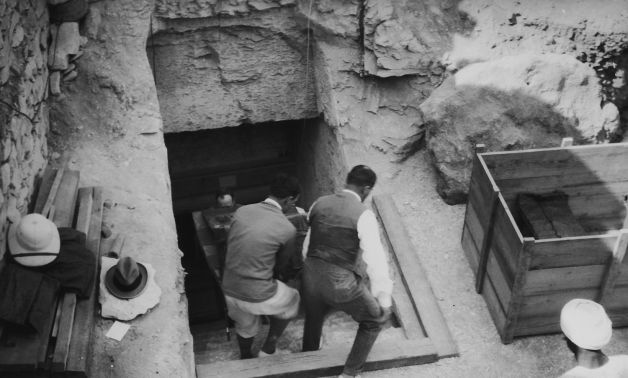
Transporting objects from King Tutankhamun's tomb. Photograph: Griffith Institute, University of Oxford Even without the beguiling legend of the curse, the tale of how Tutankhamun's tomb was discovered is a thrilling encounter with archaeology at its most spectacular. Today's archaeologists stress patient analysis of small pieces of pottery from carefully measured trenches, a scientific approach pioneered in Egypt by the Victorian great, Sir William Matthew Flinders Petrie. By Petrie's modern scientific standards, Carter and Carnarvon were naive and out of touch, looking for lost treasure like characters in some Boy's Own story.
Yet anyone lucky enough to see Tutankhamun and his burial objects in the Egyptian Museum in Cairo wonders in awe at the sheer richness of this panoply of exquisite art and design. From his chairs and games to his golden mask, the young pharaoh and his lifestyle survive as miraculously as the ash-imprisoned people of Pompeii.
The Ashmolean's exhibition revisits the greatest archaeological story ever told. Even the true bits of it are amazing.
http://www.theguardian.com/artanddesign/jonathanjonesblog/2014/jul/23/mummy-curse-legend-discovering-tutankhamun-ashmolean-museum
They were soaking up the press attention as Tutankhamun, forgotten for millennia, suddenly became world famous – and so did his discoverers.
Then Lord Carnarvon got bitten on the cheek by a mosquito. He accidentally made the bite worse while shaving, and died in a delirious fever.
Arthur Conan Doyle, creator of Sherlock Holmes and ardent believer in the supernatural, said it must be the "curse" of the mummy. Death was decreed on anyone who disturbed the young pharaoh, reported newspapers.
With an exhibition about Howard Carter and the discovery of Tutankhamun opening on 24 July at Oxford's Ashmolean Museum, should the university city be worried? Is King Tut's curse about to strike Oxford?
No wonder that in 1932, a decade after Tutankhamun's discovery, the Boris Karloff horror film The Mummy was closely modelled on the story of this famous find.
But of course there was no curse. If Tutankhamun wanted revenge, why spare Howard Carter, the man who actually found him and lived to tell the tale? The expedition mortality rate was no higher than you'd expect among the imperial British at the time – Lord Carnarvon should have been more wary of mosquito bites.
Yet anyone lucky enough to see Tutankhamun and his burial objects in the Egyptian Museum in Cairo wonders in awe at the sheer richness of this panoply of exquisite art and design. From his chairs and games to his golden mask, the young pharaoh and his lifestyle survive as miraculously as the ash-imprisoned people of Pompeii.
The Ashmolean's exhibition revisits the greatest archaeological story ever told. Even the true bits of it are amazing.
http://www.theguardian.com/artanddesign/jonathanjonesblog/2014/jul/23/mummy-curse-legend-discovering-tutankhamun-ashmolean-museum
Egyptian Carving Defaced by King Tut's Possible Father Discovered
By Owen Jarus
The panel, carved in Nubian Sandstone, was found recently in a tomb at the site of Sedeinga, in modern-day Sudan. It is about 5.8 feet (1.8 meters) tall by 1.3 feet (0.4 m) wide, and was found in two pieces.
Originally, it adorned the walls of a temple at Sedeinga that was dedicated to Queen Tiye (also spelled Tiyi), who died around 1340 B.C. Several centuries after Tiye's death — and after her temple had fallen into ruin — this panel was reused in a tomb as a bench that held a coffin above the floor
Scars of a revolution
Archaeologists found that the god depicted in the carving, Amun, had his face and hieroglyphs hacked out from the panel. The order to deface the carving came from Akhenaten (reign 1353-1336 B.C.), a pharaoh who tried to focus Egyptian religion around the worship of the "Aten," the sun disk. In his fervor, Akhenaten had the name and images of Amun, a key Egyptian god, obliterated throughout all Egypt-controlled territory. This included the ancient land of Nubia, a territory that is now partly in Sudan.
"All the major inscriptions with the name of Amun in Egypt were erased during his reign," archaeology team member Vincent Francigny, a research associate at the American Museum of Natural History in New York, told Live Science in an interview.
The carving was originally created for the temple of Queen Tiye — Akhenaten's mother — who may have been alive when the defacement occurred. Even so, Francigny stressed that the desecration of the carving wasn't targeted against Akhenaten's own mom.
Today, only one column and a plethora of blocks survive from Queen Tiye's temple, which has not been excavated, Francigny said.
The archaeologists also found that, after Akhenaten's death, the god's face and hieroglyphs on this carving were restored. This restoration may have been done during the reign of the boy king Tutankhamun (reign 1336-1327 B.C.), who is famous for his rich tomb.
"The name of Amun as well as his face were first hammered out and later carved anew, proving that the persecution of this god extended to this remote province during the reign of Akhenaton and that his images were restored during the following reigns," Francigny and Claude Rilly, director of the French archaeological mission in Sedeinga, wrote in the most recent edition of the journal Sudan and Nubia.
Restoration
Akhenaten's religious revolution did not last. Shortly after his death, Tutankhamun, who may have been Akhenaten's son, assumed the throne and returned Egypt to its former polytheistic religion.
This particular carving would have been restored either during King Tut's reign or one of his successors'.
An ancient record tells of Tutankhamun's efforts to try to undo the revolution Akhenaten had unleashed. The account blasts Akhenaten, claiming that his revolution led the gods to abandon Egypt.
The "temples and the cities of the gods and goddesses … were fallen into decay, and their shrines were fallen into ruin, having become mere mounds overgrown with grass," the ancient record states (translation by William Murnane). "The gods were ignoring this land … if one prayed to a god, to ask something from him, he did not come at all, and if one beseeched any goddess in the same way, she did not come at all."
http://www.livescience.com/46978-egyptian-carving-discovered.html
The panel, carved in Nubian Sandstone, was found recently in a tomb at the site of Sedeinga, in modern-day Sudan. It is about 5.8 feet (1.8 meters) tall by 1.3 feet (0.4 m) wide, and was found in two pieces.
Originally, it adorned the walls of a temple at Sedeinga that was dedicated to Queen Tiye (also spelled Tiyi), who died around 1340 B.C. Several centuries after Tiye's death — and after her temple had fallen into ruin — this panel was reused in a tomb as a bench that held a coffin above the floor
Scars of a revolution
Archaeologists found that the god depicted in the carving, Amun, had his face and hieroglyphs hacked out from the panel. The order to deface the carving came from Akhenaten (reign 1353-1336 B.C.), a pharaoh who tried to focus Egyptian religion around the worship of the "Aten," the sun disk. In his fervor, Akhenaten had the name and images of Amun, a key Egyptian god, obliterated throughout all Egypt-controlled territory. This included the ancient land of Nubia, a territory that is now partly in Sudan.
The carving was originally created for the temple of Queen Tiye — Akhenaten's mother — who may have been alive when the defacement occurred. Even so, Francigny stressed that the desecration of the carving wasn't targeted against Akhenaten's own mom.
Today, only one column and a plethora of blocks survive from Queen Tiye's temple, which has not been excavated, Francigny said.
The archaeologists also found that, after Akhenaten's death, the god's face and hieroglyphs on this carving were restored. This restoration may have been done during the reign of the boy king Tutankhamun (reign 1336-1327 B.C.), who is famous for his rich tomb.
"The name of Amun as well as his face were first hammered out and later carved anew, proving that the persecution of this god extended to this remote province during the reign of Akhenaton and that his images were restored during the following reigns," Francigny and Claude Rilly, director of the French archaeological mission in Sedeinga, wrote in the most recent edition of the journal Sudan and Nubia.
Restoration
Akhenaten's religious revolution did not last. Shortly after his death, Tutankhamun, who may have been Akhenaten's son, assumed the throne and returned Egypt to its former polytheistic religion.
This particular carving would have been restored either during King Tut's reign or one of his successors'.
An ancient record tells of Tutankhamun's efforts to try to undo the revolution Akhenaten had unleashed. The account blasts Akhenaten, claiming that his revolution led the gods to abandon Egypt.
The "temples and the cities of the gods and goddesses … were fallen into decay, and their shrines were fallen into ruin, having become mere mounds overgrown with grass," the ancient record states (translation by William Murnane). "The gods were ignoring this land … if one prayed to a god, to ask something from him, he did not come at all, and if one beseeched any goddess in the same way, she did not come at all."
http://www.livescience.com/46978-egyptian-carving-discovered.html
Sunday, May 4, 2014
Replica King Tut Tomb Unveiled in Egypt
By Megan Gannon, News Editor
King Tutankhamun's tomb in Egypt went undisturbed for 3,000 years. But in the 90 years since its discovery, the ancient burial chamber has been ravaged by tourism.
To prevent further damage and deterioration, conservationists hope a newly unveiled, life-size replica of the tomb will ease the flow of traffic to the original. To coincide with the public opening, BBC World News is set to air a 30-minute documentary on the mock tomb this weekend, titled "A New Tomb for Tutankhamun: A Travel Show Special," hosted by broadcaster Rajan Datar.
Often referred to as the "boy king," Tut lived between roughly 1343 and 1323 B.C., during a period known as Egypt's New Kingdom. When he died at 19, Tut was buried in the Valley of the Kings, a sprawling necropolis for pharaohs, along the Nile opposite Luxor. The tomb was lost to history until 1922, when British archaeologist Howard Carter first opened it, finding the linen-wrapped mummy of Tutankhamun in a grand sarcophagus. [Photos: The Life and Death of King Tut]
The discovery was sensational. Tutankhamun became the world's most famous pharaoh. But the influx of tourists who flocked to his tomb took its toll. Because of constant changes in humidity, as well as the breath and body oils of people, the walls are crumbling.
The prospect of sealing Tut's tomb to the public has been thought to be "commercial suicide for Luxor," Datar says in the documentary. But in an attempt to mitigate the damage from tourism, conservationists began making a replica in 2009. They painstakingly laser-scanned each tiny speck of sand and paint crack inside the tomb and used technology like 3D printing to make facsimile as close to the original as possible.
Political upheaval in Egypt stalled initial plans to install the replica in 2011. In December 2013, the components of the mock tomb were finally pulled out of storage in a basement in Cairo and moved to Luxor. It officially opened on Wednesday (April 30).
On camera, tourists as well as guides and locals expressed doubt that many people would come all the way to the Valley of the Kings and choose to see the facsimile over the real thing. The replica's creators, however, are adamant that a facsimile is, for now, the most sustainable way for visitors to enjoy the tomb, since there is no restoration technology that can undo the damage to the original.
"People want to puts screens of glass. People want to put in air conditioning systems," Adam Lowe, a technical artist with the Factum Foundation, said in the documentary. "But the tomb was never meant to be visited … the simple truth is the tombs can't take that number of visitors."
The Factum Foundation created the replica with the Society of the Friends of the Royal Tombs in Egypt and the Egyptian Tourism and Antiquities ministries.
http://www.livescience.com/45327-replica-king-tut-tomb-unveiled.html
|
Credit: BBC World News |
King Tutankhamun's tomb in Egypt went undisturbed for 3,000 years. But in the 90 years since its discovery, the ancient burial chamber has been ravaged by tourism.
To prevent further damage and deterioration, conservationists hope a newly unveiled, life-size replica of the tomb will ease the flow of traffic to the original. To coincide with the public opening, BBC World News is set to air a 30-minute documentary on the mock tomb this weekend, titled "A New Tomb for Tutankhamun: A Travel Show Special," hosted by broadcaster Rajan Datar.
Often referred to as the "boy king," Tut lived between roughly 1343 and 1323 B.C., during a period known as Egypt's New Kingdom. When he died at 19, Tut was buried in the Valley of the Kings, a sprawling necropolis for pharaohs, along the Nile opposite Luxor. The tomb was lost to history until 1922, when British archaeologist Howard Carter first opened it, finding the linen-wrapped mummy of Tutankhamun in a grand sarcophagus. [Photos: The Life and Death of King Tut]
The discovery was sensational. Tutankhamun became the world's most famous pharaoh. But the influx of tourists who flocked to his tomb took its toll. Because of constant changes in humidity, as well as the breath and body oils of people, the walls are crumbling.
The prospect of sealing Tut's tomb to the public has been thought to be "commercial suicide for Luxor," Datar says in the documentary. But in an attempt to mitigate the damage from tourism, conservationists began making a replica in 2009. They painstakingly laser-scanned each tiny speck of sand and paint crack inside the tomb and used technology like 3D printing to make facsimile as close to the original as possible.
Political upheaval in Egypt stalled initial plans to install the replica in 2011. In December 2013, the components of the mock tomb were finally pulled out of storage in a basement in Cairo and moved to Luxor. It officially opened on Wednesday (April 30).
On camera, tourists as well as guides and locals expressed doubt that many people would come all the way to the Valley of the Kings and choose to see the facsimile over the real thing. The replica's creators, however, are adamant that a facsimile is, for now, the most sustainable way for visitors to enjoy the tomb, since there is no restoration technology that can undo the damage to the original.
"People want to puts screens of glass. People want to put in air conditioning systems," Adam Lowe, a technical artist with the Factum Foundation, said in the documentary. "But the tomb was never meant to be visited … the simple truth is the tombs can't take that number of visitors."
The Factum Foundation created the replica with the Society of the Friends of the Royal Tombs in Egypt and the Egyptian Tourism and Antiquities ministries.
http://www.livescience.com/45327-replica-king-tut-tomb-unveiled.html
Subscribe to:
Comments (Atom)