Showing posts with label museum. Show all posts

Sunday, May 7, 2017

Golden Crown on A Coffin Leads the Way to Discovery of Five ‘Lost’ Archbishops of Canterbury

Ancient Origins


Construction workers have stumbled across the tombs of five archbishops of Canterbury, dating back to the 17th century during Garden museum’s refurbishment. The museum is located in a deconsecrated medieval parish church next to Lambeth Palace, the Archbishop of Canterbury’s official London residence. The Archbishop of Canterbury is the senior bishop and principal leader of the Church of England, the symbolic head of the worldwide Anglican Communion and the diocesan bishop of the Diocese of Canterbury.

 Use of Mobile Phone Leads to the Lucky Discovery
Last year, during the refurbishment of the Garden Museum, construction builders working in the site made an incredible discovery, finding a cache of thirty lead coffins that were hiding underground for centuries. Closer examination uncovered metal plates bearing the names of five former Archbishops of Canterbury, going back to the early 1600s. Building site managers, Karl Patten and Craig Dick, discovered the coffins accidentally as the former chancel at St Mary-at-Lambeth was being converted into an exhibition space. With the use of a mobile phone on a stick to film a flight of stairs leading down to a hidden vault, they spotted the coffins lying on top of each other alongside an archbishop's mitre. Karl Patten told BBC News: "We discovered numerous coffins - and one of them had a gold crown on top of it.”


The Garden Museum at St Mary-at-Lambeth (CC by SA 3.0)

Some Coffins Include Nameplates and Reveal Valuable Information
 Two coffins had nameplates, which belonged to Richard Bancroft, who served as archbishop from 1604 to 1610, and John Moore, archbishop from 1783 to 1805. Additionally, Moore’s wife, Catherine Moore, has a coffin plate as well. It’s important to mention here that Richard Bancroft was the lead supervisor of the publication of a new English translation of the Bible, known as the “King James Bible”, which was first published in 1611.

Also identified from his coffin plate is John Bettesworth (1677-1751), the Dean of Arches, the judge who sits at the ecclesiastical court of the Archbishop of Canterbury.


Archbishop Richard Bancroft (public domain)

According to Harry Mount, a Sunday Telegraph's journalist and the first person who wasn’t involved directly to the discovery but was granted access, St Mary-at-Lambeth’s records suggest that three more archbishops were most likely buried in the secret vault: Thomas Tenison, archbishop from 1695 to 1715, Matthew Hutton, archbishop from 1757 to 1758, and Frederick Cornwallis, who served as archbishop from 1768 to 1783. A sixth archbishop (1758 to 1768), named Thomas Secker had his viscera buried in a canister in the churchyard. “It was amazing seeing the coffins. We’ve come across lots of bones on this job. But we knew this was different when we saw the Archbishop’s crown,” an excited Patten tells The Sunday Telegraph.


The archbishops' lead coffins in the hidden crypt CREDIT: HEATHCLIFF O'MALLEY

 Mystery Surrounds the Identify of the Rest Bodies
Garden Museum Director Christopher Woodward confesses that when he first received the call from the builders he worried that something was wrong with the project and couldn’t imagine that such an important discovery would’ve taken place. “I didn’t know what to expect,” Woodward tells The Sunday Telegraph and continues, “I knew there had been 20,000 bodies buried in the churchyard. But I thought the burial places had been cleared from the nave and aisles, and the vaults under the church had been filled with earth.”

The good news though, made him more than happy, “Wow, it was the crown - it's the mitre of an archbishop, glowing in the dark,” he told BBC News. However, he suggests that there are many more things we don’t know about the church’s history, “Still, we don't know who else is down there,” he said. And continues, "This church had two lives: it was the parish church of Lambeth, this little village by the river…but it was also a kind of annex to Lambeth Palace itself. And over the centuries a significant number of the archbishops' families and archbishops themselves chose to worship here, and chose to be buried here."

 Deconsecrated back in the early seventies, St Mary's was due to be wrecked before becoming the Garden Museum. In October 2015, the museum closed for nearly a year and half to go through a € 8,8 million redevelopment project and is due to reopen in May 2017.

Top image: Archbishops were buried with painted, gilded, funerary mitres placed on their coffins CREDIT: GARDEN MUSEUM

By Theodoros Karasavvas

Friday, November 6, 2015

Ancient Sunken Cities and Artifacts to be revealed with Ambitious Underwater Museum in Egypt

Ancient Origins

Ancient sunken treasures hidden for thousands of years will be revealed in an underwater antiquity museum, the first of its kind, set for the history-rich Bay of Alexandria in Egypt.
The ambitious project put forth by the Ministry of Antiquities is set to allow visitors to experience the submerged ruins of ancient Alexandria, including some stonework and artifacts dating back to 365 AD.

Visit Lost Underwater Sites Firsthand

Youssef Khalifa, chairman of the Central Administration of Lower Egypt Antiquities, told news website Al-Monitor that the museum is planned to be partially submerged in the Bay of Alexandria, on the Mediterranean coast in Egypt.
Khalifa said museum is planned to feature an above-water building showcasing relics that have been recovered from the sea, as well as an underwater section leading visitors down into the water, to walk along the bay floor some seven meters (23 feet) deep and see the submerged antiquities.
“Visitors will be able to see the relics either by diving or walking inside underwater tunnels.  There will also be glass submarines taking tourists on a tour inside the museum,” said Khalifa.
French architect Jacques Rougerie is behind the proposed design of the compelling architecture, including fiberglass tunnels connecting waterfront galleries to underwater viewing chambers, reports WebUrbanist. The design will allow visitors to experience the ancient ruins in context.
Design of the proposed underwater museum of Alexandria.
Design of the proposed underwater museum of Alexandria. Image Credit: © UNESCO/Rougerie
Additionally, “the museum will include four tall underwater buildings in the form of Nile boats connected to one another over an area of 22,000 square meters (5.4 acres). They will be lined up in a circle with a radius of 40 meters (131 feet). The museum will accommodate 3 million visitors a year,” Khalifa told AlMonitor.
Underwater Museum of Alexandria, Egypt featuring Architect Jacques Rougerie (2009) [French language].
Research and construction plans, originally proposed in 2008, were delayed with regional political strife. UNESCO sent an international scientific advisory committee to assist with a feasibility study, but the proposal was put on indefinite hold during the January 2011 revolution in Egypt. Those involved with the project believe the time is now right to revive the exciting plans for the underwater museum.

Sunken Ancient History Revealed

The underwater heritage of Alexandria Bay is protected by UNESCO conventions. The 270,000 square foot area includes invaluable sites such as Pharos, the Lighthouse of Alexandria, one of the Seven Wonders of the ancient world, and Cleopatra’s palace, found in the submerged ancient ruins of Thonis-Heracleion, which plunged into the Mediterranean Sea off the coast of Egypt nearly 1,200 years ago.
Pharaohs of Alexandria: Idealized representation of the Bay of Alexandria.
Pharaohs of Alexandria: Idealized representation of the Bay of Alexandria. (Public Domain)
During the middle ages earthquakes caused much of the land to fall beneath the sea, where it lay hidden for ages.
Lighthouse remains found in the Mediterranean Sea.
Lighthouse remains found in the Mediterranean Sea. (CC BY-SA 3.0)

Protection and Preservation

Other underwater archaeological sites, such as those submerged in waters in China, Turkey and Mexico, highlight contemporary sculpture in a marine environment for groups of divers. This self-contained, glass-walled, underwater museum featuring sunken ancient relics, however, will be the world’s first.
Not only will the Alexandria sub-marine museum allow the public to experience first-hand the ancient history of the region, but an underwater presence and watchful eyes will further protect the antiquities from thieves. Underwater looting is a real problem, but it is fortunately less easily accomplished than antiquity theft on land.
The project’s estimated cost is $150 million.
Beyond highlighting and preserving almost 2,000 years of regional history, Youssef Khalifa listed the additional benefits of the intended museum saying, “The museum will reshape the Arab region, as it will be the first of its kind in the world. Undoubtedly it will revive tourism and boost the Egyptian economy after a long recession.”
Featured Image: The ambitious proposed design of the planned underwater antiquity museum set for the Bay of Alexandria, Egypt. Image Credit: © UNESCO/Rougerie
By: Liz Leafloor   


Sunday, April 26, 2015

Rare Bronze Owl Brooch Found on Danish Island

Discovery News

Archaeologists excavating an Iron Age settlement on the Baltic island of Bornholm in Denmark have unearthed a unique enameled bronze clasp.
Cast as a flat piece of bronze and decorated with green enamel and glass disks in brilliant red, yellow, and black colors, the brooch is shaped like an owl and dates between 100-250 A.D.
“The bird’s big black glass pupils seem to stare directly back at you,” Ulla Lund Hansen, a leading scholar in the field of Roman Iron Age research, and Christina Seehusen, archaeologist at Bornholm Museum, wrote in the Danish archaeology magazine Skalk.
Viking Jewelry Unearthed in Denmark
“Its large, luminous eyes are made even more dramatic by the stunning inlays of orange glass around the pupils,” she added.
The rare brooch, which measures just 1.5 by 1.5 inches, would have been used to fasten a man’s cloak. It was found in the Roman-age soil deposits of an ancient house in September 2014, but only now the find was made public.
“It is very uncommon to find such items in a settlement context in Denmark. We usually find these things only in burials,” Seehusen told Discovery News.
“The settlement was unusual in itself, as it was extremely well preserved compared to typical standards,” she said.
Indeed, on the settlement site Seehusen’s team found very well preserved remains of workshops, pottery, traces of houses and other buildings.
Photos: Iron Age Fashion
“We found Roman coins representing Faustina the Younger [the Empress consort to Marcus Aurelius (161-175 AD)] a bronze spur, several dress pins, bronze and iron brooches, glass beads, iron smelting cinders and plenty of animal bones from pig, cattle, horse, bird, fish and dog,” Seehusen said.
The brooch, or fibula, was probably made along the Roman frontier that ran along the Danube and the Rhine in what is now Germany.
How it ended up on Bornholm, an island in the middle of the Baltic Sea, remains a mystery.
“We can only guess who the original owner was and how it came to be preserved on the island,” Seehusen said.
The unusual piece represents a personal item, which is very rarely found outside the borders of the Roman Empire. It was possibly owned by a person who served as a mercenary in the Roman army in the northern provinces.
With its unusal shape and bright colors, it probably provided its owner with a great level of prestige.
“Perhaps it was lost or maybe it was deliberately hidden for reasons known only to its owner. Most likely, we will never know the brooch’s full story,” Seehusen said.
Video: What Ancient Wine Tasted Like
Flat brooches made in various designs were popular between the 1st and 4th century A.D. Their shapes reminded common objects such as axes, spears, wheels, shoes, mythical creatures such as sea serpents and animals including horses, dogs, bees, deers, boars, lions and various types of fish and birds.
Owls were a symbol of wisdom, portrayed as companions to both Athena, the Greek Goddess of war, and Minerva, the Roman goddess of wisdom, art, trade, and war. The owl was one of the rarest types of animals depicted on brooches.
“It is possible that Germanic mercenaries in the Roman territories somehow adopted Roman traditions of symbolic jewellery,” Seehusen said.
The majority of such clasps was found in frontier forts in what is now Germany, but small numbers were also found in various European countries.
“They are nonetheless extremely rare in Northern Europe,” Seehusen said.
The brooch has been now restored and is currently on display at the National Museum of Denmark in Copenhagen.

Monday, May 19, 2014

Tomb raider: enter the British Museum's underground mummy store

From Edgar Allan Poe to Scooby Doo, culture is cursed with the ancient Egyptian dead. Jonathan Jones visits the British Museum's mummy store to unwrap our fascination


CT scan 3D visualisation of the mummified remains of Tayesmutengebtiu
Living for ever … a CT scan 3D visualisation of the mummified remains of Tayesmutengebtiu, also called Tamut (detail). Photograph: Trustees of the British Museum
It was a couple of days after I visited the mummy store that my nightmares began. Bandaged bodies on shelves. A loose wrapping, perhaps about to uncoil further as the corpse within awoke from its 3,000-year sleep. Most of all, the painted face of a young man gazing untiringly into darkness as the curator turned out the lights behind us and firmly locked the door.
Hidden in the heart of the British Museum, deep within a labyrinth of research departments the public never sees, is a secret world of the dead. This museum, whose collections blossomed in the age of empire when Egypt was under British control, owns more than 100 mummies. Many are on permanent display. Eight were taken to hospital to undergo CT scans for the museum's revelatory new exhibition Ancient Lives. Others lie here, on wooden pallets, layered one over the other, in London's most enigmatic morgue.
The room doesn't need to be especially cold – the mummies were embalmed millennia ago, their brains and organs removed to prevent internal decay – but it does have a carefully regulated temperature that suits the fragile dead. Their casings, too, are organic and need care: linen wrappings, wooden coffins. One of the coffins dates from about 3,000BC – older than the pyramids – and is just a timber crate. Later ones are painted in styles from Old Kingdom to Roman, laden with hieroglyphic spells.
Why are mummies spooky? Why are horror stories told about them and why do Scooby Doo scenarios come to mind when you see them in a museum? I'd love to pretend that I was too interested in proper archaeology to waste time on such stuff, but I really did have nightmares after visiting the mummy store. And they got me thinking about what mummies really are: vehicles of immortality.
It's amazing that any Egyptian mummies have survived to be preserved in the British Museum. Over the centuries, thousands have been destroyed through superstition and morbid curiosity. In the 18th century, "mummy", the powdered flesh and bone of the ancient Egyptian dead, was swallowed as medicine. Even when a growing fascination with Egypt made this seem wasteful, things got little better, for public unwrappings of mummies became all the rage. Invaluable archaeological evidence was destroyed for cheap thrills.
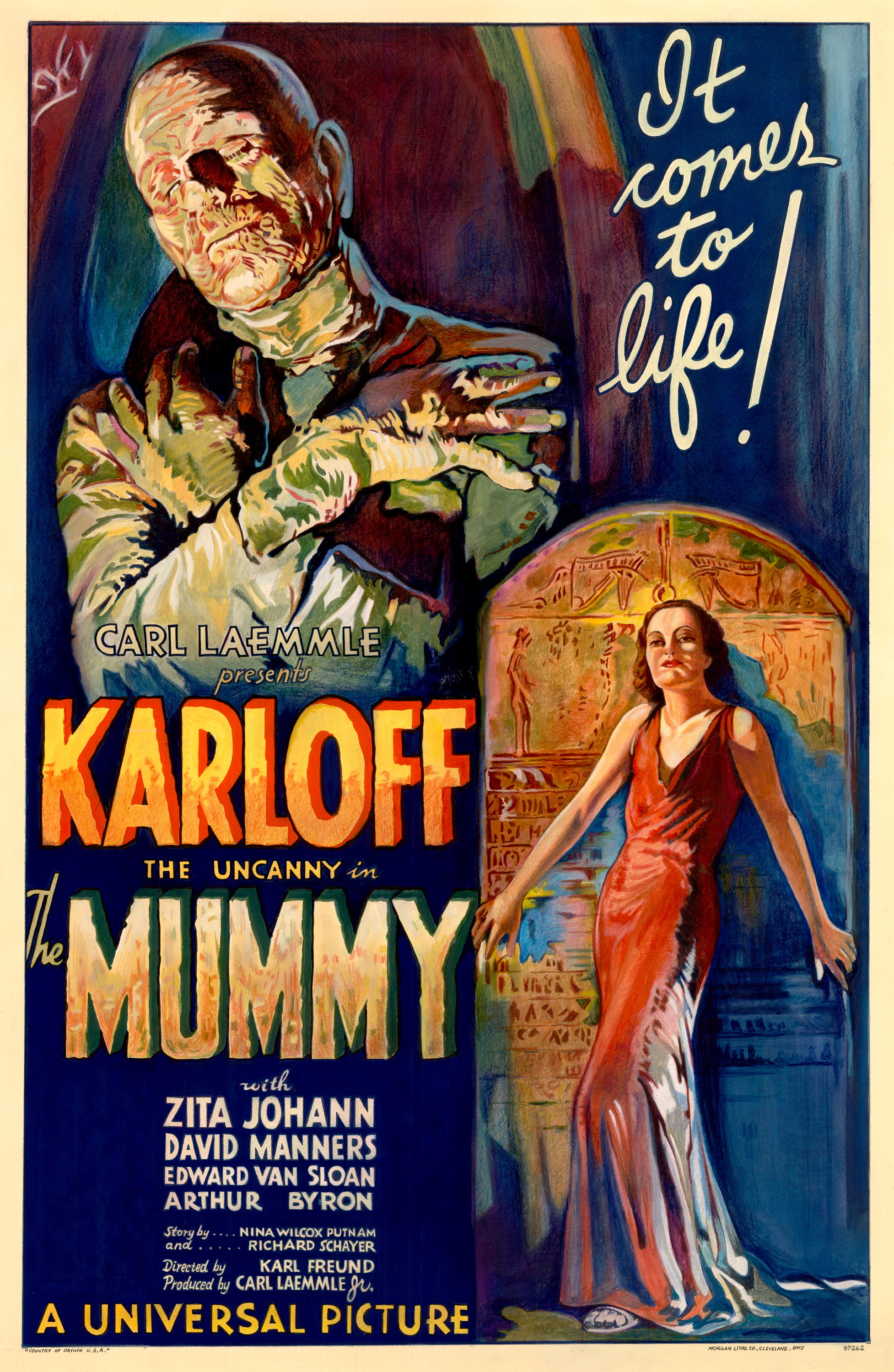
Mummies Cartonnage of a priestess, named Tayesmutengebtiu, found in Thebes, 22nd Dynasty. Photograph: Trustees of the British Museum. Then the horror stories began. The 19th-century writers Theophile Gautier, Edgar Allan Poe and Bram Stoker all wrote eerie tales about mummies, but it was Arthur Conan Doyle, creator of Sherlock Holmes, who hit on the perfect formula of the revived mummy in his story Lot 249. Soon the 1932 Boris Karloff classic The Mummy launched the pharaonic dead on their fantastic film career.
Is all this a depressing insight into our vulgar souls and inability to be interested in the remote past unless it is turned into cheap fiction? No. The gothic imagination feasts on mummies for a good reason. They are genuinely uncanny: the closest that humanity has come to conquering death.
Ancient Egyptians wanted to live for ever. Almost all the Egyptian art and artefacts in museums are part of an effort to achieve this. False doors from tombs – the British Museum has a majestic one painted red that resembles a massive stone Mark Rothko painting – are portals through which the ka, or spirit double, of the deceased person could come to receive food offerings. The models of people brewing beer that were put in tombs were intended to provide actual beer for the living dead.
Everything important in a tomb, from small sculpted servants to the mummy itself, was touched with an adze by a priest in a ritual called "the opening of the mouth". This rite gave magical potency to everything the ka would need in the next life – and its needs included the mummified corpse. The reason for perfectly preserving the corpse was so that its ka could recognise it, and so connect with it to enjoy the food and drink the mummy digested on its behalf.
Spirit and body were mysteriously connected. It's not that Egyptians believed that the mummy could get up and chase people round museums – but they did believe that the dead person's spiritual ka form, which needed the mummy to exist, could leave the tomb and walk around. There are statues of it doing just that.
So what? People believe all kinds of things. But the ancient Egyptians believed in their conquest of death for at least 3,000 years and repeated their spells and rituals over and over again. Their art is incredibly powerful because it is full of the confidence and faith of those rituals. It is truly magical art. Looking at the painted caskets in the mummy store I am moved by the conviction they communicate that death is not the end, but only the beginning of a strange adventure.
The door closes. The eternal night of the tomb returns. The young man's painted face looks calmly into the eyes of his ka.
Ancient Lives: New Discoveries is at the British Museum, London WC1, until 30 November. Tickets: 020-7323 8181.
http://www.theguardian.com/artanddesign/2014/may/19/ancient-lives-new-discoveries-egyptian-mummies-british-museum
 
Follow on Bloglovin