Showing posts with label Switzerland. Show all posts

Tuesday, November 21, 2023

Book Spotlight: The Matchstick Boy by Rowena Kinread


Follow the tour  HERE

When his young brother, Josef, is killed by a rock avalanche, Jakob believes it is murder. He had seen someone on the mountain ridge, above the scree, before it began to roll. But who would want to kill a child, and why? Jakob suspects Ramun, the privileged son of the owner of a matchstick factory, but nobody takes him seriously and he is powerless to obtain justice.

Thirty years later, Jakob’s profoundly deaf daughter is raped by Ramun and becomes with child. Determined to gain justice for his daughter, Jakob unearths a myriad of well-kept secrets in the tight-lipped community, but is anyone willing to tell the truth?

Just as he thinks he has uncovered all the facts, he realises he has made a vital mistake all along. Nothing is really as it seems.

Buy Links:

 This title is available to read on #KindleUnlimited.

 Universal Link


Rowena Kinread grew up in Ripon, Yorkshire with her large family and a horde of pets. Keen on travelling, her first job was with Lufthansa in Germany.

She began writing in the nineties. Her special area of interest is history. After researching her ancestry and finding family roots in Ireland with the Dalriada clan, particularly this era. Her debut fiction novel titled “The Missionary” is a historical novel about the dramatic life of St. Patrick. It was published by Pegasus Publishers on April 29th, 2021 and has been highly appraised by The Scotsman, The Yorkshire Post and the Irish Times.

Her second novel “The Scots of Dalriada” centres around Fergus Mór, the founder father of Scotland and takes place in 5th century Ireland and Scotland. It is due to be published by Pegasus Publishers on January 26th, 2023.

The author lives with her husband in Bodman-Ludwigshafen, Lake Constance, Germany. They have three children and six grandchildren.

Author Links: 

Saturday, December 3, 2016

Puzzling Roman-Era Remains Found in Switzerland

Ancient Origins


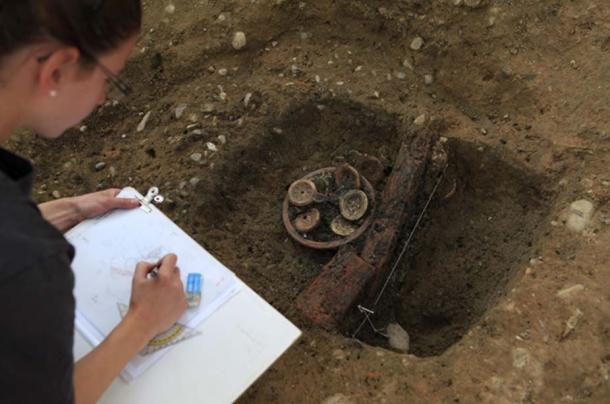
A team of archaeologists have discovered a peculiar Roman-era earthenware pot filled with 22 oil lamps, each containing a bronze coin, in Windisch, a municipality in the district of Brugg in the canton of Aargau in Switzerland. According to the Aargau canton archeology department , the pot was discovered under a street in the area as part of an archaeological investigation in order for the local authorities to proceed with the construction of an ambitious architectural project comprising apartment blocks and commercial property. The Romans Made It to Switzerland Almost 2000 Years Ago Experts believe that the pot has probably been buried there for nearly 2,000 years, dating it from the time of the Roman legion camp Vindonissa, which was located near where Windisch is now. According to most contemporary historians Vindonissa was probably established in 15 AD. The Legio XIII Gemina, also known as Legio tertia decima Gemina, was stationed at Vindonissa until 44 or 45 AD. It was a legion of the Imperial Roman army and according to most historical accounts it was one of Julius Caesar's most powerful and important units in Gaul and in the civil war. It was also the legion with which Julius Caesar crossed the Rubicon on January 10, 49 BC and what’s even more impressive is that the legion appears to have still been in existence in the 5th century AD. With the arrival of the 21st legion (XXI Rapax), the camp was reconstructed with stone fortifications. After the 21st legion had looted the countryside in 69 AD, it was replaced by the 11th legion (XI Claudia) which remained stationed until 101 AD. After this date, Vindonissa was a civilian settlement, with a castle built in the 4th century.


The Roman amphitheatre of Vindonissa, now Windisch, Switzerland ( public domain ) A Very Exciting but Also Mysterious Discovery Previous archaeological excavations in the area have exhumed clear confirmation of organized habitation and civilization dating from the Roman era, including the foundations of relatively big structures. This discovery, however, is considered by most archaeologists and experts a very special and puzzling one. Despite the pot being pretty common and representative of the cooking pots used by soldiers stationed at Vindonissa, the purpose of its contents – 22 oil lamps, each containing a carefully situated coin – is surrounded by mystery. Aargau cantonal archaeologist Georg Matter, describes the mixed feelings of his team after the fascinating discovery in the best possible way, “What astonished us was the quantity and the combination of coins and lamps” [via The Local.ch ]. Every single lamp is decorated with an image, including the moon goddess Luna, a gladiator, a lion, a peacock and an erotic scene. The bronze coins are not of value but demonstrate a symbolic gesture and date from 66-67 AD.


An extraordinary find: A Roman cooking pot filled with lamps and coins. Credit: Aargau canton archeology department Future Discoveries Might Reveal More about the Pot’s Content The pot also contained charred fragments of animal bones, ruling it out as an urn for human remains. Despite Matter not being sure about the nature of the pot and its content, he speculates that it could be a ritual burial. However, the fact that there have never been any other comparable or similar discoveries, makes things for Matter and his team even harder. “The intentions behind this burial are puzzling at the moment,” adds Matter, who hopes that additional discoveries will help him understand the use of the pot and its content a little better. From a historical point of view, it’s interesting to notice that the Romans made it right over the Swiss Alps with no modern conveniences, a fact that clearly shows that nothing was poised to stop the ferocious Roman Legions back then.


A researcher documents the Roman find. Credit: Aargau canton archeology department

 Top image: The recently discovered pot containing 22 oil lamps. Credit: Aargau canton archeology department

By Theodoros II

Tuesday, November 24, 2015

Trove of Antique Roman Coins Found in Swiss Orchard

Discovery News


More than 4,000 bronze and silver coins dating back to Ancient Rome were found by a Swiss farmer in his cherry orchard.
© Kanton Aargau. Foto: Béla Polyvàs

A Swiss fruit-and-vegetable farmer stumbled across more than tree roots when inspecting his cherry orchard recently, uncovering a massive trove of coins buried some 1,700 years earlier, archaeologists said Thursday.
The trove of more than 4,000 bronze and silver coins dating back to Ancient Rome and weighing 15 kilos (33 pounds) was discovered in Ueken, in the northern canton of Aargau, the regional archaeological service said, describing it as one of the biggest such treasures ever found in Switzerland.
A farmer had made the spectacular discovery back in July, when he spotted a molehill with some shimmering green coins.
Largest Trove of Gold Coins Found off Israel
A few months earlier, remains of an early Roman settlement were discovered in a dig in the nearby town of Frick, so the farmer suspected he may have found Roman coins.
He contacted the regional archeological service and his suspicions were confirmed.
The service announced Thursday that after months of discreet excavations, a total of 4,166 coins had been found in excellent condition.
Their imprints remain legible, allowing an expert to determine they date back to Ancient Rome, stretching from the rein of Emperor Aurelian (year 270-275) to that of Maximilian (286-305), with the most recent coins dated to year 294.
Ancient Coins Found Buried in British Cave
“The orchard where the coins were found was never built on. It is land that has always been farmed,” archeologist Georg Matter told AFP, explaining how the treasure could have laid dormant for so long.
The coins’ excellent condition indicates that their owner systematically stashed them away shortly after they were made, the archeologists said.
For some reason, the owner had buried them shortly after 294 and never retrieved them, the archeologists said.
Recovering a Silver Treasure: Photos
Some of the coins, made mainly of bronze but with an unusually high silver content of five percent, were buried in small leather pouches.
The archaeologists said it was impossible to determine their original value due to rampant inflation at the time, but said they clearly must have been worth at least a year or two of wages.
How much the coins are worth today is beside the point, Matter said, pointing out that the farmer would not be allowed to keep his treasure.
“He will likely get a finders fee,” he said, “but the objects found belong to the public, in accordance with Swiss law.”
The Ueken treasure is set to go on display at the Vindonissa de Brugg Museum in Aargau.

Tuesday, September 22, 2015

History Trivia - Emperor Nero creates the Legion I Italica.

Sept 22,

66 Emperor Nero created the Legion I Italica. 

1499 Switzerland became an independent state. 

1515 Anne of Cleves was born. The fourth wife of Henry VIII, Anne was able to obtain a divorce and maintained a friendly relationship with the Tudor family. 

Saturday, April 4, 2015

History Trivia - Francis Drake was knighted

April 4

1081 Alexius Comnenus crowned emperor. Alexius seized the throne from Nicephorus III. During his reign, he would succeed in reviving the Eastern Roman Empire after half a century of ineffective rule.

1460 University of Basle in Switzerland founded.

1581 Francis Drake was knighted for completing a circumnavigation of the world.


Monday, January 19, 2015

History Trivia - Rouen surrenders to Henry V

January 19

 1419 The French city of Rouen surrendered to Henry V in Hundred Years War.

1520 Sten Sture the Younger, the Regent of Sweden, was mortally wounded at the Battle of Bogesund, an important conflict in the campaign of Christian II to gain power over Sweden.

1523 Ulrich Zwingli, founder of the reformation in Switzerland, published his 67 Articles, the first manifesto of the Zurich Reformation which attacks the authority of the Pope.

1783 William Pitt became the youngest Prime Minister of England at age 24.


Follow on Bloglovin

Friday, January 9, 2015

History Trivia - Byzantine Emperor Zeno flees his capital at Constantinople

January 9

475 Byzantine Emperor Zeno was forced to flee his capital at Constantinople.

1349 The Jewish population of Basel, Switzerland, believed by the residents to be the cause of the ongoing Black Death, were rounded up and incinerated.

1431 Judges' investigations for the trial of Joan of Arc began in Rouen, France, the seat of the English occupation government.


Follow on Bloglovin

Monday, September 22, 2014

History Trivia - Emperor Nero creates the Legion I Italica.

Sept 22

 66 Emperor Nero created the Legion I Italica.

1499 Switzerland became an independent state.

1515 A
nne of Cleves was born. The fourth wife of Henry VIII, Anne was able to obtain a divorce and maintained a friendly relationship with the Tudor family.

1586 Battle of Zutphen was a confrontation of the Eighty Years' War fought between forces of the United Provinces of the Netherlands, aided by the English, against the Spanish, who sought to regain the northern Netherlands. Elizabeth I sent troops under the earl of Leicester to aid the rebels, however the Spanish were victorious.
Follow on Bloglovin

Saturday, July 19, 2014

History Trivia - Battle of Halidon Hill – The English defeat the Scots

July 19

711 Umayyad conquest of Hispania: Battle of Guadalete – Muslim Umayyad Caliphate forces under Tariq ibn Ziyad defeated the Visigoths led by King Roderic.

1318 Austria recognized the Three Forest Cantons, marking the beginning of modern Switzerland.

1333 Wars of Scottish Independence: Battle of Halidon Hill – The English won a decisive victory over the Scots.

1545 The Tudor warship Mary Rose capsized and sank off Portsmouth with the loss of approximately 500 men.

1553 Lady Jane Grey was replaced by Mary I of England as Queen of England after only nine days of reign.

1588 Anglo-Spanish War: Battle of Gravelines – The Spanish Armada was sighted in the English Channel.
Follow on Bloglovin

Friday, April 4, 2014

History Trivia - University of Basle in Switzerland founded

April 4,

86 Caracalla, Emperor of Rome, was born.

527 Justinian I was created co-emperor.

1081 Alexius Comnenus crowned emperor. Alexius seized the throne from Nicephorus III. During his reign, he would succeed in reviving the Eastern Roman Empire after half a century of ineffective rule.

1460 University of Basle in Switzerland founded.

1541 Ignatius of Loyola became the first superior-general of the Jesuit Order.

1581 Francis Drake was knighted for completing a circumnavigation of the world.

1588 Christian IV succeeded Frederik II as king of Denmark. Follow on Bloglovin

Sunday, January 19, 2014

History Trivia - Sten Sture the Younger, the Regent of Sweden, ie mortally wounded at the Battle of Bogesund,

January 19

 379 Theodosius installed as co-emperor of East Roman Empire.

973 Pope Benedictus VI elected

1419 The French city of Rouen surrendered to Henry V in Hundred Years War.

1520 Sten Sture the Younger, the Regent of Sweden, was mortally wounded at the Battle of Bogesund, an important conflict in the campaign of Christian II to gain power over Sweden.

1523 Ulrich Zwingli, founder of the reformation in Switzerland, published his 67 Articles, the first manifesto of the Zurich Reformation which attacks the authority of the Pope.

1783 William Pitt became the youngest Prime Minister of England at age 24.