by Owen Jarus
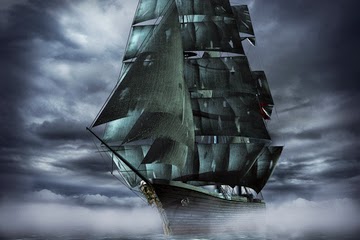
Ghost ships have long sparked fascination and fear, from mariners and nonmariners alike. These spooky vessels run the gamut from phantom ships that appear as eerie apparitions to real-life abandoned wrecks to those craft that disappeared mysteriously with no survivors, such as the HMS Erebus that was lost in the Canadian Arctic in 1845. Here's a look at some of the most haunted ships throughout history.
El Caleuche
El Caleuche is a ghost ship said to sail the waters off the coast of Chile. "El Caleuche always sails at night and appears suddenly through the fog or mist, brightly lit," writes author Ann Bingham in her book "South and Meso-American Mythology A to Z" (Chelsea House, 2010). The ship "guards the waters and punishes those who bring hardship to the sea or the creatures that live in it."
The ship’s crew is said to consist of dead, shipwrecked, sailors along with witches. The witches are said to leave the ship by riding a seahorse named Caballo Marino Bingham added. Apparently the witches and shipwrecked sailors are a happy crew. "On calm nights, it is said, music and laughter can often be heard coming from the ship," Bingham writes. [
The Top 10 Most Famous Ghosts]
HMS Erebus and Terror
On May 19, 1845, two ships, HMS Erebus and HMS Terror, departed England and set sail for the Canadian Arctic. Their goal was to travel through the treacherous waters of
the Northwest Passage that separated the Atlantic and Pacific oceans.
Led by Sir John Franklin, the ships were to collect samples and conduct scientific studies along the way. Out of the 134 officers and men on the expedition, not a single one ever returned.
Messages later discovered by a rescue mission indicate the ships became trapped in ice off of King William Island in the Canadian Arctic. Franklin died on June 11, 1847, and the ships were abandoned on April 22, 1848. The initial survivors attempted to cross the ice and reach safety on the Canadian mainland. [
See Photos of the Lost Ship from the Franklin Expedition]
Recently, Parks Canada archaeologists
found the wreck of the HMS Erebus during the 2014 Victoria Strait Expedition. (Image Credit: © Parks Canada)
København
On Dec. 14, 1928, the København, a Danish East Asiatic Company sailing ship left the Rio de la Plata (an area between Uruguay and Argentina) en route to Australia. It was notable for having five masts.
"She was a well-found vessel, fitted with wireless (radio) an auxiliary engine and ample lifeboats,"
writes Hamish Ross in Sea Breezes Magazine. "A training ship, she had a crew of 60 men, many of whom were cadets, some from very prominent Danish families."
The ship was in touch, through radio, with the Norwegian steamer William Blumer on Dec. 21, but after that it was never heard from again.
"Following the København's disappearance, many theories sprang up as to her loss, but the most likely seems to be that she struck an iceberg in darkness or fog," writes Ross. "There were also reports of sightings of a phantom five-masted vessel in 1930." In 2012, a wreck was found at the island of Tristan da Cunha that could potentially be the København. (Image Credit: State Library of Queensland, courtesy Wikimedia Commons)
HMS Eurydice
In 1878, the HMS Eurydice, a Royal Navy training vessel, was lost while sailing near the Isle of Wight. A sudden snowstorm sunk the vessel, killing 364 crewmembers, on what had been a calm day. The storm occurred so suddenly, the ship's crew didn't have enough time to react, according to news reports.
The "Eurydice continued at full sail with her gun ports open before disappearing in the midst of the blizzard," writes Victoria Bartlett in
an article on the BBC website. Ultimately, there were only two survivors, Bartlett notes. The ship was refloated but, being heavily damaged, was scrapped.
Since then, there have been stories of a ghostly HMS Eurydice haunting the area where the ship sank. "Sailors and visitors are also said to have witnessed sightings of a 'ghost ship' off the Isle of Wight," writes Bartlett. In the 1930s, a British submarine reported encountering the ghostly vessel. Additionally, "Prince Edward reportedly saw the ship while filming an ITV documentary in 1998," Bartlett writes. (Image Credit: public domain, courtesy Wikimedia)
Mary Celeste
On Dec. 4, 1872, a boarding party on the British brigantine ship named the Dei Gratia found a ship named the Mary Celeste adrift at sea in the Atlantic Ocean, not far from the Azores. The ship was completely deserted, the boarding party found.
Of the 10 people known to have sailed aboard the Mary Celeste, none were ever found. A lifeboat was missing, but the ship's log gave no indication as to why the Mary Celeste was abandoned. The boarding party found that there had been some flooding, with at least one pump out of order. The ship was carrying over 1,700 barrels of alcohol, a few of which had spilled open.
There was little damage, and the flooding posed little problem. A crew from Dei Gratia pumped out the water and sailed the Mary Celeste to Gibraltar where the British authorities began an investigation into what happened. They were unable to come up with a definitive answer, and the case of the Mary Celeste has remained unsolved ever since.
Different ideas have been put forward. A few barrels of alcohol had spilled open, which might have made the crew afraid that their hold was going to explode. This could have prompted their captain, Benjamin Briggs, to order them to abandon ship. It's also been proposed that Briggs thought the flooding was worse than it actually was. With at least one pump not working, he may have given the order to abandon ship. [
In Images: Ancient Maps and Sea Monsters]
Other, more far-fetched ideas involve
sea monsters, mutineers or pirates. (Image Credit: Public domain, courtesy Wikimedia Commons)
Flying Dutchman
The
most famous ghost ship of all is the Flying Dutchman, said to haunt the waters near the Cape of Good Hope in South Africa.
"The term 'Flying Dutchman' actually refers to the captain, not his ship," writes Angus Konstam in his book "Ghost Ships: Tales of Abandoned, Doomed and Haunted Vessels" (Lyons Press, 2005).
There are several variations of the story, but the most famous one is that the ship's pilot, Captain Hendrick Vanderdecken, who lived in the 17th century and served with the Dutch East India Company, encountered a storm off the Cape of Good Hope, Konstam notes. "He swore that he would spite God's wrath, and take his ship into Table Bay, despite anything that God and the elements could throw against him," Konstam writes. But the ship hit a rock and sank, taking the entire crew along with it.
As punishment, the captain and his ghostly crew are said to sail the waters for all eternity, hoping one day to be forgiven. "They were hence refused admittance into every port, and are ordained still to traverse the ocean on which they perished, till the period of their penance expires," reads a story, published in an 1803 book by John Leyden, describing how the crew's punishment worked. (Image Credit: PLRANG | Shutterstock.com)
Live Science