Showing posts with label graves. Show all posts

Monday, September 25, 2017

First Genetic Proof of a Viking Age Warrior Woman is Identified from an Iconic Swedish Grave

Ancient Origins


Then the high-born lady saw them play the wounding game, she resolved on a hard course and flung off her cloak; she took a naked sword and fought for her kinsmen's lives, she was handy at fighting, wherever she aimed her blows.” - ‘The Greenlandic Poem of Atli’ (st. 49) (Larrington, 1996)

Arguably the most iconic example of a warrior burial in Viking Age Sweden is a mid-10th century grave in Birka. This grave has been the example of what a Viking warrior burial should look like for over a century. Everyone assumed that a man was the one laid to rest in the grave – but new research shows assumptions should not be taken as fact. It is the remains of a warrior woman in that grave.


Illustration by Evald Hansen based on the original plan of the Viking Age warrior grave (Bj 581) by excavator Hjalmar Stolpe; published in 1889. (Stolpe, 1889)

According to The Local, the first person to do something about the fact that the skeleton’s morphological features don’t coincide with a male body was Anna Kjellström, an osteologist at Stockholm University. Kjellström was examining the skeleton for an unrelated research project when she noticed that the cheekbones were finer and thinner than men would normally have. However, the tell-tale sign that the skeleton is female is the obvious nature of the hip bones.

 After a thorough osteological analysis, DNA testing was applied. And, as Phys.org reports “DNA retrieved from the skeleton demonstrates that the individual carried two X chromosomes and no Y chromosome.” Based on the results of the study, Charlotte Hedenstierna-Jonson of Stockholm University, who led the research, asserted, “It’s actually a woman, somewhere over the age of 30 and fairly tall too, measuring around 170 centimetres [5.5ft.]”

Furthermore, the researchers write in their journal article that. “The Viking warrior female showed genetic affinity to present-day inhabitants of the British Islands (England and Scotland), the North Atlantic Islands (Iceland and the Orkneys), Scandinavia (Denmark and Norway) and to lesser extent Eastern Baltic Europe (Lithuania and Latvia).”


Romanticized depiction of a Viking woman, 1905, by Andreas Bloch. (Public Domain)

The researchers decided to confirm the nature of the woman’s travels by using a strontium isotope analysis on three molar teeth from the lower jaw. The results of this testing show that the woman was a nonlocal who had moved to Birka.


Professor Mattias Jakobsson at Uppsala University's Department of Organismal Biology highlighted the importance of this find when he said, “This is the first formal and genetic confirmation of a female Viking warrior.”


Artistic representation of a Viking Age warrior woman on a ship. (Women in History)

The belief that the woman found in Birka, Sweden was a warrior is largely based on the grave goods that were found alongside her body. Her weapons included a sword and armor-piercing arrows, an axe, a spear, a battle knife. There were also shields, two horses, and a war-planning gaming board with a full set of gaming pieces in the grave, which suggest the woman was a high-ranking Viking warrior. As Charlotte Hedenstierna-Jonson explained:

“The gaming set indicates that she was an officer, someone who worked with tactics and strategy and could lead troops in battle. What we have studied was not a Valkyrie from the sagas but a real life military leader, that happens to have been a woman.”


Reconstruction of what the grave may have looked like. (Uppsala University)

Although the gender stereotype for Viking Age warriors has almost exclusively described them as men, the idea of female warriors is not unknown in Norse society. For instance, Norse mythology discusses a group of figures known as Valkyries. Ancient Origins writer ‘Dwhty’ explained that the Valkyries were: “believed to be the handmaidens of Odin, the supreme god of the Norse pantheon. They were sent by this god to the battlefield to select warriors worthy of entering Valhalla after their deaths. The Valkyrie were portrayed as warriors, being equipped with helmets, mail-coats, and spears.”


‘Valkyrien’ by Peter Nicolai Arbo. (Public Domain)

Another example of female warriors in Norse society can be seen in the Battle of Bråvalla, a legendary battle from the 8th century AD. 300 female warriors known as shieldmaidens are said to have fought on the side of King Harald Wartooth in that battle.

This supports the conclusion by Neil Price, Professor at Uppsala University's Department of Archaeology and Ancient History, who said there is some written evidence supporting the idea of female warriors in the Viking Age, but it doesn’t detract from the importance of the discovery because “this is the first time that we've really found convincing archaeological evidence for their existence.”


Lagertha - a respected warrior and reigning queen of Denmark in the TV series ‘Vikings’. (CC BY SA)

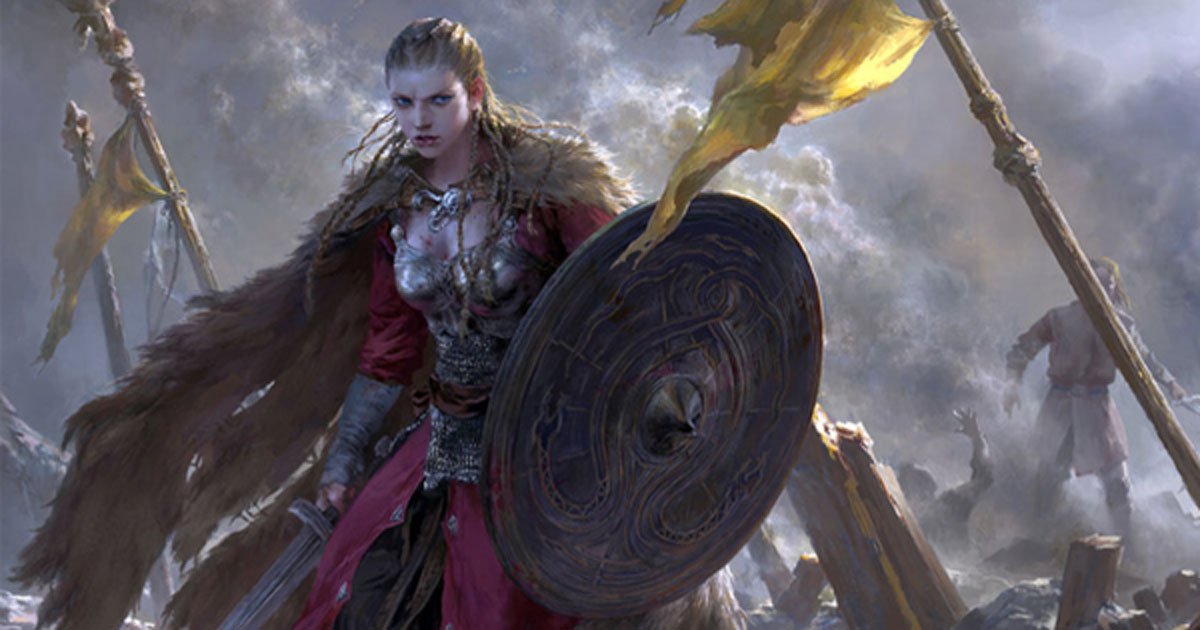
Top Image: ‘Brynhildr.’ Used here as a representational image of a woman warrior in the Viking Age. Source: FLOWERZZXU/Deviant Art

By Alicia McDermott

Tuesday, April 19, 2016

Anglo-Saxon Cemetery Full of Grave Goods Discovered Near Prehistoric Henge Monuments

Ancient Origins


A site in England with burials dating from the mid-Anglo Saxon period of 660 to 780 AD and other ancient features is being excavated. Archaeologists also have found Bronze Age or Neolithic monuments nearby, though no evidence of houses.

The archaeologists also found military features from both world wars at the site in Bulford, Wiltshire, where 227 new homes for British Army families are to be built.
Archaeologists from Wessex Archaeology were called in to investigate the site before construction began in case there were valuable archaeological features on the site. A press release from Wessex Archaeology states:
“Further investigations revealed an Anglo-Saxon cemetery of about 150 graves, with grave goods including spears, knives, jewellery, bone combs and other personal items. One of the burials has been radiocarbon dated to between AD 660 and 780 which falls in the mid-Anglo-Saxon period in England.”
“A further phase of excavation is planned to examine the two adjacent prehistoric monuments beside which the Saxon cemetery was established. These appear to consist of Early Bronze Age round barrows that may have earlier, Neolithic origins. They are to be granted scheduled monument protection by Historic England and will be preserved in situ in a part of the site that will remain undeveloped. Neolithic pits outside the monuments contained decorated ‘Grooved Ware’ pottery, stone and flint axes, a finely made disc-shaped flint knife, a chalk bowl, and the bones of red deer, roe deer and aurochs (wild cattle).”
Archaeology.co.uk reports that the 150 graves contain the remains of men, women, and children laid out close together in neat rows. Wessex Archaeology osteologist Jackie McKinley told Archaeology.co.uk she believes it was a planned cemetery with graves perhaps identified with markers or a low mound.
One of the skeletons found at the cemetery.
One of the skeletons found at the cemetery. (BBC)
The people were buried with personal items and grave goods giving indications of their social status, including jewelry of glass beads and brooches, knives, and cowrie shells from the Red Sea, which indicate far-reaching trade. One grave had a large comb made of antlers and decorated with dots, rings and chevrons.
Archaeologists also found a “work box” that may have served as an amulet meant to ward off evil. A scan of the small, cylindrical container showed it has traces of copper-alloy fragments. Other such boxes from the era had contained metal pins, thus they are called work boxes.
“This was a status symbol, and may have had amuletic as well as functional properties,” McKinley told Archaeology.co.uk. “This grave also contained what appears to be some kind of metal net bag, although we need to do more work on this to understand what it was.”
A workbox found in the grave of a woman.
A workbox found in the grave of a woman. (Wessex Archaeology)
Still another grave, the largest on the site, contained an unusually large spear whose haft had bronze decorations. The spear may have had symbolic or ritualistic meaning and belonged to a man who apparently was of special status in his community.
There is no settlement of habitations near the hilltop burial ground, but archaeologists are exploring the site as a ceremonial or sacred gathering place dating from the Neolithic. The people may have lived in a nearby river valley.
Archaeology.co.uk says excavations at the site uncovered clues as to why the Anglo-Saxon people buried their dead there, including two prehistoric “hengiform” monuments not far away. Preliminary dating puts these in the Neolithic or Bronze Age.
The article speculates that the early medieval occupants of the area were drawn by the enigmatic features of the barrows and monuments and buried the dead near them, as they did at other sites in Salisbury.
Neolithic ritual or ceremonial activity was found in large pits that contained unusual objects, including sherds of pottery, antler and wild ox bones, axes and ax fragments, carved pieces of chalk in the form of a bowl, and little ball and flint hammerstones. Archaeologists also found a rare discoidal knife of flint. Only two of these are known in the area around Stonehenge.
A decorated bone comb found during the excavation of a grave.
A decorated bone comb found during the excavation of a grave. (Wessex Archaeology)
“What stands out is that there is very little domestic activity going on here,” Phil Harding, a Wessex Archaeology prehistory expert, told Archaeology.co.uk. “You don’t see much in the way of burning, or of flint-knapping debris. The pits’ contents seem more ritual/ceremonial in nature.”
Featured Image: Saxon woman buried with her workbox and cowrie shell and a reconstruction what she may have looked like when she was buried. (Wessex Archaeology)
By Mark Miller

Thursday, April 14, 2016

Workers Building Parishioners a Toilet Unearth a Mass Anglo-Saxon Grave

Ancient Origins

A group of more than 40 skeletons was found during the building of a new toilet for the parishioners of a church in Hildersham, Cambridgeshire, UK. The remains are about 900 years old.
According to the BBC, the burials are dated to the 11th or 12th century. Some of the graves lay 45 cm (18 in) below the path outside the Holy Trinity Church. They were dug into the chalk, with the bodies laid directly in the cavity. Most of the skeletons were of adults, but five of the individuals were children. The researchers examined 19 skeletons dated to the 9th or 10th century, predating the church by several hundred years, but they left 24 graves intact.
According to Mr. Andrew Westwood-Bate, a local historian and the Holy Trinity churchwarden:
"The discovery of the children was one of the most moving moments of the excavation. The graves were dug into the chalk and bodies laid directly in the cavity. When they were removed the bones were all put in bags and placed in a grave together. We gave them a proper funeral, again at 8am because we didn't want to draw any attention to ourselves. It was very moving and they have been laid to rest looking over the meadow where they would have lived when they were alive."
Excavating one of the skeletons.


Excavating one of the skeletons. (Andrew Westwood-Bate)
The graves are said to be Anglo-Saxon, although Cambridge University Archaeological Unit experts who examined the site dated the bones to the 11th or 12th century. Until the discovery was made, there was no proof for the existence of a cemetery in this area. The researchers believe that the graves belonged to villagers who lived outside the walls of what was probably an Anglo-Saxon church.
During the excavations, the bones were stored in the mortuary at the village undertaker's for the night. After the end of the works, the skeletons were buried in one new grave. A funeral took place just before Christmas 2015, and the toilet was completed soon after. The new grave is commemorated by a sculpture made by Per Hall, a surgeon and sculptor from the village, who made a mold of the grave of one of the children. The church paid archaeologists £20,000 (approximately 28,500 USD) to examine the 19 intact skeletons and accomplish works.
The skeletons were laid to rest together and a funeral was held before they were reburied.
The skeletons were laid to rest together and a funeral was held before they were reburied. (Andrew Westwood-Bate)
Another mass grave was found on September 2015, by workmen during the demolition of a Westminster Abbey toilet block. This burial contained about 50 individuals. The bones of men were thought to be connected with the events of 1066 in Westminster Abbey, when one king was buried and two were crowned in a year. The remains were discovered along with the skeleton of a child, no older than 3 years old, which was buried under the Victorian drainage pipes just outside the wall of Poet’s Corner.
“What the child is doing there is one of the many unanswered questions, but it is a feature of many ecclesiastical sites that you find the remains of women and children in places where you might not quite expect them.” the Westminster Abbey’s archaeologist Warwick Rodwell told the Guardian.
A painting of Westminster Abbey by Thomas H. Shepherd (1792-1864).
A painting of Westminster Abbey by Thomas H. Shepherd (1792-1864). (Public Domain)
The skeleton of the child was small and not well preserved, so the determination of gender was impossible. The child was buried in a wooden coffin, unlike some of the monks buried nearby. It is unknown why the baby was buried there.
The remains of other individuals from the discovery are believed to be dated to the 11th or 12th century. The most interesting was a grave of a man buried in a grand coffin made of Barnack stone from Northamptonshire, whose skull was stolen by Victorian workmen. The remains were discovered previously by archaeologists in the 1950s, after a lavatory block was demolished to make the new tower.
The history of finds related to toilets continues to be one of the most interesting parts of daily life. It contains the discovery of many surprising artifacts including jewelry, books, and organic remains. Another example from 2015 comes in the form of Polish archaeologists unearthing a 250-year-old sex toy during excavations in a latrine dated back to the 6th century AD.
While examining an ancient medieval port of Burgos in Bulgaria, archaeologists also discovered a number of artifacts which presented more on life in this area in the period from the 3rd to 6th century AD.
Featured Image: Skeleton of one of the individuals unearthed in Hildersham. Source: Andrew Westwood-Bate
By: Natalia Klimczak

Wednesday, March 30, 2016

New 3D View of Richard III's Humble Grave Revealed

Live Science

Scientists have created an interactive digital model of King Richard III's grave and skeleton. Enthusiasts can explore the model with the 3D-sharing platform Sketchfab.
Credit: University of Leicester


A new digital model of the original grave of English King Richard III offers a three-dimensional glimpse into this humble resting place.
Richard III's lost skeleton was discovered under a parking lot in Leicester in 2012. He'd been buried in a too-short, hastily dug grave after his death in the Battle of Bosworth Field in 1485. One year ago, the king got a long-delayed royal funeral when his remains were re-interred in Leicester Cathedral.
In honor of this one-year anniversary, the University of Leicester has released a digital 3D model of Richard III's original grave. The model highlights features of Richard's grave and skeleton, including the king's missing feet, which were lost sometime between 1485 and the modern day, when someone dug a trench that severed them. [Gallery: The Search for Richard III's Remains (Photos)]


Tuesday, May 5, 2015

Archaeological dig at ancient fortress site in Egypt reveals massive gate and graves of fallen warriors

Ancient Origins

Remnants of an ancient Egyptian army camp and mass graves containing fallen warriors have been found buried in the desert ruins site of Tjaru by a team of archaeologists.
The impressive size of the eastern gate of the ancient Tjaru fortress is revealed by the fragments uncovered at the site. Bearing inscriptions of Pharaoh Ramses II, the limestone pieces are 15 meters (49 feet) long and one meter (3 feet) wide. This massive gate secured the Way of Horus between Palestine and Egypt.


Large limestone fragments of the ancient gate at Tjaru Fortress, Egypt. Credit: Egypt Antiquities Ministry photo
Mamdouh al-Damaty, Minister of Antiquities in Egypt announced the discovery of the Egyptian army camp from the time of Thutmose III (Thutmosis) and Ramses II. The camp, located at the Tjaru Fortress in North Sinai (near present day Qantara) was led by the respective Pharaohs in the battles of Megiddo and Kadesh, reports Egypt Independent.
MORE

 
A bas-relief carving of Seti I and Ramses II at Abydos. A collection of reliefs of these two men was found during the recent digs around Tharu. (Wikimedia Commons photo by Kurohito)
The 3,000-year-old ruin site of Tjaru was home to an ancient fortress on the Way of Horus. Due to its remote and hostile environment it was also said to be a place of exile for criminals.  The Way of Horus, or the Horus Military Road, led out of Egypt into Canaan (present day Gaza Strip). Along the route was a series of military forts with water reservoirs. These measures served as protection for ancient Egypt’s eastern borders.
“It was a key starting point for military campaigns during Egypt’s New Kingdom period (1580 B.C. – 1080 B.C.)” reports The Cairo Post.
This Google Map shows the present-day route of the ancient Horus Military Route from Qantara to Rafah. The body of water to the north is the Mediterranean Sea.
Archaeologists, working 3 kilometers (approximately 2 miles) east of the Suez Canal, also discovered several storage sites with seals bearing the name of Pharaoh Tuthmose III, as well as the graves and skeletal remains of soldiers who were killed in battle during the 26th Dynasty.


Thutmose III smiting his enemies. Relief on the seventh pylon in Karnak. Wikipedia
Thutmose III was the sixth Pharaoh of the 18th Dynasty. During the first 22 years of his reign, he was co-regent with his stepmother and aunt Hatshepsut, famous for taking on the male role of Pharaoh. After her death and his later rise to pharaoh of the kingdom, Thutmose III created the largest empire Egypt had ever seen, through numerous successful campaigns.
MORE
Ramses II, the third Pharaoh of the 19th Dynasty, came to power during his late teens after the death of Seti I, his father. His long reign of 66 years was recorded as prosperous, and at the time he was considered one of the most powerful men on earth. Ramses II undertook numerous military campaigns against neighboring regions.
The artifacts from Tjaru are set to go on display at a Military History Museum planned for the eastern bank of the Suez Canal.
Speaking earlier this year to The Cairo Post, chief of the Tjaru excavation team, archaeologist Mohammed Abdel-Maqsoud said, “The discovery is significant as it reflects the details of the ancient Egyptian military history. It is a model example of Ancient Egypt’s military architecture, as well as the Egyptian war strategies through different ages, for the protection of the entirety of Egypt.”
Featured Image: The ruins of the fortress near the ancient fortified city of Tell Habua (Tjaru) after recent excavations. Credit: Egypt Antiquities Ministry photo