Showing posts with label Mercia. Show all posts

Tuesday, March 28, 2023

Spotlight on MJ Porter, author of Pagan Warrior


 Follow the tour HERE

From bestselling author MJ Porter comes the tale of the mighty pagan king, Penda of Mercia.

Britain. AD632.

Penda, a warrior of immense renown, has much to prove if he is to rule the Mercian kingdom of his dead father and prevent the neighbouring king of Northumbria from claiming it.

Unexpectedly allying with the British kings, Penda races to battle the alliance of the Northumbrian king, unsure if his brother stands with him or against him as they seek battle glory for themselves, and the right to rule gained through bloody conquest.

There will be a victor and a bloody loser, and a king will rise from the ashes of the great and terrible battle of Hædfeld.


 Buy Links:

 Universal Links

.•*´¨) ¸.•*¨) ( ¸.•´

  FUN FACTS

Very relevant to the story which pitches the Saxon kingdoms of Northumbria against that of Mercia, I was born in Mercia but have lived in Northumbria for nearly twenty years. I think I’m still very much a Mercian at heart.

Much to many people's disgust at the time, my children learned to ride their bikes on Lindisfarne, as it’s lovely and flat. Lindisfarne, or Holy Island, is mentioned throughout the Gods and Kings Trilogy as it’s where Bishop Aidan built his monastery.


Ruins of the later Lindisfarne Priory
(Source: Author photo)

In one of the books, there's a scene where the Northumbrians all complain that it’s too hot in Mercia without the usual Northumbrian wind. My children said this to me when we went to Alton Towers in the summer of one year. They missed the cooling wind.

One of the battles in Pagan King, book two of the trilogy, is based somewhere close to where I grew up, although I changed the name a little.


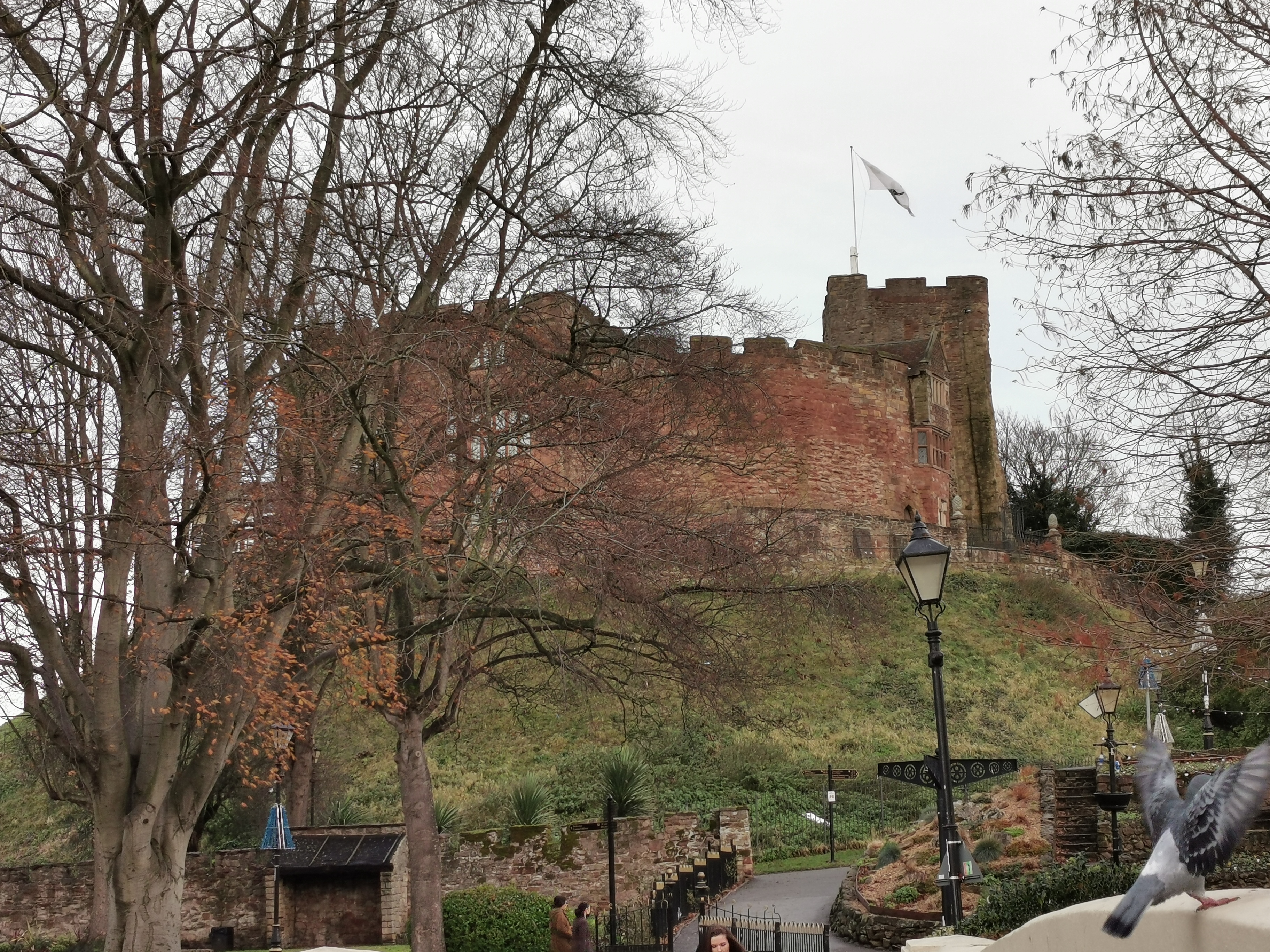
Tamworth Castle, while not Saxon era, Tamworth is believed to have been a Mercia capital at this time, and I grew up quite close to Tamworth.
(Source: author photo)

The first time I wrote a battle scene, I used my children’s play swords, purchased from a castle, to try and determine how my characters might have been able to fight and defend themselves.


MJ Porter is the author of many historical novels set predominantly in Seventh to Eleventh-Century England, as well as three twentieth-century mysteries. Being raised in the shadow of a building that was believed to house the bones of long-dead Kings of Mercia, meant that the author's writing destiny was set.

Social Media Links:

 Website    Blog    Twitter   Facebook   Linked-in   Instagram   Pinterest    BookBub

Amazon Author Page    Goodreads   Linktree   TikTok


Matt Coles
audiobook narrator:

Instagram   TikTok   Website


Saturday, April 23, 2016

Viking Invaders Struck Deep into the West of England – and May have Stuck Around

Ancient Origins


It’s well chronicled that wave after wave of Vikings from Scandinavia terrorised western Europe for 250 years from the end of the eighth century AD and wreaked particular havoc across vast areas of northern England. There’s no shortage of evidence of Viking raids from the Church historians of the time. But researchers are now uncovering evidence that the Vikings conquered more of the British Isles than was previously thought

At the time England consisted of four independent kingdoms: Wessex, to the south of the River Thames, and Mercia, East Anglia and Northumbria to the north of it. The latter three were all conquered by Scandinavian armies in the late ninth century and their kings killed or deposed – which allowed expansive Scandinavian settlement in eastern and northern England. However the kings of Wessex successfully defended their territory from the Viking intruders (and eventually went on to conquer the North, creating the unified kingdom of England).
Un-united Kingdoms, Mike Christie
Un-united Kingdoms, Mike Christie (Public Domain)
But precisely because Wessex remained independent, there has never been much examination of Scandinavian influence in that part of the United Kingdom. But we’re beginning to get a different picture suggesting that Viking leaders such as Svein and his son Knut were active as far south as Devon and Cornwall in the West Country.
In 838AD, the Anglo-Saxon Chronicle recorded a battle fought at Hingston Down in east Cornwall in which the local Britons joined forces with the Vikings against King Egbert of Wessex and his attempts to expand his kingdom. The fiercely independent Cornish appear to have held out against West Saxon control and presumably cast around for a strong ally in their fight. But why were Viking leaders interested in aiding the Cornish? Perhaps it was a political move, made in the hope of gaining a foothold in the peninsula in order to use it as a strategic base against Wessex. If so, it was thwarted, as the allied army was soundly defeated.
There are also records of raids for plunder in the West Country. A Viking fleet sailed up the river Tamar in 997, attacked the abbey at Tavistock and brought back treasure to their ships.
Cardinham churchyard.  Len Williams
Cardinham churchyard.  Len Williams, (CC BY-SA 2.0)
There is further evidence indicating Scandinavians in the West Country in a close examination of stone sculptures in Devon and Cornwall which has revealed Scandinavian art motifs and monument forms. A Norwegian Borre ring chain ornament decorates the cross in Cardinham churchyard in east Cornwall and a mounted warrior is in one of the panels of the Copplestone Cross near Crediton, mid Devon. Both are matched by examples in northern England in the Viking Age, but seem out of place in the West. Late versions of the “hogback” memorial stones, which have a pronounced ridge and look like a small stone long house, are well known in Cornwall too – the best example is at Lanivet near Bodmin.
These sort of memorials were popular with the Norse settlers in Cumbria and Yorkshire and may be the work of itinerant sculptors bringing new ideas into the West, or patrons ordering forms and patterns which they had seen elsewhere. However, the possibility that the patrons may have been Scandinavian settlers cannot be excluded.

All in the name

People with Scandinavian names such as Carla, Thurgod, Cytel, Scula, Wicing, Farman are recorded as working in the mints in Exeter and at other Devon sites from the end of the tenth century – and, although such names became popular in the general population, there is an unusual concentration in these areas. Detectorists operating in the West Country are finding increasing numbers of metal objects from the period, many with Scandinavian connections. Scandinavian dress-fittings, lead weights, coins and silver ingots – and all manner of gear for horses have been identified in the past few years. A woman’s trefoil brooch, probably made in Scandinavia, was discovered where it had been dropped in Wiltshire. This is the only example of the type yet found in Wessex, whereas 15 have been discovered in northern England.
Like these Viking artefacts, place names with Scandinavian links are well known in northern England – but we would not have previously expected them in the West Country. Yet the islands in the Bristol Channel: Lundy, Steepholm and Flatholme are hybrid names with Old Norse and Old English elements. Spaxton in Somerset was Spacheston in the Domesday Book, that is Spakr’s tun another hybrid. Knowstone in central Devon, recorded as Chenutdestana in Domesday Book, combines Scandinavian Knut with English stana to give Knut’s stone, perhaps named after the Danish king. More intriguing still are the 11 landholders in the Devon section of the Domesday Book with the personal name wichin which means “viking”. These names are rare in England and do not occur at all elsewhere in the West Country, so the cluster in Devon is significant. A combination of sculptural, archaeological and word usage evidence therefore points to a new appreciation of how far the Vikings travelled within the UK – and the dramatic reach of their influence. Featured image: Guests from Overseas, Nicholas Roerich (1899) (Public Domain) The article ‘Viking invaders struck deep into the west of England – and may have stuck around‘ by Derek Gore was originally published on The Conversation and has been republished under a Creative Commons license. -

Monday, February 15, 2016

History Trivia - Oswy, King of Bernicia dies

February 15


670 Oswy, King of Bernicia and subordinate to King Penda of Mercia for 13 years died. When Penda invaded Bernicia, he was killed by Oswy's forces. Oswy then united all of Northumbria, which he ruled from 655 until his death.

Sunday, November 15, 2015

History Trivia - Battle of Winwaed - Penda of Mercia defeated

November 15, 655 - Battle of Winwaed:  Penda of Mercia was defeated by Oswiu of Northumbria.  Although the battle was said to be the most important between the early northern and southern divisions of the Anglo-Saxons in Britain, few details are available.  Significantly, the battle marked the effective demise of Anglo-Saxon paganism.
1515 - England's Thomas Wolsey was invested as a Cardinal.

Thursday, October 1, 2015

History Trivia - Battle of Arbela - Alexander the Great victorious

October 1

331 BC, Alexander the Great defeated Persian emperor Darius III in the Battle of Arbela in Mesopotamia in one of the fifteen decisive battles of history. 

959 Edgar, King of the Mercians and Northumbrians, became King of the West Saxons and was then considered to be King of all England. 

Henry III was born. King of England 1216-1264, his 56-year reign was one of the longest in history. The building of the Westminster Abbey was his most enduring moment. 

Sunday, September 20, 2015

History Trivia - The Battle of Châlons - Attila the Hun defeated

September 20

451 The Battle of Châlons took place in North Eastern France. Flavius Aetius's victory over Attila the Hun in a day of combat is considered to be the largest battle in the ancient world. 

1066 The Battle of Fulford: King Harald III of Norway (Harald Hardrada) and Tostig Gowinson, his English allay, defeated Edwin of Mercia and Morcar of Northumbria. 

1633 Galileo Galilei was tried before the Congregation for the Doctrine of the Faith for teaching that the Earth orbits the Sun and was found "vehemently suspect of heresy", forced to recant, and spent the rest of his life under house arrest.

Wednesday, August 5, 2015

History Trivia - William Wallace captured by the English

August 5

642 – Battle of Maserfield – Penda of Mercia defeated and killed Oswald of Bernicia (Northumbria).

910 The last major Danish army to raid England was defeated at the Battle of Tettenhall by the allied forces of Mercia and Wessex, led by King Edward the Elder and Earl Aethelred of Mercia.

1305 William Wallace, who led the Scottish resistance against England, was captured by the English near Glasgow and transported to London where he was put on trial and executed.

Thursday, May 28, 2015

Saxon butter churn found in Staffordshire sheds light on life in Mercian Kingdom

 
Archaeologists working on the site of a rail improvement project in the UK have discovered the lid of a butter churn from the Saxon period.
The discovery of a wooden object at Norton Bridge, reported in the Staffordshire Newsletter, was made on the site of a new flyover currently being constructed by Network Rail along with 11 new bridges. The work is being carried out in order to remove a bottleneck on the busy West Coast Main Line.
The artifact was discovered among the remains of worked wooden stakes and wood chips on waterlogged peat near Meece Road, just south of Yarnfield in Staffordshire. Radiocarbon tests have dated the wooden lid to 715 to 890 AD when the area was part of the Saxon kingdom of Mercia. The results show that the artifact is roughly the same age as the famous Staffordshire Hoard, the largest collection of Anglo-Saxon gold found anywhere in the world.
The Staffordshire Hoard, discovered in a field in Hammerwich, near Lichfield in July 2009, is perhaps the most important collection of Anglo-Saxon objects found in England. 2009, David Rowan, Birmingham Museum and Art Gallery.
The Staffordshire Hoard, discovered in a field in Hammerwich, near Lichfield in July 2009, is perhaps the most important collection of Anglo-Saxon objects found in England. 2009, David Rowan, Birmingham Museum and Art Gallery. (en.wikipedia.org)
Archaeologists originally believed the lid to be far older, as evidence of prehistoric occupation has been discovered nearby. Furthermore, no pottery or other metalwork was found on the site, which could have helped to date the artifact. Dr Emma Tetlow of Headland Archaeology said she was delighted by the find as precious little evidence of the Mercian kingdom has been discovered in the UK so far. Wooden artifacts and other organic evidence from the Saxon period are very rare indeed.
“During this period this part of Staffordshire was part of the Mercian heartland and was populated by a pagan tribe called the Pencersaete” said Dr Tetlow. “Existing knowledge of this period for the north and east of the Midlands and the UK in general is very scarce, so this find is fantastic and of regional significance.”
Dr Tetlow said that the climate of the area at that time would not have been too different from that experienced by people in the UK today as the country was becoming affected by dynamic climate change at the start of what is now known as the ‘Medieval Warm Period’. This was a short climatic interval that is thought to have taken place roughly between 900 and 1300 AD, predominantly affecting the Northern Hemisphere. The Pencersaete would therefore have had to endure unsettled and stormy weather including flooding and a general increase in temperature.
Map of England showing where Mercia was located in the 700-late 800’s.
Map of England showing where Mercia was located in the 700-late 800’s. (Wikimedia Commons)
Butter churns were containers, looking much like a wooden barrel, used to convert cream into butter. They had a hole in the lid through which a pole was inserted. This was then used to agitate the cream in order to disrupt the milk fat, the membranes of which break down thereby creating lumps called butter grains. These join with each other to form larger globules and when the air is forced out of them the mixture becomes buttermilk. Constant and continued churning forces the globules together to form butter. Consumption of butter can be traced as far back as 2000 BC.
Butter churning equipment with all the features for churning, storing, and processing. At the Beskid Museum in Wisła. Photo by Piotrus, 2008.
Butter churning equipment with all the features for churning, storing, and processing. At the Beskid Museum in Wisła. Photo by Piotrus, 2008. (Wikimedia Commons)
The archaeologists intend holding an information day when members of the public can view the finds and discuss them with Dr Tetlow and her colleagues. Dr Tetlow is also planning to write a paper on the discovery for the Stafford and Mid-Staffs Archaeological Society.
Mercia was one of the seven great kingdoms of Anglo-Saxon England, the other kingdoms being East Anglia, Essex, Kent, Northumbria, Sussex and Wessex. It was ruled from a capital at Tamworth and expanded rapidly during the 6th and 7th centuries, becoming one of the ‘big three’ kingdoms alongside Northumbria and Wessex. The first ruler of Mercia was King Icel (515-535 AD) and the last was Queen AElfwynn (918 AD) who was deposed by King Edward the Elder of Wessex when he rode into the kingdom and conquered it. The Anglo-Saxon Chronicle mentions this episode, commenting that “the daughter of Æthelred, lord of the Mercians, was deprived of all dominion over the Mercians, and carried into Wessex, three weeks before mid-winter; she was called Ælfwynn.” Mercia reached its strongest point during the rule of King Offa when the kingdom dominated much of central England.
King Offa of Mercia from the Benefactors Book of St. Alban's Abbey. C1380.
King Offa of Mercia from the Benefactors Book of St. Alban's Abbey. C1380. (Wikimedia Commons)
The Pencersaete took their name from the Penk Valley, named after a hill near Penkridge. They are named in an Anglo-Saxon charter of 849 describing the area of Cofton Hackett in the Lickey Hills, south of the present city of Birmingham. This region formed the boundary between the Pencersaete and their neighbors, the Tomsaete.
Featured Image: Butter Churn from the Saxon Period, found at Norton Bridge.


Sunday, February 15, 2015

History Trivia - Julius Caesar refuses the diadem of royalty

February 15

44 BC, Mark Antony offered Julius Caesar the diadem of royalty which he refused.

670 Oswy, King of Bernicia and subordinate to King Penda of Mercia for 13 years died. When Penda invaded Bernicia, he was killed by Oswy's forces. Oswy then united all of Northumbria, which he ruled from 655 until his death.

1113 Knights Hospitaller was formally named and recognized. The Hospitallers were founded to care for sick pilgrims in Jerusalem.  The order evolved throughout the Crusades and still exists today. 

Saturday, November 15, 2014

History Trivia - Battle of Winwaed - Penda of Mercia defeated by Oswiu of Northumbria

November 15

655 Battle of Winwaed: Penda of Mercia was defeated by Oswiu of Northumbria. Although the battle was said to be the most important between the early northern and southern divisions of the Anglo-Saxons in Britain, few details are available. Significantly, the battle marked the effective demise of Anglo-Saxon paganism.

1397 Pope Nicholas V was born. Known as the Humanist Pope, he had a significant role in the founding of the Vatican Library.

1515 England's Thomas Wolsey was invested as a Cardinal.


Follow on Bloglovin

Wednesday, October 1, 2014

History Trivia - Alexander the Great defeats Persian emperor Darius III in the Battle of Arbela

October 1

 331 BC, Alexander the Great defeated Persian emperor Darius III in the Battle of Arbela in Mesopotamia in one of the fifteen decisive battles of history.

959 Edgar, King of the Mercians and Northumbrians, became King of the West Saxons and was then considered to be King of all England.

1189 Gerard de Ridefort, grandmaster of the Knights Templar since 1184, was killed in the Siege of Acre.

1207 Henry III was born. King of England 1216-1264, his 56-year reign was one of the longest in history. The building of the Westminster Abbey was his most enduring moment.

1404 Boniface IX died. The second pope in Rome during the Western Schism, Boniface was unable to end the breach and increased hostility with his attempts to raise money in order to combat the antipopes.
Follow on Bloglovin

Saturday, September 20, 2014

History Trivia - . Flavius Aetius defeats Attila the Hun

September 20

 451 The Battle of Châlons took place in North Eastern France. Flavius Aetius's victory over Attila the Hun in a day of combat is considered to be the largest battle in the ancient world.

1066 The Battle of Fulford: King Harald III of Norway (Harald Hardrada) and Tostig Gowinson, his English allay, defeated Edwin of Mercia and Morcar of Northumbria.
Follow on Bloglovin

Tuesday, August 5, 2014

History Trivia - Oswald of Bernicia defeated by Penda of Mercia

August 5

  642 Battle of Maserfield – Penda of Mercia defeated and killed Oswald of Bernicia (Northumbria).

910 The last major Danish army to raid England was defeated at the Battle of Tettenhall by the allied forces of Mercia and Wessex, led by King Edward the Elder and Earl Aethelred of Mercia.

1100 Henry I was crowned King of England in Westminster Abbey.

1305 William Wallace, who led the Scottish resistance against England, was captured by the English near Glasgow and transported to London where he was put on trial and executed.

1388 The Battle of Otterburn, a border skirmish was fought between the Scots and the English in Northern England; the Scots were victorious.


Follow on Bloglovin

Wednesday, July 23, 2014

History Trivia - Crusaders attack Damascus

July 23

 365 a great earthquake struck the eastern Mediterranean and destroyed the Roman city of Kourion on the island of Cyprus.

685 John V became Roman Catholic pope. He was the first pope of the Byzantine Papacy allowed to be consecrated by the Byzantine Emperor without prior consent, and the first in a line of ten consecutive popes of Eastern origin. His papacy was marked by reconciliation between the city of Rome and the Empire.

1148 Crusaders attacked Damascus.

1313 Bridget the patron saint of Sweden who founded the Brigittine Order died. Bridget was a Swedish princess renowned for her piety from her childhood; she was given in marriage to Ulf, Prince of Mercia, by whom she had a large family. After Ulf's death in 1344 and with the help of King Magnus, she established on her own estate at Vadstena the first monastery for men and women, of which Katherine, her daughter, became the first Abbess soon after her death in 1375. At this time double monasteries were not unusual: the monks and nuns used the same chapel, but lived in separate wings of the monastery, the confessor alone having access to the nuns.

 
Follow on Bloglovin